
Table of Contents
(State or Other Jurisdiction of Incorporation or Organization) |
(Primary Standard Industrial Classification Code Number) |
(I.R.S. Employer Identification Number) |
Alexander D. Lynch Ashley J. Butler Weil, Gotshal & Manges LLP 767 Fifth Avenue New York, NY 10153 (212) 310-8000 |
Marc D. Jaffe Erika Weinberg Latham & Watkins LLP 1271 Avenue of the Americas New York, NY 10020 (212) 906-1200 |
| Large accelerated filer | ☐ | Accelerated filer | ☐ | |||
| ☒ | Smaller reporting company | |||||
| Emerging growth company | ||||||
Table of Contents
The information in this preliminary prospectus is not complete and may be changed. We may not sell these securities until the registration statement filed with the Securities and Exchange Commission is effective. This preliminary prospectus is not an offer to sell these securities and it is not soliciting an offer to buy these securities in any jurisdiction where the offer or sale is not permitted.
Subject to Completion, Dated May 26, 2026.
PRELIMINARY PROSPECTUS

14,000,000 Shares
SOLV Energy, Inc.
Class A Common Stock
This prospectus relates to the sale of (i) 7,185,181 shares of Class A common stock of SOLV Energy, Inc. (the “Company”) by ASP Endeavor Investco LP, ASP SOLV Aggregator LP and ASP VIII Alternative Investments Solstice, L.P. (collectively, the “selling stockholders”) and (ii) 6,814,819 shares of Class A common stock by us. We intend to use the net proceeds we receive from this offering to purchase 6,814,819 LLC Interests (as defined herein) (or 7,837,041 LLC Interests if the underwriters exercise in full their option to purchase additional shares of Class A common stock) from the Continuing Equity Owners (as defined herein), including our Sponsor, directors and, indirectly through the purchase of LLC Interests from Management Holdings (as defined herein), our executive officers (collectively, the “Redeeming Holders”). We will not receive any of the proceeds from the sale of shares of Class A common stock by the selling stockholders in this offering. See “Use of Proceeds.”
Our shares of Class A common stock are listed on the Nasdaq Global Select Market (“Nasdaq”) under the trading symbol “MWH.” On May 22, 2026, the last reported sale price of our Class A common stock as reported on Nasdaq was $38.44 per share.
We have two classes of common stock outstanding: Class A common stock and Class B common stock. Each share of our Class A common stock entitles its holder to one vote per share and each share of our Class B common stock entitles its holder to one vote per share on all matters presented to our stockholders generally. As of the date of hereof, the Continuing Equity Owners (as defined herein) beneficially own, directly and indirectly, approximately 88.4% of the voting power of our outstanding common stock.
As a result, the Continuing Equity Owners are able to control any action requiring the general approval of our stockholders, including the election of our board of directors, the adoption of amendments to our certificate of incorporation and bylaws and the approval of any merger or sale of the Company or substantially all of our assets. See “Management.”
Our organizational structure, commonly referred to as an umbrella partnership-C-corporation, or UP-C structure, provides potential future tax benefits to both SOLV Energy, Inc. and our Continuing Equity Owners. In connection with the IPO (as defined herein) we entered into a Tax Receivable Agreement (as defined herein) with the Continuing Equity Owners and the Blocker Shareholders (as defined herein) that provides for certain cash payments to be made by SOLV Energy, Inc. to such Continuing Equity Owners and the Blocker Shareholders in respect of certain of the future tax benefits received by SOLV Energy, Inc., utilizing cash for the benefit of such holders that otherwise would have been available to us for other uses and for the benefit of all of our stockholders. See “Certain Relationships and Related Person Transactions—Tax Receivable Agreement.”
We are a holding company and our principal asset consists of LLC Interests (as defined herein) representing an aggregate 57.0% economic interest in SOLV Energy Holdings LLC. The remaining 43.0% economic interest in SOLV Energy Holdings LLC is owned by the Continuing Equity Owners through their ownership of LLC Interests.
A wholly-owned subsidiary of SOLV Energy, Inc. is the sole managing member of SOLV Energy Holdings LLC. SOLV Energy, Inc., through the managing member, operates and controls all of the business and affairs of SOLV Energy Holdings LLC and its direct and indirect subsidiaries and, through SOLV Energy Holdings LLC and its direct and indirect subsidiaries, conducts our business.
We are a “controlled company” within the meaning of the Nasdaq rules. See “Our Organizational Structure” and “Management—Controlled Company Status.”
Investing in our Class A common stock involves risks. See “Risk Factors” starting on page 24 to read about factors you should consider before buying shares of our Class A common stock.
Neither the Securities and Exchange Commission (the “SEC”) nor any state securities commission has approved or disapproved of these securities or determined if this prospectus is truthful or complete. Any representation to the contrary is a criminal offense.
| Per Share | Total | |||||||
| Public offering price |
$ | $ | ||||||
| Underwriting discount(1) |
$ | $ | ||||||
| Proceeds, before expenses, to us |
$ | $ | ||||||
| Proceeds, before expenses, to the selling stockholders |
$ | $ | ||||||
| (1) | See “Underwriting” for additional information regarding total underwriter compensation. |
We have granted the underwriters an option for a period of 30 days from the date of this prospectus to purchase up to an additional 1,022,222 shares of our Class A common stock from us and 1,077,778 shares of our Class A common stock from the selling stockholders, in each case at the public offering price, less the underwriting discounts and commissions.
The underwriters expect to deliver the shares against payment in New York, New York on , 2026.
| Jefferies | J.P. Morgan |
Prospectus dated , 2026
Table of Contents

Table of Contents
TABLE OF CONTENTS
| Page | ||||
| 1 | ||||
| 15 | ||||
| 24 | ||||
| 67 | ||||
| 70 | ||||
| 74 | ||||
| 75 | ||||
| 76 | ||||
| UNAUDITED PRO FORMA CONDENSED CONSOLIDATED FINANCIAL INFORMATION |
77 | |||
| MANAGEMENT’S DISCUSSION AND ANALYSIS OF FINANCIAL CONDITION AND RESULTS OF OPERATIONS |
86 | |||
| 110 | ||||
| 128 | ||||
| 135 | ||||
| 155 | ||||
| 166 | ||||
| 168 | ||||
| 174 | ||||
| MATERIAL U.S. FEDERAL INCOME TAX CONSIDERATIONS TO NON-U.S. HOLDERS OF CLASS A COMMON STOCK |
177 | |||
| 181 | ||||
| 191 | ||||
| 191 | ||||
| 191 | ||||
| F-1 | ||||
You should rely only on the information contained in this prospectus or in any free writing prospectus we may specifically authorize to be delivered or made available to you. Neither we, the selling stockholders nor any of the underwriters (or any of our or their respective affiliates) have authorized anyone to provide any information or to make any representations other than those contained in this prospectus, any amendment or supplement to this prospectus or in any free writing prospectus prepared by us or on our behalf or to which we have referred you. Neither we, the selling stockholders nor the underwriters (or any of our or their respective affiliates) take any responsibility for, and can provide no assurance as to the reliability of, any other information that others may give you. This prospectus is an offer to sell only the shares of Class A common stock offered hereby, but only under circumstances and in jurisdictions where it is lawful to do so. You should assume that the information contained in this prospectus or any free writing prospectus is accurate only as of the date of this prospectus, regardless of the time of delivery of this prospectus or the time of any sale of shares of our Class A common stock. Our business, financial condition, results of operations and prospects may have changed since that date.
For investors outside the United States: Neither we, the selling stockholders nor any of the underwriters have done anything that would permit this offering or possession or distribution of this prospectus in any jurisdiction where action for that purpose is required, other than in the United States. Persons outside of the United States who come into possession of this prospectus must inform themselves about, and observe any restrictions relating to, the offering of the shares of our Class A common stock and the distribution of this prospectus outside of the United States.
i
Table of Contents
ABOUT THIS PROSPECTUS
Certain Definitions
Unless otherwise specified or the context requires otherwise in this prospectus, all references to:
| • | “AC” refers to alternating current. |
| • | “American Securities” or “Sponsor” refers to American Securities LLC, a private equity firm, and affiliated funds managed by American Securities. |
| • | “ASPE” refers to ASP Endeavor Acquisition LLC, the parent company of CS Energy. |
| • | “Blocker Companies” refers to SOLV Manager Sub Inc. and SOLV Sub 2 Inc. |
| • | “Blocker Shareholders” refers collectively to the owners of the Blocker Companies prior to the acquisition of the Blocker Companies by SOLV Energy, Inc., who exchanged their interests in the Blocker Companies for shares of our Class A common stock in connection with the consummation of the IPO Transactions, and includes any aggregator vehicle to which such owners contributed such shares of Class A common stock in connection with the consummation of the IPO Transactions. |
| • | “CCGT” refers to combined cycle gas turbine, a type of power plant that uses both a gas turbine and a steam turbine to generate electricity using natural gas. |
| • | “Continuing Equity Owners” refers collectively to direct and indirect holders of LLC Interests and our Class B common stock immediately following consummation of the IPO Transactions, including American Securities, Management Holders and other minority investors and their respective permitted transferees who may exchange at each of their respective options (other than, prior to the Management Elective Redemption Date, Management Holders), in whole or in part from time to time, their LLC Interests (along with an equal number of shares of Class B common stock (and such shares shall be immediately cancelled)) for, at our election, cash or newly-issued shares of our Class A common stock as described in “Certain Relationships and Related Person Transactions—SOLV Energy Holdings LLC Agreements—SOLV Energy Holdings LLC Agreement in Effect Upon Consummation of the IPO Transactions.” |
| • | “CS Energy” refers to CS Energy, LLC and CS Energy Devco, LLC. |
| • | “CS Merger” refers to the merger, on October 7, 2024, of ASPE with SOLV Energy Holdings LLC, pursuant to which SOLV Energy Holdings LLC was the surviving entity. |
| • | “DC” refers to direct current. |
| • | “EBOS” refers to electrical balance of system, which includes wiring, junction boxes, connections and disconnect switches used in solar and battery energy storage projects. |
| • | “EPC” refers to engineering, procurement and construction, a type of contracting where the contractor performs design and engineering services for the project, procures key equipment used in the project and builds the project, such as a solar power plant. |
| • | “FNTP” refers to full-notice-to-proceed and may also be referred to as “NTP” or notice-to-proceed. FNTP/NTP is a mechanism in some EPC contracts which upon enactment, entitles us to proceed with the full scope of work and have an enforceable right to consideration for all costs incurred, subject to the terms and conditions of the underlying contract. Not all EPC contracts have an FNTP/NTP mechanism as the execution of the contract itself constitutes FNTP/NTP. |
| • | “GW” refers to gigawatts, a unit of measurement of electrical power. |
| • | “HVAC” refers to heating, ventilation and air conditioning. |
| • | “IPO” refers to our initial public offering, which we completed on February 12, 2026, and through which we offered and sold 23,575,000 shares of our Class A common stock at a price to the public of |
ii
Table of Contents
| $25.00 per share. The gross proceeds to us from the IPO were $589.4 million, before deducting underwriting discounts. |
| • | “IPO Transactions” refers to the reorganizational transactions, the redemption of units held by a minority investor, the IPO and the application of the net proceeds therefrom. |
| • | “kWh” refers to kilowatt hour, the amount of energy produced or consumed in a single hour. |
| • | “LLC Interests” refers to the common units of SOLV Energy Holdings LLC. |
| • | “LNTP” refers to limited-notice-to-proceed agreements, which authorize us to proceed with limited activities on a given EPC contract (e.g., perform initial engineering and site investigation work, procure long lead time equipment) in exchange for a payment that is typically creditable to the overall contract price if the customer uses us to build the project. |
| • | “Management Elective Redemption Date” refers to the earlier to occur of (i) the date upon which American Securities (excluding, for the avoidance of doubt, Management Holdings) owns, directly or indirectly, less than twenty percent (20%) of the aggregate economic interests of the Company and (ii) the third anniversary of the closing of the IPO. |
| • | “Management Holders” refers to the executive officers of SOLV Energy, Inc. and other employees, former employees and other service providers of SOLV Energy, Inc. and its direct and indirect subsidiaries who are limited partners of Management Holdings. |
| • | “Management Holdings” refers to SOLV Energy Management Holdings LP, which is an affiliate of, and controlled by, American Securities. |
| • | “MW” refers to megawatt, a unit of measurement of electric power. In the context of solar energy, MW is generally used to describe the power generating capacity of a solar system. |
| • | “NERC CIP” refers to the North American Electric Reliability Corporation Critical Infrastructure Protection. |
| • | “O&M” refers to operations and maintenance. |
| • | “Offering Transactions” refers to this offering and the application of the use of proceeds therefrom. |
| • | “Original Equity Owners” refers to the direct and indirect owners of LLC Interests prior to the consummation of the IPO Transactions, collectively. Prior to the consummation of the IPO Transactions, SOLV Energy Parent Holdings LP was the sole holder of LLC Interests. As used throughout this prospectus, Original Equity Owners is deemed to include the indirect holders of LLC Interests, including American Securities, certain executive officers, employees and other minority investors. |
| • | “Prior Credit Facilities” refers to the Prior Revolving Credit Facility and the Prior Term Loans. The Prior Credit Facilities were repaid and terminated in connection with the IPO. |
| • | “Prior Holdco Term Loan Credit Agreement” refers to that certain Amended and Restated Credit Agreement, dated as of October 7, 2024, among SOLV Energy Holdings LLC, Wilmington Trust, National Association (or any of its designated branch offices or affiliates), as administrative agent for the secured parties, and the lenders from time to time party thereto, as amended on January 9, 2025 by that certain Amendment No. 1 to Amended and Restated Credit Agreement (“Amendment No. 1 to the Prior Holdco Term Loan Credit Agreement”), among SOLV Energy Holdings LLC, Wilmington Trust, National Association (or any of its designated branch offices or affiliates), as administrative agent for the secured parties, and the lenders from time to time party thereto. |
| • | “Prior Revolving Credit Facility” refers to the $90,000,000 revolving credit facility available under that certain Credit Agreement, dated as of December 23, 2021 (as amended, restated, amended and restated, supplemented or otherwise modified from time to time), by and among SOLV Energy Acquisition LLC, SOLV Energy Parent LLC (f/k/a AS Renewable Technologies Intermediate LLC), SOLV Energy |
iii
Table of Contents
| Intermediate Holdings LLC (f/k/a AS Renewable Technologies Intermediate II LLC), the lenders party thereto and KeyBank National Association, as administrative agent. The Prior Revolving Credit Facility was terminated in connection with the IPO. |
| • | “Prior Term Loans” refers to (i) the initial term loans made to SOLV Energy Holdings LLC pursuant to the Prior Holdco Term Loan Credit Agreement, in an original principal amount of $373,687,500, and (ii) the incremental term loans made to SOLV Energy Holdings LLC pursuant to Amendment No. 1 to the Prior Holdco Term Loan Credit Agreement, in an original principal amount of $32,500,000. In connection with the IPO, the Prior Term Loans were repaid in full. |
| • | “PV” refers to photovoltaic, i.e., the conversion of light into electricity using semiconducting materials, such as solar cells. |
| • | “Revolving Credit Facility” refers to the $200.0 million senior secured revolving credit facility available under that certain Credit Agreement, dated as of February 12, 2026, by and among SOLV Energy Acquisition LLC, SOLV Energy Intermediate Holdings LLC, the lenders party thereto and KeyBank National Association, as administrative agent, which facility matures on February 12, 2031. |
| • | “SCADA” refers to supervisory control and data acquisition. |
| • | “SOLV,” the “Company,” “our company,” “we,” “us” and “our” refer to SOLV Energy, Inc. and its subsidiaries, including SOLV Energy Holdings LLC. |
| • | “SOLV Energy Holdings LLC Agreement” refers to SOLV Energy Holdings LLC’s amended and restated limited liability company agreement. |
| • | “SOLV Manager” refers to SOLV Manager Sub Inc., a wholly-owned subsidiary of SOLV Energy, Inc. and the sole managing member of SOLV Energy Holdings LLC and through which SOLV Energy, Inc. controls the business and affairs of SOLV Energy Holdings LLC and its direct and indirect subsidiaries. |
| • | “Swinerton” refers to Swinerton Incorporated, our former parent. |
| • | “T&D” refers to transmission and distribution. |
| • | “Tax Receivable Agreement” refers to the Tax Receivable Agreement, dated February 10, 2026, entered into by and among SOLV Energy, Inc., SOLV Energy Holdings LLC, the Continuing Equity Owners, the Blocker Shareholders and the other persons from time to time that may become a party thereto (collectively, the “TRA Participants”) in connection with the IPO, pursuant to which, among other things, SOLV Energy, Inc. is required to pay to the TRA Participants 85% of the tax benefits, if any, that it realizes, or is deemed to realize, as a result of certain tax attributes covered by the Tax Receivable Agreement as described in the section titled “Certain Relationships and Related Person Transactions” included elsewhere in this prospectus. |
Presentation of Financial Results
This prospectus includes historical consolidated financial information and other data for SOLV Energy Holdings LLC, which is the accounting predecessor of SOLV Energy, Inc. Accordingly, this prospectus contains the following historical financial statements:
| • | SOLV Energy, Inc. Other than (i) the balance sheet, dated as of December 31, 2025, and (ii) the condensed consolidated financial information for the three months ended March 31, 2026, the historical financial information of SOLV Energy, Inc. is not included in this prospectus as it had no business transactions or activities prior to the consummation of the IPO Transactions and had no assets or liabilities during the periods presented in this prospectus. |
| • | SOLV Energy Holdings LLC. SOLV Energy Holdings LLC is the accounting predecessor, and the surviving entity, of the CS Merger. Due to the common control ownership of SOLV Energy Holdings LLC, CS Energy, LLC and CS Energy Devco, LLC since 2021, the historical financial information of |
iv
Table of Contents
| SOLV Energy Holdings LLC was recast similar to the pooling of interest method and retrospectively adjusted for all periods presented to reflect the combined results of operations, financial position, and cash flow of both entities as if the merger had occurred at the earliest period presented, January 1, 2023. |
Except as noted in this prospectus, the unaudited pro forma financial information of SOLV Energy, Inc. presented in this prospectus has been derived from the application of pro forma adjustments to the historical consolidated financial statements of SOLV Energy Holdings LLC as the predecessor of SOLV Energy, Inc. These pro forma adjustments give effect to the IPO Transactions and the Offering Transactions as if all such transactions had occurred on January 1, 2025 in the case of the unaudited pro forma condensed consolidated statements of operations data, and as of March 31, 2026 in the case of the unaudited pro forma condensed consolidated balance sheet data. See “Unaudited Pro Forma Condensed Consolidated Financial Information” for a complete description of the adjustments and assumptions underlying the pro forma financial information included in this prospectus. References to the “Pro Forma Fiscal Year Ended December 31, 2025” refer to the pro forma financial information derived from or presented in the “Unaudited Pro Forma Condensed Consolidated Financial Information” for the year ended December 31, 2025 and references to the “Pro Forma Three Months Ended March 31, 2026” refer to the pro forma financial information derived from or presented in the “Unaudited Pro Forma Condensed Consolidated Financial Information” for the three months ended March 31, 2026.
Certain monetary amounts, percentages and other figures included in this prospectus have been subject to rounding adjustments. Percentage amounts included in this prospectus have not in all cases been calculated on the basis of such rounded figures, but on the basis of such amounts prior to rounding. For this reason, percentage amounts in this prospectus may vary from those obtained by performing the same calculations using the figures in our consolidated financial statements included elsewhere in this prospectus. Certain other amounts that appear in this prospectus may not sum due to rounding.
Non-GAAP Financial Measures
This prospectus contains certain financial measures that are not required by or prepared in accordance with GAAP, including EBITDA and Adjusted EBITDA. We refer to these measures as “non-GAAP financial measures.” See “Management’s Discussion and Analysis of Financial Condition and Results of Operations—Key Performance Indicators and Non-GAAP Financial Measures” for our definitions of these non-GAAP financial measures, information about how and why we use these non GAAP financial measures and a reconciliation of each of these non-GAAP financial measures to its most directly comparable financial measure calculated in accordance with GAAP.
Trademarks and Trade Names
We own or have the rights to use various trademarks, trade names, service marks and copyrights, including the following: SOLV, SOLV ENERGY, SUNSCREEN, VITALS and various logos used in association with these terms. Solely for convenience, any trademarks, trade names, service marks or copyrights referred to or used herein are listed without the applicable ©, ® or ™ symbol, but such references or uses are not intended to indicate, in any way, that we, or the applicable owner, will not assert, to the fullest extent under applicable law, our or their, as applicable, rights to these trademarks, trade names, service marks and copyrights. We do not intend our use or display of other companies’ trademarks, trade names or service marks to imply a relationship with, or endorsement or sponsorship of us by, any other companies. Other trademarks, trade names, service marks or copyrights of any other company appearing in this prospectus are, to our knowledge, the property of their respective owners.
Market and Industry Information
Unless otherwise indicated, market data and industry information used throughout this prospectus is based on management’s knowledge of the industry and the good faith estimates of management. We also relied, to the
v
Table of Contents
extent available, upon independent industry surveys and publications and other publicly available information prepared by a number of sources, including the National Renewable Energy Laboratory (“NREL”), Engineering News-Record, Bloomberg New Energy Finance (“BNEF”), Wood Mackenzie, Solar Power World, Berkeley Lab, Dodge Construction Network, the U.S. Energy Information Administration (“EIA”), and the Bureau of Labor Statistics. References to the capital, operating and maintenance costs of a solar plus storage project from NREL are based on a 100 MWdc with single-axis tracking and a 60MW/240MWh battery storage system. From time to time, these sources may change their input information or methodologies, which may change the related results. While we believe the estimated market position, market opportunity and market size information included in this prospectus is generally reliable, such information, which is derived in part from management’s estimates and beliefs, is inherently uncertain and imprecise. Other market data and industry information is based on management’s knowledge of the industry and good faith estimates of management. All of the market data and industry information used in this prospectus involves a number of assumptions and limitations, and you are cautioned not to give undue weight to such estimates. Projections, assumptions and estimates of our future performance and the future performance of the industry in which we operate are necessarily subject to a high degree of uncertainty and risk due to a variety of factors, including those described in “Risk Factors,” “Cautionary Note Regarding Forward-Looking Statements” and elsewhere in this prospectus. These and other factors could cause results to differ materially from those expressed in our estimates and beliefs and in the estimates prepared by independent parties.
vi
Table of Contents
PROSPECTUS SUMMARY
This summary highlights certain significant aspects of our business and this offering. This is a summary of information contained elsewhere in this prospectus, is not complete and does not contain all of the information that you should consider before making your investment decision. You should carefully read the entire prospectus, including the information presented under the sections entitled “Risk Factors” and “Cautionary Note Regarding Forward-Looking Statements” and the consolidated financial statements and the notes thereto, before making an investment decision. This summary contains forward-looking statements that involve risks and uncertainties.
Our Company
We are a leading provider of infrastructure services to the power industry, including engineering, procurement, construction, testing, commissioning, operations, maintenance and repowering. We have constructed more than 500 power plants representing over 21 GWdc of generating capacity since we were founded in 2008, and we currently provide, or are under contract to provide, O&M services under long-term agreements to 155 operating power plants representing nearly 22 GWdc of generating capacity. Engineering News Record ranks us the second largest solar contractor in the United States and the fifth largest contractor in power overall, based on 2024 and 2025 revenues, respectively. We also believe we are a leading builder of high-voltage substations in the southwestern United States.
We specialize in designing, building and maintaining utility-scale solar and battery storage projects with capacities of 200 MWdc and larger and related T&D infrastructure. We built one in every nine MWs of utility-scale solar projects constructed in the United States from 2014 to 2024 and were the second largest builder of battery energy storage systems in 2024 according to Solar Power World. We are the second largest provider of O&M services to existing utility-scale solar energy projects in the Americas based on the number of MWdc managed in 2024 according to Wood Mackenzie.
Demand for new generation capacity and related infrastructure services is growing rapidly in the United States. The combination of growth in the number and capacity of data centers, manufacturing reshoring, increasing use of HVAC caused by more extreme weather, electrification of industrial processes and retirement of existing coal-fired generation facilities are resulting in rapid load growth that cannot be met by existing generation capacity. According to Wood Mackenzie, an average of 65 GWac of new generation capacity will be constructed annually in the United States from 2025 through 2034 which is nearly double the prior ten-year period’s average. Solar and battery storage projects will account for 66% of the capacity added from 2025 through 2034 compared with 42% over the prior ten year period, according to Wood Mackenzie. Solar and battery storage are increasing as a percentage of new generation because they are easier to permit, use equipment that is more readily available, deliver a lower levelized cost of energy and are faster to build than competing forms of power generation such as gas and nuclear. As of March 31, 2026, we had total backlog of approximately $8.2 billion. Our revenue in future periods may differ from the amounts in our backlog due to contract changes or terminations and other factors. See “Management’s Discussion and Analysis of Financial Condition and Results of Operations—Backlog” for a discussion of our backlog.
Our customers include project developers, independent power producers and utilities. Our new construction projects are typically executed over 12 to 18 months pursuant to one or more LNTP agreements followed by a lump sum EPC contract. Under LNTP agreements, our customers pay us to perform initial engineering and site investigation work, procure long lead time equipment and begin initial mobilization of our workforce and equipment, the results of which we use to refine our price to construct the project. LNTP agreements significantly reduce our risk because they allow us to identify unforeseen costs and incorporate them into our price prior to entering into the EPC contract. Our customers also benefit from LNTP agreements because they reduce the probability that there will be unforeseen change orders or delays during construction. See “Business—Customer Contracts—EPC Services” for a discussion of our EPC contracting process and typical provisions.
1
Table of Contents
We provide O&M services pursuant to long-term contracts that typically obligate the customer to pay us a fixed fee for operations and routine preventative maintenance and additional fees for corrective maintenance on a time and materials basis. Since January 2022, we have generated annual corrective maintenance revenues equal to 70% to 90% of the amount our customers pay us in fixed fees for operations and preventative maintenance services. Our O&M contracts typically have a minimum term of five years and renew automatically for successive one-year periods at the end of the initial term. When a customer enters into an O&M agreement with us, they typically give us operational control of their power plants which we manage through a NERC-registered medium impact control center located in our San Diego headquarters. Our control center enables us to provide our customers remote monitoring, diagnostic and dispatch capabilities on a 24/7 basis, utilizing real-time data to remotely detect plant performance issues, identify targeted solutions and dispatch field technicians for repair and maintenance services. Our control center captures an aggregate of approximately 2 million data points per second across all of the power plants that we manage. We use this data to improve our construction methods, make better equipment selections and gain insights into ways to improve uptime and increase energy generation for our customers. Many of our customers that use us to build new power plants also use our O&M services. See “Business—Customer Contracts—O&M Services” for a discussion of our O&M contracting process and typical provisions.
We are headquartered in San Diego, California and have 14 additional locations across the United States. We operate a NERC CIP compliant control center in our San Diego headquarters that we use to monitor and manage the operations of our customers’ power plants. As of March 31, 2026, we employed approximately 2,007 team members specializing in engineering, project management, electrical systems, safety and compliance, innovation and technology, business development, marketing, finance, human resources and talent development. We are a licensed contractor in 41 states, have approximately 1,219 employees in the field and are authorized to operate in all 48 states within the continental United States. Our employees collaborate across diverse scopes of work, resulting in continuous improvement, enhanced communication and greater efficiency that creates value for our customers.
We were founded in 2008 as Swinerton Renewable Energy (“SRE”) and operated as a division of Swinerton Builders, one of the largest employee-owned commercial construction firms in the U.S. and a wholly-owned subsidiary of Swinerton. We were acquired by American Securities in December 2021, along with SOLV, Inc., a subsidiary we formed in 2012 to provide operating and maintenance services to both in-house and third-party power plants. Following our acquisition by American Securities, SRE and SOLV Inc. were rebranded as SOLV Energy. In October 2024, we merged with CS Energy, LLC, a leading provider of EPC services for solar and battery storage focused on the East and Southeast regions of the United States.
Our Lifecycle Approach
We offer an integrated suite of services to meet the needs of our customers throughout the entire lifecycle of their projects, from initial design through operation. Our services for new projects include engineering, equipment procurement, construction, testing and commissioning. We generally refer to these services as “EPC services.” Our services for existing projects include monitoring, preventative maintenance, corrective maintenance, upgrading and repowering. We generally refer to these services as “O&M services” and the combination of EPC and O&M services as our “lifecycle approach.” We believe we are the only top five EPC that offers O&M services at scale and the only top five O&M services provider that offers EPC services at scale. We have designed our service offering with the goal of becoming a long-term partner to our customers who creates value for them throughout the life of their projects. We believe our lifecycle approach enables us to:
| • | Demonstrate value-add to customers by increasing their revenue potential and reducing their O&M costs, rather than just minimizing initial construction cost. Under our lifecycle approach, we work with our customers to design their projects, select equipment and integrate the systems on site to maximize energy generation and minimize unnecessary maintenance. We also seek to provide ongoing O&M services |
2
Table of Contents
| after the project is operational to ensure it delivers peak performance. Our competitors who only provide construction services do not have the long-term operating data that we have access to through our O&M services so we do not believe they can offer the same insights into project design, equipment selection and system integration that we can. Our competitors who only provide O&M services are limited in their ability to influence the performance of a project because they do not play a role in designing the project or selecting the equipment used in it like we do. |
| • | Bring our customers capabilities that “O&M only” companies cannot. Through our new construction business, we have significant resources, including more than 1,200 craftworkers and technicians in the field, and a fleet of approximately 960 vehicles and trucks and more than 196 pieces of earthmoving and other heavy equipment. We use these resources to provide services to our O&M customers that we believe most “O&M only” companies are unable to self-perform, including repairing major damage from weather events such as hailstorms, hurricanes and tornadoes; performing major equipment upgrades; expanding sites to add incremental generation capacity or battery storage; and repowering. |
| • | Generate long-term, recurring revenues. Our lifecycle approach creates recurring revenues through multi-year O&M agreements and related corrective maintenance work on both the power plant and its transmission infrastructure. Since January 2022, we have generated annual corrective maintenance revenues equal to 70% to 90% of the amount our customers pay us in fixed fees for operations and preventative maintenance services. Our O&M contracts have a minimum term of five years and typically renew automatically at the end of the term for successive one year terms. |
| • | Create incumbency that makes it difficult for our competitors to displace us. Solar energy and battery storage projects have useful lives of 35 years and 20 years, respectively, according to the EIA, and a power plant’s interconnection can be renewed indefinitely. Our lifecycle approach creates continuous interaction with our customers and their projects, which gives us knowledge of their facilities and operations that no other service providers have. We have maintained an on-site presence at some of our customers projects since we began offering O&M services. Continuous interaction with our customers and their sites creates incumbency that we believe makes it difficult for our competitors to displace us. |
| • | Identify new business opportunities our competitors may never see. We remotely monitor and have a constant on-site presence at, or have our service technicians routinely visit, all of the power plants we manage. Our continuous interaction with our customers’ projects allows us to identify maintenance, expansion and repowering opportunities at their sites that our competitors may never see. |
| • | Maximize our revenue potential from each project. According to NREL, the average owner of a utility-scale solar plus battery storage project will spend $0.82 per wattdc on EPC services, $0.20 per wattdc on preventative maintenance and $0.07 per wattdc on corrective maintenance and $0.10 per wattdc on inverter replacement over its 35 year life. An owner of a utility-scale solar plus battery storage project will also spend $0.07 per wattdc on asset management and $0.37 per wattdc on battery augmentation according to NREL which are not services that we currently provide. We believe our lifecycle approach enables us to maximize our revenue potential from every project we build by providing services throughout the project’s entire lifecycle. |
| • | Leverage long-term operating data to improve construction methods, make better equipment selections, improve uptime and increase energy generation. Our control center captures approximately two million data points per second on every power plant that we manage. We have accumulated more than 50 terabytes of operating data across the power plants we monitor through our proprietary Vitals O&M analytics platform, which we believe represents one of the largest repositories of operating data on solar and battery storage projects in the world. We use the operating data that we have gathered to improve our construction methods and make better equipment selections as well as gain insights into ways to improve uptime and increase energy generation for our customers. |
3
Table of Contents
Our Market Opportunity
New Construction. Demand for our EPC services is driven primarily by investment in solar and battery storage projects with capacities of 200 MWdc and larger in the United States. According to NREL, average EPC costs are approximately $0.64 per wattdc for standalone solar projects, $0.24 per wattac for standalone battery storage projects and $0.82 per wattdc for solar plus storage projects (“hybrids”). Assuming constant average selling prices, annual investment in utility-scale solar, storage and hybrid projects with capacities of 200 MW and greater is forecast to grow 12.1% from 2026 to 2031, representing a compound annual growth rate of 2.3% according to Wood Mackenzie. Key drivers of continued growth in investment in solar and battery storage projects include:
| • | Unprecedented load growth that is creating an urgent need for new generation. Annual electricity consumption in the United States will grow 28% from 2024 to 2034 compared with only 5% over the prior ten year period from 2014 to 2024 according to Wood Mackenzie and the EIA. Demand for power is growing rapidly as more data centers are constructed; businesses move manufacturing operations back to the United States; more extreme temperatures cause businesses and consumers to use more HVAC; and more commercial and industrial processes are electrified. For example, real annualized investment in manufacturing facilities and data centers has been nearly three times the 1993 to 2020 average since October 2023 according to the U.S. Census Bureau. |
| • | Insufficiency of existing and planned fossil generation to meet demand. Peak electricity demand in the United States is expected to increase by 91 GWac from 2025 to 2030 according to Wood Mackenzie. Wood Mackenzie estimates that ramping up the existing fossil generation fleet and planned new gas generation can only provide 37 GWac of incremental capacity, net of retirements, over the same period. As a result, meeting the remaining 54 GWac of peak electricity demand will require other types of generation, including solar, wind and storage. For example, meeting 54 GWac of peak electricity demand with just solar could require approximately 300 GWdc of solar projects assuming an average capacity accreditation of 23% and a DC-to-AC ratio of 0.77. |
| • | Shorter construction timelines and equipment lead times compared to other forms of generation. Utility-scale solar energy projects with capacities of 200 MWdc and larger can typically be constructed in 18 months or less, which compares to approximately four years and nine years for natural gas-fired and nuclear power plants, respectively, according to BNEF. The lead time required for new natural gas-fired generation may also grow in the future as several major gas turbine manufacturers have reported multi-year order backlogs and sold out capacity. For example, the lead time for a new gas turbine is over five years while the lead times for solar modules, trackers and inverters are less than six months according to Wood Mackenzie. The shorter lead times required to bring new solar energy and battery storage projects online make them an attractive source of new generation capacity in regions with accelerating load growth. |
| • | Corporate offtakers’ preference for carbon-free power. According to Wood Mackenzie, 62% of power purchase agreements (“PPAs”) in the United States in 2024 and the first half of 2025 were signed with corporate offtakers and 90% of those PPAs were with wind and solar projects. Data center offtakers who, according to Wood Mackenzie, are expected to account for approximately 63% of the increase in electricity consumption from 2025 to 2034, prefer carbon free power which is underscored by the commitment of the top 10 data center owners in the United States to use 100% carbon-free power according to BNEF. |
| • | Lower cost and less environmental impact than natural gas-fired generation. Wood Mackenzie estimates that the levelized cost of energy for utility-scale solar with trackers including the investment tax credit (“ITC”); utility-scale solar with trackers excluding the ITC; and hybrids including the ITC for the battery storage system is $56.01, $72.14 and $75.65 per MWh, respectively, which compares with $106.50 per MWh for gas CCGTs. Additionally, the capital cost per megawatt for hybrids increased just 1% from 2020 to 2025, while the capital cost for gas CCGTs increased 43% over the same period according to Wood Mackenzie. Solar energy’s lower levelized cost of energy and capital cost per megawatt, combined with its |
4
Table of Contents
| lack of greenhouse gas emissions make it an attractive source of new generation capacity to utilities, corporations and the public when compared to new gas-fired generation. The falling cost of battery technologies is also making it possible for solar to compete with natural gas-fired as economical base load generation in certain areas of the United States. |
| • | Advanced permitting and interconnection. Obtaining approval to connect a new power plant to the grid can take between four and nine years, according to Enverus. As a result, only projects that are currently in the interconnection queue are likely to come online over the next several years. As of November 2025, solar and battery storage projects represented approximately 75% of the generation in the interconnection queue, according to Wood Mackenzie. |
| • | Growing demand for battery storage. Rising power prices and falling system costs have enabled more use cases for battery storage including firming renewables, load shifting, peak shaving, energy arbitrage and deferral of T&D investment. According to Wood Mackenzie, utility-scale battery storage capacity installed will increase from 85 GWh in 2025 to 859 GWh in 2034. |
| • | Retirements of coal-fired generation. Nearly 150 GWac of coal-fired and other generating capacity representing 11% of the existing generation fleet in the United States as of year-end 2024 is slated to be retired from 2025 through 2034, according to Wood Mackenzie. In most cases, these facilities must be replaced with new power plants to ensure the regions they serve will have adequate power to meet the growing needs of businesses and consumers. |
| • | Inelasticity of power demand. Installations of solar projects have continued to grow even as PPA prices have increased. For example, according to Wood Mackenzie and Berkeley Labs, annual installations of solar projects increased from 7.9 GWdc in 2019 to 41.2 GWdc in 2025 while average solar PPA prices increased from $27.60 per MWh in the first quarter of 2019 to $57.60 per MWh in the second quarter of 2025. We believe that if the cost of constructing solar projects increases after the ITC is no longer available or because of other cost increases, businesses and utilities will be willing to pay higher PPA prices to ensure that they have an adequate supply of power. |
Existing Infrastructure. Demand for our O&M services is driven primarily by the number and capacity of operating utility-scale solar energy and battery storage projects and their age. Older projects typically require more maintenance, including inverter replacements and battery augmentation. Assuming constant average selling prices, spending on O&M for solar energy and battery storage projects will grow from $2.6 billion in 2026 to $4.4 billion in 2031, representing a compound annual growth rate of 10.5%, according to Wood Mackenzie and NREL. Key drivers supporting continued growth in demand for O&M services include:
| • | Rapidly growing installed base. According to Wood Mackenzie, the capacity of operating utility-scale solar energy and battery storage projects in the United States will increase from 165 GWdc and 29 GWac at the end of 2024 to 491 GWdc and 207 GWac at the end of 2034, respectively, representing compound annual growth rates of 11.5% and 21.8%, respectively. As the total capacity of solar energy and battery storage projects in operation increases, so will spending on O&M services. Wood Mackenzie forecasts $41 billion of cumulative spend on O&M services for utility-scale solar energy and battery storage projects in the United States from 2025 to 2034. |
| • | Aging fleet that will require increasing levels of maintenance. According to Wood Mackenzie, 35 GWac and 150 GWac of solar energy and battery storage projects will be more than ten years old by the end of 2029 and 2034, respectively, compared to only 9 GWac at the end of 2024, and 9 GWac and 35 GWac of solar energy and battery storage projects will be more than 15 years old by the end of 2029 and 2034, respectively, compared to less than 1 GWac at the end of 2024. Most solar energy and battery storage projects require major maintenance following their tenth year of operation, including inverter replacements and battery augmentation. As the installed base of solar and battery storage projects ages so will spending on corrective maintenance to address equipment failures. |
5
Table of Contents
| • | Increasing return on investment from repowering. Owners of existing solar energy projects can increase their revenues by adding battery storage, replacing existing solar modules with newer models that generate more power and upgrading inverters to high efficiency models. We believe that rising power prices, falling battery prices and increasing equipment performance make repowering more attractive as projects age. From 2020 to 2024, the average wholesale power price in the United States increased 45%, while the average price per kWh for lithium-ion stationary batteries decreased nearly 30% and the average efficiency of a solar module increased 14% according to the EIA and BNEF. |
The total spending on EPC and O&M services for solar and battery storage projects is forecast to grow at a compound annual growth rate of 3.7%, assuming constant prices from NREL, according to Wood Mackenzie. We believe prices for EPC and O&M services will increase over time as a result of wage and other inflation which would increase the rate of growth in total spending. According to the Bureau of Labor Statistics, the mean wage growth for construction and extraction occupations was 4.3% and 6.6% annually from 2020 to 2024 and 2022 to 2024, respectively.
Our Strengths
We believe the following strengths position us to capitalize on continued growth in demand for the services we provide, reinforce our leadership position in the markets we focus on, and differentiate us from our competitors:
| • | Long history, large scale and market leadership. We have been building, operating and maintaining solar energy projects continuously for over 15 years. We have constructed more than 500 power plants across 35 states. We built one in every nine MWs of utility-scale solar projects constructed in the United States from 2014 to 2024 according to Solar Power World and we are one of a small number of companies that has completed multiple 200 MWdc and larger projects. We were the second largest builder of battery storage systems in 2024 according to Solar Power World, and we are the second largest independent provider of O&M services to solar energy projects in the Americas based on the number of MWdc managed in 2024 according to Wood Mackenzie. We believe our long history, large scale and market leadership give us several advantages over our smaller competitors with less operating history, including: |
| • | giving prospective customers confidence that we have the financial and operational resources to complete large, complex projects; |
| • | being recognized by our customers’ lenders as a “bankable” service provider that reduces execution and operational risk, which we believe translates to better financing terms for our customers; |
| • | giving us the experience and operating data to accurately price risk; |
| • | obtaining preferential terms from equipment suppliers; |
| • | making it easier to attract and retain talented employees; |
| • | benefiting from proprietary means and methods developed over millions of hours of experience building and maintaining projects; |
| • | giving us the financial strength to make investments in construction equipment such as pile drivers, boring machines, deep foundation drills, trenchers and customized solar production equipment that give us operational advantages; and |
| • | reducing the risk that any single project or conditions in a particular region of the country pose to our financial performance. |
| • | Lifecycle approach that differentiates us from our competitors, creates recurring revenues and maximizes our revenue potential from each project. We believe we are the only top five EPC that also |
6
Table of Contents
| offers O&M services at scale and the only top five O&M services provider that also offers EPC services at scale. We believe providing both EPC and O&M services differentiates us from our competitors that only provide EPC services because customers see us as a long-term partner that can add value to their operations throughout the entire lifecycle of their projects rather than a contractor for a particular job. Providing both EPC and O&M services also allows us to create recurring revenues and maximize our revenue potential from every project we build because we can generate revenue from our customers every year over the entire life of their projects. We believe that the owners of the nearly 22 GWdc of projects that we managed as of March 31, 2026 will spend nearly $8.1 billion on O&M services over the life of their projects based on NREL’s estimates for preventative maintenance, inverter replacements and corrective maintenance. |
| • | Industry-Leading O&M Capabilities. We have developed a comprehensive set of O&M capabilities that enable us to serve the needs of owners after their power plants commence operations, including a NERC-registered medium impact operations center that provides 24/7 monitoring and control for power plants, a team of over 190 field service technicians that are authorized to perform warranty work on most major brands of equipment used by our customers and a proprietary software platform called Vitals that integrates with our customers’ SCADA systems to provide real-time system performance information. The number of GWs that we manage has more than doubled from 9 GWdc at the end of 2020 to nearly 22 GWdc as of March 31, 2026, underscoring the strength of our O&M capabilities. |
| • | Contracting process that minimizes construction risk through LNTP agreements. We typically engage with customers on new construction projects by entering into an initial LNTP agreement pursuant to which the customer pays us for engineering and site investigation work, including in depth soil and foundation pile testing. The initial LNTP agreement allows us to thoroughly evaluate site conditions and incorporate them into our price for the project. Following the initial LNTP agreement, we typically enter into additional LNTP agreements for procurement of long-lead time equipment and initial site mobilization before we enter into a lump sum EPC contract with our customer. When an LNTP agreement includes procurement of long-lead equipment and materials, our customers prepay us for the required deposits. LNTP agreements significantly reduce our risk because they allow us to identify unforeseen costs and incorporate them into our price prior to entering into the EPC contract. Our customers also benefit from LNTP agreements because they reduce the probability that there will be unforeseen change orders or delays during construction. |
| • | Direct beneficiary of accelerating load growth and the retirement of fossil generation. The consumption of power in the United States is forecast to grow 28% from 2024 through 2034 which compares with only 5% over the prior 10-year period from 2014 to 2024 according to Wood Mackenzie and the EIA. At the same time, more than 11% of the existing generation fleet in the United States as of year-end 2024 is slated to be retired from 2025 through 2034 according to Wood Mackenzie. The combination of growing demand for power coupled with the large number of fossil generation retirements has created increasing demand for new generation capacity. According to Wood Mackenzie, the average amount of new solar and battery storage capacity constructed annually in the U.S. from 2025 to 2034 will triple to 43 GWac per year compared to the prior 10-year period and represent $518 billion of investment and 66% of all new generation constructed over the period. We believe increasing demand for power, fossil generation retirements and the large proportion of new generation that is expected to be solar and battery storage projects will result in growing demand for our services. |
| • | Longstanding relationships with leading independent power producers, utilities and developers. We strive to build long-term relationships with large customers that make significant investments in new power plants every year. We generated the majority of our 2025 revenues from jobs for clients that were also clients during the past three years and the average length of our relationship with our top 10 clients in 2025 was four years. Additionally, we have dedicated teams of technicians that are co-located at many of our clients’ facilities to assist with the operation and maintenance of their power plants, further embedding us with our customers. |
7
Table of Contents
| • | Economies of scale in O&M services. Most preventative maintenance of solar and battery storage projects is undertaken by technical service teams that travel from site-to-site on a route. The denser their route, measured by the number of projects in close proximity to one another, the more revenue the service team will generate for each hour they work. As of March 31, 2026, we provide, or are under contract to provide, preventative maintenance services to 155 power plants which has allowed us to create optimized routes that maximize the revenue we generate from each hour worked by our service employees. Additionally, we believe we have greater economies of scale than many large independent power producers that have in-house O&M organizations because we service a larger fleet than they operate. |
| • | Comprehensive risk management. We have developed a comprehensive risk management system that is designed to ensure our projects achieve their target margins. To ensure we accurately estimate project costs, we employ cross-functional teams that collaborate on each project to develop project-specific pricing and execution strategies. We validate our pricing and de-risk our target margins by entering into one or more LNTP agreements with our customers. We seek to further manage our risk by including standard provisions in all our EPC contracts that limit our risk, conducting rigorous reviews of all agreements and requiring senior management approval before contracts are signed. We monitor our performance against our targets through daily, weekly and monthly reviews of all projects by our senior management team. We also routinely conduct independent reviews of operational projects for quality and safety. |
| • | Strong free cash flow generation. We prioritize free cash flow generation. Elements of our business model that allow us to generate strong free cash flow include our contract structure which requires our customers to make upfront deposits on long-lead equipment and materials prior to us beginning work and incurring costs; payment terms that obligate our customers to make monthly progress payments; modest capital expenditures as a percentage of our revenues; and a low level of debt which keeps our cash interest cost low. For the twelve months ended March 31, 2026, we generated $325.7 million of net cash provided by operating activities which was equivalent to 81.4% of our Adjusted EBITDA for the period. |
| • | Culture of innovation that prioritizes tech-enablement. We believe that integrating technology with business processes enhances efficiency, quality, predictability and customer experience. Over the past decade, we have developed several market-leading technology solutions, including Sunscreen, a proprietary software solution we developed to manage solar energy projects, and Vitals, our proprietary O&M analytics platform. Sunscreen allows project teams to track construction progress online, offering clients near real-time status updates. Vitals detects and diagnoses asset-level issues in real-time, enabling customers to act quickly and maximize uptime. Our management team believes, based on their experience in the industry, that we have also been at the forefront in process automation and optimization through our internally developed data analytics platform; use of robotics in the field; aerial drones; and AI-based image processing. |
| • | Experienced management team with long tenures in the construction and power industries. Our management team has an average of more than 25 years of experience, including in high performing EPC and O&M services and power generation businesses. They are experts at managing large and diverse workforces to deliver generation projects on-time and on-budget while operating safely. We have a team-oriented culture and encourage candor from our employees, which we believe helps us to succeed and drive operational excellence. We believe that operating with purpose, passion and creativity benefits our clients, stakeholders and employees as well as the communities where we operate. |
Our Growth Strategy
We have developed a series of interrelated strategies designed to maximize our growth potential, including:
| • | Continuing to increase new construction market share. As solar energy projects grow larger and more complex, we believe large EPCs, such as ourselves, are well-positioned to increase our share of the market. |
8
Table of Contents
| From 2014 to 2024, the average size of a planned solar energy project increased more than five times from 20 MWac to 112 MWac according to the EIA and approximately 59% of the MWs installed from 2026 to 2031 are forecast to be projects with capacities of 200 MWdc or more according to Wood Mackenzie. At the same time, there are fewer and fewer sites available that are flat, with soils that do not require drilling or specialized foundations, and close to a substation with the capacity to interconnect new resources without upgrades. The greater financial requirements that come with larger projects coupled with increased scope of work required for more challenging sites is making it increasingly difficult for smaller contractors to compete. Our average annual market share has increased from 9% in the 2011 to 2017 period to 13% in the 2018 to 2024 period according to data from Solar Power World. |
| • | Increasing our presence in the battery storage market. Battery storage is a rapidly growing segment of the power market with annual installations forecast to grow nearly more than ten times from 85 GWh in 2024 to 859 GWh in 2034 according to Wood Mackenzie. Hybrid projects spend approximately 30% more on EPC services per MW of capacity than solar projects. The battery storage capacity we installed has grown by nearly thirty-five times from 132 MWh in 2022 to 4,586 MWh in 2024, and 66% of the jobs we started in 2025 by value were hybrids and 4% were standalone battery storage systems. As of March 31, 2026, over $1.9 billion of our backlog related to solar plus storage and standalone storage projects. |
| • | Growing our revenues from existing infrastructure. O&M services, including preventative and corrective maintenance, equipment upgrades, storm damage work and repowering generate recurring and re-occurring revenues over the life of a project that typically carry higher margins than new construction. Our strategy is to increase the share of our revenue that comes from O&M services by increasing the number of O&M customers that we have. We believe that by focusing on existing infrastructure in addition to new construction, we will be able to grow our revenues faster than our competitors who focus only on new construction as well as reduce the impact of adverse changes in the amount or pace of new construction in any year on our financial results. The cumulative capacity of operating solar and battery storage projects is expected to more than triple from 151 GWac at the end of 2024 to 580 GWac at the end of 2034, and our share and the share of the top three independent O&M providers was only 9% and 29%, respectively, according to Wood Mackenzie, underscoring the opportunity we have to grow our revenues from existing infrastructure. |
| • | Expanding into new end-markets. We intend to apply our know-how and capabilities to new end-markets that are experiencing significant growth. According to BNEF, annual investment in transmission and distribution infrastructure in the U.S. is projected to increase from $88 billion in 2025 to $141 billion by 2035, with cumulative investment from 2025 to 2034 projected to be more than $1.1 trillion, while annual data center infrastructure investment, excluding compute, is expected to increase from $41 billion in 2025 to $75 billion by 2030, according to Dodge Construction Network. We are currently evaluating the utility infrastructure and data center markets which we believe may offer both attractive EPC and O&M opportunities. For example, on June 13, 2025, we acquired Spartan Infrastructure, Inc. (“Spartan Infrastructure”), a provider of T&D infrastructure services. Spartan Infrastructure expanded our capability to perform high voltage work on transmission lines and other utility infrastructure. With these expanded capabilities, we believe we will be able to generate additional revenues from T&D work related to solar and battery storage projects as well as compete for utility projects related to the expansion, upgrading or replacement of grid infrastructure. |
| • | Leveraging innovation to improve efficiency and increase margins. We plan to apply data analytics, automation and robotics to streamline processes, reduce labor hours, optimize resource allocation and improve quality. We also have a dedicated team focused on developing and piloting new methods, tools and equipment that reduce labor hours with the goal of increasing our margins and shortening construction timelines. |
| • | Continuing to invest in craft skilled labor. We are a people business that depends on attracting and retaining high quality employees to continue our growth. To ensure we can attract and develop the best |
9
Table of Contents
| employees, we are working with trade unions to develop apprenticeship programs for craftsman and technicians and with universities to create internships for engineering students. In 2025, more than 200 apprentices and students gained on-the-job training experience and exposure to our company through our apprenticeship and internship programs. These programs allow us to identify future talent early as well as expose prospective employees to what makes our company and culture attractive in a more comprehensive way than is possible through a traditional recruiting process. |
| • | Making targeted acquisitions. We believe that acquisitions can accelerate our growth by adding capabilities that we do not currently have, creating access to new customers and expanding our geographic footprint. Our strategy is to acquire firms that offer complementary services to our own, operate in attractive markets where we do not currently have a presence and have a track record of strong financial performance and safe operations. For example, in addition to our acquisition of Spartan Infrastructure discussed above, in January 2025 we acquired Sacramento Drilling, Inc. (“SDI”), a provider of specialized foundation drilling services. The acquisition of SDI expanded the services we could offer our customers as well as allowed us to capture incremental margin by self-performing a service that we previously subcontracted to third party providers. |
Summary of Risk Factors
Investing in our Class A common stock involves a number of risks. The following is a summary of the principal factors that make an investment in our Class A common stock speculative or risky, all of which are more fully described in the section titled “Risk Factors” included elsewhere in this prospectus. This summary should be read in conjunction with the “Risk Factors” section and should not be relied upon as an exhaustive summary of the material risks facing our business.
| • | A wide range of factors, many that are beyond our control, can impact the timing, performance or profitability of our projects, any of which can result in additional costs to us, reductions or delays in revenues, the payment of liquidated damages by us or project termination; |
| • | Our results of operations, financial condition and other financial and operational disclosures are based upon estimates and assumptions that may differ from actual results or future outcomes; |
| • | Changes in estimates related to revenues and costs associated with our contracts with customers could result in a reduction or elimination of revenues, a reduction of profits or the recognition of losses; |
| • | Backlog may not be realized or may not result in profits and may not accurately represent future revenue; |
| • | The imposition of additional duties and tariffs and other trade barriers and retaliatory countermeasures implemented by the U.S. and other governments could have a material adverse effect on our business, financial condition and results of operations; |
| • | The reduction, elimination or expiration of government incentives for, or regulations mandating the use of, renewable energy and battery storage specifically could have a material adverse effect on our business, financial condition and results of operations; |
| • | Limitations on the availability or an increase in the price of materials, equipment and subcontractors that we and our customers depend on to complete and maintain projects could have a material adverse effect on our business, financial condition and results of operations; |
| • | We can incur liabilities or suffer negative financial or reputational impacts relating to health and safety matters; |
| • | Disruptions to our information technology systems or our failure to adequately protect critical data, sensitive information and technology systems could have a material adverse effect on our business, financial condition and results of operations; |
10
Table of Contents
| • | Negative macroeconomic conditions and industry-specific market conditions can have a material adverse effect on our business, financial condition and results of operations; |
| • | Projects in our industry can have long sales cycles requiring significant upfront investment of resources which, if they do not result in a project, could adversely affect our business, financial condition and results of operations; |
| • | Regulatory requirements applicable to our industry and changes in current and potential legislative and regulatory initiatives may adversely affect demand for our services; |
| • | We have identified material weaknesses in our internal control over financial reporting, which could result in us failing to detect material misstatements of our consolidated financial statements. If our remediation of the material weaknesses is not effective, or if we otherwise fail to maintain effective internal control over financial reporting in the future, we may not be able to accurately or timely report our financial condition or results of operations, which, in turn, could negatively impact the market value of our Class A common stock; |
| • | Our principal asset is our direct or indirect interest in SOLV Energy Holdings LLC and, as a result, we depend on distributions from SOLV Energy Holdings LLC to pay our taxes and expenses, including payments under the Tax Receivable Agreement. SOLV Energy Holdings LLC’s ability to make such distributions may be subject to various limitations and restrictions; |
| • | Our organizational structure, including the Tax Receivable Agreement, confers certain benefits upon the TRA Participants (as defined herein) that will not benefit holders of our Class A common stock to the same extent that it will benefit the TRA Participants; and |
| • | We qualify as a “controlled company,” as defined in Nasdaq listing rules, and, as a result, we qualify for, and may rely on, exemptions from certain corporate governance requirements. You may not have the same protections afforded to stockholders of companies that are subject to such requirements. In addition, our Sponsor’s interests may conflict with our interests and the interests of other stockholders. |
For a discussion of these and other risks you should consider before making an investment in our Class A common stock, see the section entitled “Risk Factors.”
Summary of the IPO Transactions
SOLV Energy, Inc., a Delaware corporation, was formed on April 1, 2025 and is the issuer of the Class A common stock offered by this prospectus. Prior to the IPO, all of our business operations were conducted through SOLV Energy Holdings LLC and its direct and indirect subsidiaries. Prior to the IPO Transactions, SOLV Energy Parent Holdings LP was the sole holder of common stock of SOLV Energy, Inc. In connection with the IPO, we consummated the following organizational transactions:
| • | we amended and restated the limited liability company agreement of SOLV Energy Holdings LLC to, among other things, (i) recapitalize all of the ownership interests in SOLV Energy Holdings LLC into LLC Interests and (ii) appoint a wholly-owned subsidiary of SOLV Energy, Inc. as the sole managing member of SOLV Energy Holdings LLC; |
| • | we amended and restated our certificate of incorporation to, among other things, provide for (i) Class A common stock, with each share of our Class A common stock entitling its holder to one vote per share on all matters presented to our stockholders generally and (ii) Class B common stock, with each share of our Class B common stock entitling its holder to one vote per share on all matters presented to our stockholders generally, and that shares of our Class B common stock may only be held by the Continuing Equity Owners and their respective permitted transferees as described in “Description of Capital Stock—Common Stock—Class B common stock;” |
11
Table of Contents
| • | SOLV Energy Parent Holdings LP was liquidated by distributing LLC Interests and nominal cash to the Continuing Equity Owners and merging into SOLV Energy Holdings LLC; |
| • | we acquired, directly and indirectly, LLC Interests held by certain of the Continuing Equity Owners, by means of one or more contributions in exchange for 91,773,571 shares of our Class A common stock; |
| • | we issued 87,141,865 shares of our Class B common stock to the Continuing Equity Owners, which is equal to the number of LLC Interests held by such Continuing Equity Owners, for nominal consideration; |
| • | the Blocker Shareholders contributed their equity interests in the Blocker Companies to SOLV Energy, Inc. in exchange for shares of Class A common stock; |
| • | we issued 23,575,000 shares of our Class A common stock to the purchasers in the IPO (including 3,075,000 shares after the underwriters exercised in full their option to purchase additional shares of Class A common stock) in exchange for net proceeds of approximately $552.5 million based upon an IPO price of $25.00 per share, less the underwriting discounts and commissions; |
| • | we used the net proceeds from the IPO to purchase 23,575,000 newly issued LLC Interests from SOLV Energy Holdings LLC at a price per unit equal to the IPO price, less the underwriting discounts and commissions; |
| • | we caused SOLV Energy Holdings LLC to use the net proceeds from the sale of LLC Interests to SOLV Energy, Inc. to repay in full approximately $405.6 million of amounts due upon repayment under the Prior Term Loans, and, with respect to the remainder, for general corporate purposes, which could include growth initiatives, including potential merger and acquisition opportunities; and |
| • | we entered into the Tax Receivable Agreement with SOLV Energy Holdings LLC and each of the TRA Participants. For a description of the terms of the Tax Receivable Agreement, see “Certain Relationships and Related Person Transactions—Tax Receivable Agreement.” |
Immediately following the consummation of the IPO Transactions:
| • | SOLV Energy, Inc. became a holding company and our principal assets consist of the LLC Interests we acquired directly from SOLV Energy Holdings LLC and directly and indirectly from certain of the Continuing Equity Owners and the Blocker Shareholders; |
| • | our wholly-owned subsidiary became the sole managing member of SOLV Energy Holdings LLC, and, through the managing member, we control the business and affairs of SOLV Energy Holdings LLC and its direct and indirect subsidiaries; |
| • | we owned 115,348,571 LLC Interests of SOLV Energy Holdings LLC, representing approximately 57.0% of the economic interest in SOLV Energy Holdings LLC; |
| • | American Securities (excluding, indirectly, through Management Holdings, but including, directly and indirectly, through the Blocker Shareholders) owned (i) 91,773,571 shares of Class A common stock of SOLV Energy, Inc., representing approximately 46.0% of the combined voting power of all of SOLV Energy, Inc.’s common stock and approximately 79.6% of the economic interest in SOLV Energy, Inc., (ii) directly through American Securities’ ownership of LLC Interests and indirectly through SOLV Energy, Inc.’s ownership of LLC Interests, approximately 73.9% of the economic interest in SOLV Energy Holdings LLC and (iii) 57,838,430 shares of Class B common stock of SOLV Energy, Inc., representing approximately 28.6% (and, together with the 91,773,571 shares of Class A common stock, 73.9%) of the combined voting power of all of SOLV Energy, Inc.’s common stock; |
| • | Management Holdings owned (i) 25,164,146 LLC Interests, representing approximately 12.4% of the economic interest in SOLV Energy Holdings LLC and (ii) 25,164,146 shares of Class B common stock of SOLV Energy, Inc., representing approximately 12.4% of the combined voting power of all of SOLV Energy Inc.’s common stock; |
12
Table of Contents
| • | the Continuing Equity Owners (excluding American Securities and Management Holdings) collectively owned (i) 4,139,289 LLC Interests, representing approximately 2.0% of the economic interest in SOLV Energy Holdings LLC and (ii) 4,139,289 shares of Class B common stock of SOLV Energy, Inc., representing approximately 2.0% of the combined voting power of all of SOLV Energy Inc.’s common stock; and |
| • | the purchasers in the IPO owned (i) 23,575,000 shares of Class A common stock of SOLV Energy, Inc., representing approximately 11.6% of the combined voting power of all of SOLV Energy, Inc.’s common stock and approximately 20.5% of the economic interest in SOLV Energy, Inc., and (ii) through our ownership of LLC Interests, indirectly held approximately 11.6% of the economic interest in SOLV Energy Holdings LLC. |
For more information regarding the IPO Transactions and our structure, see “Our Organizational Structure.”
Organizational Structure
The diagram below depicts our organizational structure after giving effect to the IPO Transactions.
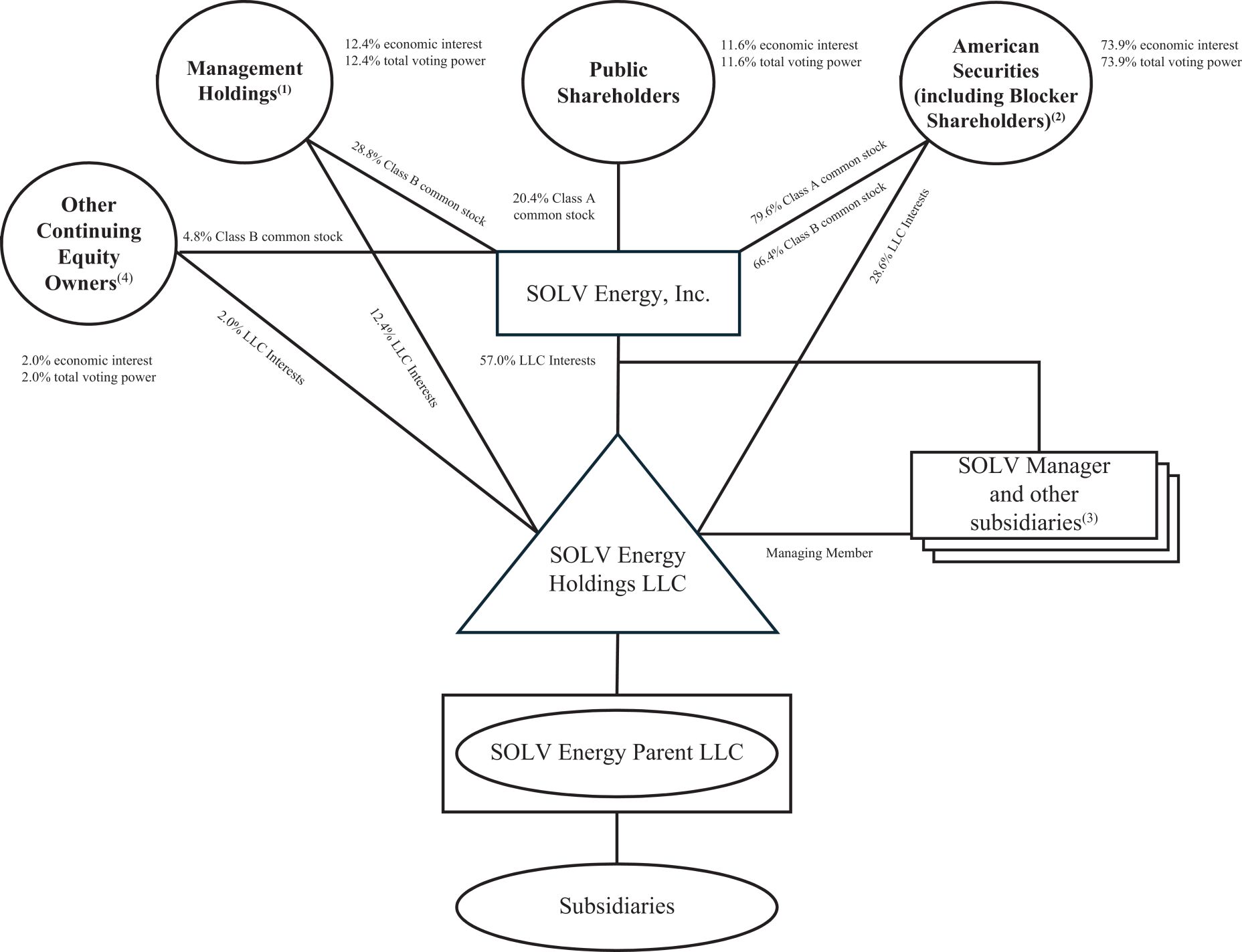
Notes:
| (1) | Management Holdings is an affiliate of, and controlled by, American Securities. All economic interests in Management Holdings are owned by Management Holders. American Securities does not own any of the economic interests in Management Holdings. |
13
Table of Contents
| (2) | Excluding Management Holdings. |
| (3) | SOLV Manager is the sole manager of SOLV Energy Holdings LLC and is able to control all of the business affairs and decision-making of SOLV Energy Holdings LLC without the approval of any other member (other than limited circumstances in which consent or determination of a member or members is required). See “Certain Relationships and Related Party Transactions—SOLV Energy Holdings LLC Agreements—SOLV Energy Holdings LLC Agreement in Effect Upon Consummation of the Transaction.” |
| (4) | Excluding American Securities and Management Holdings. |
After giving effect to the IPO Transactions, SOLV Energy, Inc. became a holding company whose principal assets consist of 57.0% of the outstanding LLC Interests of SOLV Energy Holdings LLC. After giving effect to the IPO Transactions, the Continuing Equity Owners owned 43.0% of the outstanding LLC Interests of SOLV Energy Holdings LLC.
Our Sponsor
Based in New York with an office in Shanghai, American Securities is a leading U.S. private equity firm that invests in market-leading North American companies with annual revenues generally ranging from $200 million to $2 billion. American Securities and its affiliates have approximately $23 billion under management as of December 31, 2025.
Corporate Information
SOLV Energy, Inc., the issuer of the Class A common stock, was incorporated in Delaware on April 1, 2025. Our principal executive offices are located at 16680 West Bernardo Drive, San Diego, CA 92127, and our telephone number is (858) 251-4888. Our corporate website address is www.solvenergy.com. Our website and the information contained on or that can be accessed through our website is not deemed to be incorporated by reference in, and is not considered part of, this prospectus. You should not rely on any such information in making your decision whether to purchase our Class A common stock.
14
Table of Contents
THE OFFERING
| Issuer |
SOLV Energy, Inc. |
| Class A common stock offered by us |
6,814,819 shares (7,837,041 shares if the underwriters exercise their option to purchase additional shares of Class A common stock in full). |
| Class A common stock offered by the selling stockholders |
7,185,181 shares (8,262,959 shares if the underwriters exercise their option to purchase additional shares of Class A common stock in full). |
| Option to purchase additional shares of Class A common stock |
The underwriters have an option to purchase up to an additional 1,022,222 shares of our Class A common stock from us and up to an additional 1,077,778 shares of our Class A common stock from the selling stockholders, in each case at the public offering price, less underwriting discounts and commission. The underwriters can exercise this option at any time within 30 days from the date of this prospectus. |
| Class A common stock outstanding prior to this offering |
115,348,571 shares. |
| Class B common stock outstanding prior to this offering |
87,043,055 shares. |
| LLC Interests outstanding prior to this offering |
202,391,626 LLC Interests. |
| Class A common stock to be outstanding after this offering |
122,163,390 shares (123,185,612 shares if the underwriters exercise their option to purchase additional shares of Class A common stock in full). |
| Class B common stock to be outstanding after this offering |
80,228,236 shares, representing approximately 39.6% of the combined voting power of all of SOLV Energy, Inc.’s common stock (or 79,206,014 shares, representing approximately 39.1% of the combined voting power of all of SOLV Energy, Inc.’s common stock if the underwriters exercise their option to purchase additional shares of Class A common stock in full) and no economic interest in SOLV Energy, Inc. |
| LLC Interests to be held by us immediately after this offering |
122,163,390 LLC Interests, representing approximately 60.4% of the economic interest in SOLV Energy Holdings LLC (or 123,185,612 LLC Interests, representing approximately 60.9% of the economic interest in SOLV Energy Holdings LLC if the underwriters exercise in full their option to purchase additional shares of Class A common stock). |
15
Table of Contents
| LLC Interests to be held directly by the Continuing Equity Owners immediately after this offering |
80,228,236 LLC Interests, representing approximately 39.6% of the economic interest in SOLV Energy Holdings LLC (or 79,206,014 LLC Interests, representing approximately 39.1% of the economic interest in SOLV Energy Holdings LLC if the underwriters exercise in full their option to purchase additional shares of Class A common stock). |
| Ratio of shares of Class A common stock to LLC Interests |
Our amended and restated certificate of incorporation and the SOLV Energy Holdings LLC Agreement require that we and SOLV Energy Holdings LLC at all times maintain a one-to-one ratio between the number of shares of Class A common stock issued by us and the number of LLC Interests owned by us, except as otherwise determined by us. |
| Ratio of shares of Class B common stock to LLC Interests |
Our amended and restated certificate of incorporation and the SOLV Energy Holdings LLC Agreement require that we and SOLV Energy Holdings LLC at all times maintain a one-to-one ratio between the number of shares of Class B common stock owned by the Continuing Equity Owners and their respective permitted transferees and the number of LLC Interests owned by the Continuing Equity Owners and their respective permitted transferees, except as otherwise determined by us. |
| The Continuing Equity Owners own 100% of the outstanding shares of our Class B common stock. |
| Voting rights |
Each share of Class A common stock and Class B common stock entitles its holder to one vote per share. Holders of all outstanding shares of our Class A common stock and Class B common stock vote together as a single class on all matters submitted to a vote of our stockholders. See “Description of Capital Stock.” |
| Redemption rights of holders of LLC Interests |
The Continuing Equity Owners (other than Management Holders) may at each of their options require SOLV Energy Holdings LLC to redeem all or a portion of their vested LLC Interests on a quarterly basis (subject to certain limitations) and at other times under certain permitted circumstances, in each case, in exchange for, at our election, newly issued shares of our Class A common stock on a one-for-one basis or a cash payment using proceeds from a substantially contemporaneous follow-on offering or secondary offering equal to the price per share of our Class A common stock, net of underwriting discounts and/or commissions, sold in such offering for each vested LLC Interest so redeemed, in each case, in accordance with the terms of the SOLV Energy Holdings LLC Agreement; provided that, at our election, we may effect a direct exchange by SOLV Energy, Inc. for Class A common stock or for |
16
Table of Contents
| cash, as applicable, for those vested LLC Interests. Those Continuing Equity Owners may, subject to certain exceptions, exercise such redemption right for as long as their LLC Interests remain outstanding. See “Certain Relationships and Related Person Transactions—SOLV Energy Holdings LLC Agreements—SOLV Energy Holdings LLC Agreement in Effect Upon Consummation of the IPO Transactions.” Simultaneously with the payment of cash or shares of Class A common stock, as applicable, in connection with a redemption or exchange of LLC Interests pursuant to the terms of the SOLV Energy Holdings LLC Agreement, the redeeming or exchanging holder will transfer a number of shares of our Class B common stock equal to the number of LLC Interests so redeemed or exchanged to the Company and such shares of Class B common stock will be cancelled for no consideration. Management Holders, through Management Holdings, will have these same rights as the other Continuing Equity Owners following the Management Elective Redemption Date. |
| Use of proceeds |
We estimate that the net proceeds from the sale of our Class A common stock by us in this offering will be approximately $ million (or $ million if the underwriters exercise their option to purchase additional shares of Class A common stock in full), after deducting underwriting discounts and commissions and estimated expenses payable by us in connection with this offering. |
| We intend to use the net proceeds that we receive from this offering to purchase 6,814,819 LLC Interests (or 7,837,041 LLC Interests if the underwriters exercise in full their option to purchase additional shares of Class A common stock) from the Redeeming Holders at a price per LLC Interest equal to the public offering price of our Class A common stock, less the underwriting discounts and commissions. |
| We will not receive any proceeds from the sale of our Class A common stock by the selling stockholders. We will, however, bear the costs associated with the sale of shares of Class A common stock by the selling stockholders, other than underwriting discounts and commissions. |
| SOLV Energy Holdings LLC will bear or reimburse us for the expenses incurred in connection with this offering. See “Use of Proceeds” for additional information. |
| Controlled company |
Upon the closing of this offering, American Securities will beneficially own more than 68.1% of the voting power for the election of members of our board of directors. Consequently, we will continue to be a “controlled company” under Nasdaq rules. As a controlled company, we qualify for, and may rely on, certain exemptions from certain corporate governance requirements of Nasdaq. See “Management—Controlled Company Status.” Although we qualify as a “controlled company,” we do not currently rely on these exemptions and fully comply with all corporate governance |
17
Table of Contents
| requirements under the listing standards of Nasdaq. However, we reserve the right to utilize the “controlled company” exemption in the future. |
| Dividend Policy |
We do not anticipate paying any dividends on our Class A common stock for the foreseeable future; however, we may change this policy in the future. See “Dividend Policy.” |
| Risk Factors |
Investing in our Class A common stock involves risks. See the “Risk Factors” section of this prospectus beginning on page 21 for a discussion of factors you should carefully consider before investing in our Class A common stock. |
| Listing |
Our Class A common stock is listed on Nasdaq under the symbol “MWH.” |
Unless we specifically state otherwise or the context otherwise requires, the share information in this prospectus:
| • | gives effect to the completion of the IPO Transactions and the Offering Transactions; |
| • | gives effect to the application of the net proceeds received by us from this offering to acquire LLC Interests from the Redeeming Holders and the cancellation of a corresponding number of shares of Class B common stock; |
| • | assumes no exercise of the underwriters’ option to purchase up to an additional 1,022,222 shares of Class A common stock from us and up to an additional 1,077,778 shares of Class A common stock from the selling stockholders; |
| • | does not reflect 3,050,761 shares of Class A common stock issuable upon the exercise of outstanding stock options at a weighted average exercise price of $25.04 per share, which stock options were granted under the SOLV Energy, Inc. 2026 Equity Incentive Plan (the “2026 Plan”); |
| • | does not reflect 4,197,639 additional shares of Class A common stock reserved for future issuance under the 2026 Plan; and |
| • | does not reflect 80,228,236 shares of Class A common stock reserved for issuance upon exchange of LLC Interests (and cancellation of a corresponding number of shares of Class B common stock) after this offering. |
18
Table of Contents
SUMMARY HISTORICAL AND PRO FORMA CONDENSED CONSOLIDATED
FINANCIAL AND OTHER DATA
The following tables present (i) summary historical consolidated financial and other data of SOLV Energy Holdings LLC and its consolidated subsidiaries, (ii) summary unaudited pro forma condensed consolidated financial data for SOLV Energy, Inc. after giving effect to the IPO Transactions and the Offering Transactions and (iii) summary condensed consolidated financial data for SOLV Energy, Inc. for the three months ended March 31, 2026. SOLV Energy Holdings LLC is considered our predecessor for accounting purposes and its consolidated financial statements are our historical financial statements. We derived the summary consolidated statement of operations data for the years ended December 31, 2025, 2024 and 2023, and the consolidated balance sheet data as of December 31, 2025, from our audited consolidated financial statements included elsewhere in this prospectus. We derived the summary consolidated statements of operations data for the three months ended March 31, 2026 and the consolidated balance sheet data as of March 31, 2026 from our unaudited condensed consolidated financial statements included elsewhere in this prospectus.
You should read this data together with our consolidated financial statements and related notes included elsewhere in this prospectus and the section titled “Management’s Discussion and Analysis of Financial Condition and Results of Operations.” Our historical results for any prior period are not necessarily indicative of the results of future operations and should be read in conjunction with “Management’s Discussion and Analysis of Financial Condition and Results of Operations” and the audited consolidated financial statements and notes thereto included elsewhere in this prospectus.
The summary unaudited pro forma condensed consolidated financial data of SOLV Energy, Inc. presented below has been derived from our unaudited pro forma condensed consolidated financial statements and notes included elsewhere in this prospectus. The summary unaudited pro forma condensed consolidated statement of financial condition as of March 31, 2026 gives pro forma effect to the IPO Transactions and the Offering Transactions, as though such transactions had occurred January 1, 2025. The unaudited pro forma condensed consolidated financial data includes various estimates that are subject to material change and may not be indicative of what our operations or financial position would have been had this offering and related transactions taken place on the
19
Table of Contents
dates indicated, or that may be expected to occur in the future. See “Unaudited Pro Forma Condensed Consolidated Financial Information” for a complete description of the adjustments and assumptions underlying the summary unaudited pro forma condensed consolidated financial data.
| SOLV Energy Holdings LLC | SOLV Energy, Inc. | |||||||||||||||||||||||||||
| Year Ended December 31, | Three Months Ended March 31, |
Three Months Ended March 31, |
Pro Forma Three Months Ended March 31, |
Pro Forma Year Ended December 31, |
||||||||||||||||||||||||
| 2025 | 2024 | 2023 | 2025 | 2026 | 2026 | 2025 | ||||||||||||||||||||||
| (in thousands) | ||||||||||||||||||||||||||||
| Statements of Operations Data: |
||||||||||||||||||||||||||||
| Revenue |
$ | 2,490,496 | $ | 1,847,803 | $ | 2,100,643 | $ | 407,847 | $ | 676,805 | $ | 676,805 | $ | 2,490,496 | ||||||||||||||
| Cost of revenue |
2,026,263 | 1,588,639 | 1,990,648 | 348,748 | 557,732 | 557,732 | 2,026,263 | |||||||||||||||||||||
|
|
|
|
|
|
|
|
|
|
|
|
|
|
|
|||||||||||||||
| Gross Profit |
464,233 | 259,164 | 109,995 | 59,099 | 119,073 | 119,073 | 464,233 | |||||||||||||||||||||
| Selling, general and administrative expenses |
211,041 | 127,885 | 95,836 | 36,070 | 111,375 | 62,333 | 287,012 | |||||||||||||||||||||
| Amortization expense |
57,748 | 66,347 | 67,048 | 13,768 | 14,879 | 14,879 | 57,748 | |||||||||||||||||||||
|
|
|
|
|
|
|
|
|
|
|
|
|
|
|
|||||||||||||||
| Total operating expenses |
268,789 | 194,232 | 162,884 | 49,838 | 126,254 | 77,212 | 344,760 | |||||||||||||||||||||
|
|
|
|
|
|
|
|
|
|
|
|
|
|
|
|||||||||||||||
| Operating income (loss) |
195,444 | 64,932 | (52,889 | ) | 9,261 | (7,181 | ) | 41,861 | 119,473 | |||||||||||||||||||
| Loss on debt extinguishment |
— | 4,398 | — | — | 10,688 | — | 10,688 | |||||||||||||||||||||
| Interest expense |
52,730 | 55,394 | 59,702 | 12,691 | 6,897 | 1,757 | 7,868 | |||||||||||||||||||||
| Interest income |
(7,156 | ) | (4,601 | ) | (1,634 | ) | (3,272 | ) | (1,450 | ) | (1,450 | ) | (7,156 | ) | ||||||||||||||
| Other income, net |
(3,476 | ) | (781 | ) | (1,318 | ) | 82 | (68 | ) | (68 | ) | (3,476 | ) | |||||||||||||||
|
|
|
|
|
|
|
|
|
|
|
|
|
|
|
|||||||||||||||
| Income (loss) before income taxes |
153,346 | 10,522 | (109,639 | ) | (240 | ) | (23,248 | ) | 41,622 | 111,549 | ||||||||||||||||||
| Income tax expense |
3,643 | 598 | 204 | 262 | 4,166 | 7,302 | 22,193 | |||||||||||||||||||||
|
|
|
|
|
|
|
|
|
|
|
|
|
|
|
|||||||||||||||
| Net income (loss) |
149,703 | 9,924 | (109,843 | ) | (502 | ) | (27,414 | ) | $ | 34,320 | $ | 89,356 | ||||||||||||||||
| Less: net income attributable to non-controlling interests |
520 | 2 | 1 | 212 | (4,056 | ) | 16,499 | 44,218 | ||||||||||||||||||||
|
|
|
|
|
|
|
|
|
|
|
|
|
|
|
|||||||||||||||
| Net income (loss) attributable to controlling interests |
$ | 149,183 | $ | 9,922 | $ | (109,844 | ) | $ | (714 | ) | $ | (23,358 | ) | $ | 17,821 | $ | 45,138 | |||||||||||
|
|
|
|
|
|
|
|
|
|
|
|
|
|
|
|||||||||||||||
| Weighted average shares used to compute net income per share: |
||||||||||||||||||||||||||||
| Basic |
115,348,571 | 122,163,390 | 122,163,390 | |||||||||||||||||||||||||
| Diluted |
115,348,571 | 203,383,573 | 203,383,573 | |||||||||||||||||||||||||
| Net income (loss) per share: |
||||||||||||||||||||||||||||
| Basic |
$ | (0.20 | ) | $ | 0.15 | $ | 0.37 | |||||||||||||||||||||
| Diluted |
$ | (0.20 | ) | $ | 0.15 | $ | 0.37 | |||||||||||||||||||||
20
Table of Contents
| SOLV Energy, Inc. | ||||||||
| At March 31, 2026 |
At March 31, 2026 |
|||||||
| Actual | Pro Forma | |||||||
| (in thousands) | ||||||||
| Balance Sheet Data: |
||||||||
| Cash and cash equivalents |
$ | 384,911 | $ | 382,911 | ||||
| Total assets |
$ | 1,956,606 | $ | 2,018,608 | ||||
| Total debt |
$ | — | — | |||||
| Total liabilities, excluding debt |
1,145,382 | $ | 1,206,494 | |||||
| Total stockholder’s equity |
$ | 811,224 | $ | 812,114 | ||||
(1) Amount includes current and long-term debt net of unamortized debt issuance costs.
| SOLV Energy Holdings LLC | SOLV Energy, Inc. | |||||||||||||||||||
| Year Ended December 31, | Three Months Ended March 31, |
Three Months Ended March 31, |
||||||||||||||||||
| 2025 | 2024 | 2023 | 2025 | 2026 | ||||||||||||||||
| (in thousands) |
||||||||||||||||||||
| Other Financial Data: |
||||||||||||||||||||
| EBITDA |
$ | 283,943 | $ | 146,149 | $ | 30,260 | $ | 28,751 | $ | 5,929 | ||||||||||
| Adjusted EBITDA |
$ | 341,677 | $ | 165,133 | $ | 52,608 | $ | 34,031 | $ | 92,515 | ||||||||||
See “— EBITDA and Adjusted EBITDA” for a discussion of our results of operations for definitions and a reconciliation of our net income to Adjusted EBITDA.
EBITDA and Adjusted EBITDA
We report our financial results in accordance with GAAP. To supplement this information, we also use EBITDA and Adjusted EBITDA, non-GAAP financial measures, in this prospectus. EBITDA represents net income (loss) before interest, income taxes, depreciation and amortization. Adjusted EBITDA is defined as EBITDA adjusted for (i) non-cash compensation expense; (ii) the (gain) or loss on the disposal of assets and the extinguishment of debt; (iii) the change in fair value of derivatives; (iv) the change in fair value of investments; (v) non-recurring private equity management fees; (vi) Tax Receivable Agreement liability remeasurements; and (vii) certain other items which we do not consider indicative of future operating performance such as one-time legal settlements not considered part of normal course business operations, transaction, integration, transition and other non-cash costs. We adjust for these items in our Adjusted EBITDA as our management believes these items would distort from their ability to efficiently view and assess core operating trends. Our board of directors, management, and investors use EBITDA and Adjusted EBITDA to assess our financial performance because such measures allow them to compare our operating performance on a consistent basis across periods by removing the effects of our capital structure (such as varying levels of interest expense), asset base (such as depreciation and amortization), and items outside the control of our management team (such as income taxes).
EBITDA and Adjusted EBITDA are not defined under GAAP. Our use of the terms EBITDA and Adjusted EBITDA may not be comparable to similarly titled measures of other companies in our industry and are not measures of performance calculated in accordance with GAAP. Our presentation of EBITDA and Adjusted EBITDA are intended as supplemental measures of our performance that are not required by, or presented in accordance with, GAAP. EBITDA and Adjusted EBITDA should not be considered as alternatives to operating income (loss), net income (loss), earnings per share, net sales, net income margin or any other performance measures derived in accordance with GAAP, or as measures of operating cash flows or liquidity.
21
Table of Contents
EBITDA and Adjusted EBITDA have important limitations as analytical tools, and such measures should not be considered either in isolation or as a substitute for analyzing our results as reported under GAAP. Some of these limitations include:
| • | EBITDA and Adjusted EBITDA do not reflect our interest expense or the cash requirements necessary to service interest or principal payments on our debt; |
| • | EBITDA and Adjusted EBITDA do not reflect our tax expenses or the cash requirements to pay our taxes; |
| • | Although depreciation and amortization are non-cash charges, the assets being depreciated and amortized will often have to be replaced in the future, and EBITDA and Adjusted EBITDA do not reflect any cash requirements for such replacements; and |
| • | Other companies in our industry may calculate EBITDA and Adjusted EBITDA differently, limiting their usefulness as comparative measures. |
In evaluating EBITDA and Adjusted EBITDA, you should be aware that in the future we may incur expenses similar to those eliminated in this prospectus
The following table reconciles the differences between Adjusted EBITDA and net income (loss), which is the most comparable GAAP measure:
| SOLV Energy Holdings LLC | SOLV Energy, Inc. | |||||||||||||||||||
| Year Ended December 31, |
Three Months Ended March 31, |
Three Months Ended March 31, |
||||||||||||||||||
| 2025 | 2024 | 2023 | 2025 | 2026 | ||||||||||||||||
| (in thousands) |
||||||||||||||||||||
| Net income (loss) |
$ | 149,183 | $ | 9,922 | $ | (109,844 | ) | $ | (502 | ) | $ | (27,414 | ) | |||||||
| Interest expense |
52,730 | 55,394 | 59,702 | 12,691 | 6,897 | |||||||||||||||
| Interest income |
(7,156 | ) | (4,601 | ) | (1,634 | ) | (3,272 | ) | (1,450 | ) | ||||||||||
| Provisions for income taxes |
3,643 | 598 | 204 | 262 | 4,166 | |||||||||||||||
| Depreciation and amortization |
85,543 | 84,836 | 81,832 | 19,572 | 23,730 | |||||||||||||||
|
|
|
|
|
|
|
|
|
|
|
|||||||||||
| EBITDA |
$ | 283,943 | $ | 146,149 | $ | 30,260 | $ | 28,751 | 5,929 | |||||||||||
| Non-cash compensation expense |
27,326 | 8,607 | 2,375 | 712 | 64,874 | |||||||||||||||
| Loss (gain) on disposal of property and equipment |
38 | 215 | — | — | (10 | ) | ||||||||||||||
| Loss on the extinguishment of debt |
— | 4,398 | — | — | 10,688 | |||||||||||||||
| Change in the fair value of derivative |
17 | (236 | ) | 220 | 82 | — | ||||||||||||||
| Gain on investment |
— | (750 | ) | (1,803 | ) | — | — | |||||||||||||
| Non- recurring private equity management fees, transaction, integration and transition costs, and other non- cash costs(1) |
30,353 | 6,750 | 21,556 | 4,486 | 11,034 | |||||||||||||||
|
|
|
|
|
|
|
|
|
|
|
|||||||||||
| Adjusted EBITDA |
$ | 341,677 | $ | 165,133 | $ | 52,608 | $ | 34,031 | $ | 92,515 | ||||||||||
|
|
|
|
|
|
|
|
|
|
|
|||||||||||
| (1) | Consists of management fees paid to American Securities, that are no longer paid following the closing of the IPO, non-recurring transition costs related to our separation from Swinerton, one-time IPO related costs, non-recurring transaction and integration costs inclusive of deferred compensation or earn-out structures to employees of acquired businesses that are not related to normal course compensation and are conditioned on post-closing service obligations, and other non-cash or non-recurring expenses. We recorded management fees, including reimbursable expenses, of $3,454, $3,120 and $3,114 in the years ended December 31, 2025, |
22
Table of Contents
| 2024, and 2023, respectively, and $750 and $750, respectively, in the three months ended March 31, 2026 and 2025, respectively. For the three months ended March 31, 2026, we recorded $6,491 related to transaction and integration costs, and non-capitalized IPO related costs, and wrote-off $3,939 of capitalized development costs included in cost of revenue related to activity from the historical development business no longer in service, which were offset by miscellaneous immaterial adjustments. For the year ended December 31, 2025, we recorded $20,275 related to transaction and integration costs, and non-capitalized IPO related costs, and wrote-off $6,377 of capitalized development costs included in cost of revenue related to activity from the historical development business no longer in service, which were offset by miscellaneous immaterial adjustments. In 2023, we recorded a $16,122 expense for a legal settlement related to certain legacy projects at CS Energy prior to the merger which we consider to be a non-recurring event due to the nature of the settlement. |
23
Table of Contents
RISK FACTORS
Investing in our Class A common stock involves a high degree of risk. You should carefully consider each of the following risk factors, as well as other information contained in this prospectus, including “Management’s Discussion and Analysis of Financial Condition and Results of Operations” and our audited consolidated financial statements and related notes, before investing in our Class A common stock. The occurrence of any of the following risks could have a material adverse effect on our business, financial condition and results of operations, in which case the trading price of our Class A common stock could decline and you could lose all or part of your investment. Some statements in this prospectus, including statements in the following risk factors, constitute forward-looking statements. See the section of this prospectus captioned “Cautionary Note Regarding Forward-Looking Statements.”
Risks Related to Operating Our Business
A wide range of factors, many that are beyond our control, can impact the timing, performance or profitability of our projects, any of which can result in additional costs to us, reductions or delays in revenues, the payment of liquidated damages by us or project termination.
Our business is dependent on successfully constructing projects for our customers. Many of our projects involve challenging design, engineering, financing, permitting, interconnection, right of way acquisition, procurement, construction, operation and maintenance phases that occur over extended time periods, including sometimes over several years, and we have encountered and may in the future encounter project delays, additional costs or project performance issues as a result of, among other things:
| • | inability to meet project schedule requirements, achieve guaranteed performance or quality standards for a project or failure to comply with mandatory reliability standards set forth by the NERC, which can result in increased costs, through rework, replacement or otherwise, monetary penalties to NERC or the payment of liquidated damages to the customer or contract termination; |
| • | failure to accurately estimate project costs or accurately establish the scope of our services; |
| • | failure to make judgments in accordance with applicable professional standards (e.g., engineering standards); |
| • | unforeseen circumstances or project modifications not included in our cost estimates or covered by our contract for which we cannot obtain adequate compensation, including concealed or unknown environmental, geological or geographical site conditions or technical problems such as design or engineering issues; |
| • | changes in laws or permitting, interconnection and regulatory requirements during the course of our work; |
| • | delays in the delivery or management of design or engineering information, equipment or materials; |
| • | our or a customer’s failure to manage a project, including the inability to timely obtain land, permits or rights of way or meet other permitting, interconnection, regulatory or environmental requirements or conditions; |
| • | changes to project or customer schedules; |
| • | natural disasters or emergencies, including wildfires and earthquakes, as well as significant weather events (e.g., hurricanes, tropical storms, tornadoes, floods, hail storms, droughts, blizzards and extreme temperatures) and adverse or unseasonable weather conditions (e.g., prolonged rainfall or snowfall or early thaw in the northern U.S.); |
| • | difficult terrain and site conditions where delivery of materials and availability of labor are impacted or where there is exposure to harsh and hazardous conditions; |
24
Table of Contents
| • | protests and other public activism, legal challenges or other political activity or opposition to a project; |
| • | other factors such as terrorism, acts of war, including but not limited to conflicts in the Middle East, geopolitical conflicts, public health crises (e.g., pandemics or epidemics) and delays attributable to U.S. government shutdowns or any related under-staffing of government departments or agencies; |
| • | changes in the cost, availability, lead times or quality of equipment, commodities, materials, consumables or labor; and |
| • | delay or failure to perform by suppliers, subcontractors or other third parties, or our failure to coordinate performance of such parties. |
Many of these difficulties and delays are beyond our control and can negatively impact our ability to complete the project in accordance with the required delivery schedule, performance requirements or achieve our anticipated operating income margin on the project. Delays and additional costs associated with delays may be substantial and not recoverable from third parties, and in some cases, we may be required to compensate the customer for such delays, including in circumstances where we have guaranteed project completion or performance by a scheduled date and incur liquidated damages if we do not meet such schedule.
We generate a significant portion of our revenues from lump sum contracts, pursuant to which our customer pays us a fixed amount regardless of the costs that we incur. The contracts for these projects often involve complex pricing, scope of services and other bid preparation components that require challenging estimates and assumptions on the part of our personnel far in advance of contract performance, which increases the risk that costs incurred on such projects can vary, sometimes substantially, from our original estimates.
Additionally, in certain of our EPC contracts we guarantee that we will complete a project by a scheduled date and sometimes provided that the project, when completed, will also achieve certain performance standards. If we fail to complete these projects on time or the equipment we design, furnish and/or install does not meet guaranteed performance standards, we may be liable to our customers for damages, which can be significant. Our O&M services contracts also require us to meet certain minimum performance standards. If we fail to meet agreed project deadlines and/or meet guaranteed performance standards under our EPC contracts, or we fail to perform as required under our O&M service contracts, we may be held responsible for costs incurred by the customer resulting from any delay or any modifications made in order to achieve the performance standards, generally in the form of contractually agreed-upon liquidated damages or obligations to re-perform substandard work. If we are required to pay such costs, the total costs of the project would likely exceed our original estimate, and we could experience reduced profits or a loss related to the applicable project or contract. In addition, such failures on our part could result in project delays, project cancelations, service contract cancelations or damage to our relationships with customers, as well as damage to our reputation, which can be exacerbated when difficulties arise on a high-profile project. As a result, additional costs or penalties, a reduction in our productivity or efficiency or a project termination in any given period could have a material adverse effect on our business, financial condition and results of operations, including our ability to secure new contracts.
Our results of operations, financial condition and other financial and operational disclosures are based upon estimates and assumptions that may differ from actual results or future outcomes.
In preparing our consolidated financial statements and financial and operational disclosures, estimates and assumptions are used by management to report, among other things, assets, liabilities, revenues and expenses. These estimates and assumptions are necessary because certain information utilized is dependent on future events, cannot be calculated with a high degree of precision from available data or cannot be readily calculated based on generally accepted methodologies. In some cases, these estimates are particularly difficult to determine, and we must exercise significant judgment, and as a result actual results and future outcomes can differ materially from the estimates and assumptions that we use and could have a material adverse effect on our business, financial condition and results of operations. For example, our remaining performance obligations and
25
Table of Contents
backlog are difficult to determine with certainty. Customers often have no obligation under our contracts to assign or release work to us, and many contracts may be terminated on short notice. Cancelation or reduction in scope of a contract can significantly reduce the revenues and profit we recognize. Consequently, our estimates of remaining performance obligations and backlog may not be accurate, and we may not be able to realize our estimated remaining performance obligations and backlog.
Impairments to goodwill, other intangible assets, and long-lived assets, the values of which are dependent upon certain estimates and assumptions, could also have a material adverse effect on our results of operations. We record goodwill when we acquire a business, which must be tested at least annually for impairment. Any future impairments could have a material adverse effect on our results of operations for the period in which the impairment is recognized.
Changes in estimates related to revenues and costs associated with our contracts with customers could result in a reduction or elimination of revenues, a reduction of profits or the recognition of losses.
For lump sum contracts, we recognize revenue as performance obligations that are satisfied over time, and earnings or losses recognized on individual contracts are based on estimates of contract revenues, costs and profitability as discussed in Note 5—Revenue from Contracts with Customers in the notes to our audited consolidated financial statements included elsewhere in this prospectus. Changes in contract estimates are recognized on a cumulative catch-up basis in the period in which the revisions to the estimates are made, and contract losses are recognized in full in the period in which they become evident. Variable consideration amounts, including, among other things, unexecuted change orders and liquidated damages penalties, may also cause changes in contract estimates. In addition, we recognize amounts associated with change orders and/or claims as revenue when it is probable that a significant reversal in the amount of cumulative revenue recognized will not occur or when the uncertainty associated with the variable consideration is resolved. Actual amounts collected in connection with change orders and claims have in the past and may in the future differ from estimated amounts. Consequently, the timing for recognition of revenues and profit or loss and any subsequent changes in estimates is uncertain and could result in a reduction or an elimination of previously reported revenues or profits or the recognition of losses on the associated contract. Any such adjustments could be significant and could have a material adverse effect on our business, financial condition and results of operations.
Backlog may not be realized or may not result in profits and may not accurately represent future revenue.
Backlog is difficult to determine accurately and is not a comprehensive indicator of future revenue amounts or timing, and companies within our industry may define backlog differently. Reductions in backlog due to project or contract cancelation, termination or scope adjustment by a customer or for other reasons could significantly reduce the revenue and profit we actually receive from contracts in backlog. In the event of a project cancelation, termination or scope adjustment, we typically have no contractual right to the total revenues reflected in our backlog. The timing of contract awards, duration of large new contracts and the mix of services, subcontracted work and material in our contracts can significantly affect backlog. Given these factors and our method of calculating backlog, our backlog at any point in time may not accurately represent the revenue that we expect to realize during any period, and our backlog as of the end of a fiscal year may not be indicative of the revenue we expect to earn in the following fiscal year and should not be viewed or relied upon as a stand-alone indicator.
Consequently, we cannot provide assurance that our estimates of backlog will accurately reflect future revenue. See “Management’s Discussion and Analysis of Financial Condition and Results of Operations” for a discussion on how we calculate backlog for our business.
The imposition of additional duties and tariffs and other trade barriers and retaliatory countermeasures implemented by the U.S. and other governments could have a material adverse effect on our business, financial condition and results of operations.
Recently there have been significant changes to U.S. trade policies, sanctions, legislation, treaties and tariffs, including, but not limited to, trade policies and tariffs affecting products from outside of the U.S. For example, in
26
Table of Contents
2025 and 2026, the U.S. presidential administration announced significant new tariffs on foreign imports into the U.S., including from China, Mexico, Canada, Europe and certain Southeast Asian countries, and has proposed additional new tariffs that may be implemented in the future. The extent and duration of increased tariffs and the resulting impact on general economic conditions and on our business are uncertain and depend on various factors, such as negotiations between the U.S. and affected countries, the responses of other countries or regions, exemptions or exclusions that may be granted, and the availability and cost of alternative sources of supplies. Any new or additional tariffs on goods imported to the U.S. from China, Mexico, Canada, Southeast Asian or other countries, or products imported into the European Union or other non-U.S. markets, could also increase the cost of some of our services and reduce our margins. In response to the tariffs, we may seek to increase prices to our customers, which may diminish demand for our services and could have a material adverse effect on our business, financial condition and results of operations. Other countries where we or our suppliers, subcontractors or manufacturers source materials and goods used in connection with our business have changed, and may continue to change, their own policies on trade as well as business and foreign investment in their respective countries. Additionally, it is possible that U.S. policy changes and uncertainty about such changes could increase market volatility and currency exchange rate fluctuations. As a result of these dynamics, we cannot predict the impact to our business of any future changes to the U.S.’s or other countries’ trading relationships or the impact of new laws or regulations adopted by the U.S. or other countries.
Our results of operations may vary significantly from quarter to quarter.
Our business is subject to seasonality and other factors that can result in significantly different results of operations from quarter to quarter, and therefore our results in any particular quarter may not be indicative of future results. Our quarterly results have been and may in the future be materially and adversely affected by, among other things:
| • | the timing and volume of work we perform and our performance with respect to ongoing projects and services, including, for example, as a result of changes in customer priorities and the availability of tax credits, delays and reductions in scope of projects, project and agreement terminations, expirations or cancelations, and availability of critical equipment and supplies; |
| • | increases in project costs that result from, among other things, natural disasters and emergencies, adverse weather conditions or events, legal challenges, permitting, interconnection delays, regulatory or environmental processes, tariffs, delays or damage of material, labor productivity and availability, or inaccurate project cost estimates; |
| • | variations in the size, scope, costs and operating income margins of ongoing projects, as well as the mix of our customers, contracts and business; |
| • | fluctuations in economic, political, financial, industry and market conditions on a regional, national or global basis, including as a result of, among other things, inflationary pressure that impacts our costs associated with labor, equipment and materials; increased interest rates; default or threat of default by the U.S. federal government with respect to its debt obligations; U.S. government shutdowns; natural disasters and other emergencies (e.g., wildfires, weather-related events or pandemics); deterioration of global or specific trade relationships; or acts of war, including but not limited to conflicts in the Middle East, geopolitical conflicts and political unrest; |
| • | changes in regulation or government policy that causes our customers to delay, change or abandon their projects; |
| • | pricing pressures as a result of competition; |
| • | changes in the budgetary spending patterns or strategic plans of customers or governmental entities; |
| • | supply chain and other logistical difficulties, as well as sourcing restrictions on materials necessary for the services we provide; |
27
Table of Contents
| • | liabilities and costs incurred in our operations that are not covered by, or that are in excess of, our third-party insurance or indemnification rights, including significant liabilities that can arise from hazards at our customers’ sites (e.g., explosions or fires), and which could be exacerbated by the geographies in which we operate; |
| • | disputes with customers or delays and payment risk relating to billing and payment under our contracts and change orders, including as a result of customers that encounter financial difficulties, are insolvent or have filed for bankruptcy protection; |
| • | the resolution of, or unexpected or increased costs associated with, pending or threatened legal proceedings, indemnity obligations, multiemployer pension plan obligations (e.g., withdrawal liability) or other claims; |
| • | restructuring, severance and other costs associated with, among other things, winding down certain operations and exiting markets; |
| • | estimates and assumptions in determining our financial results, remaining performance obligations and backlog, including the timing and significance of impairments of goodwill and other long-lived assets, including intangible assets, equity or other investments, and receivables; |
| • | the recognition of tax impacts related to changes in tax laws or uncertain tax positions; |
| • | the timing and magnitude of costs we incur to support our operations or growth internally or through acquisitions; |
| • | engineering quality or installation errors, resulting in rework and serial defect liabilities; and |
| • | accidents and injuries resulting in delays, increased costs, reputational damage and loss of future work. |
Any of the above-listed factors could have a material adverse effect on our business, financial condition and results of operations.
The reduction, elimination or expiration of government incentives for, or regulations mandating the use of, renewable energy and battery storage specifically could have a material adverse effect on our business, financial condition and results of operations.
Federal and certain state and local government bodies provide incentives to owners, end-users and manufacturers designed to promote the use of renewable energy and battery storage primarily in the form of tax credits. Consequently, the attractiveness of solar energy and battery storage projects depends in part on the availability of certain government incentives. We derive our revenues primarily from providing EPC and O&M services to solar energy and battery storage projects. The reduction, elimination or expiration of these incentives, including tax credits for solar and battery storage projects or renewable portfolio standards may negatively affect the competitiveness of solar electricity relative to conventional and non-solar renewable sources of electricity which could reduce the number of new solar and battery storage projects and, consequently, reduce demand for our services, which could have a material adverse effect on our business, financial condition and results of operations. For example, see “—Risks Related to Regulation and Compliance—The unavailability, reduction or elimination of government and economic incentives could have a material adverse effect on our business, financial condition and results of operations.”
Limitations on the availability or an increase in the price of materials, equipment and subcontractors that we and our customers depend on to complete and maintain projects could have a material adverse effect on our business, financial condition and results of operations.
We rely on suppliers and equipment manufacturers to obtain necessary materials and equipment and subcontractors to perform portions of our services, and our customers rely on suppliers for materials necessary for the construction, maintenance, repair and upgrading of their projects. Limitations on the availability of
28
Table of Contents
suppliers, subcontractors or equipment manufacturers could negatively impact our or our customers’ operations, particularly in the event we or our customers rely on a single or small number of providers. We are also exposed to price increases for materials that are utilized in connection with our operations, including, among other things, copper, steel, aluminum and equipment (e.g., transformers, inverters and trackers). Prices and availability of materials, suppliers and manufacturers could be materially impacted by, among other things, supply chain and other logistical challenges (including the inability of manufacturers to timely meet demand), global trade relationships (e.g., tariffs, duties, taxes, assessments or sourcing restrictions) and other general market and geopolitical conditions (e.g., inflation, market volatility, increased interest rates and acts of war and other geopolitical conflicts, including but not limited to conflicts in the Middle East). For example, the availability of power transformers utilized in electric power plants has been negatively impacted by the inability of manufacturers to meet current market demand, which has increased and is expected to continue to increase. If the supply of power transformers and other critical equipment is unable to meet the demand for such equipment, prices and lead times may continue to increase which could put upward pressure on our costs and adversely affect our profitability. In addition, customers in certain U.S. states, in order to receive certain funding or for other reasons, may expect or compel us to engage a specified percentage of services from suppliers or subcontractors that meet local or diversity-ownership requirements, which can further limit our pool of available suppliers and subcontractors and limit our ability to secure contracts, maintain our services or grow in those areas. Such laws, regulations and policies relating to diversity programs are rapidly evolving, and we may face changing or conflicting regulations or requirements related to such matters.
Additionally, successful completion of our contracts can depend on whether our subcontractors successfully fulfill their contractual obligations. If our subcontractors fail to perform their contractual obligations (including making payments to their subcontractors and suppliers), fail to meet the expected completion dates or quality or safety standards or fail to comply with applicable laws, such shortcomings may subject us to claims or require us to incur additional costs or provide additional services to mitigate such shortcomings. Regulatory or contractual requirements that require us to outsource a percentage of services to subcontractors also limit our ability to self-perform our services, thereby potentially increasing performance risk associated with our services. Furthermore, services subcontracted to other service providers generally yield lower margins, and therefore these regulatory requirements can impact our profitability and results of operations.
There are also increasing expectations in various jurisdictions that companies diligence and monitor the environmental and social performance of their value chain, including compliance with a variety of labor practices, as well as consider a wider range of potential environmental and social matters. Compliance can be costly, require us to establish or augment programs to diligence or monitor our suppliers, or potentially design supply chains to avoid certain regions altogether, and, in addition, there may also be retaliation against companies that are perceived as boycotting products manufactured or sourced in certain regions, such as Xinjiang, China. Failure to comply with such regulations can result in fines, contractual penalties, reputational damage, denial of import for materials for our projects, or otherwise have a material adverse effect on our business, financial condition and results of operations.
Our business is labor-intensive, and we may be unable to attract and retain qualified employees or we may incur significant costs in the event we are unable to efficiently manage our workforce or the cost of labor increases.
Our ability to perform our services and grow our business requires hiring, training and retaining the necessary skilled personnel, which is subject to a number of risks. The demand for labor in our industry has continued to increase in response to growing demand for infrastructure services in the United States. The pool of skilled workers available in our industry has also declined, and may further decline, due primarily to an aging workforce and fewer new workers entering into the trades and professions that are required for our business, especially with respect to experienced program managers and qualified engineers, electricians and craft workers. The seasonal nature of our industry can also create shortages of qualified labor during periods of high demand, and the amount of travel required for project management-level positions can impact the number of qualified potential candidates
29
Table of Contents
that decide to enter our industry. A shortage in the supply of personnel creates competitive hiring markets that may result in increased labor expenses, and we have incurred, and expect to continue to incur, significant recruiting and training expenses in order to recruit and train employees. The uncertainty of contract award timing and project delays can also present difficulties in managing our workforce size. Additionally, we may not be able to attract and retain the necessary skilled personnel for our expanding service offerings. Our inability to efficiently manage our workforce may require us to incur costs resulting from excess staff, reductions in staff, or redundancies that could have a material adverse effect on our business, financial condition and results of operations. Also, we may trigger indemnification obligations to our customers if, on projects where we have agreed to comply with certain prevailing wage and apprenticeship standards or domestic content standards, we fail to do so and this causes our customers to lose bonus federal tax credits under the Inflation Reduction Act of 2022 (the “IRA”).
Additionally, the recent inflationary pressure in the U.S. and our other markets has increased our labor costs. Under certain of our contracts, labor costs are passed through to customers, and the portion of our workforce that is represented by labor unions typically operates under multi-year collective bargaining agreements that provide some visibility into future labor costs prior to the expiration and renegotiation of such contracts. However, the costs related to a significant amount of our workforce are subject to market conditions, and therefore inflationary pressure could increase our labor costs with respect to those employees. Increased labor costs can also impact our customers’ decision-making with respect to viability or timing of certain projects, which could result in project delays or cancelations and in turn have a material adverse effect on our business, financial condition and results of operations.
The loss of, or reduction in business from, certain significant customers could have a material adverse effect on our business, financial condition and results of operations.
A few customers have in the past and may in the future account for a significant portion of our revenues. For example, our 10 largest customers accounted for approximately 81% of our consolidated revenues as of March 31, 2026. Although we have longstanding relationships with many of our significant customers, a significant customer may unilaterally reduce or discontinue business with us at any time or merge or be acquired by a company that decides to reduce or discontinue business with us. A significant customer may also encounter financial constraints, based on cost of capital or other reasons, file for bankruptcy protection or cease operations, any of which could also result in reduced or discontinued business with us. The loss of business from a significant customer could have a material adverse effect on our business, financial condition and results of operations.
Many of our contracts may be canceled or suspended on short notice or may not be renewed upon completion or expiration, and we may be unsuccessful in replacing our contracts, which could have a material adverse effect on our business, financial condition and results of operations.
Our customers have in the past and may in the future cancel, suspend, delay or reduce the number or size of projects available to us for a variety of reasons, including capital constraints, changing market conditions or an inability to meet regulatory requirements. Furthermore, many of our customers may cancel or suspend our contracts for convenience on short notice even if we are not in default under the contract. Additionally, the in-house service organizations of our existing or prospective customers are capable of performing, or acquiring businesses that perform, the same types of services we provide, and these customers may also face pressure or be compelled by regulatory or other requirements to self-perform an increasing amount of the services we currently perform for them, thereby reducing the services they outsource to us in the future. While our customers are obligated to compensate us for work completed prior to the cancelation of any contract, if our customers cancel or suspend contracts having significant value or we fail to renew or replace a significant number of our existing contracts when they expire or are completed, the actual revenue received on such projects prior to such cancelation, suspension, completion or expiration, if any, may be significantly less than the revenue reflected in our backlog estimates. As a result, we may fail to realize all amounts in our backlog, which could have a material adverse effect on our business, financial condition and results of operations.
30
Table of Contents
We may fail to adequately recover on contract modifications against project owners for payment or performance, which could have a material adverse effect on our business, financial condition and results of operations.
We have in the past brought, and may in the future bring, claims against our customers. We periodically present contract modifications to our customers for changes in contract specifications or requirements, as a result of added scope under such contracts, or for events outside our control which have impacted the cost or time to perform our obligations under the contracts. We consider unapproved change orders to be contract modifications for which customers have not yet agreed to both scope and price. We consider claims to be contract modifications which have been denied by our customers, and for which we seek, or will seek, to collect from such customers. These types of claims occur due to, among other things, impacts to projects as a result of factors not within our control, such as natural disasters, unforeseen site conditions, significant weather events and public health events (e.g., pandemics), delays caused by customers and third parties and changes in project scope, which can result in delays and/or additional costs that may not be recovered until the claim is resolved. While we generally negotiate with the customer for additional compensation, we may be unable to obtain, through negotiation, arbitration, litigation or otherwise, adequate amounts to compensate us for the additional work or expenses incurred. Litigation, arbitration or government approval (if needed) with respect to these matters is generally lengthy and costly, involves significant uncertainty as to timing and amount of any resolution, and can adversely affect our relationships with existing or potential customers. Furthermore, we could be required to invest significant working capital to fund cost overruns while the resolution of a claim is pending. Failure to obtain adequate and prompt compensation for these matters can result in a reduction of revenues and gross profit recognized in prior periods or the recognition of a loss. Any such reduction or loss can be substantial and could have a material adverse effect on our business, financial condition and results of operations.
The nature of our business exposes us to potential liability for warranty, engineering and other related claims.
We typically provide contractual warranties for our services and materials, guaranteeing the work performed against, among other things, defects in workmanship, and we may agree to indemnify our customers for losses related to our services. The lengths of these warranty periods varies and can extend for several years. Certain projects can have longer warranty periods and include facility performance warranties that are broader than the warranties we generally provide. Warranties generally require us to re-perform the services and/or repair or replace the warranted item and any other facilities impacted thereby, at our sole expense, and we could also be responsible for other damages if we are not able to adequately satisfy our warranty obligations. In addition, we can be required under contractual arrangements with our customers to warrant any defects or failures in materials we provide. While we generally require materials and equipment suppliers to provide us warranties that are consistent with those we provide customers, if any of these suppliers default on their warranty obligations to us, we may incur costs to repair or replace the defective materials.
Furthermore, our business involves professional judgments regarding the planning, design, development, construction, operations and management of solar power and renewable generation projects. Because our projects are often technically complex, our failure to make judgments and recommendations in accordance with applicable professional standards, including engineering standards, could result in damages. A significantly adverse or catastrophic event at a project site or completed power plant resulting from the services we performed could result in significant professional or product liability, personal injury (including claims for loss of life) or property damage claims or other claims against us, as well as reputational harm. These liabilities could exceed our insurance limits or impact our ability to obtain third-party insurance in the future, and customers, subcontractors or suppliers who have agreed to indemnify us against any such liabilities or losses might refuse or be unable to pay us. As a result, warranty, engineering and other related claims could have a material adverse effect on our business, financial condition and results of operations.
31
Table of Contents
During the ordinary course of our business, we are subject to lawsuits, claims and other legal proceedings, as well as bonding claims and related reimbursement requirements.
We have in the past been, and may in the future be, named as a defendant in lawsuits, claims and other legal proceedings that arise in the ordinary course of our business. These actions may seek, among other things, compensation for alleged personal injury (including claims for loss of life), workers’ compensation, employment discrimination, sexual harassment, workplace misconduct, wage and hour claims and other employment-related damages, compensation for breach of contract, negligence or gross negligence or property damage, environmental liabilities, multiemployer pension plan withdrawal liabilities, punitive damages, consequential damages, and civil penalties or other losses or injunctive or declaratory relief, as well as interest and attorneys’ fees associated with such claims. Furthermore, given our recent growth, we have become a more attractive target for lawsuits by various third parties.
We also generally indemnify our customers for claims related to the services we provide and actions we take under our contracts, and, in some instances, we are allocated risk through our contract terms for actions by our customers, subcontractors or other third parties. Because our services in certain instances can be integral to the operation and performance of our customers’ infrastructure, we have been and may become subject to lawsuits or claims for any failure of the systems that we work on or damages caused by accidents and events related to such systems, even if our services are not the cause of such failures and damages. We could also be subject to civil and criminal liabilities, which could be material. Insurance coverage may not be available or may be insufficient for these lawsuits, claims or legal proceedings. The outcome of any allegations, lawsuits, claims or legal proceedings, as well as any public reaction thereto, is inherently uncertain and could result in significant costs, damage to our brands or reputation and diversion of management’s attention from our business. Payments of significant amounts, even if reserved, could have a material adverse effect on our business, financial condition and results of operations.
In addition, certain customers, particularly in connection with new construction, may require us to post performance and payment bonds. These bonds provide a guarantee that we will perform under the terms of a contract and pay our subcontractors and vendors. If we fail to perform, the customer may demand that the surety make payments or provide services under the bond, and we must reimburse the surety for any expenses or outlays it incurs. To the extent reimbursements are required, the amounts could be material and could have a material adverse effect on our business, financial condition and results of operations.
We can incur liabilities or suffer negative financial or reputational impacts relating to health and safety matters.
Our operations are inherently hazardous and subject to extensive laws and regulations relating to the maintenance of safe conditions in the workplace. While we have invested, and will continue to invest, substantial resources in our occupational health and safety programs, our industry involves a high degree of operational risk, and there can be no assurance that we will avoid significant liability exposure. Although we have taken precautions designed to mitigate this risk, we have suffered serious accidents in connection with our operations, and we anticipate that our operations may result in additional serious accidents in the future. As a result of these events, we could be subject to substantial penalties, revocation of operating licenses, criminal prosecution or civil litigation, including claims for bodily injury or loss of life, that could result in substantial costs and liabilities. In addition, if our safety record were to substantially deteriorate or we were to suffer substantial penalties or criminal prosecution for violation of health and safety regulations, our customers could cancel our contracts and elect to procure future services from other providers. Unsafe work sites also have the potential to increase employee turnover, increase the costs of projects for our customers, and raise our operating costs. Any of the foregoing could have a material adverse effect on our business, financial condition and results of operations.
32
Table of Contents
Disruptions to our information technology systems or our failure to adequately protect critical data, sensitive information and technology systems could have a material adverse effect on our business, financial condition and results of operations.
We rely on information technology systems to manage our operations and other business processes and to protect sensitive company information. We also collect and retain information about our customers, stockholders, vendors, employees, contractors, business partners and other parties, all of whom expect that we will adequately protect such information. We face numerous and evolving cybersecurity risks that threaten the confidentiality, integrity and availability of our information technology systems and confidential information as well as the systems and information of key third parties and information technology vendors upon whom we rely, including from diverse threat actors, such as state-sponsored organizations, opportunistic hackers and hacktivists, as well as through diverse attack vectors, such as social engineering/phishing, malware (including ransomware), malfeasance by insiders, human or technological error, and as a result of “bugs,” misconfigurations or exploited vulnerabilities in software or hardware, including malicious code embedded in open-source software, or misconfigurations, “bugs” or other vulnerabilities in commercial software that is integrated into our or our key third parties and information technology vendors upon whom we rely. Additionally, any integration of artificial intelligence (“AI”) in our or our information technology vendors’ operations, products or services is expected to pose new or unknown cybersecurity risks and challenges. Furthermore, the energy infrastructure systems on which we work are strategic targets that are at greater risk of cyber-attacks or acts of terrorism than other targets. Our operations are decentralized with operating companies maintaining some of their own information systems, data and service providers. While our cybersecurity risk management program and processes, including policies, controls and procedures, are designed to cover our operating companies, there can be no assurance that these will be fully implemented, complied with or effective in protecting all information systems and operations. In addition, as a NERC-registered entity, we are subject to periodic audits by an independent auditor of our compliance with operations and critical infrastructure protection standards. Although we maintain a robust 693 and NERC CIP compliance program pursuant to NERC requirements, if we fail to comply with NERC CIP standards we could be subject to sanctions, including substantial monetary penalties and increased compliance obligations, any one of which could have a material adverse effect on our business, financial condition and results of operations. While we have security measures and technology in place to protect our and our customers’ confidential or proprietary company information, there can be no assurance that our efforts will prevent all threats to our systems and information. Moreover, we have acquired and continue to acquire companies which may have cybersecurity vulnerabilities and/or unsophisticated security measures, which may expose us to significant cybersecurity, operational, and financial risks until such companies are fully integrated into our information systems and an intrusion into the information systems of a business we acquire may also ultimately compromise our systems. Additionally, while we maintain appropriate policies and procedures to minimize the cybersecurity risks associated with the use of remote working arrangements by employees, vendors, and other third parties, such arrangements may nonetheless present increased exposure to possible attacks, thereby increasing the risk of a data security compromise.
To date we have not experienced any cyber-attacks, breaches or disruptions of our information systems resulting in any material impact to our business; however, the ultimate impact of future and similar events remains unknown, and we expect additional vulnerabilities to arise. Any adverse impact to the confidentiality, integrity and availability of our information technology systems and confidential information, including security breaches and cyber-attacks, whether at our Company, our suppliers and vendors or other third parties, could expose us to loss, unauthorized release or disclosure of customer, employee or Company confidential information, litigation (such as class actions), investigation, regulatory enforcement action, penalties and fines, orders to stop any alleged noncompliant activity, information technology system failures or network disruptions, increased cyber-protection and remediation costs, financial losses, potential liability, or loss of customers’, employees’ or third-party providers’ trust and business, any of which could adversely impact our reputation, competitiveness and financial performance. An attack could also cause material service disruptions to our internal systems or, in extreme circumstances, infiltration into, damage to or loss of control of our customers’ energy infrastructure systems. Any such breach or disruption could subject us to material liabilities, cause damage to our reputation or
33
Table of Contents
customer relationships, or result in regulatory investigations or other actions by governmental authorities, which could have a material adverse effect on our business, financial condition and results of operations. Furthermore, we may incur additional costs related to the investigation and reporting of any such breach or disruption.
Additionally, because the techniques used to obtain unauthorized access or sabotage information technology systems change frequently and are generally not identifiable until they are launched against a target, we are unable to anticipate all attacker techniques or to implement comprehensive preventative measures, particularly because threat actors are increasingly using tools, including AI, that are designed to circumvent controls and evade detection. As a result, we may be required to expend significant resources to protect against the threat of system disruptions and security breaches or to alleviate problems caused by these disruptions and breaches. Furthermore, we cannot guarantee that any costs and liabilities incurred in relation to an attack or incident will be covered by our existing insurance policies or that applicable insurance will be available to us in the future on economically reasonable terms or at all.
Any deterioration in the quality or reputation of our brands, which can be exacerbated by the effect of social media or significant media coverage, could have a material adverse effect on our business, financial condition and results of operations.
Our brands and our reputation are among our most important assets, and our ability to attract and retain customers, as well as qualified employees, depends on brand recognition and reputation. Such dependence makes our business susceptible to reputational damage and to competition from other companies. A variety of events could result in damage to our reputation or brands, some of which are outside of our control, including:
| • | acts or omissions that adversely affect our business such as a crime, scandal, cyber-related incident, litigation or other negative publicity; |
| • | failure to successfully perform, or negative publicity related to, a high-profile project; |
| • | actual or potential involvement in a catastrophic fire, explosion, mechanical failure of infrastructure or similar event; or |
| • | actual or perceived responsibility for a serious accident or injury. |
Increased media coverage and interest in energy transition matters and our industry, along with the intensification of media coverage generally, including through the considerable expansion in the use of social media, have increased the volume and speed at which negative publicity arising from these events can be generated and spread, and we may be unable to timely respond to, correct any inaccuracies in, or adequately address negative perceptions arising from such media coverage. In addition, negative publicity relating to certain projects may result in increased regulatory scrutiny, adverse rulings or regulatory actions. If the reputation or perceived quality of our brands decline, customers lose confidence in us or we are unable to attract or retain qualified employees, such outcomes could have a material adverse effect on our business, financial condition and results of operations.
The loss of, or our inability to attract or keep, key personnel could disrupt our business.
We depend on the continued efforts of our senior management team and key technical personnel. We also depend on our ability to attract key operational, professional and technical personnel as we grow our business and in order to establish and maintain an effective succession planning process. A shortage of these employees for various reasons, including intense competition for highly skilled individuals with technical expertise, labor shortages, increased labor costs and the preference of some candidates to work remotely, could jeopardize our ability to successfully manage our decentralized operations or our ability to grow and expand our business. The loss of key personnel, as well as our inability to attract, develop and retain qualified employees could negatively impact our ability to manage our business and could have a material adverse effect on our business, financial condition and results of operations.
34
Table of Contents
Our inability to successfully execute our acquisition strategy may have an adverse impact on our growth.
Our business strategy includes expanding our presence in the industry we serve and adjacent industries through strategic acquisitions of companies that complement or enhance our business. The number of acquisition targets that meet our criteria may be limited. We may also face competition for acquisition opportunities, and other potential acquirers may offer more favorable terms or have greater financial resources available for potential acquisitions. This competition may further limit our acquisition opportunities or raise the prices of acquisitions and make them less accretive, or possibly not accretive, to us. Furthermore, the increased antitrust scrutiny of and compliance requirements for potential acquisitions, including by the Federal Trade Commission (“FTC”) and Department of Justice under the Hart-Scott Rodino Act, the Sherman Act, the Clayton Act (each as amended) or other applicable laws, could negatively impact the cost and timing of or our ability to complete certain potential acquisitions. Failure to consummate future acquisitions could negatively affect our growth strategies.
Additionally, our past acquisitions have involved, and our future acquisitions may involve, significant cash expenditures or stock issuances, the incurrence or assumption of debt and other known and unknown liabilities and exposure to burdensome regulatory requirements. We may also discover previously unknown liabilities or, due to market conditions, be required pursuant to specific transaction terms to assume certain prior known liabilities associated with an acquired business, and we may have inadequate or no recourse under applicable indemnification provisions or representation and warranty insurance coverage (due to policy terms or lack of coverage at rates we believe are reasonable). Known liabilities may also change over time and become more severe than previously anticipated. As a result, past or future acquisitions may ultimately have a material adverse effect on our business, financial condition and results of operations.
The success of our acquisition strategy also depends on our ability to successfully conduct diligence and integrate the operations of the acquired businesses with our existing operations and realize the anticipated benefits from the acquired businesses, such as the expansion of our existing operations, expansion into new, complementary or adjacent business lines, elimination of redundant costs and capitalizing on cross-selling opportunities. Our ability to integrate and realize benefits can be negatively impacted by, among other things:
| • | failure to adequately perform necessary diligence on prospective acquisitions; |
| • | failure of an acquired business to achieve the results we expect; |
| • | diversion of our management’s attention from operational and other matters or other potential disruptions to our existing business; |
| • | difficulties incorporating the operations and personnel, or inability to retain key personnel, of an acquired business; |
| • | the complexities and difficulties associated with managing our business as it grows and evolves; |
| • | additional financial reporting and accounting challenges associated with an acquired business; |
| • | unanticipated events or liabilities associated with the operations of an acquired business; |
| • | loss of business due to customer overlap or other factors; and |
| • | risks and liabilities arising from the prior operations of an acquired business, such as performance, operational, safety, cybersecurity, environmental, workforce or other compliance or tax issues, some of which we may not have discovered or accurately estimated during our due diligence and may not be covered by indemnification obligations or insurance. |
We cannot be sure that we will be able to successfully complete the integration process without substantial costs, delays, disruptions or other operational or financial problems. Failure to successfully integrate acquired businesses could have a material adverse effect on our business, financial condition and results of operations.
Additionally, we also generally require that key management and former principals of the businesses we acquire agree to non-compete covenants in the purchase agreement or, as applicable, employment agreements.
35
Table of Contents
Enforceability of these non-competition agreements varies by jurisdiction and typically is dependent upon specific facts and circumstances, making it difficult to predict their enforceability. Additionally, the FTC has adopted new rules to, among other things, prohibit and make unenforceable any post-employment non-compete arrangement that restricts an employee or individual independent contractor, unless such arrangement was entered into in connection with an acquisition and meets certain conditions. While these rules have been challenged judicially and their implementation has been stayed, if the rules are ultimately upheld, we might be subject to increased competition if the restrictive covenants entered into by key management personnel of acquired businesses are not enforceable or have expired, which could have a material adverse effect on our business, financial condition and results of operations.
We may be unable to compete for projects if we are not able to obtain surety bonds, letters of credit or bank guarantees.
A portion of our business depends on our ability to provide surety bonds, letters of credit, bank guarantees or other financial assurances, including parent guarantees. Current or future market conditions, including losses incurred in the construction industry or as a result of large corporate bankruptcies, as well as changes in our sureties’ assessment of our operating and financial risk, could cause our surety providers and lenders to decline to issue or renew, or substantially reduce the amount of, bid or performance bonds for our work and could increase our costs associated with collateral. These actions could be taken on short notice. If our surety providers or lenders were to limit or eliminate our access to bonding, letters of credit or guarantees, our alternatives would include seeking capacity from other sureties and lenders or finding more business that does not require bonds or that allows for other forms of collateral for project performance, such as cash. We may be unable to secure these alternatives in a timely manner, on acceptable terms, or at all, which could affect our ability to bid for or work on future projects requiring financial assurances and could have a material adverse effect on our business, financial condition and results of operations.
Under standard terms in the surety market, sureties issue or continue bonds on a project-by-project basis and can decline to issue bonds at any time or require the posting of additional collateral as a condition to issuing or renewing bonds. If we were to experience an interruption or reduction in the availability of bonding capacity as a result of these or other reasons, we may be unable to compete for or work on certain projects that require bonding.
Additionally, from time to time, we may be required to provide parent guarantees of certain obligations and liabilities of our subsidiaries that may arise in connection with, among other things, contracts with customers, equipment lease obligations and contractor licenses. These guarantees may cover all of the subsidiary’s unperformed, undischarged and unreleased obligations and liabilities under or in connection with the relevant agreement. For example, with respect to customer contracts, a parent guarantee may cover a variety of obligations and liabilities arising during the ordinary course of the subsidiary’s business or operations, including, among other things, warranty and breach of contract claims, third party and environmental liabilities arising from the subsidiary’s work and for which it is responsible, liquidated damages, or indemnity claims. To the extent a subsidiary incurs an obligation or liability that we have guaranteed, the recovery by a customer or other counterparty or a third party will not be limited to the assets of the subsidiary and could have a material adverse effect on our business, financial condition and results of operations.
We are generally paid in arrears for our services and may enter into other arrangements with certain of our customers, which could subject us to potential credit or investment risk and the risk of client defaults.
We are generally paid in arrears for our services and if we or our customers are unable to meet contractual requirements, we may experience delays in collection of and/or be unable to collect our client balances. While we take precautions against default on payment for these services (such as credit analysis and advance billing of clients), such precautions may fail to mitigate our exposure to clients’ credit risk, and we may experience significant uncollectible receivables from our clients. If we are unable to collect our receivables or unbilled services it could have a material adverse effect on our business, results of operations and financial condition.
36
Table of Contents
Our customers typically withhold some portion of amounts due to us as retainage until a project is complete. In addition, we have provided in the past and may provide in the future other forms of financing, such as agreeing to defer payment until certain project milestones have been met. These payment arrangements subject us to potential credit risk related to changes in business and economic factors affecting our customers. Often, in the case of EPC contracts and O&M service contracts, our counterparties (customers) are special purpose vehicles whose only assets are the project under development or operation. In this case, we typically request a parent guarantee, letters of credit or evidence of financial close for the project from the customer. If we are unable to collect amounts owed, or retain amounts paid to us, our cash flows are reduced and we could experience losses.
Business and economic factors resulting in financial difficulties (including bankruptcy) for our customers (or their guarantors if applicable) can also reduce the value of any financing or equity investment arrangements we have with our customers, thereby increasing the risk of loss in those circumstances. Losses experienced as a result of these risks could have a material adverse effect on our business, financial condition and results of operations.
Insurance and claims expenses, as well as the unavailability or cancelation of third-party insurance coverage, could have a material adverse effect on our business, financial condition and results of operations.
We maintain insurance with insurance carriers for potential losses arising out of our business and operations, and such insurance is subject to high deductibles. We renew our third-party insurance policies on an annual basis, and therefore deductibles and levels of coverage offered may change in future periods, and there is no assurance that any of our coverages will be renewed at their current levels or at all or that any future coverage will be available at reasonable and competitive rates. In connection with such renewals, we evaluate the level of insurance coverage and adjust insurance levels based on risk tolerance, risk volatility, and premium expense. Our insurance coverages may not be sufficient or effective under all circumstances or against all claims and liabilities asserted against us, and if we are not fully insured against such claims and liabilities, it could have a material adverse effect on our business, financial condition and results of operations.
Our insurance policies include various coverage requirements, including the requirement to give appropriate notice under the policy. If we fail to comply with these requirements, our coverage could be denied. Losses under our insurance programs are accrued based upon our estimates of the ultimate liability for claims reported and an estimate of claims incurred but not reported, with assistance from third-party actuaries. Insurance liabilities are difficult to assess and estimate due to unknown factors, including the severity of an injury, the extent of damage, the determination of our liability in proportion to other parties and the number of incidents not reported. The accruals are based upon known facts and historical trends.
Further, there has been a wave of blockbuster, or so-called “nuclear”, verdicts resulting from liabilities arising out of vehicle and other accidents in recent years. Given the current claims environment, the amount of coverage available from excess insurance carriers is decreasing, and the premiums for this excess coverage are increasing significantly. For these reasons, our insurance and claims expenses may increase.
Although we reserve for anticipated losses and expenses and periodically evaluate and adjust our claims reserves to reflect our experience, estimating the number and severity of claims, as well as related costs to settle or resolve them, is inherently difficult and subject to a high degree of variability, and such costs could exceed our reserve estimates. Accordingly, our actual losses associated with insured claims may differ materially from our reserve estimates, which could have a material adverse effect on our business, financial condition and results of operations.
Our business and results of operations are subject to physical risks including those associated with climate change.
Changes in climate have caused, and are expected to continue to cause, among other things, increasing mean annual temperatures, rising sea levels and changes to meteorological and hydrological patterns, as well as
37
Table of Contents
impacts to the frequency and intensity of wildfires, hurricanes, floods, droughts, extreme temperatures, storms and severe weather-related events and natural disasters. We are also subject to physical risks such as earthquakes and landslides, such as in active earthquake zones in California. These risks extend to certain facilities and suppliers operating in the same region or in other locations that are susceptible to natural disasters, which could cause significant business interruptions, or damage or destroy our facilities, our suppliers’, or the manufacturing equipment or inventory of our suppliers. These changes have and could continue to significantly impact our future results of operations and may have a material adverse effect on our business, financial condition and results of operations. While we seek to mitigate our risks associated with climate change, we recognize that there are inherent climate-related risks regardless of how and where we conduct our operations. For example, catastrophic natural disasters can negatively impact projects we are working on, our facilities and other physical locations, portions of our equipment, or the locations and service regions of our customers. Accordingly, a natural disaster has the potential to disrupt our and our customers’ businesses and may cause us to experience work stoppages, project delays, financial losses and additional costs to resume operations, including increased insurance costs or loss of coverage, legal liability and reputational losses, and we expect that increasing physical climate-related impacts may result in further changes to the cost or availability of insurance in the future.
Physical risks associated with climate change have also increased hazards associated with our operations, which in turn has increased the potential for liability and increased the costs associated with our operations. For example, as discussed above, severe weather events could result in a delay of our operations and could cause severe damage to equipment used in our projects and/or our customers’ assets. In addition, the risk of wildfires in some of the areas where we operate has exposed us and other contractors and O&M service providers to increased risk of liability in connection with our operations in those locations, as these events can be started by electrical power and other infrastructure on which we have performed services. Given the potentially significant liabilities associated with any of these events, it could have a material adverse effect on our business, financial condition and results of operations. Furthermore, these climate conditions could also result in increased costs for third-party insurance and reduce the amount insurance carriers are willing to make available to us under such policies.
Our business is subject to operational hazards, including, among others, damage from severe weather conditions and electrical hazards, that can result in significant liabilities, and we may not be insured against all potential liabilities.
Due to the nature of our services and certain of our product solutions, as well as the conditions in which we and our customers operate, our business is subject to operational hazards and accidents that can result in significant liabilities. These operational hazards include, among other things, electrocution, explosions, leaks, collisions, mechanical failures, and damage from severe weather conditions and natural disasters such as extreme temperatures, flooding or severe rain or hail. Furthermore, certain operational hazards have become more widespread in recent years due to changes in climate and other factors, and certain of our customers operate in locations and environments that increase the likelihood and/or severity of these operational hazards.
Our projects are subject to the risk of damage and disruption which are caused by severe weather events (such as extreme cold weather, hail, hurricanes, tornadoes and heavy snowfall), seismic activity, fires, floods and other natural disasters or catastrophic events, which could result in a project delay and could cause severe damage to equipment used in our projects and/or our customers’ assets. Any of these events would negatively impact our ability to deliver our services to our customers and could result in reduced demand for our services, which could have a material adverse effect on our business, financial condition, and results of operations.
Events arising from operational hazards and accidents have resulted in significant liabilities to us in the past and may expose us to significant claims and liabilities in the future. These claims and liabilities can arise through indemnification obligations to customers, our negligence or otherwise, and such claims and liabilities can arise even if our operations are not the cause of the harm. We also perform site-work services and construction services, as well as services on other infrastructure assets, and failure of, or accidents with respect to work we
38
Table of Contents
perform on, any of these types of assets could result in significant claims or liabilities. Our exposure to liability can also extend for years after we complete our services, and potential claims and liabilities arising from significant accidents and events can take years and significant legal costs to resolve.
Potential liabilities include, among other things, claims associated with personal injury, including severe injury or loss of life, and destruction of or significant damage to property and equipment (with respect to both our customers and other third parties), as well as harm to the environment, and other claims discussed above. These potential liabilities could lead to suspension of operations, adverse effects to our safety record and reputation and/or material liabilities and legal costs. In addition, if any of these events or related losses are alleged or found to be the result of our or our customers’ activities or services, we could be subject to government enforcement actions, regulatory penalties, civil litigation and governmental actions, including investigations, citations, fines and suspension of operations. Insurance coverage may not be available to us or may be insufficient to cover the cost of any of these liabilities and legal costs, and our insurance costs may increase if we incur liabilities associated with operational hazards. If we are not fully insured or indemnified against such liabilities and legal costs or a counterparty fails to meet its indemnification obligations to us, it could have a material adverse effect on our business, financial condition and results of operations. Further, to the extent our reputation or safety record is adversely affected, demand for our services could decline or we may not be able to bid for certain work.
Increasing scrutiny and changing expectations from various stakeholders with respect to corporate sustainability practices may impose additional costs on us or expose us to reputational or other risks.
Investors, customers and other stakeholders have focused on sustainability practices of companies, including, among other things, practices with respect to human capital resources, emissions and environmental impact and political spending. Expectations and requirements of our investors, customers and other stakeholders evolve rapidly and are largely out of our control, and our initiatives and disclosures in response to such expectations and requirements may result in increased costs (including but not limited to increased costs related to compliance, stakeholder engagement, contracting and insurance), changes in demand for certain services, enhanced compliance or disclosure obligations, or other material adverse effects to our business, financial condition and results of operations. In addition, there has been an increase in activism, media attention, and litigation related to such matters. While we have programs and initiatives in place related to our sustainability practices, investors may decide to reallocate capital or to not commit capital as a result of their assessment of our practices, and there is no guarantee that our programs and initiatives will have the desired outcomes, or that we will be successful in achieving related goals or targets that we may set. Failure or a perception of failure to implement corporate sustainability practices or achieve sustainability goals and targets we have set, or that we have set them at all, could damage our reputation, causing investors or customers to lose confidence and negatively impact the business. In addition, our customers may require that we implement certain additional procedures or standards in order to continue to do business with us. A failure to comply with investor, customer and other stakeholder expectations and standards, which are evolving and can conflict, or if we are perceived not to have responded appropriately to their growing concerns around sustainability issues, regardless of whether there is a legal requirement to do so, could also cause reputational harm to our business and could have a material adverse effect on our business, financial condition and results of operations. For example, if a portion of our operations are perceived to result in high greenhouse gas emissions, our reputation could suffer. In addition, organizations that provide ratings information to investors on sustainability matters may assign unfavorable ratings to us or our industry, which may lead to negative investor sentiment and the diversion of investment to other companies or industries, which could have a negative impact on our stock price and our costs of capital.
Moreover, while we may create and publish voluntary disclosures regarding sustainability matters from time to time, many of the statements in those voluntary disclosures are based on hypothetical expectations and estimates and assumptions that may not be representative of current or actual risks or events or forecasts of expected risks or events, including the costs associated therewith. Such expectations and assumptions are necessarily uncertain and may be prone to error or subject to misinterpretation given the long timelines involved and the lack of an established single approach to identifying, measuring and reporting on many sustainability matters. In addition,
39
Table of Contents
we expect there will likely be increasing levels of regulation, disclosure-related and otherwise, with respect to sustainability matters. For example, certain jurisdictions in which we operate have adopted new requirements that would require companies to provide expanded emissions-related disclosures on an annual basis. Additionally, the State of California has enacted rules that require companies to provide significantly expanded climate-related disclosures, whereas other jurisdictions have attempted to impose conflicting regulations. While certain of these rules are subject to ongoing legal challenges, these new and proposed regulatory requirements may require us to incur significant additional costs to comply, including the implementation of significant additional internal controls processes and procedures regarding matters that have not been subject to such controls in the past, may subject us to fines or penalties for noncompliance, and may impose increased oversight obligations on our management and board of directors, all of which could have a material adverse effect on our business, financial condition and results of operations.
Our unionized workforce and related obligations may have a material adverse effect on our business, financial condition and results of operations.
As of March 31, 2026, approximately 28% of our employees were covered by collective bargaining agreements. The number of our employees covered by collective bargaining agreements could increase in the future for a variety of reasons, including acquisitions, unionization of a non-union operating company, project requirements (e.g., project labor agreements) and changes in law. The political and labor environment in recent years has also generally been more conducive to unionization attempts, and we have experienced an increase in unionization attempts at certain of our operating companies and expect such attempts to continue in the future. For a variety of reasons, our unionized workforce could adversely impact relationships with our customers and could have a material adverse effect on our business, financial condition and results of operations. Certain of our customers also require or prefer a non-union workforce, and they may reduce the amount of work assigned to us if our non-union labor crews become unionized. Additionally, although the majority of the collective bargaining agreements prohibit strikes and work stoppages, certain of our unionized employees have participated in strikes and work stoppages in the past and strikes or work stoppages could occur in the future. Our ability to complete future acquisitions also could be adversely affected because of our operating companies’ union status, including because our union agreements may be incompatible with the union agreements of a business we want to acquire or because a business we want to acquire may not want to become affiliated with our operating companies that have employees covered by collective bargaining obligations.
Our collective bargaining agreements generally require us to participate with other companies in multiemployer pension plans. To the extent a plan is underfunded, we may be subject to substantial liabilities under the Employee Retirement Income Security Act of 1974 (“ERISA”), as amended by the Multiemployer Pension Plan Amendments Act of 1980 if we withdraw or are deemed to withdraw from the plan or the plan is terminated or experiences a mass withdrawal, and we have been involved in several litigation matters associated with withdrawal liabilities in the past. Further, the Pension Protection Act of 2006 added special funding and operational rules generally applicable to multiemployer plans that are classified as “endangered,” “seriously endangered” or “critical” status based on multiple factors (including, for example, the plan’s funded percentage, cash flow position and a projected minimum funding deficiency). Plans in these classifications must adopt remedial measures, which may require additional contributions from employers (e.g., a surcharge on benefit contributions) and/or modifications to retiree benefits. Certain plans to which we contribute or may contribute in the future have these funding statuses, and we may be obligated to contribute material amounts to these plans in the future, which could have a material adverse effect on our business, financial condition and results of operations.
Our inability to maintain, protect or enforce our rights in intellectual property could adversely affect our business.
Our success depends, at least in part, on our ability to maintain, protect and enforce our intellectual property rights, including rights in our proprietary software platforms. Any failure to maintain, protect or enforce our
40
Table of Contents
intellectual property and proprietary rights adequately could result in our competitors offering similar services more quickly than anticipated, potentially resulting in the loss of some of our competitive advantage and a decrease in our revenue that could adversely affect our business, financial condition and results of operations.
We rely on intellectual property laws, primarily a combination of trademark, copyright and trade secret laws in the U.S., as well as contractual restrictions in our confidentiality, license and other agreements with our employees, consultants and other third parties with whom we have a relationship to protect our intellectual property rights. However, the steps we take to protect our intellectual property, trade secrets and other confidential information may not adequately secure our intellectual property rights. We cannot be certain our agreements will not be breached, including a breach involving the use or disclosure of our trade secrets or other confidential information, or that adequate remedies will be available in the event of any breach. In addition, our trade secrets may otherwise become known or lose trade secret protection.
We cannot be certain that we will be able to assert our intellectual property rights successfully in the future or that they will not be invalidated, circumvented, or challenged. Third parties may infringe, misappropriate or otherwise violate our intellectual property rights. Monitoring unauthorized use of our intellectual property is difficult and costly, and the steps we have taken or may take in the future in an effort to prevent infringement, misappropriation or other violation may not be successful. From time to time, we may have to resort to litigation to enforce our intellectual property, which could result in significant costs and diversion of our management’s attention and other resources.
In addition, we cannot be certain that our competitors will not independently develop same or similar technology, obtain information we regard as proprietary, or design around intellectual property rights of ours. Any failure by us to adequately protect or enforce our trademarks, copyrights or other intellectual property rights could adversely affect business, financial condition and results of operations.
We may be subject to intellectual property rights claims by third parties, which are extremely costly to defend, could require us to pay significant damages and could limit our ability to use certain technologies.
We cannot be certain the conduct of our business does not or will not infringe, misappropriate or otherwise violate the intellectual property rights of a third party. Third parties, including our competitors, may currently own or obtain in the future patents or other intellectual property rights that cover aspects of our proprietary technology or business methods. Such parties may claim we have misappropriated, misused, infringed or otherwise violated third-party intellectual property rights and if we gain greater recognition in the market, we face a higher risk of being the subject of claims we have violated others’ intellectual property rights. Any claim we violated a third party’s intellectual property rights, whether with or without merit, could be time-consuming, expensive to settle or litigate and could divert our management’s attention and other resources, all of which could adversely affect our business, financial condition and results of operations. Additionally, intellectual property claims against our customers relating to technology used on a project could cause delays in the completion of our projects. If we do not successfully settle or defend an intellectual property claim, we could be liable for significant monetary damages and could be prohibited from continuing to use certain technology, business methods, content or brands. To avoid a prohibition, we could seek a license from third parties, which could require us to pay significant royalties, increasing our operating expenses. If a license is not available at all or not available on commercially reasonable terms, we may be required to develop or license a non-violating alternative, either of which could adversely affect business, financial condition and results of operations.
We use AI technologies in our business, and the deployment, use, and maintenance of these technologies involve significant technological and legal risks.
We use AI technologies in our business, and we are making investments to continuously evaluate, develop, deploy, use, maintain, and improve our use of such technologies. The market for AI technologies is rapidly evolving and these technologies are yet to become widely accepted in many industries, including the solar and
41
Table of Contents
renewable energy industry as well as the energy infrastructure industry generally. We cannot be sure that the market will continue to grow or that it will grow in ways we anticipate. We are in varying stages of evaluation and implementation in relation to AI technologies, and we may not be successful in our ongoing development of these technologies in the face of novel and evolving technical, reputational, and market factors. We currently leverage a small number of mainstream, third-party AI tools, primarily including Microsoft Copilot and ChatGPT Enterprise, and are in early stages of working with third-party vendors and consultants to further develop our AI strategy. We have not initiated the development of any proprietary AI technology.
Our use of AI could also result in unintended consequences. For example, AI algorithms and models that are used may have undisclosed inherent limitations, be flawed or contain errors or may be based on datasets that are biased, outdated, collected in violation of applicable laws, or insufficient.
We also face competition in relation to the evaluation, development, deployment, use, maintenance, and improvement of AI technologies. Our competitors or our customers may develop or use technologies that are similar or superior to ours, are more cost-effective, or are quicker to develop and deploy. Our failure to successfully commercialize product offerings involving AI technologies, or our failure to offer or deploy new technologies as effectively, as quickly or as cost-efficiently as our competitors, could impair our ability to expand our business and deliver value to our customers. We expect that increased investment will be required in the future to continuously implement data-driven solutions and improve our use of AI technologies.
The technologies underlying AI and its use cases are rapidly developing, and remain subject to existing laws, including privacy, consumer protection and federal equal opportunity laws. As a result, it is not possible to predict all of the legal, operational or technological risks related to the use of AI. Such uncertainty in the legal regulatory regime relating to AI, such as evolving review by agencies including the SEC and the FTC, may require significant resources to modify and maintain business practices to comply with U.S. and non-U.S. laws and regulations, the nature of which cannot be determined at this time.
As with many technological innovations, there are significant risks involved in evaluating, developing, deploying, using, maintaining and improving these technologies, and there can be no assurance that the usage of or our investments in such technologies will always enhance our data-driven solutions or be beneficial to our business, including our efficiency or profitability. Any of the foregoing, together with developing guidance and/ or decisions in this area, may affect our use of AI and our ability to provide and improve our services, require additional compliance measures and changes to our operations and processes, and result in increased compliance costs and potential increases in civil claims against us. Any actual or perceived failure to comply with evolving regulatory frameworks around the development and use of AI technologies could adversely affect our business, results of operations, and financial condition.
Risks Related to Our Industry
Negative macroeconomic conditions and industry-specific market conditions can have a material adverse effect on our business, financial condition and results of operations.
Stagnant or deteriorating economic conditions, including a prolonged economic downturn or recession, as well as significant events that have an impact on financial or capital markets, can adversely impact the demand for our services and result in the delay, reduction or cancelation of certain projects. Macroeconomic conditions, including inflation, slow growth or recession, changes to fiscal and monetary policy, changes in global trade relationships, and tighter credit and higher interest rates could materially and adversely affect demand for our services and the availability and cost of the materials and equipment that we need to deliver our services or that our customers need for their projects. During periods of elevated economic uncertainty, our customers may reduce or eliminate their spending on the services we provide. In addition, volatility in the debt or equity markets, as well as prolonged higher interest rates, may negatively impact our customers’ access to or willingness to raise capital and result in the reduction or elimination of spending on the services we provide. Our
42
Table of Contents
vendors, suppliers and subcontractors may also be, to varying degrees, adversely affected by these conditions.
These conditions, which can develop rapidly, could have a material adverse effect on our business, financial condition and results of operations.
A number of factors can also adversely affect the power industry, including, among other things, prevailing power prices, the economic impact of supply chain and other logistical issues, financing conditions, potential bankruptcies, global and U.S. trade relationships, changes in regulations, including modifications to tax credits and renewable energy mandates, and other geopolitical conflicts and other events. A reduction in cash flows or the lack of availability of debt or equity financing for our customers on favorable terms could result in a reduction in our customers’ spending for our services and also impact the ability of our customers to pay amounts owed to us, which could have a material adverse effect on our business, financial condition and results of operations. Consolidation, competition, capital constraints or negative economic conditions in the renewable energy industry can also result in reduced spending by, or the loss of, one or more of our customers.
Our business is also exposed to risks associated with the renewable energy industry. These risks, which are not subject to our control, including power prices, the availability and attractiveness of incentives for renewable energy, the demand for renewable energy sources, including improvements in the affordability and efficiency of traditional and novel electric generation technologies, and legislative and regulatory actions, as well as public opinion, regarding the impact of fossil fuels on the climate and environment. Specifically, lower power prices, or perceived risk thereof, can result in decreased or delayed spending by our customers.
Projects in our industry can have long sales cycles requiring significant upfront investment of resources which, if they do not result in a project, could adversely affect our business, financial condition and results of operations.
The sales cycles for our customers’ projects vary substantially and can take many months or years to mature. As a result of these long sales cycles, we may need to make significant upfront investments of resources (including, for example, sales and marketing, engineering and research and development expenses) in advance of the signing of EPC contracts, commencing construction, and recognizing any revenue, which may not be recognized for several additional months following contract signing. Our potential inability to enter into contracts with potential customers on favorable terms after making such upfront investments could cause us to forfeit certain nonrefundable payments or otherwise have a material adverse effect on our business, financial condition and results of operations.
Our revenues and profitability can be negatively impacted if our customers encounter financial difficulties or file bankruptcy or disputes arise with our customers.
Our contracts often require us to satisfy or achieve certain milestones in order to receive payment, or in the case of cost-reimbursable contracts, provide support for billings in advance of payment. As a result, we could be required to incur significant costs or perform significant amounts of work prior to receipt of payment. We could face difficulties collecting payment and sometimes fail to receive payment for such costs in circumstances where our customers do not proceed to project completion, terminate or cancel a contract, default on their payment obligations, or dispute the adequacy of our billing support. We have in the past brought, and may in the future bring, claims against our customers related to the payment terms of our contracts, and any such claims may harm our relationships with our customers.
Slowing economic conditions in the power industry can also impair the financial condition of our customers and hinder their ability to pay us on a timely basis or at all. To the extent a customer files bankruptcy, payment of amounts owed can be delayed and certain payments we receive prior to the filing of the bankruptcy petition may be avoided and returned to the customer’s bankruptcy estate. Furthermore, many of our customers for larger projects are project-specific entities that do not have significant assets other than their interests in the project and could be more likely to encounter financial difficulties relating to their businesses. We ultimately may be unable
43
Table of Contents
to collect amounts owed to us by customers experiencing financial difficulties or in bankruptcy, and accounts receivable from such customers may become uncollectible and ultimately have to be written off, which could have a material adverse effect on our business, financial condition and results of operations.
Our business is highly competitive, and competitive pressures could negatively affect our business.
We cannot be certain that we will maintain or enhance our competitive position or maintain our current customer base. Our industry is served by numerous companies, from small, owner-operated private companies to large multi-national, public companies. Relatively few barriers prevent entry into some areas of our business, and as a result, any organization that has adequate financial resources and access to technical expertise may become one of our competitors. In addition, some of our competitors have significant financial, technical and marketing resources, and may have or develop expertise, experience and resources to provide services that are superior in both price and quality to our services. Certain of our competitors may also have lower overhead cost structures, and therefore may be able to provide services at lower rates than us. Additionally, many of our existing or prospective customers are now capable, or may in the future become capable, of performing the same types of O&M services we provide, and these customers may also face pressure or be compelled to self-perform an increasing amount of the services we currently perform for them, thereby reducing the services they outsource to us in the future.
We also subcontract certain of our services, including pursuant to customer and regulatory requirements, and certain of these subcontractors may develop into a competitor to us on prime contracts with our customers. Our subcontracting requirements have also increased in recent years, primarily as a result of these customer and regulatory requirements, which not only increases the number of viable competitors but could also negatively impact our ability to self-perform projects.
Furthermore, a substantial portion of our revenues is directly or indirectly dependent upon obtaining new contracts, which is unpredictable and often involves complex and lengthy negotiations and bidding processes that are impacted by a wide variety of factors, including, among other things, price, governmental approvals, financing contingencies, commodity prices, environmental conditions, overall market and economic conditions, and a potential customer’s perception of our ability to perform the work or the technological advantages held by our competitors. The competitive environment we operate in can also affect the timing of contract awards and the commencement or progress of work under awarded contracts. For example, based on rapidly changing competition and market dynamics, we have recently experienced, and may in the future experience, more competitive pricing for smaller scale projects. Additionally, changing competitive pressures present difficulties in matching workforce size with available contract awards. As a result of the factors described above, the competitive environment we operate in could have a material adverse effect on our business, financial condition and results of operations.
Technological advancements in other forms of power generation could negatively affect our business.
Technological advancements in other forms of power generation could result in reduced investment in solar and battery storage projects and reduced demand for our services, which could have a material adverse effect on our business, financial condition and results of operations. For example, if other forms of power generation, including natural gas, nuclear, coal or other renewable energy technologies, are able to generate and deliver electricity at lower cost or with improved operational and/or environmental efficiency, relative to solar and battery storage projects, demand for our services could be significantly reduced. Additionally, any technological advancements may result in increased investment in other forms of power generation in lieu of investment in our industry, which could result in changing customer priorities and lead to reduced demand.
Our future success will depend, in part, on our ability to anticipate and adapt to these and other potential changes in a cost-effective manner and to offer services that meet customer demands and evolving industry standards.
Our failure to do so or the incurrence of significant expenditures in adapting to such changes could have a material adverse effect on our business, financial condition and results of operations.
44
Table of Contents
Furthermore, we view our portfolio of energized services tools and techniques, as well as our other process and design technologies, as competitive strengths, which we believe differentiate our service offerings. If our intellectual property rights or work processes become obsolete, through technological advancements or otherwise, we may not be able to differentiate our service offerings and some of our competitors may be able to offer more attractive services to our customers, which could have a material adverse effect on our business, financial condition and results of operations.
Risks Related to Regulation and Compliance
Regulatory requirements applicable to our industry and changes in current and potential legislative and regulatory initiatives may adversely affect demand for our services.
The federal, state and local regulations affecting the power industry, including, among other things, environmental, health, safety, and permitting requirements and materials sourcing and transportation obligations, have a material effect on our business. These regulations are complex and subject to change both in substance and interpretation and often regulations across various jurisdictions can differ or conflict, all of which can negatively impact our or our customers’ ability to efficiently operate. In recent years, customers in our industry have faced heightened regulatory requirements and increased regulatory enforcement, as well as private legal challenges related to compliance with such regulatory requirements, which have resulted in delays, reductions in scope and cancelations of projects. Furthermore, we are subject to certain regulatory requirements applicable to our customers, and our inability to meet those requirements could result in decreased demand for our services.
Increased and changing regulatory requirements applicable to us and our customers have resulted in, among other things, project delays and decreased demand for our services in the past, and may do so in the future, which could have a material adverse effect on our business, financial condition and results of operations.
For example, in the past, sourcing restrictions on critical components for our customers’ projects have resulted in supply chain and logistical challenges, which negatively impacted certain of our services. We may be impacted in the future by sourcing restrictions, including, but not limited to, taxes, tariffs and duties, which may negatively impact project timing and cost within certain of our markets in the future. Furthermore, with respect to our contracts under which we are responsible for procuring all or a portion of the materials needed for projects, including our EPC contracts, we are often required to comply with complex sourcing and transportation regulations, which can involve cross-border movement of such materials. Changes to, or our failure to comply with, these regulatory requirements can result in project delays and additional project costs, which may be substantial and not recoverable from third parties, and in some cases, we may be required to compensate the customer for such delays, including in circumstances where we have guaranteed project completion or performance by a scheduled date and incur liquidated damages if we do not meet such schedule. Our failure to comply with these regulatory requirements, including reliability standards promulgated by the designated Electric Reliability Organization (which is currently NERC), could result in criminal or civil fines, penalties, forfeitures or other sanctions.
Regulatory requirements focused on concerns about climate-change related issues, including any new or changed requirements concerning the reduction, production or consumption of fossil fuels, could negatively impact the production volumes of our customers, which could in turn negatively impact demand for certain of our services. Additionally, new regulations addressing greenhouse gas emissions from mobile sources could also significantly increase costs for our large fleet of vehicles, render portions of our fleet of vehicles obsolete or reduce the availability of vehicles we need to perform our services. Laws, regulations and existing policies related to climate change and to greenhouse gas emissions have been rapidly evolving and are increasingly difficult to predict, particularly in light of recent announcements and actions by the U.S. government to reconsider air-related regulations and policies.
For example, shortly following the passage of the One Big Beautiful Bill Act (the “OBBBA”), on July 7, 2025, the Trump Administration issued an executive order directing the Secretary of the Interior to revise any
45
Table of Contents
regulations, guidance, policies and practices to eliminate any preferential treatment to wind and solar facilities in comparison to dispatchable energy sources. On July 29, 2025, the Secretary of Interior issued an order directing the Department of Interior to identify and halt support for policies biased in favor of wind and solar energy (including with respect to land use and its authorizations, environmental and wildlife permits, processes related to Tribal and Native lands, commercial and financial authorizations and other actions such as temporary use permits and access road authorizations). This and other similar governmental actions can impact continuous or future investment and development of wind and solar projects on federal land or that require federal permits or approvals and therefore reduce the demand for our services.
With respect to certain services within our business, current and potential legislative or regulatory initiatives may be amended or repealed or may not be implemented or extended or result in incremental increased demand for our services, including the Infrastructure Investment and Jobs Act (the “IIJA”), legislation or regulation that mandates percentages of power to be generated from renewable sources, requires utilities to meet reliability standards, provides for existing or new production tax credits for renewable energy developers, or encourages installation of new electric power transmission and renewable energy generation facilities. While these actions and initiatives have positively impacted demand for our services in the past, it is not certain whether they will continue to do so in the future, which could have a material adverse effect on our business, financial condition and results of operations.
The unavailability, reduction or elimination of government and economic incentives could have a material adverse effect on our business, financial condition and results of operations.
We or our customers benefit from certain government subsidies and economic incentives from time to time, including renewable energy tax credits, rebates and other incentives that support the development and adoption of clean energy solutions. The IRA introduced and extended several U.S. federal income tax credits to promote clean energy development. The IRA has driven significant investments in clean energy developments since its enactment and thereby increased demand from our customers for our services. However, under the OBBBA, which was signed into law on July 4, 2025, the clean electricity production credit (the “CEPC”) and the clean electricity investment credit (the “CEIC”) under Section 45Y and Section 48E of the U.S. Internal Revenue Code of 1986, as amended (the “Code”), respectively, for solar and wind projects are scheduled to terminate on an accelerated schedule. Solar and wind projects must either (1) begin construction (as determined for U.S. federal income tax purposes) on or before July 4, 2026 or (2) be placed in service (as determined for U.S. federal income tax purposes) on or before December 31, 2027 to be eligible for these tax credits. Moreover, following the enactment of the OBBBA, the Trump Administration issued an executive order requiring the U.S. Department of the Treasury (“Treasury”), among other things, to enforce the accelerated termination of the CEPC and CEIC for solar and wind projects. Following the executive order, Treasury and the U.S. Internal Revenue Service (the “IRS”) released IRS Notice 2025-24, which, among other changes, eliminated the opportunity for developers and other project owners to be treated as having begun construction of a solar or wind project by paying or incurring at least five percent (5%) of the total costs of the relevant project. The accelerated sunset of the CEPC and CEIC for solar projects under the OBBBA, along with the Trump Administration’s recent enforcement efforts, could limit the availability of U.S. federal income tax credits for future solar projects and therefore could have a material adverse impact on future levels of investment in utility-scale solar projects in the United States, which could result in a significant reduction in the demand for our services.
In addition, the OBBBA created new limitations and restrictions relating to the direct or indirect ownership, influence, or control of U.S. clean energy projects by, and the inclusion of equipment and components within U.S. clean energy projects provided by, citizens of and entities organized under the laws of or having their principal place of business in certain non-U.S. countries, including the People’s Republic of China (the “PRC”), and certain affiliated entities thereof. Solar and battery storage projects that fail to comply with these limitations and restrictions generally will be ineligible to claim the CEPC and CEIC (in the case of solar projects) and the CEIC (in the case of battery storage projects). These new limitations and restrictions may negatively affect the competitiveness of utility-scale solar projects and co-located solar and battery storage projects relative to conventional sources of electricity, which could reduce the number of new utility-scale solar and battery projects
46
Table of Contents
and result in a significant reduction in the demand for our services. Moreover, the restrictions on the inclusion of equipment and components provided by entities with nexus to the PRC may require us to reevaluate our suppliers (and underlying supply chains) and could materially increase the cost of providing EPC services to our customers.
Further, as demonstrated by the above discussion of the OBBBA and related changes in law, government incentives are subject to inherent uncertainties and may be discontinued, repealed or amended at any time. Any reduction, elimination or discriminatory application of government subsidies and economic incentives that would otherwise be available to our customers because of further policy changes, or the reduced need for such subsidies and incentives due to the perceived success of clean and renewable energy products, a new U.S. presidential administration and its focus on the development of more traditional energy generation projects or other reasons, may require our customers to seek additional financing, which may not be obtainable on commercially attractive terms or at all, or abandon or not proceed with projects and may result in the diminished competitiveness of the solar and renewable energy industry generally or our business in particular. In addition, as illustrated in the foregoing paragraphs, any change in the level of subsidies and incentives from which we (directly or indirectly) benefit could have a material adverse effect on our business, financial condition and results of operations.
We are subject to complex federal, state and other environmental, health and safety laws and regulations that could adversely affect the cost, manner or feasibility of conducting our operations or expose us to significant liabilities.
Our operations are subject to a complex and rapidly evolving set of federal, state, local and international environmental, health and safety laws and regulations. These laws govern the generation, use, storage, release, management and disposal of, or exposure to, hazardous materials and wastes, the remediation of contaminated sites, fuel storage, wastewater and stormwater discharges, air emissions, the protection of natural resources (such as protected wetlands or threatened and endangered species and their habitat) and occupational health and safety. These laws, rules and regulations require us to obtain and maintain regulatory licenses, permits and other approvals, comply with the requirements of such licenses, permits and other approvals and perform environmental impact studies prior to commencing new projects or making changes to existing projects.
Additionally, as a company with a focus on environmental, social and governance (“ESG”) and sustainability, noncompliance with environmental laws, rules or regulations can also significantly harm our reputation. We could be held liable for significant penalties and damages under certain environmental laws and regulations or be subject to revocation of certain licenses or permits, which could have a material adverse effect on our business, financial condition and results of operations.
We perform work, including directional drilling, in and around environmentally sensitive areas such as rivers, lakes and wetlands. Due to the inconsistent nature of the terrain and water bodies, it is possible that such work may cause the release of subsurface materials that contain contaminants in excess of amounts permitted by law, potentially exposing us to remediation costs and fines. For example, the Clean Water Act (the “CWA”) and comparable state laws and regulations applicable to our construction activities require us to establish authorization for the discharge of stormwater, which may require the development and implementation of a Stormwater Pollution Prevention Plan (“SWPPP”) to describe the construction activities and the pollution prevention practices that will be implemented in connection with those activities.
Additionally, we lease numerous properties and facilities, including certain of which that contain above-and below-ground fuel storage tanks or otherwise involve operations including the generation, use, storage or management of hazardous materials and wastes. Under certain environmental laws, we could be held responsible for costs (including remediation costs and fines) relating to contamination at our past or present properties and facilities. Although we maintain environmental insurance policies to address certain environmental risks, we can give no assurance that we will be able to maintain such policies in the future or that such policies will cover the full cost of environmental liabilities. The obligations, liabilities, fines and costs associated with these events and conditions may be material and could have a material adverse effect on our business, financial condition and results of operations.
47
Table of Contents
Moreover, new or amended laws and regulations, changes in the interpretation of existing laws and increased regulatory scrutiny could require us to incur significant costs or result in new or increased liabilities. For instance, changes to the definition of “waters of the United States” by the Environmental Protection Agency may broaden the scope of the CWA, potentially impacting construction activities near certain waterways. In some cases, we have obtained indemnification and other rights from third parties (including predecessors or lessors) for such obligations and liabilities; however, these indemnities may not cover all of our costs and indemnitors may fail to fulfill their financial obligations to us. Further, in connection with an acquisition, we may not identify all potential environmental liabilities associated with the acquired business. Such uncertainty could have a material adverse effect on our business, financial condition and results of operations.
Certain regulatory requirements applicable to us could have a material adverse effect on our business, financial condition and results of operations.
We are subject to various specific regulatory regimes and requirements that could result in significant compliance costs and liabilities. As a public company, we are subject to various corporate governance and financial reporting requirements, including requirements for management to report on our internal control over financial reporting and for our independent registered public accounting firm to express an opinion on the operating effectiveness of our internal control over financial reporting. Failure to maintain effective internal controls, including the identification and remediation of significant internal control deficiencies in acquired businesses (both prior acquisitions and future acquisitions), could result in a reduced ability to obtain debt and equity financing, a loss of customers, fines or penalties, and/or additional expenditures to meet the requirements or remedy any deficiencies.
Any actual or perceived failure to comply with new or existing laws, regulations or other requirements relating to the privacy, security and processing of personal information could have a material adverse effect on our business, financial condition and results of operations.
We also collect, process and retain information that relates to individuals and/or constitutes “personal data,” “personal information,” “personally identifiable information,” or similar terms under applicable data privacy laws, including from and about our customers, stockholders, vendors and employees. Legislation and regulatory requirements, as well as contractual commitments, affect how we must store, use, transfer and process the confidential information of our customers, stockholders, vendors and employees. The application and interpretation of such requirements are constantly evolving and are subject to change, creating a complex compliance environment. In some cases, these requirements may be either unclear in their interpretation and application or they may have inconsistent or conflicting requirements with each other. Further, there has been a substantial increase in legislative activity and regulatory focus on data privacy and security in the United States, including in relation to cybersecurity incidents. These laws, as well as other new or changing legislative, regulatory or contractual requirements concerning data privacy and protection, could require us to expend significant additional compliance costs, implement new processes, or change our handling of information and business operations, and any failure or perceived failure to comply with such requirements can result in significant liability legal claims or proceedings (including class actions), regulatory investigations or enforcement actions, or harm to our reputation. In addition, we could incur significant costs in investigating and defending such claims and, if found liable, pay significant damages or fines or be required to make changes to our business. Any of these events could have a material adverse effect on our business, financial condition and results of operations.
Changes in tax laws or our tax estimates or positions could have a material adverse effect on our business, financial condition and results of operations.
We are or will be subject to extensive tax liabilities imposed by multiple jurisdictions, including income taxes, indirect taxes (excise/duty, sales/use, gross receipts, and value-added taxes), payroll taxes, franchise taxes, withholding taxes and ad valorem taxes. New tax laws and regulations and changes in existing tax laws and regulations are continuously being enacted or proposed, all of which can result in significant changes to the tax rate on our earnings and have a material impact on our earnings and cash flows from operations. Since future
48
Table of Contents
changes to tax legislation and regulations are unknown, we cannot predict the ultimate impact such changes may have on our business. In addition, significant judgment is required in determining our provision for income taxes. In the ordinary course of our business, there are many transactions and calculations where the ultimate tax determination is uncertain. We are and will be regularly under audit by tax authorities, and our tax estimates and tax positions could be materially affected by many factors, including the final outcome of tax audits and related litigation, the introduction of new tax accounting standards, legislation, regulations and related interpretations, our mix of earnings, our ability to realize deferred tax assets and changes in uncertain tax positions. A significant increase in our tax rate or change to our tax positions could have a material adverse effect on our business, financial condition and results of operations.
We could be adversely affected by our failure to comply with anti-corruption, anti-bribery and/or international trade laws to which we are subject.
Applicable U.S. and non-U.S. anti-corruption and anti-bribery laws, including but not limited to the U.S. Foreign Corrupt Practices Act (“FCPA”), prohibit us from, among other things, corruptly making payments to non-U.S. officials for the purpose of obtaining or retaining business. We pursue certain opportunities in countries that experience government corruption, and in certain circumstances, compliance with these laws may conflict with local customs and practices. Our policies mandate compliance with all applicable anti-corruption and anti-bribery laws and our procedures and practices are designed to ensure that our employees and intermediaries comply with these laws. However, it is possible that our employees, subcontractors, agents and partners may take actions in violation of our policies, company-wide standards, procedures and anti-corruption and anti-bribery laws and that the controls we undertake to facilitate lawful conduct, which include internal control policies, could be intentionally circumvented or become inadequate because of changed conditions. Liability for such actions or inadvertences could result in severe criminal or civil fines, penalties, forfeitures, disgorgements or other sanctions, which in turn could have a material adverse effect on our reputation, business, financial condition and results of operations. In addition, detecting, investigating and resolving actual or alleged violations can be expensive and consume significant time and attention of our senior management, in-country management, and other personnel.
Additionally, pursuant to our EPC and other contracts where we have assumed responsibility to procure all or part of the materials needed for certain projects, we may source materials from outside the U.S. and be subject to non-U.S. laws associated with the procurement and transportation of such materials. The laws and regulations associated with such cross-border procurement activities are complex and our failure to comply with such laws or regulations may result in criminal or civil fines, penalties, sanctions or other liabilities, which could have a material adverse effect on our business, financial condition and results of operations.
Violations of export control and/or economic sanctions laws and regulations to which we are subject and changes to U.S. foreign trade policy could have a material adverse effect on our business, financial condition and results of operations, and we cannot predict the impact to our business or the future development of such laws and regulations.
Our services may be subject to export control regulations, including the Export Administration Regulations administered by the U.S. Department of Commerce’s Bureau of Industry and Security. We are also subject to foreign assets control and economic sanctions regulations administered by the U.S. Department of the Treasury’s Office of Foreign Assets Control, which restrict or prohibit our ability to transact with certain foreign countries, individuals and entities. Export control regulations may restrict our ability to exchange technical information with foreign manufacturers and suppliers and economic sanctions regulations may restrict our ability to source from certain suppliers. In addition, in the future we may conduct business outside of the U.S. We will consider these scenarios when designing our policies and procedures and conducting training designed to facilitate compliance with U.S. export control and economic sanctions laws and regulations. Although we believe our policies and procedures will mitigate the risk of violations of such laws, our employees and intermediaries may take actions in violation of our policies or these laws. Any such violation, even if prohibited by our policies, could subject us to criminal or civil penalties or other sanctions, which could have a material adverse effect on our reputation, business, financial condition and results of operations.
49
Table of Contents
In addition, changes in U.S. foreign policy, including as a result of the new presidential administration, could lead to additional export barriers or economic sanctions being imposed against foreign jurisdictions. Any such change in U.S. foreign policy could restrict or prohibit our ability to transact with, source from or export to certain foreign countries, individuals and entities (including manufacturers and suppliers) or to conduct business outside of the U.S. We cannot predict what changes to U.S. trade policy will be made by the Trump Administration, a future presidential administration or Congress, including whether existing tariff policies will be maintained or modified or whether the entry into new bilateral or multilateral trade agreements will occur, nor can we predict the effects that any such changes would have on our business. Changes in U.S. trade policy have resulted and could again result in adverse reactions from U.S. trade partners, including the adoption by such countries of responsive trade policies that may make it more difficult or costly for U.S. businesses to do business with suppliers and manufacturers of such countries. Changes to U.S. foreign trade policy that restrict our ability to transact with other countries, individuals or entities or to conduct business outside the U.S. could have a material adverse effect on our business, financial condition and results of operations.
Immigration laws, including our inability to verify employment eligibility, could have a material adverse effect on our business, financial condition and results of operations.
We employ a significant number of employees, and while we utilize processes to assist in verifying the employment eligibility of our employees so that we maintain compliance with applicable laws, it is possible some of our employees may be unauthorized workers. The employment of unauthorized workers or failure to comply with the requirements of non-immigrant visas could subject us to fines, penalties and other costs, as well as result in adverse publicity that negatively impacts our reputation and brand and may make it more difficult to hire and retain qualified employees. Immigration laws have also been an area of considerable political focus in recent years, and, from time-to-time, the U.S. government considers or implements changes to federal immigration laws, regulations or enforcement programs. Changes in immigration or work authorization laws may increase our obligations for compliance and oversight, which could subject us to additional costs and potential liability and make our hiring processes more cumbersome, or reduce the availability of potential employees. Any of the foregoing could have a material adverse effect on our business, financial condition and results of operations.
Risks Related to Our Indebtedness
Our variable rate indebtedness subjects us to interest rate risk, which could cause our debt service obligations to increase significantly.
Borrowings under the agreements governing our indebtedness are at variable rates of interest and expose us to interest rate risk. If interest rates increase, our debt service obligations on the variable rate indebtedness would increase even though the amount borrowed remains the same, and our net income and cash flows, including cash available for servicing our indebtedness, would correspondingly decrease. Although we may enter into agreements limiting our exposure to higher interest rates, these agreements may not be effective.
Our failure to comply with the covenants contained in the credit agreement governing the Revolving Credit Facility, including as a result of events beyond our control, could result in an event of default that could cause repayment of our debt to be accelerated.
The credit agreement governing the Revolving Credit Facility imposes, and the agreements governing our future indebtedness may impose, material restrictions on us that limit our operating flexibility, which could harm our long-term interests. These restrictions, subject in certain cases to ordinary course of business and other exceptions, may limit our ability to engage in some transactions, including the following:
| • | incurring or guaranteeing additional indebtedness; |
| • | paying dividends, redeeming capital stock or making other restricted payments; |
50
Table of Contents
| • | making payments in respect of certain subordinated indebtedness; |
| • | making investments, including acquisitions, loans and advances; |
| • | entering into burdensome agreements with negative pledge clauses or restrictions on subsidiary distributions; |
| • | selling, transferring or otherwise disposing of assets, properties or licenses not in the ordinary course of business; |
| • | creating liens on assets and capital stock to secure any indebtedness; |
| • | undergoing a change in control; |
| • | merging, consolidating, liquidating, winding up or dissolving; |
| • | entering into unrelated lines of business and the business conducted by certain of our subsidiaries; and |
| • | entering into transactions with affiliates. |
In addition to imposing restrictions on our business and operations, some of our debt instruments include covenants relating to one or more financial ratios and tests.
Any failure to comply with the restrictions of our indebtedness, and any subsequent financing agreements, including as a result of events beyond our control, may result in an event of default under these agreements, which in turn may result in defaults or acceleration of obligations under these agreements and other agreements, giving our lenders and other debt holders the right to terminate any commitments they may have made to provide us with further funds and to require us to repay all amounts then outstanding. Our assets and cash flow may not be sufficient to fully repay borrowings under our outstanding debt instruments. In addition, we may not be able to refinance or restructure the payments on the applicable debt. Even if we were able to secure additional financing, it may not be available on favorable terms. Any future debt that we incur may contain financial maintenance covenants.
We may incur substantial additional indebtedness in the future and may not be able to generate sufficient cash to service such indebtedness, and may be forced to take other actions to satisfy our obligations under such indebtedness, which may not be successful.
As of March 31, 2026, we had no long-term debt and $191.5 million (net of $8.5 million of outstanding letters of credit) of unused commitments available to be borrowed under the Revolving Credit Facility. See “Management’s Discussion and Analysis of Financial Condition and Results of Operations—Liquidity and Capital Resources” and “Description of Material Indebtedness” for descriptions of our Revolving Credit Facility.
We may incur substantial indebtedness in the future, which would increase our debt service obligations and could further reduce the cash available to invest in operations. If new debt is added to our debt levels, or any debt is incurred by our subsidiaries, the related risks that we and our subsidiaries currently face could increase. The terms of our Revolving Credit Facility do not fully prohibit us or our subsidiaries from incurring additional indebtedness, subject to limitations.
Any such substantial indebtedness could restrict our operations and could have important consequences. For example, it could:
| • | make it more difficult for us to satisfy our obligations with respect to our existing indebtedness; |
| • | increase our vulnerability to general adverse economic and industry conditions; |
| • | require us to dedicate a substantial portion of our cash flows from operations to payments on our indebtedness, thereby reducing the availability of our cash flows to fund working capital and capital expenditures, and for other general corporate purposes; |
51
Table of Contents
| • | limit our flexibility in planning for, or reacting to, changes in our business and industry, which may place us at a competitive disadvantage compared to our competitors that have less debt; |
| • | restrict us from making strategic acquisitions or other investments or cause us to make non-strategic divestitures; |
| • | limit our ability to obtain additional financing for working capital and capital expenditures, and for other general corporate purposes; and |
| • | require compliance with financial and other restrictive covenants that may restrict our ability to operate or expand. |
Our ability to make scheduled payments due on any future debt obligations or to refinance any future debt obligations will depend on our financial condition and operating performance, which are subject to prevailing economic, industry and competitive conditions and to certain financial, business, legislative, regulatory and other factors beyond our control. We may be unable to maintain a level of cash flow from operating activities sufficient to permit us to pay the principal, premium, if any, and interest on any future indebtedness.
If our cash flow and capital resources are insufficient to fund any future debt service obligations, we could face substantial liquidity problems. Any decrease in our liquidity could result in our inability to meet financial obligations or fund growth plans, and we could be forced to reduce or delay investments and capital expenditures or to dispose of material assets or operations, seek additional debt or equity capital or restructure or refinance our indebtedness. We may not be able to implement any such alternative measures on commercially reasonable terms or at all and, even if successful, those alternative actions may not allow us to meet our scheduled debt service obligations.
Our inability to generate sufficient cash flow to satisfy any future debt obligations or to refinance any future indebtedness on commercially reasonable terms or at all would have a material adverse effect on our business, financial condition and results of operations.
Risks Related to Our Organizational Structure
Our principal asset is our direct or indirect interest in SOLV Energy Holdings LLC and, as a result, we depend on distributions from SOLV Energy Holdings LLC to pay our taxes and expenses, including payments under the Tax Receivable Agreement. SOLV Energy Holdings LLC’s ability to make such distributions may be subject to various limitations and restrictions.
In connection with the IPO we became a holding company and our principal asset is our ownership of LLC Interests. As such, we have no independent means of generating revenue or cash flow, and our ability to pay our taxes and operating expenses or declare and pay dividends in the future, if any, is dependent upon the financial results and cash flows of SOLV Energy Holdings LLC and its subsidiaries and distributions we receive from SOLV Energy Holdings LLC. There can be no assurance that SOLV Energy Holdings LLC and its subsidiaries will generate sufficient cash flow to distribute funds to us or that applicable state law and contractual restrictions, including negative covenants in the agreements governing SOLV Energy Holdings LLC’s and its subsidiaries’ indebtedness, will permit such distributions. Additionally, the terms of the credit agreement governing our Revolving Credit Facility limit SOLV Energy Holdings LLC and its subsidiaries from making distributions and paying dividends to us, subject to certain exceptions, which includes the making of certain distributions and/or dividends or the issuance of public debt securities to pay fees and expenses in connection with being a public company. Deterioration in the financial condition, earnings or cash flow of SOLV Energy Holdings LLC and its subsidiaries for any reason could limit or impair their ability to pay such distributions to us, which could have a material adverse effect on our business, cash flows, financial condition and results of operations.
For U.S. federal income tax purposes, SOLV Energy Holdings LLC was historically an entity disregarded as separate from SOLV Energy Parent Holdings LP, an entity taxed as a partnership for U.S. federal income tax
52
Table of Contents
purposes. As a disregarded entity, SOLV Energy Holdings LLC was not subject to any entity level U.S. federal income tax. In connection with the IPO Transactions, SOLV Energy Holdings LLC became a partnership for U.S. federal income tax purposes and is treated as a continuation of SOLV Energy Parent Holdings LP for U.S. federal income tax purposes. As a partnership for U.S. federal income tax purposes, SOLV Energy Holdings LLC is generally not subject to any entity level U.S. federal income tax, and we will incur income taxes on our allocable share of any net taxable income of SOLV Energy Holdings LLC at the prevailing corporate tax rates. Under the terms of the SOLV Energy Holdings LLC Agreement, SOLV Energy Holdings LLC will be obligated, subject to various limitations and restrictions, including with respect to any debt instruments to which SOLV Energy Holdings LLC or any subsidiary thereof is a party, to make tax distributions to members, including us. In addition to tax expenses, we may also incur expenses related to our operations, including payments under the Tax Receivable Agreement (which payments we expect could be significant). For a description of the terms of the Tax Receivable Agreement, see “Certain Relationships and Related Person Transactions—Tax Receivable Agreement.” We intend, through our control of the managing member, to cause SOLV Energy Holdings LLC to make cash distributions to its members in an amount sufficient to (i) fund all or part of their tax obligations in respect of taxable income allocated to them and (ii) cover our operating expenses, including payments under the Tax Receivable Agreement. However, SOLV Energy Holdings LLC’s ability to make such distributions may be subject to various limitations and restrictions, such as restrictions on distributions that would either violate any contract or agreement to which SOLV Energy Holdings LLC or any subsidiary thereof is then a party, including debt instruments, or any applicable law, or that would have the effect of rendering SOLV Energy Holdings LLC insolvent. If we do not have sufficient funds to pay tax or other liabilities or to fund our operations (including, if applicable, as a result of any payments required to be made under the Tax Receivable Agreement (including in the case of any acceleration of our obligations thereunder)), we may have to borrow funds, which could have a material adverse effect on our liquidity, business, financial condition and results of operations and subject us to various restrictions imposed by any lenders of such funds. To the extent that we are unable to make payments under the Tax Receivable Agreement for any reason, the unpaid amounts will accrue interest until paid by us. Nonpayment for a specified period may constitute a breach of a material obligation under the Tax Receivable Agreement and, therefore, may accelerate payments due under the Tax Receivable Agreement. See “Certain Relationships and Related Person Transactions—Tax Receivable Agreement.” In addition, if SOLV Energy Holdings LLC does not have sufficient funds to make distributions, our ability to declare and pay cash dividends will also be restricted or impaired. See “—Risks Related to this Offering and Ownership of Our Class A Common Stock” and “Dividend Policy.”
SOLV Energy Holdings LLC may make distributions of cash to us in excess of the amounts we use to make distributions to our stockholders and pay our expenses (including our taxes and payments under the Tax Receivable Agreement). To the extent we do not distribute such excess cash to our stockholders, the direct or indirect members in SOLV Energy Holdings LLC may benefit from any value attributable to such cash if they acquire shares of Class A common stock in exchange for their LLC Interests.
Under the SOLV Energy Holdings LLC Agreement, SOLV Energy Holdings LLC is generally required to make tax distributions, and we intend to cause SOLV Energy Holdings LLC, from time to time, to make such distributions in cash to its members (including us) in amounts that are sufficient to cover such members’ taxes imposed as a result of their allocable share of the taxable income of SOLV Energy Holdings LLC. These tax distributions may be in amounts that exceed our tax liabilities and obligations to make payments under the Tax Receivable Agreement, including as a result of (i) tax distributions being made on a pro rata basis based on percentage interests regardless of potential differences in the amount of net taxable income allocable to us and to SOLV Energy Holdings LLC’s other members, (ii) the lower tax rate applicable to corporations as opposed to individuals, (iii) the use of an assumed tax rate (which will be based on the tax rate applicable to individuals) and (iv) certain tax benefits that we may obtain from, among other things, acquisitions of direct or indirect interests in SOLV Energy Holdings LLC in connection with the consummation of the IPO Transactions or in the future (including as a result of any exchange or redemptions of LLC Interests from the other members of SOLV Energy Holdings LLC) and payments under the Tax Receivable Agreement. Our board of directors determines the appropriate uses for any excess cash so accumulated, which may include, among other uses, the payment of
53
Table of Contents
obligations under the Tax Receivable Agreement or the payment of other expenses. We are not obligated to distribute such cash (or other available cash) to our stockholders. To the extent we do not distribute such excess cash as dividends on our Class A common stock, we may take other actions with respect to such excess cash, such as, for example, holding such excess cash, contributing such cash to SOLV Energy Holdings LLC in exchange for additional LLC Interests (or contributing such cash to SOLV Energy Holdings LLC and making corresponding adjustments to other members’ LLC Interests), lending such cash (or a portion thereof) to SOLV Energy Holdings LLC, or repurchasing outstanding shares of our Class A common stock, some of which may result in shares of our Class A common stock increasing in value relative to the value of LLC Interests. No adjustments to the exchange ratio for LLC Interests and corresponding shares of Class A common stock is required to be made as a result of any retention or distribution of cash by us. To the extent that we do not distribute such excess cash as dividends on our Class A common stock or otherwise take ameliorative actions between LLC Interests and shares of Class A common stock and instead, for example, hold such cash balances, members (other than SOLV Energy, Inc.) may benefit from any value attributable to such cash balances if they acquire shares of Class A common stock in exchange for their LLC Interests, notwithstanding that such holders may have participated previously as members in distributions that resulted in such excess cash balances.
The Tax Receivable Agreement requires us to make cash payments to the TRA Participants in respect of certain tax benefits to which we may become entitled, and we expect that such payments will be substantial.
In connection with the IPO Transactions, we entered into the Tax Receivable Agreement with the TRA Participants, which provides for the payment by us to the TRA Participants of 85% of the tax benefits, if any, that we actually realize, or we are deemed to realize (calculated using certain assumptions), pursuant to U.S. federal, state and local income tax laws, as a result of (i) our allocable share of tax basis acquired as a result of the acquisition of LLC Interests in connection with the Transaction and increases to such allocable share of tax basis as a result of any future contribution to SOLV Energy Holdings LLC by us or our subsidiaries (except to the extent such contribution is treated as a direct purchase of LLC Interests from another SOLV Energy Holdings LLC member for U.S. federal income tax purposes); (ii) our utilization of certain tax attributes of the Blocker Companies (including net operating losses and the Blocker Companies’ allocable share of tax basis) as a result of the contributions of the Blocker Companies to us; (iii) increases in tax basis of assets of SOLV Energy Holdings LLC and its subsidiaries (“Basis Adjustments”) or increases in our allocable share of tax basis, in each case, resulting from acquisitions of LLC Interests from Continuing Equity Owners, future redemptions or exchanges (or deemed exchanges in certain circumstances) of LLC Interests for Class A common stock or cash as described above under “Prospectus Summary—The Offering—Redemption rights of holders of LLC Interests,” or distributions (or deemed distributions) to a holder of LLC Interests; and (iv) certain tax benefits (such as interest deductions) arising from payments made under the Tax Receivable Agreement. We generally expect to benefit from the remaining 15% of cash tax benefits, if any, that we realize from the covered tax attributes. We are required to make payments to the TRA Participants under the Tax Receivable Agreement even if all of the Continuing Equity Owners exchange or redeem their remaining LLC Interests, and the payments under the Tax Receivable Agreement are not conditioned upon continued ownership of our stock by the exchanging Continuing Equity Owners or the Blocker Shareholders and will be assignable in certain circumstances. The payment obligations under the Tax Receivable Agreement are obligations of SOLV Energy, Inc. and not of SOLV Energy Holdings LLC. Any payments made by us to the TRA Participants under the Tax Receivable Agreement will generally reduce the amount of cash that might have otherwise been available to us for other uses and for the benefit of all our stockholders. Although the actual timing and amount of any payments that we may make under the Tax Receivable Agreement will vary, we expect the payments required to be made to the TRA Participants could be substantial. Assuming there are no material changes in the relevant tax laws, that we earn sufficient taxable income to realize all tax benefits that are subject to the Tax Receivable Agreement, and that all exchanges or redemptions would occur immediately after this offering, based on a price of $38.44 per share of our Class A common stock, which is the last reported sale price of our Class A common stock on May 22, 2026, we would be required to pay approximately $931.8 million over the fifteen-year period from the date of this offering. However, estimating the amount of payments that may be made under the Tax Receivable Agreement is
54
Table of Contents
by its nature imprecise, insofar as the calculation of amounts payable depends on a variety of factors. Thus, the actual amounts we will be required to pay under the Tax Receivable Agreement may be significantly different from the amounts described above.
Any payments made by us to the TRA Participants under the Tax Receivable Agreement will not be available for reinvestment in our business and will generally reduce the amount of overall cash flow that might have otherwise been available to us. The term of the Tax Receivable Agreement will continue until all such tax benefits have been utilized or expired, unless we exercise our right to terminate the Tax Receivable Agreement early, certain changes of control occur (as further described below) or we breach any of our material obligations under the Tax Receivable Agreement, in which case all obligations generally will be accelerated and due as if we had exercised our right to terminate the Tax Receivable Agreement. In the event of a transaction or occurrence (or series of transactions or occurrences) that would otherwise result in a change of control under the Tax Receivable Agreement (and an acceleration of payments thereunder), the TRA Participants’ representative may elect to treat such transaction or occurrence (or series of transactions or occurrences) as not resulting in a change of control. In that case, payments under the Tax Receivable Agreement will not be accelerated as a result thereof. We may elect to terminate the Tax Receivable Agreement early by making an immediate payment equal to the then present value of the anticipated future cash tax benefits. The then present value of such anticipated future cash tax benefits will be discounted at a rate equal to the lesser of (i) 6.5% per annum and (ii) the Secured Overnight Financing Rate (“SOFR”) (or its successor rate) plus 100 basis points. In determining such anticipated future cash tax benefits, the Tax Receivable Agreement includes several assumptions, including that (i) any LLC Interests that have not been exchanged are deemed exchanged for the market value of the shares of Class A common stock at the time of termination, (ii) we will have sufficient taxable income in each future taxable year to fully utilize, and will fully utilize, all potential tax benefits (other than as described in the following clause (iii)), (iii) we will fully utilize loss carryovers or disallowed interest carryovers that were generated by deductions arising from any tax attributes covered by the Tax Receivable Agreement and any covered tax attributes of the Blocker Companies on a pro rata basis over the shorter of the statutory expiration date for such carryovers or the five-year period after the early termination or change in control, (iv) the tax rates for future years will be those specified in the law as in effect at the time of the early termination or change of control and the apportionment factors with respect to state and local taxes will be calculated based on the apportionment factors applicable in the prior taxable year and (v) certain non-amortizable assets are deemed disposed on the fifteen-year anniversary of the applicable exchange, the date of the IPO, or date of the IPO Transactions, as applicable (or, if later, the date of the early termination or change of control). As a result of such assumptions, we could be required to make payments under the Tax Receivable Agreement that are greater than 85% of the actual cash tax benefits that we realize in respect of the tax attributes subject to the Tax Receivable Agreement or that are prior to the actual realization, if any, of such future tax benefits. In these situations, our obligations under the Tax Receivable Agreement could have a substantial negative impact on our liquidity. Changes in law or changes in tax rates following the date of acceleration may also result in payments being made in excess of the future tax benefits, if any. This payment obligation could (i) make us a less attractive target for an acquisition, particularly in the case of an acquirer that cannot use some or all of the tax benefits that are the subject of the Tax Receivable Agreement and (ii) result in holders of our Class A common stock receiving substantially less consideration in connection with a change of control transaction than they would receive in the absence of such obligation. Accordingly, the interests of the TRA Participants (including those that have exchanged their LLC Interests for Class A common stock and are TRA Participants) may conflict with those of holders of our Class A common stock. Assuming that the market value of a share of Class A common stock were to be equal to a price of $38.44 per share of Class A common stock, which is the last reported sale price of our Class A common stock on May 22, 2026, and a discount rate of 4.63%, we estimate that the aggregate amount of termination payments under the Tax Receivable Agreement would be approximately $648.6 million if we were to exercise its early termination right immediately following this offering.
The actual covered tax attributes, as well as the amount and timing of any payments under the Tax Receivable Agreement, will vary depending upon a number of factors, including the timing of future redemptions or exchanges, the price of our Class A common stock at the time of the redemption or exchange, the extent to which
55
Table of Contents
such redemptions or exchanges are taxable, the amount of (or limitations on) the Blocker Companies’ tax attributes, any changes in tax rates, and the amount and timing of our income.
Our organizational structure, including the Tax Receivable Agreement, confers certain benefits upon the TRA Participants that will not benefit holders of our Class A common stock to the same extent that it will benefit the TRA Participants.
Our organizational structure, including the Tax Receivable Agreement, confers certain benefits upon the TRA Participants that will not benefit holders of our Class A common stock to the same extent that it will benefit the TRA Participants. In connection with the IPO Transactions we entered into the Tax Receivable Agreement with the TRA Participants, which provides for the payment by us to the TRA Participants of 85% of the tax benefits, if any, that we actually realize, or we are deemed to realize (calculated using certain assumptions), pursuant to U.S. federal, state and local income tax laws, as a result of (i) our allocable share of tax basis acquired as a result of the acquisition of LLC Interests in connection with the Transaction and increases to such allocable share of tax basis as a result of any future contribution to SOLV Energy Holdings LLC by us or our subsidiaries (except to the extent such contribution is treated as a direct purchase of LLC Interests from another SOLV Energy Holdings LLC member for U.S. federal income tax purposes); (ii) our utilization of certain tax attributes of the Blocker Companies (including net operating losses and the Blocker Companies’ allocable share of tax basis) as a result of the contributions of the Blocker Companies to us; (iii) increases in tax basis of assets of SOLV Energy Holdings LLC and its subsidiaries or increases in our allocable share of tax basis, in each case, resulting from acquisitions of LLC Interests from Continuing Equity Owners, future redemptions or exchanges (or deemed exchanges in certain circumstances) of LLC Interests for Class A common stock or cash as described above under “Prospectus Summary—The Offering—Redemption rights of holders of LLC Interests,” or distributions (or deemed distributions) to a holder of LLC Interests; and (iv) certain tax benefits (such as interest deductions) arising from payments made under the Tax Receivable Agreement. Although we will generally expect to retain 15% of the amount of such tax benefits, this and other aspects of our organizational structure may adversely impact the future trading market for the Class A common stock.
Additionally, we are a holding company and have no material assets other than our ownership of LLC Interests. As a consequence, our ability to declare and pay dividends to holders of our Class A common stock is subject to the ability of SOLV Energy Holdings LLC to provide distributions to us. If SOLV Energy Holdings LLC makes such distributions, the Continuing Equity Owners that hold LLC Interests will be entitled to receive equivalent distributions from SOLV Energy Holdings LLC on a pro rata basis. However, because we must pay taxes, make payments under the Tax Receivable Agreement and pay our expenses, amounts ultimately distributed as dividends to holders of our Class A common stock would be expected to be less on a per share basis than the amounts distributed by SOLV Energy Holdings LLC to such Continuing Equity Owners on a per unit basis, even if we were to pay cash dividends on our Class A common stock. This and other aspects of our organizational structure may adversely impact the future trading market for our Class A common stock.
In certain cases, payments under the Tax Receivable Agreement to the TRA Participants may be accelerated or significantly exceed any actual benefits we realize in respect of the tax attributes subject to the Tax Receivable Agreement.
Under the Tax Receivable Agreement, if we exercise our right to terminate the Tax Receivable Agreement early, certain changes of control occur (as further described below) or we breach any of our material obligations under the Tax Receivable Agreement, our obligations under the Tax Receivable Agreement to make payments would be accelerated and based on certain assumptions, including an assumption that we would have sufficient taxable income to fully utilize all potential future tax benefits that are subject to the Tax Receivable Agreement.
Thus, under certain circumstances, we may be required to make payments significantly in advance of the actual realization, if any, of any tax benefits covered by the Tax Receivable Agreement. We could also be required to make cash payments to the TRA Participants that are greater than 85% of any actual benefits we ultimately
56
Table of Contents
realize in respect of the tax benefits that are subject to the Tax Receivable Agreement. In these situations, our obligations under the Tax Receivable Agreement could have a substantial negative impact on our liquidity and could have the effect of delaying, deferring or preventing certain mergers, asset sales, other forms of business combinations or other changes of control. There can be no assurance that we will be able to fund or finance our obligations under the Tax Receivable Agreement. We may need to incur debt to finance payments under the Tax Receivable Agreement to the extent our cash resources are insufficient to meet our obligations under the Tax Receivable Agreement as a result of timing discrepancies or otherwise.
We will not be reimbursed for any payments made to the TRA Participants under the Tax Receivable Agreement in the event that any tax benefits are disallowed.
Payments under the Tax Receivable Agreement will generally be based on the tax reporting positions that we determine, and the IRS or another tax authority may challenge all or part of the tax benefits we claim, as well as other related tax positions we take, and a court could sustain such challenge. The Tax Receivable Agreement provides TRA Participants with certain rights in the event of such a challenge. In particular, if the outcome of any challenge to all or part of the covered tax benefits we claim would reasonably be expected to adversely affect the rights and obligations of any TRA Participant under the Tax Receivable Agreement in any material respect, we will not be permitted to settle such challenge without the consent (not to be unreasonably withheld, conditioned or delayed) of the TRA Participants’ representative. We will not be reimbursed for any payments previously made under the Tax Receivable Agreement in the event that any tax benefits initially claimed by us and for which payment has been made are subsequently challenged by a taxing authority and ultimately disallowed. Instead, any excess cash payments made by us to a TRA Participant will be netted against any future cash payments we might otherwise be required to make to such TRA Participant under the terms of the Tax Receivable Agreement. However, we might not determine that we have made an excess cash payment to a TRA Participant for a number of years following the initial time of such payment and, if any of our tax reporting positions are challenged by a taxing authority, we will not be permitted to reduce any future cash payments under the Tax Receivable Agreement until any such challenge is finally settled or determined. Moreover, the excess cash payments we made previously under the Tax Receivable Agreement could be greater than the amount of future cash payments against which we would otherwise be permitted to net such excess. The applicable U.S. federal income tax rules for determining applicable tax benefits we may claim are complex and factual in nature, and there can be no assurance that the IRS or a court will not disagree with our tax reporting positions. As a result, payments could be made under the Tax Receivable Agreement significantly in excess of any actual cash tax savings that we realize in respect of the tax attributes with respect to a TRA Participant that are the subject of the Tax Receivable Agreement.
Unanticipated changes in effective tax rates or adverse outcomes resulting from examination of our income or other tax returns could adversely affect our results of operations and financial condition.
We are subject to taxes by the U.S. federal, state and local tax authorities. Our future effective tax rates could be subject to volatility or adversely affected by a number of factors, including:
| • | allocation of expenses to and among different jurisdictions; |
| • | changes in the valuation of our deferred tax assets and liabilities; |
| • | expected timing and amount of the release of any tax valuation allowances; |
| • | tax effects of stock-based compensation; |
| • | costs related to intercompany restructurings; |
| • | changes in tax laws, regulations or interpretations thereof; or |
| • | lower than anticipated future earnings in jurisdictions where we have lower statutory tax rates and higher than anticipated future earnings in jurisdictions where we have higher statutory tax rates. |
57
Table of Contents
In addition, we may be subject to audits of our income, sales and other taxes by U.S. federal, state and local taxing authorities. Outcomes from these audits could have a material adverse effect on our business, financial condition and results of operations.
If SOLV Energy Holdings LLC were to become a publicly traded partnership taxable as a corporation for U.S. federal income tax purposes, we and SOLV Energy Holdings LLC might be subject to potentially significant tax inefficiencies.
We intend to operate such that SOLV Energy Holdings LLC does not become a publicly traded partnership taxable as a corporation for U.S. federal income tax purposes. A “publicly traded partnership” is a partnership the interests of which are traded on an established securities market or are readily tradable on a secondary market or the substantial equivalent thereof. Under certain circumstances, redemptions of LLC Interests pursuant to the redemption right, or other transfers of LLC Interests, could cause SOLV Energy Holdings LLC to be treated as a publicly traded partnership. Applicable U.S. Treasury regulations provide for certain safe harbors from treatment as a publicly traded partnership. We intend to operate such that redemptions or other transfers of LLC Interests qualify for one or more such safe harbors or are otherwise restricted in a manner that is intended to prevent SOLV Energy Holdings LLC from becoming a publicly traded partnership taxable as a corporation for U.S. federal income tax purposes.
If SOLV Energy Holdings LLC were to become a publicly traded partnership taxable as a corporation for U.S. federal income tax purposes, significant tax inefficiencies might result for us and for SOLV Energy Holdings LLC, including as a result of the inability to file a consolidated U.S. federal income tax return with SOLV Energy Holdings LLC.
If we were deemed to be an investment company under the Investment Company Act of 1940, as amended, or the 1940 Act, including as a result of our ownership of SOLV Energy Holdings LLC, applicable restrictions could make it impractical for us to continue our business as contemplated and could have a material adverse effect on our business, financial condition and results of operations.
Under Sections 3(a)(1)(A) and (C) of the 1940 Act, a company generally will be deemed to be an “investment company” for purposes of the 1940 Act if (i) it is, or holds itself out as being, engaged primarily, or proposes to engage primarily, in the business of investing, reinvesting or trading in securities, or (ii) it engages, or proposes to engage, in the business of investing, reinvesting, owning, holding or trading in securities and it owns or proposes to acquire investment securities having a value exceeding 40% of the value of its total assets (exclusive of U.S. government securities and cash items) on an unconsolidated basis. We do not believe that we are an “investment company,” as such term is defined in either of those sections of the 1940 Act.
We and SOLV Energy Holdings LLC intend to conduct our operations so that we will not be deemed an investment company. Through our control of the sole managing member of SOLV Energy Holdings LLC, we control and operate SOLV Energy Holdings LLC. On that basis, we believe that our interest in SOLV Energy Holdings LLC is not an “investment security” as that term is used in the 1940 Act. However, if we were to cease participation in the management of SOLV Energy Holdings LLC, or if SOLV Energy Holdings LLC itself becomes an investment company, our interest in SOLV Energy Holdings LLC could be deemed an “investment security” for purposes of the 1940 Act.
If it were established that we were an unregistered investment company, there would be a risk that we would be subject to monetary penalties and injunctive relief in an action brought by the SEC, that we would be unable to enforce contracts with third parties and that third parties could seek to obtain rescission of transactions undertaken during the period it was established that we were an unregistered investment company. If we were required to register as an investment company, restrictions imposed by the 1940 Act, including limitations on our capital structure and our ability to transact with affiliates, could make it impractical for us to continue our business as contemplated and could have a material adverse effect on our business, financial condition and results of operations.
58
Table of Contents
Risks Related to this Offering and Ownership of Our Class A Common Stock
Our Sponsor has significant influence over us.
After giving effect to this offering, our Sponsor will beneficially own 68.1% of our outstanding capital stock and hold 68.1% of the voting power of our outstanding capital stock (or 67.3% and 67.3%, respectively, if the underwriters exercise their option to purchase additional shares of our Class A common stock in full). As long as our Sponsor owns or controls a significant percentage of our outstanding voting power, it has the ability to significantly influence all corporate actions requiring stockholder approval, including the election and removal of directors and the size of our board of directors, any amendment to our organizational documents, or the approval of any merger or other significant corporate transaction, including a sale of substantially all of our assets. Our Sponsor’s influence over our management could have the effect of delaying or preventing a change in control or otherwise discouraging a potential acquirer from attempting to obtain control of us, which could cause the market price of our Class A common stock to decline. Because our amended and restated certificate of incorporation contains provisions that have the same effect as Section 203 of the General Corporation Law of the State of Delaware (the “DGCL”) regulating certain business combinations with interested stockholders, but provides that our Sponsor or its affiliates or transferees do not constitute an interested stockholder, our Sponsor may transfer shares to a third party by transferring their common stock without the approval of our board of directors or other stockholders, which may limit the price that investors are willing to pay in the future for shares of our Class A common stock.
Our Sponsor’s interests may not align with our interests as a company or the interests of our other stockholders. For example, our Sponsor may have a different tax position from us (especially in light of the Tax Receivable Agreement), which could influence our Sponsor’s and our decisions regarding whether and when we should dispose of assets, incur or refinance existing indebtedness, undergo certain changes of control, terminate the Tax Receivable Agreement or undertake actions that would result in the acceleration of any obligations thereunder. The structuring of future transactions may take into account these tax or other considerations even where no corresponding benefit would accrue to us. Accordingly, our Sponsor could cause us to enter into transactions or agreements of which you would not approve or make decisions with which you would disagree. Further, our Sponsor is in the business of making investments in companies and may acquire and hold interests in businesses that compete directly or indirectly with us. Our Sponsor may also pursue acquisition opportunities that may be complementary to our business, and, as a result, those acquisition opportunities may not be available to us. In recognition that principals, members, directors, managers, partners, stockholders, officers, employees and other representatives of our Sponsor and its affiliates and investment funds may serve as our directors or officers, our amended and restated certificate of incorporation provides, among other things, that none of our Sponsor or any of our directors who are employees of or affiliated with our Sponsor has any duty to refrain from engaging directly or indirectly in the same or similar business activities or lines of business that we do. In the event that any of these persons or entities acquires knowledge of a potential transaction or matter which may be a corporate opportunity for itself and us, we will not have any expectancy in such corporate opportunity, and these persons and entities will not have any duty to communicate or offer such corporate opportunity to us and may pursue or acquire such corporate opportunity for themselves or direct such opportunity to another person. So long as our Sponsor continues to directly or indirectly own a significant amount of our common stock, even if such amount is less than the majority thereof, our Sponsor will continue to be able to substantially influence or effectively control our ability to enter into corporate transactions. These potential conflicts of interest could have a material adverse effect on our business, financial condition and results of operations if, among other things, attractive corporate opportunities are allocated by our Sponsor to itself or its other affiliates.
Our management has not previously managed a public company in their current roles.
Prior to the IPO, certain of the individuals who constitute our management had not previously managed a publicly traded company in their current roles. Compliance with public company requirements places significant additional demands on our management and requires us to enhance our investor relations, legal, financial and tax reporting, internal audit, legal, governance, investor relations and corporate communications functions. These
59
Table of Contents
additional demands may strain our resources and divert management’s attention from other business concerns, which could have a material adverse effect on our business, financial condition and results of operations.
We qualify as a “controlled company,” as defined in Nasdaq listing rules, and, as a result, we qualify for, and may rely on, exemptions from certain corporate governance requirements. You may not have the same protections afforded to stockholders of companies that are subject to such requirements. In addition, our Sponsor’s interests may conflict with our interests and the interests of other stockholders.
After the closing of this offering, our Sponsor will continue to control more than 50% of the voting power for the election of directors.
As a result, we will continue to qualify as a “controlled company” within the meaning of the Nasdaq corporate governance standards. Under the rules of Nasdaq, a company of which more than 50% of the outstanding voting power in the election of directors is held by an individual, group or another company is a “controlled company” and may elect not to comply with certain Nasdaq corporate governance requirements, including:
| • | the requirement that a majority of our board of directors consists of independent directors; |
| • | the requirement that the nominating and corporate governance committee be composed entirely of independent directors; and |
| • | the requirement that the compensation committee be composed entirely of independent directors. |
Although we qualify as a “controlled company,” we do not currently rely on these exemptions and we fully comply with all corporate governance requirements under the listing standards of Nasdaq. However, we reserve the right to utilize the “controlled company” exemption in the future. Accordingly, you may not have the same protections afforded to stockholders of companies that are subject to all of the stock exchange corporate governance requirements.
In addition, our Sponsor’s interests may conflict with our interests and the interests of other stockholders.
Delaware law and anti-takeover provisions in our governing documents, as well as our existing and future debt agreements, could make an acquisition of our company more difficult, limit attempts by our stockholders to replace or remove our current directors and may deprive our investors of the opportunity to receive a premium for their shares.
Our amended and restated certificate of incorporation, amended and restated bylaws and Delaware law contain provisions that have the effect of rendering more difficult, delaying or preventing a third party from, acquiring control of us without the approval of our board of directors. Among other things, these provisions:
| • | have terms that have the same effect as DGCL Section 203 but such provisions will not apply to our Sponsor, its affiliates or its transferees; |
| • | provide for a classified board of directors with staggered three-year terms; |
| • | authorize the issuance of “blank check” preferred stock, the terms of which are established by our board of directors without any need for action by stockholders, that could be used to implement a stockholder rights plan; |
| • | do not permit stockholders to call special meetings of stockholders except for when our Sponsor owns at least 50% of the combined voting power of all of our then-outstanding shares of capital stock; |
| • | do not permit stockholders to act by written consent except for when our Sponsor owns at least 50% of the combined voting of all of our then-outstanding shares of capital stock; and |
| • | establish advance notice procedures, which apply for stockholders to nominate candidates for election to our board of directors or for proposing matters that can be acted on by stockholders at stockholder meetings. |
60
Table of Contents
Further, our credit agreements impose, and we anticipate that documents governing our future indebtedness may impose, limitations on our ability to enter into change of control transactions. The occurrence of a change of control transaction could constitute an event of default thereunder and permit acceleration of the indebtedness, thereby impeding our ability to enter into certain transactions.
The foregoing factors, as well as the significant common stock ownership by our Sponsor, could discourage, delay, or prevent a transaction involving a change in control of the Company, which could limit the opportunity for our stockholders to receive a premium for their shares of our Class A common stock and could also affect the price that some investors are willing to pay for our Class A common stock. See “Description of Capital Stock.”
We do not intend to pay any cash distributions or dividends on our Class A common stock in the foreseeable future.
We do not currently intend to pay any dividends on our Class A common stock, and our ability to pay dividends in the future may be restricted or limited by the terms of our existing or future indebtedness. We may also enter into other credit agreements or other borrowing arrangements in the future that restrict or limit our ability to pay dividends on our Class A common stock. As a result, you may not receive any return on an investment in our Class A common stock unless you sell our Class A common stock for a price greater than that which you paid for it. See “Dividend Policy.”
Our amended and restated certificate of incorporation designates the Court of Chancery of the State of Delaware and the federal district courts of the United States as the sole and exclusive forums for certain types of actions and proceedings that may be initiated by our stockholders, which could limit our stockholders’ ability to obtain a favorable judicial forum for disputes with us or our directors, officers or other employees.
Our amended and restated certificate of incorporation provides that, subject to certain exceptions, unless we consent in writing in advance to the selection of an alternative forum, the Court of Chancery of the State of Delaware will be the sole and exclusive forum for any (i) derivative action or proceeding brought on our behalf, (ii) action asserting a claim of breach of a fiduciary duty owed by any current or former director, officer, or other employee to us or our stockholders, (iii) action asserting a claim against the Company or any of its directors, officers or other employees arising pursuant to any provision of the DGCL, our amended and restated certificate of incorporation or our amended and restated bylaws or as to which the DGCL confers jurisdiction on the Court of Chancery of the State of Delaware (iv) any action asserting a claim against the Company or any of its directors, officers, or other employees governed by the internal affairs doctrine of the law of the State of Delaware or (v) any other action asserting an “internal corporate claim,” as defined in Section 115 of the DGCL, in all cases subject to the court’s having personal jurisdiction over all indispensable parties named as defendants. Pursuant to the Securities Exchange Act of 1934, as amended (the “Exchange Act”), claims or causes of action arising thereunder must be brought in federal district courts of the United States. The exclusive forum provision provides that the provision does not apply to claims or causes of action arising under the Exchange Act.
Our amended and restated certificate of incorporation also provides that, unless we consent in writing to an alternative forum, the federal district courts of the United States are the sole and exclusive forum for the resolution of any action asserting a claim arising under the Securities Act of 1933, as amended (the “Securities Act”) or the rules and regulations thereunder. Section 22 of the Securities Act creates concurrent jurisdiction for federal and state courts over all suits brought to enforce any duty or liability created by the Securities Act or the rules and regulations thereunder, accordingly we cannot be certain that a court would enforce such a provision. By agreeing to this provision, however, stockholders will not be deemed to have waived our compliance with the federal securities laws and the rules and regulations thereunder.
These choice of forum provisions may limit a stockholder’s ability to bring a claim in a judicial forum that it finds favorable for disputes with us or our directors, officers, employees or other stockholders, which may discourage such lawsuits. While the Delaware courts have determined that such choice of forum provisions are
61
Table of Contents
facially valid, a stockholder may nevertheless seek to bring an action in a venue other than those designated in the exclusive forum provisions. In such instance, we would expect to assert the validity and enforceability of our exclusive forum provisions, which may require significant additional costs associated with resolving such action in other jurisdictions, and there can be no assurance that the provisions will be enforced by a court in those other jurisdictions. If a court were to find that the exclusive forum provision in our amended and restated certificate of incorporation to be inapplicable or unenforceable in an action, we may incur further significant additional costs associated with resolving the dispute in other jurisdictions, which could have a material adverse effect on our business, financial condition and results of operations.
Claims for indemnification by our directors and officers may reduce our available funds to satisfy successful third-party claims against us and may reduce the amount of money available to us.
Our amended and restated certificate of incorporation and amended and restated bylaws provide that we will indemnify our directors and officers, in each case, to the fullest extent permitted by Delaware law. Pursuant to our certificate of incorporation, our directors and officers will not be liable to us or any stockholders for monetary damages for any breach of fiduciary duty, except (i) for acts that breach his or her duty of loyalty to us or our stockholders, (ii) for acts or omissions not in good faith or which involve intentional misconduct or a knowing violation of the law, (iii) pursuant to Section 174 of the DGCL, which provides for liability of directors for unlawful payments of dividends or unlawful stock purchase or redemption, (iv) for any transaction from which the director or officer derived an improper personal benefit or (v) with respect to officers, any action brought in the right of the corporation. Our amended and restated bylaws also require us, if so requested, to advance expenses that such director or officer incurred in defending or investigating a threatened or pending action, suit or proceeding, provided that such person will return any such advance if it is ultimately determined that such person is not entitled to indemnification by us. Any claims for indemnification by our directors and officers may reduce our available funds to satisfy successful third-party claims against us and may reduce the amount of money available to us.
We have identified material weaknesses in our internal control over financial reporting, which could result in us failing to detect material misstatements of our consolidated financial statements. If our remediation of the material weaknesses is not effective, or if we otherwise fail to maintain effective internal control over financial reporting in the future, we may not be able to accurately or timely report our financial condition or results of operations, which, in turn, could negatively impact the market value of our Class A common stock.
During the periods presented in our consolidated financial statements included elsewhere in this prospectus, our control environment did not meet the standards required for financial reporting as a public company. Since the conclusion of our transition services agreements with our former parent, Swinerton, in 2022, we have been developing our financial reporting processes and hiring personnel. However, during this time, we lacked the formalized business processes and internal controls necessary to ensure reliable financial reporting. These deficiencies contributed to material weaknesses in internal control over financial reporting which were identified in connection with the audit of such consolidated financial statements. A material weakness is a deficiency, or a combination of deficiencies, in internal control over financial reporting, such that there is a reasonable possibility that a material misstatement of our financial statements will not be prevented or detected on a timely basis. The material weaknesses that we identified included the following:
| • | We did not design and implement appropriate controls, policies or procedures over the procure-to-pay process, including the recognition of liabilities incurred and prepayments at period-end. We also lacked appropriate controls around the vendor set-up process and approvals of transactions entered into with vendors as well as controls pertaining to completeness and accuracy of indirect tax accruals on purchases. |
| • | We did not design and operate effective controls over percentage-of-completion revenue recognition and disclosure, including controls over timely and accurate revenue cut-off, estimates to complete, identification of contracts, transaction price and transaction price allocated to unsatisfied performance |
62
Table of Contents
| obligation disclosures. Further, we did not have sufficient personnel with an appropriate level of technical accounting knowledge to review our revenue recognition conclusions. |
| • | We did not design or operate effective controls over the review of third-party analyses to determine fair value for purposes of goodwill impairment assessments, business combinations and equity award valuations, including review of significant assumptions and valuation methodologies. |
| • | We did not design or operate IT general controls related to user access, change management, segregation of duties, and system operations within all IT systems and applications deemed relevant to our financial reporting. |
Considering the foregoing, we did not maintain sufficient resources to support effective internal control over financial reporting, including personnel with an appropriate level of technical accounting and public company reporting expertise. In addition, we did not select and develop effective control activities across relevant financial reporting processes, including control activities over technology and generation of data, did not establish and deploy adequate policies and procedures and did not adequately capture and communicate certain risks or impacts due to changes in risks to support the execution of control activities. Accordingly, management concluded that these deficiencies in entity level controls also constitute a material weakness.
We have made progress in executing our remediation plan and are continuing to enhance our control environment. While we are committed to completing our remediation efforts as quickly as possible and investing in the personnel, processes and systems necessary to maintain an effective internal control over financial reporting, these efforts are ongoing and will require validation and testing of the design and operating effectiveness of internal controls over a sustained period of financial reporting cycles. We cannot be certain that such measures will successfully remediate the material weaknesses or that other material weaknesses and control deficiencies will not be discovered in the future. If the steps we take do not correct the material weaknesses in a timely manner, we will be unable to conclude that we maintain effective internal control over financial reporting.
As a public company, we are required to comply with the Sarbanes-Oxley Act of 2002 (the “Sarbanes-Oxley Act”), which requires our management to certify financial and other information in our quarterly and annual reports and provide an annual management report on the effectiveness of our internal control over financial reporting commencing with our second annual report after the IPO. In addition, our independent registered public accounting firm also needs to attest to the effectiveness of our internal control over financial reporting commencing with our third annual report after the IPO. To achieve compliance with the Sarbanes-Oxley Act within the prescribed period, we need to continue to dedicate internal resources, engage outside consultants and continue to execute on a detailed work plan to assess and document the adequacy of our internal control over financial reporting, continue taking steps to improve control processes, as appropriate, validate through testing that controls are functioning as documented and implement a continuous reporting and improvement process for internal control over financial reporting. Despite our efforts, there is a risk that we will not be able to conclude, within the prescribed timeframe or at all, that our internal control over financial reporting is effective.
We may not be able to remediate any material weaknesses prior to the deadline imposed by Section 404(a) of the Sarbanes-Oxley Act for management’s assessment of internal control over financial reporting. The failure to achieve and maintain effective internal control over financial reporting could have a material adverse effect on our business, financial condition and results of operations. In the event that we are not able to successfully remediate the existing material weaknesses in our internal control over financial reporting or identify additional material weaknesses, or if our internal control over financial reporting is perceived as inadequate or it is perceived that we are unable to produce timely or accurate consolidated financial statements, investors may lose confidence in our results of operations, the price of our Class A common stock could decline, we could become subject to investigations by Nasdaq, the SEC or other regulatory agencies, which could require additional financial and management resources, or our Class A common stock may not be able to remain listed on Nasdaq.
63
Table of Contents
If securities or industry analysts do not publish research or publish inaccurate or unfavorable research about our business, our stock price and trading volume could decline.
The trading market for our Class A common stock relies in part on the research and reports that industry or financial analysts publish about us or our business. If one or more of the analysts covering our business downgrade their evaluations of our stock, the price of our Class A common stock could decline. If one or more of these analysts cease to cover our Class A common stock, we could lose visibility in the market for our stock, which in turn could cause our Class A common stock price to decline.
Being a public company increases our compliance costs significantly and requires the expansion and enhancement of a variety of financial and management control systems and infrastructure and the hiring of significant additional qualified personnel.
Prior to the IPO, we were not subject to the reporting requirements of the Exchange Act, the Sarbanes-Oxley Act, the Dodd-Frank Wall Street Reform and Consumer Protection Act of 2010 (the “Dodd-Frank Act”) or the other rules and regulations of the SEC, or any securities exchange relating to public companies. We have worked, and are continuing to work, with our legal, independent accounting and financial advisors to identify those areas in which changes should be made to our financial and management control systems to manage our growth and our obligations as a public company. These areas include financial planning and analysis, tax, corporate governance, accounting policies and procedures, internal controls, internal audit, disclosure controls and procedures and financial reporting and accounting systems. We have made, and will continue to make, significant changes in these and other areas. Further, we have incurred and will continue to incur expenses as a result. The expenses required in order to operate as a public company could be material. Compliance with the various reporting and other requirements applicable to public companies requires considerable time and attention of management and requires us to successfully hire and integrate a significant number of additional qualified personnel into our existing finance, legal, human resources and operations departments.
The requirements of being a public company may strain our resources, divert management’s attention and affect our ability to attract and retain qualified board members and officers, which may divert from our business operations.
As a public company, we are subject to the reporting requirements of the Exchange Act, the listing requirements of Nasdaq and other applicable securities rules and regulations. Compliance with these rules and regulations increases our legal and financial compliance costs, makes some activities more difficult, time-consuming or costly and increases demand on our systems, resources and employees. The Exchange Act requires, among other things, that we file annual, quarterly and current reports with respect to our business and results of operations and maintain effective disclosure controls and procedures and internal control over financial reporting. In order to maintain and, if required, improve our disclosure controls and procedures and internal control over financial reporting to meet this standard, significant resources and management oversight may be required. As a result, management’s attention may be diverted from other business concerns, which could have a material adverse effect on our business, financial condition and results of operations. Although we have already hired additional employees in preparation for these heightened requirements, we may need to hire more employees in the future, which would increase our costs and expenses.
Being a public company makes it more expensive for us to obtain director and officer liability insurance, and we may have to choose between reduced coverage and substantially higher costs to obtain coverage. These factors could make it more difficult for us to attract and retain qualified executive officers and members of our board of directors, particularly to serve on our audit committee and compensation committee.
64
Table of Contents
Future sales, or the perception of future sales, by us or our existing stockholders in the public market could cause the market price for our Class A common stock to decline.
The sale of shares of our Class A common stock in the public market, or the perception that such sales could occur, could harm the prevailing market price of shares of our Class A common stock. These sales, or the possibility that these sales may occur, also might make it more difficult for us to sell equity securities in the future at a time and at a price that we deem appropriate.
After giving effect to this offering we will have a total of 122,163,390 shares (or 123,185,612 shares if the underwriters exercise in full their option to purchase additional shares from us) of Class A common stock outstanding. Of the outstanding shares, 37,575,000 shares (39,675,000 shares if the underwriters exercise in full their option to purchase additional shares from us) will be freely tradable without restriction or further registration under the Securities Act, other than any shares held by our affiliates. In addition, the 84,588,390 shares (83,510,612 shares if the underwriters exercise in full their option to purchase additional shares from the selling stockholders) of Class A common stock held by the Blocker Shareholders will be eligible for resale pursuant to Rule 144 without restriction or further registration under the Securities Act, other than affiliate restrictions under Rule 144. Any shares of Class A common stock held by our affiliates are eligible for resale pursuant to Rule 144 under the Securities Act, subject to the volume, manner of sale, holding period and other limitations of Rule 144.
Our directors, executive officers, Sponsor and our other Continuing Equity Owners entered into lock-up agreements with the underwriters in connection with the IPO that, subject to certain exceptions, restrict the sale of the shares of our Class A common stock and certain other securities held by them for a period of 180 days after the IPO. Upon the expiration of the lock-up agreements, shares held by our directors, executive officers, our Sponsor and our other Continuing Equity Owners will be eligible for resale in the public market subject, in the case of shares held by our affiliates, to the volume, manner of sale, holding period and other limitations of Rule 144. Jefferies LLC and J.P. Morgan Securities LLC may, in their sole discretion and at any time without notice, release all or any portion of the shares or securities subject to any such lock-up agreements. In connection with this offering, Jefferies LLC and J.P. Morgan Securities LLC have provided a limited waiver of certain of the IPO lock-up agreements to permit us and the selling stockholders to sell the shares of Class A common stock offered hereby, permit the filing of the registration statement of which this prospectus forms a part, and to permit our officers and directors to sell their LLC Interests to us, as described under “Use of Proceeds.” The Class A common stock held by the selling stockholders and not sold in this offering will continue to be subject to the lock-up agreements entered into in connection with the IPO until the expiration of the original 180-day lock-up period. See “Underwriting” and “Shares Eligible for Future Sale” for additional information.
In addition, pursuant to the Registration Rights Agreement (as defined herein), our Sponsor has certain registration rights, including the right, subject to certain conditions, to require us to register the offer and sale of its shares of our Class A common stock under the Securities Act (including shares of Class A common stock issuable upon exchange of LLC Interests). Following the completion of this offering, the shares of Class A common stock covered by registration rights will represent approximately 69.2% of our outstanding Class A common stock. Registration of any of these outstanding shares of Class A common stock or shares of Class A common stock issuable upon exchange of LLC Interests would result in such shares becoming freely tradable without compliance with Rule 144 upon effectiveness of the registration statement. See “Certain Relationships and Related Person Transactions” and “Shares Eligible for Future Sale” for a description of these registration rights.
Exercise of such registration rights and any subsequent sales of a large number of shares of our Class A common stock by our Sponsor could cause the prevailing market price of our Class A common stock to decline. Subject to the lock-up agreement, the Registration Rights Agreement and applicable law, our Sponsor will determine the timing and amount of such sales, and such sales could be executed by our Sponsor at a time or times that otherwise may not align with our interests and the interests of our other stockholders.
65
Table of Contents
In the future, we may also issue securities in connection with investments, acquisitions or capital raising activities. In particular, the number of shares of our Class A common stock issued in connection with an investment or acquisition, or to raise additional equity capital, could constitute a material portion of our then-outstanding shares of our Class A common stock. Any such issuance of additional securities in the future may result in additional dilution to you, or may adversely impact the price of our Class A common stock.
Our stock price may decline or may be subject to significant volatility.
Shares of our Class A common stock may experience significant volatility. An active, liquid and orderly market for our Class A common stock may not be sustained, which could depress the trading price of our Class A common stock or cause it to be highly volatile or subject to wide fluctuations. The market price of our Class A common stock may fluctuate or may decline significantly in the future and you could lose all or part of your investment. Some of the factors that could negatively affect our share price or result in fluctuations in the price or trading volume of our Class A common stock include:
| • | variations in our quarterly or annual results of operations; |
| • | changes in our earnings estimates (if provided) or differences between our actual results of operations and those expected by investors and analysts; |
| • | the contents of published research reports about us or our industry; |
| • | additions or departures of key management personnel; |
| • | any increased indebtedness we may incur in the future; |
| • | announcements by us or others and developments affecting us; |
| • | actions by institutional stockholders; |
| • | litigation and governmental investigations; |
| • | legislative or regulatory changes; |
| • | judicial pronouncements interpreting laws and regulations; |
| • | changes in government programs; |
| • | changes in market valuations of similar companies; |
| • | speculation or reports by the press or investment community with respect to us or our industry in general; |
| • | announcements by us or our competitors of significant contracts, acquisitions, dispositions, strategic relationships, joint ventures or capital commitments; |
| • | the market response to rights granted to our Sponsor pursuant to our amended and restated certificate of incorporation; and |
| • | general market, political and economic conditions, including local conditions in the markets in which we operate. |
These broad market and industry factors may decrease the market price of our Class A common stock, regardless of our actual financial performance. The stock market in general has from time to time experienced extreme price and volume fluctuations, including recently. In addition, in the past, following periods of volatility in the overall market and decreases in the market price of a company’s securities, securities class action litigation has often been instituted against these companies. This litigation, if instituted against us, could result in substantial costs and a diversion of our management’s attention and resources, which could have a material adverse effect on our business, financial condition and results of operations.
66
Table of Contents
CAUTIONARY NOTE REGARDING FORWARD-LOOKING STATEMENTS
This prospectus contains forward-looking statements. All statements other than statements of historical facts contained in this prospectus may be forward-looking statements. Examples of forward-looking statements included, but are not limited to, statements we make regarding our future results of operations and financial position, business strategy and plans and objectives of management for future operations, including, among others, statements regarding expected growth, future capital expenditures and debt service obligations, such as those contained in “Management’s Discussion and Analysis of Financial Condition and Results of Operations” included elsewhere in this prospectus. Many of the forward-looking statements contained in this prospectus can be identified by the use of forward-looking words such as “anticipate,” “believe,” “could,” “expect,” “should,” “plan,” “may,” “will,” “intend,” “estimate” and “potential,” or the negative of these words and phrases, other variations of these words and phrases or comparable terminology, but not all forward-looking statements included such identifying words.
Forward-looking statements are based on our current expectations and assumptions regarding our business, the economy and other future conditions. Because forward-looking statements relate to the future, by their nature, they are subject to inherent uncertainties, risks and changes in circumstances that are difficult to predict. As a result, our actual results may differ materially from those contemplated by the forward-looking statements.
Important factors that could cause actual results to differ materially from those in the forward-looking statements include regional, national or global political, economic, business, competitive, market and regulatory conditions and the following:
| • | a wide range of factors, many that are beyond our control, can impact the timing, performance or profitability of our projects, any of which can result in additional costs to us, reductions or delays in revenues, the payment of liquidated damages by us or project termination; |
| • | our results of operations, financial condition and other financial and operational disclosures are based upon estimates and assumptions that may differ from actual results or future outcomes; |
| • | changes in estimates related to revenues and costs associated with our contracts with customers could result in a reduction or elimination of revenues, a reduction of profits or the recognition of losses; |
| • | backlog may not be realized or may not result in profits and may not accurately represent future revenue; |
| • | the imposition of additional duties and tariffs and other trade barriers and retaliatory countermeasures implemented by the U.S. and other governments could have a material adverse effect on our business, financial condition and results of operations; |
| • | our results of operations may vary significantly from quarter to quarter; |
| • | the reduction, elimination or expiration of government incentives for, or regulations mandating the use of, renewable energy and battery storage specifically could have a material adverse effect on our business, financial condition and results of operations; |
| • | limitations on the availability or an increase in the price of materials, equipment and subcontractors that we and our customers depend on to complete and maintain projects could have a material adverse effect on our business, financial condition and results of operations; |
| • | our business is labor-intensive, and we may be unable to attract and retain qualified employees or we may incur significant costs in the event we are unable to efficiently manage our workforce or the cost of labor increases; |
| • | the loss of, or reduction in business from, certain significant customers could have a material adverse effect on our business, financial condition and results of operations; |
67
Table of Contents
| • | many of our contracts may be canceled or suspended on short notice or may not be renewed upon completion or expiration, and we may be unsuccessful in replacing our contracts, which could have a material adverse effect on our business, financial condition and results of operations; |
| • | we may fail to adequately recover on contract modifications against project owners for payment or performance, which could have a material adverse effect on our business, financial condition and results of operations; |
| • | the nature of our business exposes us to potential liability for warranty, engineering and other related claims; |
| • | during the ordinary course of our business, we are subject to lawsuits, claims and other legal proceedings, as well as bonding claims and related reimbursement requirements; |
| • | we can incur liabilities or suffer negative financial or reputational impacts relating to health and safety matters; |
| • | disruptions to our information technology systems or our failure to adequately protect critical data, sensitive information and technology systems could have a material adverse effect on our business, financial condition and results of operations; |
| • | any deterioration in the quality or reputation of our brands, which can be exacerbated by the effect of social media or significant media coverage, could have a material adverse effect on our business, financial condition and results of operations; |
| • | the loss of, or our inability to attract or keep, key personnel could disrupt our business; |
| • | our inability to successfully execute our acquisition strategy may have an adverse impact on our growth; |
| • | we may be unable to compete for projects if we are not able to obtain surety bonds, letters of credit or bank guarantees; |
| • | we are generally paid in arrears for our services and may enter into other arrangements with certain of our customers, which could subject us to potential credit or investment risk and the risk of client defaults; |
| • | insurance and claims expenses, as well as the unavailability or cancellation of third-party insurance coverage, could have a material adverse effect on our business, financial condition and results of operations; |
| • | our business and results of operations are subject to physical risks including those associated with climate change; |
| • | our business is subject to operational hazards, including, among others, damage from severe weather conditions and electrical hazards, that can result in significant liabilities, and we may not be insured against all potential liabilities; |
| • | increasing scrutiny and changing expectations from various stakeholders with respect to corporate sustainability practices may impose additional costs on us or expose us to reputational or other risks; |
| • | our unionized workforce and related obligations may have a material adverse effect on our business, financial condition and results of operations; |
| • | our inability to maintain, protect or enforce our rights in intellectual property could adversely affect our business; |
| • | we may be subject to intellectual property rights claims by third parties, which are extremely costly to defend, could require us to pay significant damages and could limit our ability to use certain technologies; |
68
Table of Contents
| • | we use artificial intelligence technologies in our business, and the deployment, use, and maintenance of these technologies involve significant technological and legal risks; |
| • | projects in our industry can have long sales cycles requiring significant upfront investment of resources which, if they do not result in a project, could adversely affect our business, financial condition and results of operations; |
| • | regulatory requirements applicable to our industry and changes in current and potential legislative and regulatory initiatives may adversely affect demand for our services; |
| • | we are subject to complex federal, state and other environmental, health and safety laws and regulations that could adversely affect the cost, manner or feasibility of conducting our operations or expose us to significant liabilities; |
| • | any failure to maintain effective internal control over financial reporting or remediate our material weaknesses in our internal control over financial reporting may result in our being unable to accurately or timely report our financial condition or results of operations, which could negatively impact the market value of our Class A common stock; and |
| • | Violations of export control and/or economic sanctions laws and regulations to which we are subject and changes to U.S. foreign trade and tariff policies; |
| • | the expenses that are required in order to operate as a public company could be material. |
See “Risk Factors” for a further description of these and other factors. For the reasons described above, we caution you against relying on any forward-looking statements, which should also be read in conjunction with the other cautionary statements that are included elsewhere in this prospectus. Any forward-looking statement made by us in this prospectus speaks only as of the date on which we make it. Factors or events that could cause our actual results to differ may emerge from time to time, and it is not possible for us to predict all of them. We undertake no obligation to publicly update or revise any forward-looking statement, whether as a result of new information, future developments or otherwise, except as may be required by law.
69
Table of Contents
OUR ORGANIZATIONAL STRUCTURE
SOLV Energy, Inc., a Delaware corporation, was formed on April 1, 2025 and is the issuer of the Class A common stock offered by this prospectus. Prior to the IPO Transactions, all of our business operations were conducted through SOLV Energy Holdings LLC and its direct and indirect subsidiaries, and the Original Equity Owners (through SOLV Energy Parent Holdings LP) were the only owners of SOLV Energy Holdings LLC.
IPO Transactions
Prior to the IPO Transactions, SOLV Energy Parent Holdings LP was the sole holder of common stock of SOLV Energy, Inc. In connection with the IPO, we consummated the following organizational transactions:
| • | we amended and restated the limited liability company agreement of SOLV Energy Holdings LLC to, among other things, (i) recapitalize all of the ownership interests in SOLV Energy Holdings LLC into LLC Interests and (ii) appoint a wholly-owned subsidiary of SOLV Energy, Inc. as the sole managing member of SOLV Energy Holdings LLC; |
| • | we amended and restated our certificate of incorporation to, among other things, provide for (i) Class A common stock, with each share of our Class A common stock entitling its holder to one vote per share on all matters presented to our stockholders generally and (ii) Class B common stock, with each share of our Class B common stock entitling its holder to one vote per share on all matters presented to our stockholders generally, and that shares of our Class B common stock may only be held by the Continuing Equity Owners and their respective permitted transferees as described in “Description of Capital Stock—Common Stock—Class B common stock;” |
| • | SOLV Energy Parent Holdings LP was liquidated by distributing LLC Interests and nominal cash to the Continuing Equity Owners and merging into SOLV Energy Holdings LLC; |
| • | we acquired, directly and indirectly, LLC Interests held by certain of the Continuing Equity Owners, by means of one or more contributions in exchange for 91,773,571 shares of our Class A common stock; |
| • | we issued 87,141,865 shares of our Class B common stock to the Continuing Equity Owners, which is equal to the number of LLC Interests held by such Continuing Equity Owners, for nominal consideration; |
| • | the Blocker Shareholders contributed their equity interests in the Blocker Companies to SOLV Energy, Inc. in exchange for shares of Class A common stock; |
| • | we issued 23,575,000 shares of our Class A common stock to the purchasers in the IPO (including 3,075,000 shares after the underwriters exercised in full their option to purchase additional shares of Class A common stock) in exchange for net proceeds of approximately $552.5 million based upon an IPO price of $25.00 per share, less the underwriting discounts and commissions; |
| • | we used the net proceeds from the IPO to purchase 23,575,000 newly issued LLC Interests from SOLV Energy Holdings LLC at a price per unit equal to the IPO price, less the underwriting discounts and commissions; |
| • | we caused SOLV Energy Holdings LLC to use the net proceeds from the sale of LLC Interests to SOLV Energy, Inc. to repay in full approximately $405.6 million of amounts due upon repayment under the Prior Term Loans, and, with respect to the remainder, for general corporate purposes, which could include growth initiatives, including potential merger and acquisition opportunities; and |
| • | we entered into the Tax Receivable Agreement with SOLV Energy Holdings LLC and each of the TRA Participants. For a description of the terms of the Tax Receivable Agreement, see “Certain Relationships and Related Person Transactions—Tax Receivable Agreement.” |
70
Table of Contents
Organizational Structure Following the IPO Transactions
Immediately following the consummation of the IPO Transactions:
| • | SOLV Energy, Inc. became a holding company and our principal assets consist of the LLC Interests we acquired directly from SOLV Energy Holdings LLC and directly and indirectly from certain of the Continuing Equity Owners and the Blocker Shareholders; |
| • | our wholly-owned subsidiary became the sole managing member of SOLV Energy Holdings LLC, and, through the managing member, we control the business and affairs of SOLV Energy Holdings LLC and its direct and indirect subsidiaries; |
| • | we owned 115,348,571 LLC Interests of SOLV Energy Holdings LLC, representing approximately 57.0% of the economic interest in SOLV Energy Holdings LLC; |
| • | American Securities (excluding, indirectly, through Management Holdings, but including, directly and indirectly, through the Blocker Shareholders) owned (i) 91,773,571 shares of Class A common stock of SOLV Energy, Inc., representing approximately 46.0% of the combined voting power of all of SOLV Energy, Inc.’s common stock and approximately 79.6% of the economic interest in SOLV Energy, Inc., (ii) directly through American Securities’ ownership of LLC Interests and indirectly through SOLV Energy, Inc.’s ownership of LLC Interests, approximately 73.9% of the economic interest in SOLV Energy Holdings LLC and (iii) 57,838,430 shares of Class B common stock of SOLV Energy, Inc., representing approximately 28.6% (and, together with the 91,773,571 shares of Class A common stock, 73.9%) of the combined voting power of all of SOLV Energy, Inc.’s common stock; |
| • | Management Holdings owned (i) 25,164,146 LLC Interests, representing approximately 12.4% of the economic interest in SOLV Energy Holdings LLC and (ii) 25,164,146 shares of Class B common stock of SOLV Energy, Inc., representing approximately 12.4% of the combined voting power of all of SOLV Energy Inc.’s common stock; |
| • | the Continuing Equity Owners (excluding American Securities and Management Holdings) collectively owned (i) 4,139,289 LLC Interests, representing approximately 2.0% of the economic interest in SOLV Energy Holdings LLC and (ii) 4,139,289 shares of Class B common stock of SOLV Energy, Inc., representing approximately 2.0% of the combined voting power of all of SOLV Energy Inc.’s common stock; and |
| • | the purchasers in the IPO owned (i) 23,575,000 shares of Class A common stock of SOLV Energy, Inc., representing approximately 11.6% of the combined voting power of all of SOLV Energy, Inc.’s common stock and approximately 20.5% of the economic interest in SOLV Energy, Inc., and (ii) through our ownership of LLC Interests, indirectly held approximately 11.6% of the economic interest in SOLV Energy Holdings LLC. |
Our post-IPO organizational structure, as described above, is commonly referred to as an umbrella partnership-C-corporation (or UP-C) structure. This organizational structure allows our Continuing Equity Owners to retain their equity ownership in SOLV Energy Holdings LLC, an entity that is classified as a partnership for U.S. federal income tax purposes, in the form of LLC Interests. Investors in this offering will, by contrast, hold their equity ownership in SOLV Energy, Inc., a Delaware corporation that is a domestic corporation for U.S. federal income tax purposes, in the form of shares of Class A common stock. The diagram below depicts our current organizational structure after giving effect to the IPO Transactions.
71
Table of Contents
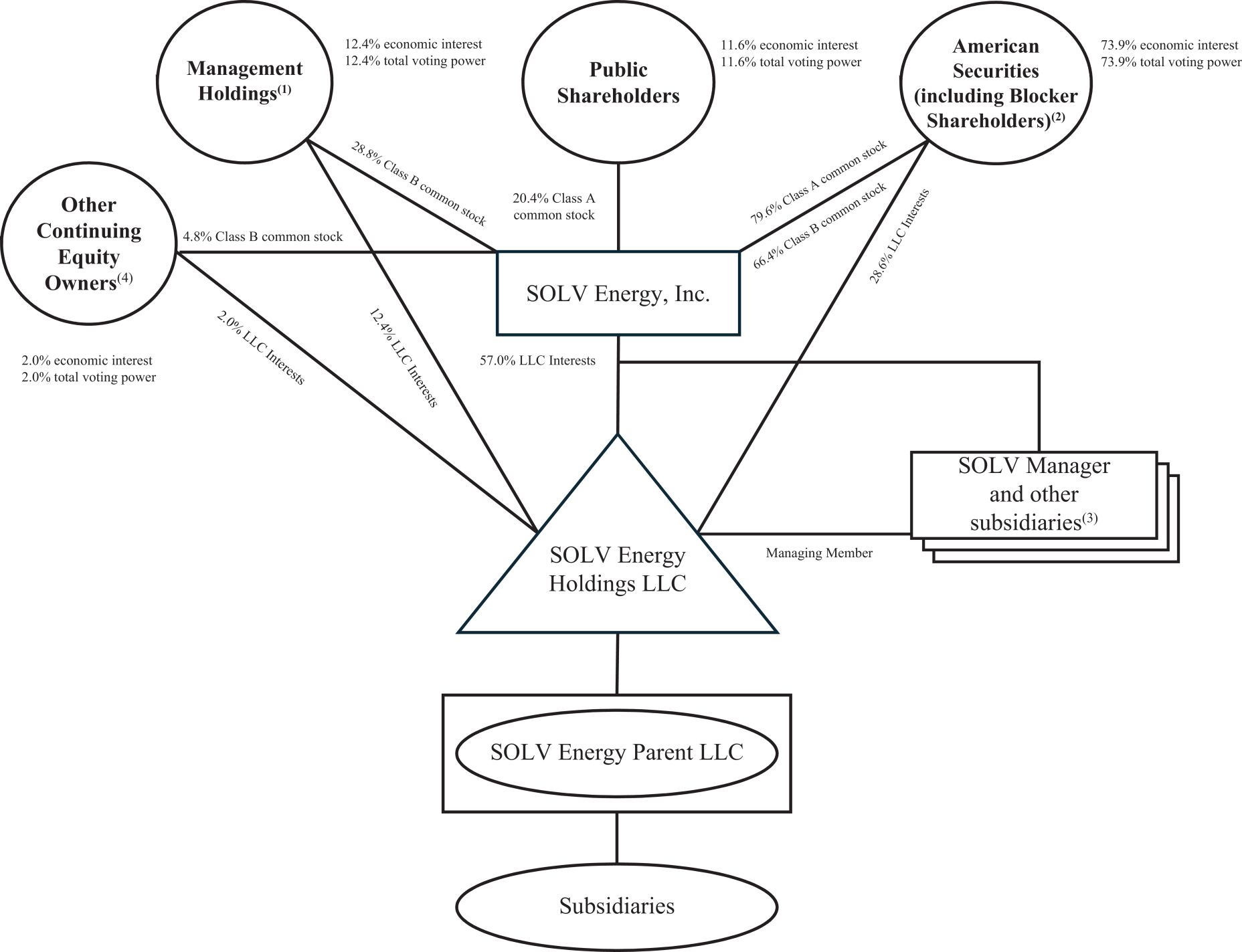
Notes:
| (1) | Management Holdings is an affiliate of, and controlled by, American Securities. All economic interests in Management Holdings are owned by Management Holders. American Securities does not own any of the economic interests in Management Holdings. |
| (2) | Excluding Management Holdings. |
| (3) | SOLV Manager is the sole manager of SOLV Energy Holdings LLC and is able to control all of the business affairs and decision-making of SOLV Energy Holdings LLC without the approval of any other member (other than limited circumstances in which consent or determination of a member or members is required). See “Certain Relationships and Related Party Transactions—SOLV Energy Holdings LLC Agreements—SOLV Energy Holdings LLC Agreement in Effect Upon Consummation of the Transaction.” |
| (4) | Excluding American Securities and Management Holdings. |
Through our control of the sole managing member of SOLV Energy Holdings LLC, we operate and control all of the business and affairs of SOLV Energy Holdings LLC and, through SOLV Energy Holdings LLC and its direct and indirect subsidiaries, conduct our business. As a result, we consolidate SOLV Energy Holdings LLC and record a significant non-controlling interest in a consolidated entity in our consolidated financial statements for the economic interest in SOLV Energy Holdings LLC held by the Continuing Equity Owners.
Incorporation of SOLV Energy, Inc.
SOLV Energy, Inc., the issuer of the Class A common stock offered by this prospectus, was incorporated as a Delaware corporation on April 1, 2025. SOLV Energy, Inc. did not engage in any material business or other
72
Table of Contents
activities except in connection with its formation and the IPO Transactions. The amended and restated certificate of incorporation of SOLV Energy, Inc. authorizes two classes of common stock, Class A common stock and Class B common stock, each having the terms described in “Description of Capital Stock.”
Amendment and Restatement of the SOLV Energy Holdings LLC Agreement
In connection with the IPO Transactions, the limited liability company agreement of SOLV Energy Holdings LLC was amended and restated to, among other things, recapitalize its then-existing capital structure into LLC Interests and provide for a right of redemption of LLC Interests in exchange for, at our election, shares of our Class A common stock or cash. See “Certain Relationships and Related Person Transactions—SOLV Energy Holdings LLC Agreements.”
Tax Receivable Agreement
In connection with the IPO Transactions, we entered into the Tax Receivable Agreement with the TRA Participants that provides for cash payments to the TRA Participants equal to 85% of the tax benefits, if any, that we actually realize or in certain circumstances are deemed to realize as a result of certain tax attributes (calculated using certain assumptions). We are required to make payments to the TRA Participants under the Tax Receivable Agreement even if all of the Continuing Equity Owners exchange or redeem their remaining LLC Interests, and the payments under the Tax Receivable Agreement are not conditioned upon continued ownership of our stock by any TRA Participant. The payment obligations under the Tax Receivable Agreement are obligations of SOLV Energy, Inc. and not of SOLV Energy Holdings LLC. We expect that the amount of the cash payments we are required to make under the Tax Receivable Agreement will be substantial. For a description of the terms of the Tax Receivable Agreement, see “Certain Relationships and Related Person Transactions—Tax Receivable Agreement.”
73
Table of Contents
USE OF PROCEEDS
We estimate that the net proceeds to us from our sale of 6,814,819 shares of Class A common stock in this offering will be approximately $ million, after deducting underwriting discounts and commissions and estimated expenses payable by us in connection with this offering. The underwriters also have an option to purchase up to an additional 1,022,222 shares of Class A common stock from us. We estimate that the net proceeds to us, if the underwriters exercise their right to purchase the maximum of 1,022,222 additional shares of Class A common stock from us, will be approximately $ million, after deducting underwriting discounts and commissions and estimated expenses payable by us in connection with this offering.
We intend to use the net proceeds that we receive from this offering to purchase 6,814,819 LLC Interests (or 7,837,041 LLC Interests if the underwriters exercise in full their option to purchase additional shares of Class A common stock) from the Redeeming Holders at a price per LLC Interest equal to the public offering price of our Class A common stock, less the underwriting discounts and commissions.
We will not receive any proceeds from the sale of our Class A common stock by the selling stockholders. We will, however, bear the costs associated with the sale of shares of Class A common stock by the selling stockholders, other than underwriting discounts and commissions. SOLV Energy Holdings LLC will bear or reimburse us for the expenses incurred in connection with this offering, which we estimate to be approximately $2.0 million. For more information, see “Principal and Selling Stockholders” and “Underwriting.”
74
Table of Contents
DIVIDEND POLICY
We do not currently intend to pay cash dividends on our Class A common stock in the foreseeable future. However, in the future, subject to the factors described below and our future liquidity and capitalization, we may change this policy and choose to pay dividends. Any determination to pay dividends in the future will be at the discretion of our board of directors and will depend upon our results of operations, cash requirements, financial condition, contractual restrictions, restrictions imposed by applicable laws and other factors that our board of directors may deem relevant.
Our ability to pay dividends is currently subject to the restrictions specified by the credit agreement governing the Revolving Credit Facility and may be further restricted by any future indebtedness we incur.
We are a holding company that does not conduct any business operations of our own and has no material assets other than its direct and indirect ownership of LLC Interests. As a result, our ability to pay dividends on our Class A common stock, if our board of directors determines to do so, is dependent upon the ability of SOLV Energy Holdings LLC to pay cash dividends and distributions to us. SOLV Energy Holdings LLC’s ability to pay cash dividends and distributions to us is currently restricted by the terms of Revolving Credit Facility and may be further restricted by any future indebtedness we may incur. See “Description of Material Indebtedness.”
If SOLV Energy Holdings LLC makes such distributions, the holders of LLC Interests will be entitled to receive equivalent distributions from SOLV Energy Holdings LLC. However, because we must pay taxes, make payments under the Tax Receivable Agreement and pay our expenses, amounts ultimately distributed as dividends to holders of our Class A common stock would be expected to be less on a per share basis than the amounts distributed by SOLV Energy Holdings LLC to the other holders of LLC Interests on a per unit basis, even if we were to pay cash dividends on our Class A common stock. See “Certain Relationships and Related Person Transactions.”
Under the SOLV Energy Holdings LLC Agreement, SOLV Energy Holdings LLC is generally required from time to time to make pro rata distributions in cash to us and the other holders of LLC Interests at an assumed tax rate (based on the highest combined marginal rate applicable to individuals) in amounts that are at least sufficient to cover the income taxes payable on our and the other LLC Interest holders’ respective allocable shares of the taxable income of SOLV Energy Holdings LLC. We may receive tax distributions significantly in excess of our tax liabilities and obligations to make payments under the Tax Receivable Agreement. Our board of directors, in its sole discretion, will make any determination from time to time with respect to the use of any such excess cash so accumulated, which may include, among other uses, funding repurchases of Class A common stock; acquiring additional newly issued LLC Interests from SOLV Energy Holdings LLC at a per unit price determined by reference to the market value of the Class A common stock; paying dividends, which may include special dividends, on its Class A common stock; or any combination of the foregoing. We have no obligation to distribute such cash (or other available cash) to our stockholders. We also may, if necessary, undertake ameliorative actions, which may include pro rata or non-pro rata reclassifications, combinations, subdivisions or adjustments of outstanding LLC Interests, to maintain a one-to-one ratio between LLC Interests and shares of Class A common stock. See “Risk Factors—Risks Related to Our Organizational Structure—Our principal asset is our direct or indirect interest in SOLV Energy Holdings LLC and, as a result, we depend on distributions from SOLV Energy Holdings LLC to pay our taxes and expenses, including payments under the Tax Receivable Agreement. SOLV Energy Holdings LLC’s ability to make such distributions may be subject to various limitations and restrictions.”
75
Table of Contents
CAPITALIZATION
The following table sets forth our cash and cash equivalents and our capitalization as of March 31, 2026:
| • | on an actual basis; and |
| • | on an as adjusted basis to give effect to this offering and the use of proceeds therefrom as described under “Use of Proceeds.” |
The following table should be read in conjunction with “Use of Proceeds,” “Management’s Discussion and Analysis of Financial Condition and Results of Operations,” “Description of Material Indebtedness,” “Description of Capital Stock” and the consolidated financial statements and notes thereto appearing elsewhere in this prospectus.
| As of March 31, 2026 | ||||||||
| Actual | As Adjusted | |||||||
| (in thousands) | ||||||||
| Cash and cash equivalents |
$ | 384,911 | $ | 382,911 | ||||
|
|
|
|
|
|||||
| Long-term debt(1): |
||||||||
| Revolving Credit Facility(2) |
— | — | ||||||
| Equipment financing, long-term |
19,703 | 19,703 | ||||||
| Total long-term debt |
$ | 19,703 | $ | 19,703 | ||||
|
|
|
|
|
|||||
| Members’ / Stockholders’ equity(3): |
||||||||
| Class A common stock, $0.0001 par value; 1,250,000,000 shares authorized, 115,348,571 shares issued and outstanding, actual; 1,250,000,000 shares authorized, 122,163,390 shares issued and outstanding, as adjusted; |
12 | 13 | ||||||
| Class B common stock, $0.0001 par value; 100,000,000 shares authorized, 87,128,137 shares issued and outstanding, actual 100,000,000 shares authorized, 80,228,236 shares issued and outstanding, as adjusted; |
9 | 8 | ||||||
| Additional paid-in capital |
455,857 | 487,306 | ||||||
| Accumulated other comprehensive (loss) income |
||||||||
| Accumulated deficit |
(23,358 | ) | (23,358 | ) | ||||
| Non-controlling interest |
378,704 | 348,145 | ||||||
|
|
|
|
|
|||||
| Total stockholders’ equity |
811,224 | 812,114 | ||||||
|
|
|
|
|
|||||
| Total capitalization |
$ | 830,927 | $ | 831,817 | ||||
|
|
|
|
|
|||||
| (1) | For a description of our debt, see “Description of Material Indebtedness.” |
| (2) | Total availability under the Revolving Credit Facility as of March 31, 2026 was $191.5 million (net of $8.5 million of outstanding letters of credit). |
| (3) | As adjusted share amounts give effect to (i) the Offering Transactions and (ii) forfeitures of LLC Interests and corresponding shares of Class B common stock that occurred subsequent to March 31, 2026. |
76
Table of Contents
UNAUDITED PRO FORMA CONDENSED CONSOLIDATED FINANCIAL INFORMATION
The following unaudited pro forma consolidated statement of operations for the three months ended March 31, 2026 and the year ended December 31, 2025 give effect to the pro forma adjustments related to the IPO Transactions, which we refer to as “IPO Transaction Adjustments”, and the Offering Transactions, which we refer to as the “Offering Adjustments.” We refer to the IPO Transaction Adjustments and the Offering Adjustments collectively as the “IPO Transactions and Offering”. The unaudited pro forma consolidated statement of operations for the three months ended March 31, 2026 and the year ended December 31, 2025 give pro forma effect to the IPO Transactions and Offering as if they had occurred on January 1, 2025. The unaudited pro forma balance sheet information as of March 31, 2026 gives effect to the Offering Adjustments as if they had occurred on March 31, 2026. The unaudited pro forma financial information has been prepared by our management and is based on SOLV Energy Holdings LLC’s historical financial statements for the historical financial statements prior to the IPO Transactions and SOLV Energy, Inc.’s historical financial statements for the period subsequent to the IPO Transactions and the assumptions and adjustments described in the notes to the unaudited pro forma financial information below.
Our historical financial information (i) as of March 31, 2026 and for the three months ended March 31, 2026 has been derived from SOLV Energy, Inc.’s consolidated financial statements and accompanying notes included elsewhere in this prospectus, and (ii) for the year ended December 31, 2025 has been derived from SOLV Energy Holdings LLC’s audited consolidated financial statements and accompanying notes included elsewhere in this this prospectus. Because the IPO Transactions were completed on February 12, 2026, the historical financial information for the year ended December 31, 2025 reflects the results of SOLV Energy Holdings LLC prior to the completion of the IPO Transactions, and the historical financial information for the three months ended March 31, 2026 reflects the consolidated results of SOLV Energy, Inc. subsequent to the completion of the IPO Transactions, including the pre-IPO Transactions stub period from January 1, 2026 through February 12, 2026.
We based the pro forma adjustments on available information and on assumptions that we believe are reasonable under the circumstances in order to reflect, on a pro forma basis, the impact of the relevant transactions on the historical financial information of SOLV Energy Holdings LLC and SOLV Energy, Inc. See the notes to unaudited pro forma financial information below for a discussion of assumptions made. The unaudited pro forma financial information does not purport to be indicative of our results of operations or financial position had the relevant transactions occurred on the dates assumed and does not project our results of operations or financial position for any future period or date.
The IPO Transaction Adjustments are described in the notes to the unaudited pro forma consolidated financial information, with $ amounts in thousands, and primarily include:
| • | the entry into the SOLV Energy Holdings LLC Agreement and the entry into the Tax Receivable Agreement; |
| • | the recognition of a non-controlling interest in SOLV Energy Holdings LLC held by the Continuing Equity Owners, which is exchangeable for shares of Class A common stock on a one-for-one basis in accordance with the terms of the SOLV Energy Holdings LLC Agreement; |
| • | provision for federal and state income taxes of SOLV Energy, Inc. for the three months ended March 31, 2026 and the year ended December 31, 2025 calculated using a U.S. federal income tax rate of 21.0%; |
| • | the issuance of shares of our Class A common stock to the purchasers in the IPO in exchange for net proceeds of approximately $552,500, after deducting underwriting discounts and commissions but before offering expenses; |
| • | the application directly and indirectly by SOLV Energy, Inc. of the net proceeds from the IPO to acquire LLC Interests from SOLV Energy Holdings LLC at a purchase price per LLC Interest equal to the IPO price per share of Class A common stock, net of underwriting or placement agent discounts and/or commissions; |
77
Table of Contents
| • | the entry into the Revolving Credit Facility; |
| • | the application by SOLV Energy Holdings LLC of a portion of the proceeds from the sale of LLC Interests to SOLV Energy, Inc. in connection with the IPO to (i) pay fees and expenses of approximately $11,506 in connection with the IPO and (ii) repay in full the outstanding indebtedness under the Prior Term Loans; and |
| • | the redemption of the units held by a minority investor in SOLV Energy Parent Holdings LP. |
The Offering Adjustments are described in the notes to the unaudited pro forma consolidated financial information, with $ amounts in thousands, and primarily include:
| • | the issuance of 6,814,819 shares of our Class A common stock to the purchasers in this offering in exchange for net proceeds of approximately $253,448, assuming that the shares are offered at $38.44 (which is the last reported sale price of our Class A common stock on May 22, 2026), after deducting underwriting discounts and commissions but before offering expenses; |
| • | the sale of 7,185,181 shares of our Class A common stock by selling stockholders. We will bear the costs associated with the sale of Class A common stock by the selling stockholders, other than the underwriting discounts and commissions; and |
| • | the application by SOLV Energy, Inc. of the net proceeds from this offering to acquire LLC Interests from the Redeeming Holders at a purchase price per LLC Interest equal to the public offering price per share of Class A common stock, net of underwriting or placement agent discounts and/or commission, as set forth in “Use of Proceeds,” and the cancellation of a corresponding number of shares of Class B common stock. |
As a new public company, we are in the process of implementing additional procedures and processes for the purpose of addressing the standards and requirements applicable to public companies. We expect to incur additional annual expenses related to these procedures and processes and, among other things, additional directors’ and officers’ liability insurance, director fees, reporting requirements of the SEC, transfer agent fees, hiring additional accounting, legal, and administrative personnel, increased auditing and legal expenses, and other related costs. Due to the scope and complexity of these activities, the amount of these costs could increase or decrease materially and are based on subjective estimates and assumptions that cannot be factually supported. We have not included any pro forma adjustments related to these costs.
Because SOLV Energy, Inc. was formed on April 1, 2025 and prior to the IPO had no material assets or results of operations until the completion of the IPO, its historical financial information is not included in the unaudited pro forma consolidated financial information for the year ended December 31, 2025.
The unaudited pro forma consolidated financial information is provided for informational purposes only and is not necessarily indicative of the operating results that would have occurred if the IPO Transactions and Offering had been completed as of the dates set forth above, nor is it indicative of our future results. Additionally, the unaudited pro forma consolidated financial information does not give effect to the potential impact of any anticipated synergies, operating efficiencies, or cost savings that may result from the IPO Transactions and Offering or any integration costs that will not have a continuing impact.
The unaudited pro forma consolidated financial information should be read together with “Our Organizational Structure,” “Capitalization,” “Management’s Discussion and Analysis of Financial Condition and Results of Operations” and our historical financial statements and related notes thereto included elsewhere in this prospectus.
78
Table of Contents
UNAUDITED PRO FORMA CONSOLIDATED
STATEMENT OF OPERATIONS
For the Three Months Ended March 31, 2026
| Historical SOLV Energy Inc. |
IPO Transaction Adjustments |
As Adjusted Before Offering |
Offering Adjustments |
Pro Forma SOLV Energy Inc. |
||||||||||||||||||||||||||||
| (in thousands, except per share data) | ||||||||||||||||||||||||||||||||
| Revenue |
$ | 676,805 | $ | — | $ | 676,805 | $ | — | $ | 676,805 | ||||||||||||||||||||||
| Cost of revenue |
557,732 | — | 557,732 | — | 557,732 | |||||||||||||||||||||||||||
|
|
|
|
|
|
|
|
|
|
|
|||||||||||||||||||||||
| Gross profit |
119,073 | — | 119,073 | — | 119,073 | |||||||||||||||||||||||||||
|
|
|
|
|
|
|
|
|
|
|
|
|
|||||||||||||||||||||
| Selling, general and administrative expenses |
111,375 | (49,042 | ) | (5 | ) | 62,333 | — | 62,333 | ||||||||||||||||||||||||
| Amortization expense |
14,879 | — | 14,879 | — | 14,879 | |||||||||||||||||||||||||||
|
|
|
|
|
|
|
|
|
|
|
|||||||||||||||||||||||
| Total operating expenses |
126,254 | (49,042 | ) | 77,212 | — | 77,212 | ||||||||||||||||||||||||||
|
|
|
|
|
|
|
|
|
|
|
|||||||||||||||||||||||
| Operating income (loss) |
(7,181 | ) | 49,042 | 41,861 | — | 41,861 | ||||||||||||||||||||||||||
| Loss on debt extinguishment |
10,688 | (10,688 | ) | (4 | ) | — | — | — | ||||||||||||||||||||||||
| Interest expense |
6,897 | (5,140 | ) | (4 | ) | 1,757 | — | 1,757 | ||||||||||||||||||||||||
| Interest income |
(1,450 | ) | — | (1,450 | ) | — | (1,450 | ) | ||||||||||||||||||||||||
| Other income |
(68 | ) | — | (68 | ) | — | (68 | ) | ||||||||||||||||||||||||
|
|
|
|
|
|
|
|
|
|
|
|||||||||||||||||||||||
| Income (loss) before income taxes |
(23,248 | ) | 64,870 | 41,622 | — | 41,622 | ||||||||||||||||||||||||||
| Income tax expense |
4,166 | 2,842 | (1 | ) | 7,008 | 294 | (1 | ) | 7,302 | |||||||||||||||||||||||
|
|
|
|
|
|
|
|
|
|
|
|||||||||||||||||||||||
| Net income |
$ | (27,414 | ) | $ | 62,028 | $ | 34,614 | $ | (294 | ) | $ | 34,320 | ||||||||||||||||||||
|
|
|
|
|
|
|
|
|
|
|
|
|
|||||||||||||||||||||
| Less: net income (loss) attributable to non-controlling interests |
(4,056 | ) | 20,730 | (2 | ) | 16,674 | (175 | ) | (2 | ) | 16,499 | |||||||||||||||||||||
|
|
|
|
|
|
|
|
|
|
|
|||||||||||||||||||||||
| Net income attributable to SOLV Energy, Inc. |
$ | (23,358 | ) | $ | 41,298 | $ | 17,940 | $ | (119 | ) | $ | 17,821 | ||||||||||||||||||||
|
|
|
|
|
|
|
|
|
|
|
|||||||||||||||||||||||
| Pro forma net income per share data: |
||||||||||||||||||||||||||||||||
| Pro forma weighted-average shares of Class A common stock outstanding |
||||||||||||||||||||||||||||||||
| Basic |
$ | 115,348,571 | 122,163,390 | (3 | ) | |||||||||||||||||||||||||||
| Diluted |
$ | 115,348,571 | 203,383,573 | (3 | ) | |||||||||||||||||||||||||||
| Net income per share of Class A common stock: |
||||||||||||||||||||||||||||||||
| Basic |
$ | (0.20 | ) | $ | 0.15 | (3 | ) | |||||||||||||||||||||||||
| Diluted |
$ | (0.20 | ) | $ | 0.15 | (3 | ) | |||||||||||||||||||||||||
See accompanying notes to unaudited pro forma financial information.
79
Table of Contents
UNAUDITED PRO FORMA CONSOLIDATED
STATEMENT OF OPERATIONS
For the Year Ended December 31, 2025
| Historical SOLV Energy Holdings LLC |
IPO Transactions Adjustments |
As Adjusted Before Offering |
Offering Adjustments |
Pro Forma SOLV Energy, Inc. |
||||||||||||||||||||||||||||
| (in thousands, except per share data) | ||||||||||||||||||||||||||||||||
| Revenue |
$ | 2,490,496 | $ | — | $ | 2,490,496 | $ | — | $ | 2,490,496 | ||||||||||||||||||||||
| Cost of revenue |
2,026,263 | — | 2,026,263 | — | 2,026,263 | |||||||||||||||||||||||||||
|
|
|
|
|
|
|
|
|
|
|
|||||||||||||||||||||||
| Gross profit |
464,233 | — | 464,233 | — | 464,233 | |||||||||||||||||||||||||||
|
|
|
|
|
|
|
|
|
|
|
|||||||||||||||||||||||
| Selling, general and administrative expenses |
211,041 | 75,971 | (5 | ) | 287,012 | — | 287,012 | |||||||||||||||||||||||||
| Amortization expense |
57,748 | — | 57,748 | — | 57,748 | |||||||||||||||||||||||||||
|
|
|
|
|
|
|
|
|
|
|
|||||||||||||||||||||||
| Total operating expenses |
$ | 268,789 | $ | 75,971 | $ | 344,760 | $ | — | $ | 344,760 | ||||||||||||||||||||||
|
|
|
|
|
|
|
|
|
|
|
|||||||||||||||||||||||
| Operating income (loss) |
195,444 | (75,971 | ) | 119,473 | — | 119,473 | ||||||||||||||||||||||||||
| Loss on debt extinguishment |
— | 10,688 | (4 | ) | 10,688 | — | 10,688 | |||||||||||||||||||||||||
| Interest expense |
52,730 | (44,862 | ) | (4 | ) | 7,868 | — | 7,868 | ||||||||||||||||||||||||
| Interest income |
(7,156 | ) | — | (7,156 | ) | — | (7,156 | ) | ||||||||||||||||||||||||
| Other income |
(3,476 | ) | — | (3,476 | ) | — | (3,476 | ) | ||||||||||||||||||||||||
|
|
|
|
|
|
|
|
|
|
|
|||||||||||||||||||||||
| Income (loss) before income taxes |
$ | 153,346 | $ | (41,797 | ) | $ | 111,549 | $ | — | $ | 111,549 | |||||||||||||||||||||
| Income tax expense |
3,643 | 17,466 | (1 | ) | 21,109 | 1,084 | (1 | ) | 22,193 | |||||||||||||||||||||||
|
|
|
|
|
|
|
|
|
|
|
|||||||||||||||||||||||
| Net income |
$ | 149,703 | $ | (59,263 | ) | $ | 90,440 | $ | (1,084 | ) | $ | 89,356 | ||||||||||||||||||||
|
|
|
|
|
|
|
|
|
|
|
|||||||||||||||||||||||
| Less: net income attributable to non-controlling interests |
$ | 520 | $ | 38,896 | (2 | ) | $ | 39,416 | $ | 4,802 | (2 | ) | $ | 44,218 | ||||||||||||||||||
|
|
|
|
|
|
|
|
|
|
|
|||||||||||||||||||||||
| Net income attributable to SOLV Energy, Inc. |
$ | 149,183 | $ | (98,159 | ) | $ | 51,024 | $ | (5,886 | ) | $ | 45,138 | ||||||||||||||||||||
|
|
|
|
|
|
|
|
|
|
|
|||||||||||||||||||||||
| Pro forma net income per share data: |
||||||||||||||||||||||||||||||||
| Pro forma weighted average shares of Class A common stock outstanding: |
||||||||||||||||||||||||||||||||
| Basic |
122,163,390 | (3 | ) | |||||||||||||||||||||||||||||
| Diluted |
203,383,573 | (3 | ) | |||||||||||||||||||||||||||||
| Net income per share of Class A common stock: |
||||||||||||||||||||||||||||||||
| Basic |
$ | 0.37 | (3 | ) | ||||||||||||||||||||||||||||
| Diluted |
$ | 0.37 | (3 | ) | ||||||||||||||||||||||||||||
See accompanying notes to unaudited pro forma financial information.
80
Table of Contents
Notes to the Unaudited Pro Forma Consolidated Statements of Operations (Year ended December 31, 2025 and Three Months ended March 31, 2026)
| (1) | SOLV Energy, Inc., is subject to U.S. federal income taxes, in addition to state and local taxes. As a result, the pro forma statement of operations reflects an adjustment to income tax expense for corporate income taxes to reflect a statutory tax rate of 21.0%. For U.S. federal income tax purposes, SOLV Energy Holdings LLC was historically an entity disregarded as separate from SOLV Energy Parent Holdings LP, an entity taxed as a partnership for U.S. federal income tax purposes. In connection with the IPO Transactions, SOLV Energy Holdings LLC became a partnership for U.S. federal income tax purposes and, as a result, its members, including SOLV Energy, Inc., pay income taxes with respect to their allocable shares of its taxable income. |
The pro forma adjustment for income tax expense represents tax expense on income that is taxable in jurisdictions after the IPO Transactions that previously had not been taxable. The adjustment is calculated as pro forma income before income taxes multiplied by the ownership percentage of the controlling interest and multiplied by the statutory tax rate of 21.0%.
| (2) | In connection with the IPO Transactions, our wholly-owned subsidiary was appointed as the sole managing member of SOLV Energy Holdings LLC pursuant to the SOLV Energy Holdings LLC Agreement. As a result, while we own less than 100% of the economic interest in SOLV Energy Holdings LLC, we have, through our direct control of the sole managing member, 100% of the voting power and control the management of SOLV Energy Holdings LLC. Because we manage and operate the business and control the strategic decisions and day-to-day operations of SOLV Energy Holdings LLC and also have a substantial financial interest in SOLV Energy Holdings LLC, we consolidate the financial results of SOLV Energy Holdings LLC, and a portion of our net income (loss) is allocated to non-controlling interests to reflect the entitlement of the Continuing Equity Owners to a portion of SOLV Energy Holdings LLC net income (loss). Following the IPO Transactions, we initially held approximately 57.0% of the outstanding LLC Interests and following the consummation of this offering we will hold approximately 60.4% of the outstanding LLC Interest (or approximately 60.9% if the underwriters exercise their option to purchase additional shares of common stock in full), and the remaining LLC Interests will be held by the Continuing Equity Owners. Net income attributable to the non-controlling interests will represent approximately 39.6% of income before income taxes. |
| (3) | Pro forma basic net income per share of Class A common stock is computed by dividing the pro forma net income available to Class A common stockholders by the pro forma weighted-average shares of Class A common stock outstanding during the period. Pro forma diluted net income per share of Class A common stock is computed by adjusting the pro forma net income available to Class A common stockholders and the pro forma weighted-average shares of Class A common stock outstanding to give effect to potentially dilutive securities. |
| Three Months Ended March 31, 2026 |
Twelve Months Ended December 31, 2025 |
|||||||
| Pro forma net income per share of Class A |
(in thousands) | |||||||
| Numerator: |
||||||||
| Pro forma net income attributable to the issuer’s common stockholders (basic) |
$ | 17,821 | $ | 45,138 | ||||
| Pro forma net income attributable to the issuer’s common stockholders (diluted) |
$ | 30,855 | $ | 75,680 | ||||
| Denominator: |
||||||||
| Pro forma weighted average of shares of common stock outstanding (basic) |
122,163,390 | 122,163,390 | ||||||
| Pro forma weighted average of shares of common stock outstanding (diluted) |
203,383,573 | 203,383,573 | ||||||
| Pro forma basic net income per share |
$ | 0.15 | $ | 0.37 | ||||
| Pro forma diluted net income per share |
$ | 0.15 | $ | 0.37 | ||||
81
Table of Contents
| (4) | Reflects an adjustment to give effect to SOLV Energy, Inc. (i) entering into a new senior secured revolving credit facility, (ii) using the net proceeds from the IPO to repay in full the outstanding indebtedness under the Prior Credit Facilities, and (iii) the recognition of a non-recurring loss on debt extinguishment of approximately $10,688 related to the write-off of unamortized deferred financing costs and prepayment penalty associated with the Prior Credit Facilities. |
The adjustments below reflect the elimination of historical interest expense related to the existing Term Loans, as well as the incurrence of interest expense related to the Revolving Credit Facility:
| Three Months Ended March 31, 2026 |
Twelve Months Ended December 31, 2025 |
|||||||
| (in thousands) | ||||||||
| Interest expense under the Prior Term Loans |
5,466 | 46,165 | ||||||
| Interest expense under the new senior secured revolving credit facility |
(326 | ) | (1,303 | ) | ||||
|
|
|
|
|
|||||
| Total |
5,140 | 44,862 | ||||||
|
|
|
|
|
|||||
| (5) | Reflects an adjustment to give effect to (i) a one-time, non-cash stock-based compensation expense of approximately $52,270 recognized in connection with the modification of certain pre-IPO equity awards that occurred upon the consummation of the IPO, which is not deductible for income tax purposes, and (ii) incremental non-cash stock-based compensation expense of approximately $3,228 and $23,701 for the three months ended March 31, 2026 and year ended December 31, 2025, respectively, related to the ongoing recognition of modified pre-IPO equity awards and new equity awards granted under the 2026 Plan in connection with the IPO, including stock options issued upon the conversion of legacy Class C profits interests and restricted stock awards granted to employees, each to be recognized over the remaining vesting periods. Impacts from the IPO Transaction Adjustments will be reflected in “Selling, general and administrative expenses.” |
82
Table of Contents
UNAUDITED PRO FORMA CONSOLIDATED BALANCE SHEET
(AS OF March 31, 2026)
| SOLV Energy, Inc | Offering Adjustments |
Pro Forma SOLV Energy, Inc. |
||||||||||||
| ($ in thousands, except per share data) | ||||||||||||||
| Assets |
||||||||||||||
| Current Assets: |
||||||||||||||
| Cash and cash equivalents |
$ | 384,911 | $ | (2,000 | ) | (1) | $ | 382,911 | ||||||
| Accounts receivable, net |
285,039 | — | 285,039 | |||||||||||
| Contract assets |
157,875 | — | 157,875 | |||||||||||
| Capitalized project development costs |
13,297 | — | 13,297 | |||||||||||
| Prepaid and other current assets |
105,528 | — | 105,528 | |||||||||||
|
|
|
|
|
|
|
|||||||||
| Total current assets |
946,650 | (2,000 | ) | 944,650 | ||||||||||
| Property and equipment, net |
116,137 | — | 116,137 | |||||||||||
| Operating lease right-of-use assets |
7,598 | — | 7,598 | |||||||||||
| Deferred tax asset |
101,302 | 64,002 | (2), (4) | 165,304 | ||||||||||
| Goodwill |
429,035 | — | 429,035 | |||||||||||
| Intangible assets, net |
347,511 | — | 347,511 | |||||||||||
| Other long-term assets |
8,373 | — | 8,373 | |||||||||||
|
|
|
|
|
|
|
|||||||||
| Total Assets |
$ | 1,956,606 | $ | 62,002 | $ | 2,018,608 | ||||||||
|
|
|
|
|
|
|
|||||||||
| Liabilities and Stockholders’ Equity |
||||||||||||||
| Current Liabilities: |
||||||||||||||
| Accounts payable and accrued expenses |
$ | 524,898 | $ | — | $ | 524,898 | ||||||||
| Contract liabilities |
346,295 | — | 346,295 | |||||||||||
| Current portion of equipment financing |
6,617 | — | 6,617 | |||||||||||
| Current portion of lease liabilities |
14,461 | — | 14,461 | |||||||||||
| Current portion of long-term debt |
|
— |
|
— |
|
— |
| |||||||
|
|
|
|
|
|
|
|||||||||
| Total current liabilities |
892,271 | — | 892,271 | |||||||||||
|
|
|
|
|
|
|
|||||||||
| Long-Term liabilities: |
||||||||||||||
| Equipment financing, long-term |
19,703 | — | 19,703 | |||||||||||
| Lease liabilities, long-term |
39,742 | — | 39,742 | |||||||||||
| Tax receivable liabilities |
172,344 | 61,112 | (2), (4) | 233,456 | ||||||||||
| Other long-term liabilities |
21,322 | — | 21,322 | |||||||||||
|
|
|
|
|
|
|
|||||||||
| Total liabilities |
1,145,382 | 61,112 | 1,206,494 | |||||||||||
|
|
|
|
|
|
|
|||||||||
| Stockholders’ Equity |
||||||||||||||
| Class A common stock, $0.0001 par value; 1,250,000,000 shares authorized, 122,163,390 shares issued and outstanding, pro forma |
12 | 1 | (1) | 13 | ||||||||||
| Class B common stock, $0.0001 par value; 100,000,000 shares authorized, 80,228,236 shares issued and outstanding, pro forma |
9 | (1 | ) | (7) | 8 | |||||||||
| Additional paid-in capital |
455,857 | 31,449 | (6) | 487,306 | ||||||||||
| Accumulated deficit |
(23,358 | ) | — | (23,358 | ) | |||||||||
| Total Stockholders’ equity to SOLV Energy, Inc. |
432,520 | 31,449 | 463,969 | |||||||||||
| Non-controlling interest |
378,704 | (30,559 | ) | (5) | 348,145 | |||||||||
|
|
|
|
|
|
|
|||||||||
| Total liabilities and Stockholders’ Equity |
$ | 1,956,606 | $ | 62,002 | $ | 2,018,608 | ||||||||
|
|
|
|
|
|
|
|||||||||
See accompanying notes to unaudited pro forma financial information.
83
Table of Contents
Notes to Unaudited Pro Forma Consolidated Balance Sheet (as of March 31, 2026)
| (1) | We estimate that our net proceeds from this offering will be approximately $253,448, after deducting underwriting discounts and commissions of approximately $8,514, based on a public offering price of $38.44 per share and assuming the underwriters’ option to purchase additional shares of Class A common stock is not exercised. If the underwriters exercise their option to purchase additional shares of Class A common stock in full, we expect to receive approximately $291,465 of net proceeds based on a public offering price of $38.44 per share. |
We estimate that the offering expenses (other than the underwriting discount and commissions) will be approximately $2,000. All of such offering expense will be paid for or otherwise borne by SOLV Energy Holdings LLC.
SOLV Energy Holdings LLC currently intends to use the proceeds from the issuance of LLC Interests to SOLV Energy, Inc. to (i) pay fees and expenses of approximately $2,000 in connection with this offering and (ii) as otherwise set forth in “Use of Proceeds.” See “Use of Proceeds.”
| (2) | We are subject to U.S. federal, state and local income taxes and will file income tax returns for U.S. federal and certain state and local jurisdictions. This adjustment reflects the recognition of deferred taxes in connection with the Offering Transaction assuming the federal rates currently in effect and the highest statutory rates apportioned to each state and local jurisdiction. We have recorded a pro forma deferred tax asset adjustment of $64,002 (or $72,130 if the underwriters exercise in full their option to purchase additional shares of Class A common stock). The deferred tax asset includes (i) $49,845 related to temporary differences in the book basis as compared to the tax basis of our investment in SOLV Energy Holdings LLC and (ii) $14,157 related to tax benefits from future deductions attributable to payments under the Tax Receivable Agreements as described further in Note (4) below. To the extent we determine it is more likely than not that we will not realize the full benefit represented by the deferred tax asset, we will record an appropriate valuation allowance based on an analysis of the objective or subjective negative evidence. |
| (3) | We estimate $2,000 of additional offering costs will have been incurred in connection with the Offering Adjustments. |
| (4) | In connection with the IPO Transactions, we entered into the Tax Receivable Agreement with SOLV Energy Holdings LLC and each of the TRA Participants, which provides for the payment by us to the TRA Participants of 85% of the tax benefits, if any, that we actually realize, or are deemed to realize (calculated using certain assumptions), pursuant to U.S. federal, state and local income tax laws, as a result of (i) our allocable share of tax basis acquired as a result of the acquisition of LLC Interests in connection with the IPO Transactions and increases to such allocable share of tax basis as a result of any future contribution to SOLV Energy Holdings LLC by us or our subsidiaries (except to the extent such contribution is treated as a direct purchase of LLC Interests from another SOLV Energy Holdings LLC member for U.S. federal income tax purposes); (ii) our utilization of certain tax attributes of the Blocker Companies (including net operating losses and the Blocker Companies’ allocable share of tax basis) as a result of the contributions of the Blocker Companies to us; (iii) increases in tax basis of assets of SOLV Energy Holdings LLC and its subsidiaries (“Basis Adjustments”) or increases in our allocable share of tax basis, in each case, resulting from acquisitions of LLC Interests from Continuing Equity Owners, redemptions or exchanges (or deemed exchanges in certain circumstances) of LLC Interests for Class A common stock or cash, including in connection with this offering, or distributions (or deemed distributions) to a holder of LLC Interests; and (iv) certain tax benefits (such as interest deductions) arising from payments made under the Tax Receivable Agreement. |
We will record an additional $61,112 liability under the Tax Receivable Agreement (or $70,279 if the underwriters exercise in full their option to purchase additional shares of Class A common stock) based on our estimate of the aggregate amount that we will pay to the Redeeming Holders under the Tax Receivable Agreement as a result of the redemption of LLC Interests in connection with this offering. The net deferred tax
84
Table of Contents
asset adjustment of $64,002 resulting from this offering and the $61,112 adjustment related to the Tax Receivable Agreement liability are based on the following assumptions: (i) only exchanges associated with this offering, (ii) a share price equal to $38.44, (iii) an estimated statutory tax rate of 21.0%, (iv) we will have sufficient taxable income to fully utilize the tax benefits, (v) no material changes in tax law, and (vi) future Tax Receivable Agreement payments. The net impact of the adjustments to net deferred taxes and the Tax Receivable Agreement liability of $2,890 has been recorded as a decrease to additional paid-in capital, as these adjustments arise from equity transactions of the Company.
Amounts payable under the Tax Receivable Agreement are contingent upon, among other things, (i) generation of future taxable income of SOLV Energy, Inc. over the term of the Tax Receivable Agreement and (ii) future changes in tax laws. If we do not generate sufficient taxable income in the aggregate over the term of the Tax Receivable Agreement to utilize the tax benefits, then we would not be required to make the related Tax Receivable Agreement payments.
| (5) | Upon completion of the Offering Transaction, and the application of the net proceeds, SOLV Energy, Inc. will hold 122,163,390 LLC Interests, constituting 60.4% of the outstanding economic interests in SOLV Energy Holdings LLC (or 123,185,612 LLC Interests, constituting 60.9% of the outstanding economic interests in SOLV Energy Holdings LLC if the underwriters exercise their option to purchase additional shares of Class A common stock in full). See “Our Organizational Structure.” |
Represents an adjustment to equity reflecting (i) par value for Class A common stock and (ii) an increase of $30,559 to additional paid-in capital to reallocate a portion of non-controlling interests in SOLV Energy Holdings LLC to SOLV Energy, Inc. stockholders’ equity.
| (6) | The following table is a reconciliation of the adjustments impacting additional paid-in-capital: |
| Net adjustment from recognition of deferred tax and tax receivable liabilities |
$ | 2,890 | ||
| Gross proceeds from offering of Class A common stock |
261,961 | |||
| Payment of underwriting discounts and commissions in connection with this offering |
(8,514 | ) | ||
| Payment for offering costs |
(2,000 | ) | ||
| Increase in APIC from reallocation of non-controlling interest in SOLV Energy Holdings LLC to SOLV Energy Inc. |
30,559 | |||
| Redemption of Class B Common Stock |
(253,447 | ) | ||
|
|
|
|||
| Total |
$ | 31,449 | ||
|
|
|
| (7) | Under the SOLV Energy Holdings LLC Agreement, holders of vested LLC interests (other than SOLV Energy, Inc. and our subsidiaries), including the Continuing Equity Owners (other than, prior to the Management Elective Redemption Date, Management Holders), may at each of their options require SOLV Energy Holdings LLC to redeem all or a portion of their vested SOLV Energy Holdings LLC interests on a quarterly basis (subject to certain limitations) and at other times under certain permitted circumstances, in each case, in exchange for, at our election, newly issued shares of our Class A common stock on a one-for-one basis or a cash payment using proceeds from a substantially contemporaneous follow-on offering or secondary offering equal to the price per share of our Class A common stock, net of underwriting discounts and/or commissions, sold in such offering for each vested LLC interest so redeemed, in each case, in accordance with the terms of the SOLV Energy Holdings LLC Agreement; provided that at our election, we may effect a direct exchange by SOLV Energy, Inc. for Class A common stock or for cash, as applicable, for those LLC Interests. See “Our Organizational Structure.” |
85
Table of Contents
MANAGEMENT’S DISCUSSION AND ANALYSIS OF FINANCIAL CONDITION
AND RESULTS OF OPERATIONS
The following is a discussion and analysis of our financial condition and results of operations as of, and for, the periods presented. This discussion refers to the consolidated financial statements of SOLV Energy Holdings LLC and its subsidiaries. You should read the following discussion and analysis of our financial condition and results of operations together with the sections entitled “About This Prospectus—Presentation of Financial Results,” “Prospectus Summary—Summary Historical and Pro Forma Condensed Consolidated Financial and Other Data,” “Risk Factors,” “Cautionary Note Regarding Forward-Looking Statements” and our consolidated financial statements and the related notes thereto included elsewhere in this prospectus. This discussion and analysis contains forward-looking statements, including statements regarding industry outlook, our expectations for the future of our business and our liquidity and capital resources as well as other non-historical statements. These statements are based on current expectations and are subject to numerous risks and uncertainties, including but not limited to the risks and uncertainties described in “Risk Factors” and “Cautionary Note Regarding Forward-Looking Statements.” Our actual results may differ materially from those contained in or implied by these forward-looking statements. We derived the summary consolidated statement of operations data for the years ended December 31, 2025, 2024 and 2023, and the consolidated balance sheet data as of December 31, 2025, from our audited consolidated financial statements included elsewhere in this prospectus. We derived the summary consolidated statements of operations data for the three months ended March 31, 2026 and 2025 and the consolidated balance sheet data as of March 31, 2026 from our unaudited condensed consolidated financial statements included elsewhere in this prospectus.
Overview
We are a leading provider of infrastructure services to the power industry, including engineering, procurement, construction, testing, commissioning, operations, maintenance and repowering. We specialize in designing, building and maintaining utility-scale solar and battery storage projects and related T&D infrastructure. Our customers include project developers, independent power producers and utilities. Our new construction projects are typically executed over 12 to 18 months pursuant to LNTP agreements followed by a lump-sum EPC contract. We provide O&M services pursuant to long-term contracts that typically obligate the customer to pay us a fixed fee for operations and routine preventative maintenance and additional fees for corrective maintenance on a time and materials basis.
Recent Developments
IPO
We completed the IPO on February 12, 2026, in which we issued and sold 23,575,000 shares of the Class A common stock at a price of $25.00 per share, resulting in gross proceeds to us approximately of $589.4 million and net proceeds to us of approximately $552.5 million, after deducting the underwriting discounts and commissions of approximately $36.9 million.
The IPO Transactions
The historical results of operations discussed in this prospectus are those of SOLV Energy Holdings LLC prior to the completion of the IPO Transactions. As a result, the historical consolidated financial data may not give you an accurate indication of what our actual results would have been if the IPO Transactions had been completed at the beginning of the periods presented or of what our future results of operations are likely to be.
Key Factors Affecting Our Performance
Our revenues, profit, margins and other results of operations can be influenced by a variety of factors in any given period, including those described under the section entitled “Risk Factors” included elsewhere in this
86
Table of Contents
prospectus, and those factors have caused fluctuations in our results in the past and are expected to cause fluctuations in our results of operations in the future. Additional information with respect to such factors is provided below.
Seasonal and Severe Weather Conditions. The results of our business in a given period can be impacted by seasonal and adverse weather conditions, severe weather events, natural disasters or other emergencies. Such events include, among other things, heavy or prolonged snowfall or rainfall, hurricanes, tropical storms, tornadoes, floods, blizzards, extreme temperatures, wildfires and earthquakes. Adverse weather conditions can affect project margins in a given period. For example, extended periods of rain or snowfall can negatively affect revenue and project margins due to reduced productivity from projects being delayed or temporarily halted.
Climate change has the potential to increase the frequency and extremity of severe weather events. These conditions and events can negatively impact our financial results due to, among other things, the termination, deferral or delay of projects, reduced productivity and exposure to significant liabilities due to failure of electrical power or other infrastructure on which we have performed services.
Project Margins. Overall project margins may fluctuate period to period due to project pricing and job conditions, changes in the cost of labor and materials, availability and cost of components and materials, crew availability, job productivity and work volume. Job productivity can be affected by a number of factors, including unexpected project difficulties or site conditions, quality of the work crew and equipment, the quality of engineering specifications and designs, availability of skilled labor, availability and cost of components and materials, inclement weather or severe weather events, environmental or regulatory factors, customer decisions or delays and crew productivity.
For example, in 2022 and 2023, our project margins were impacted by inflation, supply chain disruptions related to the COVID-19 pandemic, unexpected site conditions in new project geographies, and the impact from the separation from Swinerton in transition to a standalone company. This had an adverse impact on our gross margins in 2022 and 2023. Excluding the impact from the merger with CS Energy in October 2024, our margins in 2024 and 2025 have recovered and are comparable to our gross margins in 2020 and 2021 prior to our separation from Swinerton.
Permitting and Interconnection. Our projects typically require interconnection and permitting prior to commencing construction, and we may be affected by regulatory and utility delays as a result. Permitting and interconnection related delays are beyond our control and can negatively impact our ability to complete the project in accordance with the required delivery schedule, performance requirements or achieve our anticipated margin on the project. While we may seek to recover our additional costs resulting from our customers’ delays, those costs may not be recoverable, and in some cases, we may even be required to compensate the customer for such delays, including in circumstances where we have guaranteed project completion or performance by a scheduled date and incur liquidated damages if we do not meet such schedule.
Inflation. Our operations are affected by increases in prices, whether caused by inflation, rising interest rates or other economic factors. We attempt to recover anticipated increases in the cost of labor, equipment, fuel and materials through price escalation provisions that allow us to adjust billing rates for certain major contracts annually; by considering the estimated effect of such increases when bidding or pricing new work; or by entering into back-to-back contracts with suppliers and subcontractors.
Tariffs. Our business may be affected by tariffs that increase the cost of materials and equipment we use, which we try to mitigate through contractual protections with our customers, price increases and other cost reduction measures. The potential for continued economic uncertainty may have adverse impacts to the levels of future customer contracts and our future business operations, financial condition and liquidity. We caution that significant uncertainty remains due to supply chain challenges, inflationary costs, ongoing geopolitical and macroeconomic uncertainties, especially with the latest tariff announcements, and the possible impact on trade between the U.S. and the rest of the world, among other factors.
87
Table of Contents
Macroeconomic Policy. Our business may be affected by changes in laws and regulations as a result of shifting macroeconomic policy. The enactment of the OBBBA has resulted in modifications to tax regulations affecting the renewable energy industry and the Company continues to evaluate the impact that they may have on its business and the pacing of its current and future projects. Additionally, the OBBBA expanded certain Foreign Entity of Concern (“FEOC”) restrictions under the IRA, including expanding the types of entities that are subject to FEOC limitations and will thus be unable to take advantage of IRA credits. Certain of our suppliers or partners may be affected by such regulations, which could result in supply chain challenges. Collectively, these actions could have a material impact on future levels of investment in utility-scale solar projects and on our projects.
Costs Related to Becoming a Public Company
As a public company, we are required to continue to implement changes in certain aspects of our business and develop, manage and train management level and other employees to comply with ongoing public company requirements. We will also incur new expenses as a public company, including, among others, public reporting obligations, costs to comply with the Sarbanes-Oxley Act, increased professional fees for accounting, proxy statements and stockholder meetings, equity plan administration, stock exchange fees, transfer agent fees, SEC and Financial Industry Regulatory Authority, Inc. (“FINRA”) fees, filing fees, legal fees and offering expenses. In addition, we are a party to the Tax Receivable Agreement with the TRA Participants and are be required to make certain payments to them in accordance with the terms of the Tax Receivable Agreement. See “—Effects of the IPO Transactions.”
Effects of the IPO Transactions
SOLV Energy, Inc. was formed for the purpose of the IPO and has engaged through the year ended December 31, 2025 only in activities in contemplation of the IPO, including the IPO Transactions. SOLV Energy, Inc. is a holding company, and its sole material asset is its direct and indirect ownership interests in SOLV Energy Holdings LLC. For more information regarding our reorganization and holding company structure, see “Our Organizational Structure—IPO Transactions.” Following the completion of the IPO, all of our business is conducted through SOLV Energy Holdings LLC and its consolidated subsidiaries, and the financial results of SOLV Energy Holdings LLC and its consolidated subsidiaries are included in the consolidated financial statements of SOLV Energy, Inc.
For U.S. federal income tax purposes, SOLV Energy Holdings LLC was historically an entity disregarded as separate from SOLV Energy Parent Holdings LP, an entity taxed as a partnership for U.S. federal income tax purposes. As a disregarded entity, SOLV Energy Holdings LLC was not subject to U.S. federal income tax. In connection with the IPO Transactions, SOLV Energy Holdings LLC became a partnership for U.S. federal income tax purposes and is treated as a continuation of SOLV Energy Parent Holdings LP for U.S. federal income tax purposes. As a partnership for U.S. federal income tax purposes, SOLV Energy Holdings LLC is generally not subject to U.S. federal income tax with the exception of any subsidiary corporations that will be subject to U.S. federal, state and local corporate income tax. As a result of its direct or indirect ownership of LLC Interests, SOLV Energy, Inc. is subject to U.S. federal, state and local income taxes with respect to its allocable share of any taxable income of SOLV Energy Holdings LLC and will be taxed at the prevailing corporate tax rates. In addition to tax expenses, SOLV Energy, Inc. may also incur expenses related to its operations and will be required to make payments to the TRA Participants in accordance with the Tax Receivable Agreement. Estimating the amount of payments that may be made under the Tax Receivable Agreement is by its nature imprecise, insofar as the calculation of amounts payable depends on a variety of factors. Actual tax benefits realized by SOLV Energy, Inc. may differ from tax benefits calculated under the Tax Receivable Agreement. The payments that we may be required to make under the Tax Receivable Agreement to the TRA Participants may be significant.
88
Table of Contents
Summary of Selected Financial Results
The following table sets forth a summary of our financial highlights for the periods indicated:
| Three Months Ended March 31, | Years Ended December 31, | |||||||||||||||||||
| 2026 | 2025 | 2025 | 2024 | 2023 | ||||||||||||||||
| (dollars in thousands) |
||||||||||||||||||||
| Revenue |
$ | 676,805 | $ | 407,847 | $ | 2,490,496 | $ | 1,847,803 | $ | 2,100,643 | ||||||||||
| Gross profit |
119,073 | 59,099 | 464,233 | 259,164 | 109,995 | |||||||||||||||
| Net income (loss) |
(27,414 | ) | (502 | ) | 149,703 | 9,924 | (109,843 | ) | ||||||||||||
| EBITDA(1) |
5,929 | 28,751 | 283,943 | 146,149 | 30,260 | |||||||||||||||
| Adjusted EBITDA(1) |
$ | 92,515 | $ | 34,031 | $ | 341,677 | $ | 165,133 | $ | 52,608 | ||||||||||
| (1) | EBITDA and Adjusted EBITDA are non-GAAP financial measures. See “—Key Performance Indicators and Non-GAAP Financial Measures” below for our definition of, and additional information about, EBITDA and Adjusted EBITDA, and for a reconciliation to net income, the most directly comparable U.S. GAAP financial measure. |
Revenue disaggregated by job type
| Three Months Ended March 31, | Years Ended December 31, | |||||||||||||||||||
| 2026 | 2025 | 2025 | 2024 | 2023 | ||||||||||||||||
| (dollars in thousands) |
||||||||||||||||||||
| New construction(1) |
$ | 650,733 | $ | 377,161 | $ | 2,350,485 | $ | 1,773,868 | $ | 1,940,420 | ||||||||||
| Existing infrastructure(2) |
24,964 | 26,508 | 113,216 | 73,170 | 58,981 | |||||||||||||||
| Other(3) |
1,108 | 4,178 | 26,795 | 765 | 101,242 | |||||||||||||||
|
|
|
|
|
|
|
|
|
|
|
|||||||||||
| Total |
$ | 676,805 | $ | 407,847 | $ | 2,490,496 | $ | 1,847,803 | $ | 2,100,643 | ||||||||||
|
|
|
|
|
|
|
|
|
|
|
|||||||||||
| (1) | Includes revenue for jobs involving the construction of a new solar, battery storage, T&D or other project pursuant to EPC contracts or LNTP agreements. |
| (2) | Includes revenues from jobs involving maintaining, upgrading, repowering, repairing or expanding existing solar, battery storage, T&D or other projects pursuant to commercial agreements. |
| (3) | Includes development fees from the sale of projects we developed and sold to third parties and SDI small and large diameter drilling projects. Also includes certain construction management services that we no longer offer. |
New construction revenue by project type
| Three Months Ended March 31, | Years Ended December 31, | |||||||||||||||||||
| 2026 | 2025 | 2025 | 2024 | 2023 | ||||||||||||||||
| (dollars in thousands) |
||||||||||||||||||||
| Solar PV / Solar PV + Battery Storage |
$ | 577,338 | $ | 350,166 | $ | 2,105,002 | $ | 1,647,867 | $ | 1,915,898 | ||||||||||
| Standalone Battery Storage |
23,071 | 9,542 | 96,013 | 81,000 | 18,243 | |||||||||||||||
| T&D |
50,324 | 17,453 | 149,470 | 45,001 | 6,279 | |||||||||||||||
|
|
|
|
|
|
|
|
|
|
|
|||||||||||
| Total |
$ | 650,733 | $ | 377,161 | $ | 2,350,485 | $ | 1,773,868 | $ | 1,940,420 | ||||||||||
|
|
|
|
|
|
|
|
|
|
|
|||||||||||
89
Table of Contents
Backlog
For infrastructure services providers, backlog can be an indicator of future revenue. Different companies define and calculate backlog in different manners. As of March 31, 2026 and December 31, 2025 our Total Backlog was $8,166 million and $8,024 million, which includes all Signed Backlog, Awarded Backlog and Estimated Corrective Maintenance Backlog. Additionally, backlog differs from the amount of the remaining performance obligations, which are described in Note 5—Revenue from Contracts with Customers in the notes to our audited consolidated financial statements included elsewhere in this prospectus. We have two measures of backlog: (1) Next 12 Months Backlog, which includes Signed Backlog and Awarded Backlog (each as defined below) and Estimated Corrective Maintenance Backlog (as defined below) that we anticipate will be recognized as revenue over the next twelve months, and (2) Total Backlog, which includes all Signed Backlog and Awarded Backlog, and Estimated Corrective Maintenance Backlog. Our backlog includes the following categories of projects:
Signed Backlog: Represents the anticipated revenue from the uncompleted portions of existing contracts where scope is adequately defined, and we have enforceable rights to consideration. Signed Backlog includes the value of EPC contracts in which FNTP/NTP is enacted, LNTP agreements and the minimum amounts over the remaining term of O&M agreements that have not yet been recognized as revenue. The remaining value of EPC contracts can increase or decrease based on change orders that are mutually agreed between us and the customer during the construction process. We do not consider renewals or the impact of early terminations when estimating our backlog from O&M agreements.
Awarded Backlog: Represents the anticipated revenue from contracts where the customer has agreed upon the price for the job and signed an LNTP agreement in anticipation of entering into an EPC contract with us, but has not yet executed such contract. When a customer has an existing executed LNTP agreement with us, we include that value in Signed Backlog. Awarded Backlog only includes the remaining expected value of the EPC contract. Awarded Backlog also includes the value of those EPC contracts where FNTP/NTP has yet to be enacted.
Estimated Corrective Maintenance Backlog: Represents the estimated revenue from corrective maintenance work on sites where we have an existing O&M agreement over the remaining term of the agreement. Under the terms of our O&M agreements, we provide preventative maintenance services pursuant to a fixed fee and corrective maintenance on a time and materials basis. We estimate Estimated Corrective Maintenance Backlog by multiplying the average annual revenues we have generated from corrective maintenance, expressed as a percentage of the fixed preventative maintenance revenues we generated in the same periods since 2022 (the “CM Ratio”) by the total amount of remaining minimum preventative maintenance fees we are due pursuant to O&M agreements. As of December 31, 2025 and December 31, 2024, the CM Ratio was 75%, or $0.75, and 82%, or $0.82, respectively, of corrective maintenance revenue per $1.00 of preventative maintenance.
Backlog should not be considered a comprehensive indicator of future revenue, as a percentage of our revenue is derived from change orders and other revenues that are not included in our backlog. Additionally, any of our contracts may be terminated by our customers on relatively short notice. In the event of a project cancellation, we are typically reimbursed for all of our negotiated costs through a specific date, as well as all reasonable costs associated with demobilizing from the jobsite, but typically we have no contractual right to the total revenue reflected in Awarded Backlog. Projects can also remain in backlog for extended periods of time as a result of customer delays, permitting or regulatory delays, equipment delays or project specific issues. We do not include future revenue from projects where scope, and therefore value, is not adequately defined in our backlog. For more information on backlog, please see the “—Key Performance Indicators and Non-GAAP Financial Measures” discussion below.
90
Table of Contents
The following table summarizes our Next 12 Months and Total Backlog by contract type:
| As of December 31, 2025 | ||||||||
| Next 12 Mos | Total | |||||||
| (in thousands) |
||||||||
| Signed Backlog |
||||||||
| EPC Contracts & LNTP Agreements |
$ | 1,822,004 | $ | 2,023,670 | ||||
| O&M Agreements |
66,619 | 314,385 | ||||||
|
|
|
|
|
|||||
| Total |
1,888,623 | 2,338,055 | ||||||
|
|
|
|
|
|||||
| Awarded Backlog |
||||||||
| EPC Contracts & LNTP Agreements |
1,812,879 | 5,458,153 | ||||||
| Estimated Corrective Maintenance Backlog |
42,949 | 227,870 | ||||||
|
|
|
|
|
|||||
| Total Backlog |
$ | 3,744,451 | $ | 8,024,078 | ||||
|
|
|
|
|
|||||
Results of Operations
A discussion of our results of operations for the three months ended March 31, 2026 and March 31, 2025 and the years ended December 31, 2025, 2024 and 2023 are set forth below.
A discussion of our results of operations for the three months ended March 31, 2026 and 2025 is set forth below.
Three Months Ended March 31, 2026 Compared to Three Months Ended March 31, 2025
The following table summarizes our consolidated results of operations for the three months ended March 31, 2026 and 2025, including as a percentage of revenue, as well as the dollar and percentage change from the prior year’s three months ended:
| Three Months Ended March 31, | Change | |||||||||||||||||||||||
| 2026 | 2025 | $ | % | |||||||||||||||||||||
| (in thousands) |
||||||||||||||||||||||||
| Revenue |
$ | 676,805 | 100.0 | % | 407,847 | 100.0 | % | 268,958 | 65.9 | % | ||||||||||||||
| Cost of revenue |
557,732 | 82.4 | % | 348,748 | 85.5 | % | 208,984 | 59.9 | % | |||||||||||||||
|
|
|
|
|
|
|
|
|
|
|
|
|
|||||||||||||
| Gross profit |
119,073 | 17.6 | % | 59,099 | 14.5 | % | 59,974 | 101.5 | % | |||||||||||||||
| Selling, general and administrative expenses(1)(2) |
111,375 | 16.5 | % | 36,070 | 8.8 | % | 75,305 | 208.8 | % | |||||||||||||||
| Amortization expense |
14,879 | 2.2 | % | 13,768 | 3.4 | % | 1,111 | 8.1 | % | |||||||||||||||
|
|
|
|
|
|
|
|
|
|
|
|
|
|||||||||||||
| Total operating expenses |
126,254 | 18.7 | % | 49,838 | 12.2 | % | 76,416 | 153.3 | % | |||||||||||||||
|
|
|
|
|
|
|
|
|
|
|
|
|
|||||||||||||
| Operating income (loss) |
(7,181 | ) | (1.1 | %) | 9,261 | 2.3 | % | (16,442 | ) | -177.5 | % | |||||||||||||
| Loss on debt extinguishment |
10,688 | 1.6 | % | — | — | % | 10,688 | NM | ||||||||||||||||
| Interest expense |
6,897 | 1.0 | % | 12,691 | 3.1 | % | (5,794 | ) | -45.7 | % | ||||||||||||||
| Interest income |
(1,450 | ) | -0.2 | % | (3,272 | ) | -0.8 | % | 1,822 | (55.7 | %) | |||||||||||||
| Other (income) loss, net |
(68 | ) | 0.0 | % | 82 | 0.0 | % | (150 | ) | (182.9 | %) | |||||||||||||
|
|
|
|
|
|
|
|
|
|
|
|
|
|||||||||||||
| Loss before income taxes |
(23,248 | ) | (3.4 | %) | (240 | ) | (0.1 | %) | (23,008 | ) | 9586.7 | % | ||||||||||||
| Income tax expense |
4,166 | 0.6 | % | 262 | 0.1 | % | 3,904 | 1490.1 | % | |||||||||||||||
|
|
|
|
|
|
|
|
|
|
|
|
|
|||||||||||||
| Net loss |
$ | (27,414 | ) | (4.1 | %) | (502 | ) | (0.1 | %) | (26,912 | ) | 5361.0 | % | |||||||||||
| Less: net income (loss) attributable to non- controlling interests and LLC members prior to IPO |
(4,056 | ) | (0.6 | %) | 212 | 0.1 | % | (4,268 | ) | (2013.2 | %) | |||||||||||||
|
|
|
|
|
|
|
|
|
|
|
|
|
|||||||||||||
| Net loss attributable to SOLV Energy, Inc. |
$ | (23,358 | ) | (3.5 | %) | $ | (714 | ) | (0.2 | %) | $ | (22,644 | ) | 3171.4 | % | |||||||||
|
|
|
|
|
|
|
|
|
|
|
|
|
|||||||||||||
91
Table of Contents
| (1) | Includes non-cash compensation expense of $59.6 million and $0.7 million for the three months ended March 31, 2026 and 2025, respectively, related primarily to the modification and accelerated vesting of legacy equity awards in connection with the IPO. |
| (2) | Management fees paid to American Securities, that will no longer be paid following the IPO date, one-time IPO related costs, non-recurring transaction and integration costs inclusive of deferred compensation or earn-out structures to employees of acquired businesses that are not related to normal course compensation and are conditioned on post-closing service obligations, and other non-cash or non-recurring expenses. We recorded management fees, including reimbursable expenses, of $750 and $750 for the three months ended March 31, 2026 and 2025, respectively. For the three months ended March 31, 2026, we recorded $6,491 related to transaction and integration costs, and non-capitalized IPO related costs, and wrote-off $3,939 of capitalized development costs included in cost of revenue related to activity from the historical development business no longer in service, which were offset by miscellaneous immaterial adjustments. |
NM—Percentage is not meaningful
Revenue
Revenue increased by $269.0 million to $676.8 million for the three months ended March 31, 2026 compared to $407.8 million for the three months ended March 31, 2025, which was primarily driven by an increase in new construction of $246.9 million, revenues from acquisition activity of $26.1 million, a decrease in existing infrastructure of $1.5 million attributable to a significant repair project in 2025 and a decrease of development sales of $2.5 million.
Cost of revenue
Cost of revenue increased by $209.0 million to $557.7 million for the three months ended March 31, 2026 compared to $348.7 million for the three months ended March 31, 2025, which generally correlates to the increase in revenues. Gross profit as a percentage of revenue increased for the three months ended March 31, 2026 as compared to the three months ended March 31, 2025 due to productivity efficiencies partly related to favorable weather conditions in parts of the country, improved pricing and vendor recoveries related to prior period reserves, partially offset by a one-time development expense impairment related to the termination of the project development business and non-cash compensation expense primarily from fair value adjustments to RUA liability.
Selling, general and administrative expenses
| Three Months Ended March 31, | Change | |||||||||||||||||||||||
| 2026 | 2025 | $ | % | |||||||||||||||||||||
| (in thousands) |
||||||||||||||||||||||||
| Selling, general and administrative expense |
$ | 111,375 | 100.0% | $ | 36,070 | 100.0% | $ | 75,305 | 208.8% | |||||||||||||||
| Less: Non-cash compensation expense |
59,560 | 53.5% | 712 | 2.0% | 58,848 | 8265.2% | ||||||||||||||||||
| Less: Transaction, integration, and non-capitalized IPO related costs |
6,491 | 5.8% | 3,239 | 9.0% | 3,252 | 100.4% | ||||||||||||||||||
|
|
|
|
|
|
|
|
|
|
|
|
|
|||||||||||||
| Remaining selling, general and administrative expense |
$ | 45,324 | 40.7% | $ | 32,119 | 89.0% | $ | 13,205 | 41.1% | |||||||||||||||
|
|
|
|
|
|
|
|
|
|
|
|
|
|||||||||||||
Selling, general and administrative expenses increased by $75.3 million to $111.4 million for the three months ended March 31, 2026 compared to $36.1 million for the three months ended March 31, 2025, which was primarily as a result of an increase of $59.6 million of non-cash compensation expense related to the modification of legacy equity awards in the IPO reorganization, which resulted in a $52.3 million one-time charge, as well as $2.3 million fair value adjustment to RUA liability based on fair value of stock price and $1.5 million of restricted stock and stock option grants. The increase was also driven by $13.8 million related to
92
Table of Contents
more investment in the organization to support administrative needs and new growth, $3.3 million of non-recurring costs related to mergers and acquisitions, integration costs, and costs to prepare the company for an initial public offering, partially offset by $0.7 million of lower depreciation expense.
Amortization expense
Amortization expense increased by $1.1 million to $14.9 million for the three months ended March 31, 2026 compared to $13.8 million for the three months ended March 31, 2025, which was a result of amortization expense related to newly acquired intangible assets resulting from recent acquisitions.
Interest expense
Interest expense decreased by $5.8 million to $6.9 million for the three months ended March 31, 2026 compared to $12.7 million for the three months ended March 31, 2025, which was primarily driven by lower interest expense as a result of the retirement of the term loan from proceeds from the IPO in February 2026.
Interest income
Interest income decreased by $1.8 million to $1.5 million for the three months ended March 31, 2026 compared to $3.3 million for the three months ended March 31, 2025, which was primarily a result of customer interest received from delayed payments of $2.2 million in 2025, partially offset by $0.4 million higher interest income on higher cash balances.
Other (income) loss, net
Other income, net decreased by $0.2 million to income of $0.1 million for the three months ended March 31, 2026 compared to a loss of $0.1 million for the three months ended March 31, 2025, which was a result of $0.1 million removal of interest rate collar related to the term loan and $0.1 million income from equipment rentals.
Income tax expense
Income tax expense, net increased by $3.9 million to $4.2 million for the three months ended March 31, 2026, compared to $0.3 million for the three months ended March 31, 2025. The increase primarily resulted from the Company becoming subject to U.S. federal, state and local income taxes on its allocable share of taxable income of SOLV Energy Holdings LLC following the IPO and Transactions, as well as the impact of a one-time, non-cash stock-based compensation charge related to the modification of legacy equity awards that was not deductible for income tax purposes.
93
Table of Contents
Year Ended December 31, 2025 Compared to Year Ended December 31, 2024
The following table summarizes our annual consolidated results of operations, including as a percentage of revenue, as well as the dollar and percentage change from the prior year:
| Year Ended December 31, | Change | |||||||||||||||||||||||
| 2025 | 2024 | $ | % | |||||||||||||||||||||
| (in thousands) |
||||||||||||||||||||||||
| Revenue |
$ | 2,490,496 | 100.0 | % | $ | 1,847,803 | 100.0 | % | $ | 642,693 | 34.8 | % | ||||||||||||
| Cost of revenue |
2,026,263 | 81.4 | % | 1,588,639 | 86.0 | % | 437,624 | 27.5 | % | |||||||||||||||
|
|
|
|
|
|
|
|
|
|
|
|
|
|||||||||||||
| Gross profit |
464,233 | 18.6 | % | 259,164 | 14.0 | % | 205,069 | 79.1 | % | |||||||||||||||
| Selling, general and administrative expenses |
211,041 | 8.5 | % | 127,885 | 6.9 | % | 83,156 | 65.0 | % | |||||||||||||||
| Amortization expense |
57,748 | 2.3 | % | 66,347 | 3.6 | % | (8,599 | ) | (13.0 | %) | ||||||||||||||
|
|
|
|
|
|
|
|
|
|
|
|
|
|||||||||||||
| Total operating expenses |
268,789 | 10.8 | % | 194,232 | 10.5 | % | 74,557 | 38.4 | % | |||||||||||||||
|
|
|
|
|
|
|
|
|
|
|
|
|
|||||||||||||
| Operating income |
195,444 | 7.8 | % | 64,932 | 3.5 | % | 130,512 | 201.0 | % | |||||||||||||||
| Loss on debt extinguishment |
— | — | % | 4,398 | 0.2 | % | (4,398 | ) | NM | |||||||||||||||
| Interest expense |
52,730 | 2.1 | % | 55,394 | 3.0 | % | (2,664 | ) | (4.8 | %) | ||||||||||||||
| Interest income |
(7,156 | ) | (0.3 | %) | (4,601 | ) | -0.2 | % | (2,555 | ) | 55.5 | % | ||||||||||||
| Other income, net |
(3,476 | ) | (0.1 | %) | (781 | ) | 0.0 | % | (2,695 | ) | 345.1 | % | ||||||||||||
|
|
|
|
|
|
|
|
|
|
|
|
|
|||||||||||||
| Income before income taxes |
153,346 | 6.2 | % | 10,522 | 0.6 | % | 142,824 | 1357.4 | % | |||||||||||||||
| Income tax expense |
3,643 | 0.1 | % | 598 | 0.0 | % | 3,045 | NM | ||||||||||||||||
|
|
|
|
|
|
|
|
|
|
|
|
|
|||||||||||||
| Net income |
149,703 | 6.0 | % | 9,924 | 0.5 | % | 139,779 | 1408.5 | % | |||||||||||||||
| Less: net income attributable to non-controlling interest |
520 | 0.0 | % | 2 | 0.0 | % | 518 | NM | ||||||||||||||||
|
|
|
|
|
|
|
|
|
|
|
|
|
|||||||||||||
| Net income attributable to controlling interests |
$ | 149,183 | 6.0 | % | $ | 9,922 | 0.5 | % | $ | 139,261 | 1403.6 | % | ||||||||||||
|
|
|
|
|
|
|
|
|
|
|
|
|
|||||||||||||
| NM—Percentage is not meaningful |
||||||||||||||||||||||||
Revenue
Revenue increased by $642.7 million to $2,490.5 million for the year ended December 31, 2025 compared to $1,847.8 million for the year ended December 31, 2024, which was primarily driven by an increase in new construction of $481.7 million, revenues from acquisition activity of $105.3 million, growth in existing infrastructure of $40.0 million, and net increases of development sales and existing construction management that are no longer provided of $15.7 million.
Cost of revenue
Cost of revenue increased by $437.6 million to $2,026.2 million for the year ended December 31, 2025 compared to $1,588.6 million for the year ended December 31, 2024, which generally correlates to the increase in revenues. Gross margin increased for the year ended December 31, 2025 as compared to the year ended December 31, 2024 due to productivity efficiencies, improved pricing and existing construction management activities for certain customers, and capitalized project development costs written off during the year.
Selling, general and administrative expenses
Selling, general and administrative expenses increased by $83.1 million to $211.0 million for the year ended December 31, 2025 compared to $127.9 million for the year ended December 31, 2024, which was primarily as a result of additional changes of $32.6 million related to more investment in the organization to support
94
Table of Contents
administrative needs and new growth, $17.8 million of non-recurring costs related to mergers and acquisitions, integration costs, and costs to prepare the company for an initial public offering, $17.7 million of higher non-cash compensation expense, $14.0 million of higher incentive accrual, and $1.0 million of higher depreciation expense.
Amortization expense
Amortization expense decreased by $8.6 million to $57.7 million for the year ended December 31, 2025 compared to $66.3 million for the year ended December 31, 2024, which was a result of fully amortizing intangible assets during the period. This was offset by amortization expense related to newly acquired intangible assets resulting from recent acquisitions.
Loss on extinguishment of debt
Loss on debt extinguishment decreased to $0.0 million for the year ended December 31, 2025 compared to $4.4 million for the year ended December 31, 2024, which was primarily as a result of consolidating debt upon the completion of the CS Merger in the prior year.
Interest expense
Interest expense decreased by $2.7 million to $52.7 million for the year ended December 31, 2025 compared to $55.4 million for the year ended December 31, 2024, which was primarily as a result of lower average interest rates on the Prior Term Loans during the year.
Interest income
Interest income increased by $2.6 million to $7.2 million for the year ended December 31, 2025 compared to $4.6 million for the year ended December 31, 2024, primarily as a result of $2.2 million of higher interest income on higher cash balances and $0.4 million of customer interest received from delayed payments.
Other income, net
Other income, net increased by $2.7 million to $3.5 million for the year ended December 31, 2025 compared to the $0.8 million for the year ended December 31, 2024, which was primarily as a result of a $3.3 million income from non-recurring extinguishment of a liability, partially offset by a $0.8 million decrease in the change in the fair value of investments.
Income tax expense
Income tax expense, net increased by $3.0 million to $3.6 million for the year ended December 31, 2025 compared to $0.6 million for the year ended December 31, 2024, which was primarily due to the addition of federal income taxes and changes in state income taxes.
95
Table of Contents
Year ended December 31, 2024 compared to year ended December 31, 2023
The following table summarizes our annual consolidated results of operations, including as a percentage of revenue, as well as the dollar and percentage change from the prior year:
| Year Ended December 31, | Change | |||||||||||||||||||||||
| 2024 | 2023 | $ | % | |||||||||||||||||||||
| (in thousands) |
||||||||||||||||||||||||
| Revenue |
$ | 1,847,803 | 100.0 | % | $ | 2,100,643 | 100.0 | % | $ | (252,840 | ) | -12.0 | % | |||||||||||
| Cost of revenue |
1,588,639 | 86.0 | % | 1,990,648 | 94.8 | % | (402,009 | ) | -20.2 | % | ||||||||||||||
|
|
|
|
|
|
|
|
|
|
|
|
|
|||||||||||||
| Gross profit |
259,164 | 14.0 | % | 109,995 | 5.2 | % | 149,169 | 135.6 | % | |||||||||||||||
| Selling, general and administrative expenses |
127,885 | 6.9 | % | 95,836 | 4.6 | % | 32,049 | 33.4 | % | |||||||||||||||
| Amortization expense |
66,347 | 3.6 | % | 67,048 | 3.2 | % | (701 | ) | -1.0 | % | ||||||||||||||
|
|
|
|
|
|
|
|
|
|
|
|
|
|||||||||||||
| Total operating expenses |
194,232 | 10.5 | % | 162,884 | 7.8 | % | 31,348 | 19.2 | % | |||||||||||||||
|
|
|
|
|
|
|
|
|
|
|
|
|
|||||||||||||
| Operating income (loss) |
64,932 | 3.5 | % | (52,889 | ) | -2.5 | % | 117,821 | -222.8 | % | ||||||||||||||
| Loss on debt extinguishment |
4,398 | 0.2 | % | — | 0.0 | % | 4,398 | NM | ||||||||||||||||
| Interest expense |
55,394 | 3.0 | % | 59,702 | 2.8 | % | (4,308 | ) | -7.2 | % | ||||||||||||||
| Interest income |
(4,601 | ) | -0.2 | % | (1,634 | ) | -0.1 | % | (2,967 | ) | NM | |||||||||||||
| Other income, net |
(781 | ) | 0.0 | % | (1,318 | ) | -0.1 | % | 537 | NM | ||||||||||||||
|
|
|
|
|
|
|
|
|
|
|
|
|
|||||||||||||
| Income (loss) before income taxes |
10,522 | 0.6 | % | (109,639 | ) | -5.2 | % | 120,161 | -109.6 | % | ||||||||||||||
| Income tax expense |
598 | 0.0 | % | 204 | 0.0 | % | 394 | NM | ||||||||||||||||
|
|
|
|
|
|
|
|
|
|
|
|
|
|||||||||||||
| Net income (loss) |
9,924 | 0.5 | % | (109,843 | ) | -5.2 | % | 119,767 | -109.0 | % | ||||||||||||||
| Less: net income attributable to non-controlling interest |
2 | 0.0 | % | 1 | 0.0 | % | 1 | NM | ||||||||||||||||
|
|
|
|
|
|
|
|
|
|
|
|
|
|||||||||||||
| Net income (loss) attributable to controlling interests |
$ | 9,922 | 0.5 | % | $ | (109,844 | ) | -5.2% | $ | 119,766 | -109.0 | % | ||||||||||||
|
|
|
|
|
|
|
|
|
|
|
|
|
|||||||||||||
| NM—Percentage is not meaningful |
||||||||||||||||||||||||
Revenue
Revenue decreased by $252.8 million to $1,847.8 million for the year ended December 31, 2024 compared to $2,100.6 million for the year ended December 31, 2023, which was primarily a result of a reduction in EPC projects of $166.5 million due to increased selectivity of projects with a focus of driving higher margins and profitability, lower development sales of $34.4 million due to timing of construction completion, and exiting construction management projects of $66.1 million, partially offset by increased maintenance services of $14.2 million.
Cost of revenue
Cost of revenue decreased by $402.0 million to $1,588.6 million for the year ended December 31, 2024 compared to $1,990.6 million for the year ended December 31, 2023, which was driven by productivity efficiencies, improved pricing and exiting construction management activities for certain customers.
Selling, general and administrative expenses
Selling, general and administrative expenses increased by $32.0 million to $127.9 million for the year ended December 31, 2024 compared to $95.8 million for the year ended December 31, 2023, which was primarily a result of a $26.7 million higher bonus cost and additional changes of $5.3 million related to more investment in the organization to support administrative needs and new growth.
96
Table of Contents
Amortization expense
Amortization expense decreased by $0.7 million to $66.3 million for the year ended December 31, 2024 compared to $67.0 million for the year ended December 31, 2023, which was a result of fully amortizing intangible assets during the year.
Loss on extinguishment of debt
Loss on debt extinguishment increased to $4.4 million for the year ended December 31, 2024, compared to $0.0 million for the year ended December 31, 2023, which was primarily a result of consolidating debt upon the completion of the CS Merger.
Interest expense
Interest expense decreased by $4.3 million to $55.4 million for the year ended December 31, 2024 compared to $59.7 million for the year ended December 31, 2023, which was primarily as a result of lower average outstanding balances of our debt, which resulted in a reduction of interest expense of $3.0 million and lower floating interest rates on the Prior Term Loans, which are reset quarterly, resulting in lower interest expense of $1.7 million.
Interest income
Interest income increased by $3.0 million to $4.6 million for the year ended December 31, 2024 compared to $1.6 million for the year ended December 31, 2023, which was primarily a result of interest on delayed payments from a customer, which resulted in interest income of $2.3 million, and higher interest income on higher cash balances, which resulted in higher interest income of $0.7 million.
Other income, net
Other income, net decreased by $0.5 million to $0.8 million for the year ended December 31, 2024 compared to the $1.3 million for the year ended 2023, which was primarily from a $0.7 million decrease in income from development projects and a $0.2 million loss on the disposal of assets, partially offset by a $0.2 gain due to a fair value adjustment on an interest rate swap.
Income tax expense
Income tax expense, net increased by $0.4 million to $0.6 million for the year ended December 31, 2024, compared to $0.2 million for the year ended December 31, 2023, which was primarily due to changes in state business mix.
Components of our Results of Operations
The following discussion describes certain line items in our consolidated statements of operations.
Revenue
We provide EPC services to our customers primarily under lump sum contracts and O&M services pursuant to long-term contracts that typically obligate the customer to pay us a fixed fee for operations and routine preventative maintenance and additional fees for corrective maintenance on a time and materials basis. We recognize revenue from EPC services using the percentage-of-completion method, which is generally measured as the percentage of costs incurred to date to total estimated costs. The percentage-of-completion is then multiplied by estimated total contract values to determine revenue in the period. During the year ended December 31, 2025 and year ended December 31, 2024, approximately 94.4% and 96.0%, respectively, of our revenues recognized were associated with this revenue recognition method.
97
Table of Contents
Our actual revenues from EPC services can vary, sometimes substantially, from previous estimates due to changes in a variety of factors, including unforeseen or changed circumstances not included in management’s cost estimates or covered by the contracts. Changes in cost estimates on certain contracts may result in the issuance of change orders, which can be approved or unapproved by the customer, or the assertion of contract claims. Management determines the probability that costs associated with change orders and claims will be recovered based on, among other things, contractual entitlement, past practices with the customer and specific discussions or preliminary negotiations with the customer.
We recognize revenue from O&M services in two different ways. For standard O&M service contracts with specified service periods, revenue is recognized on a straight-line basis over the service period. For other O&M service contracts that are based on time and materials rates, such as repair, replacement, and refurbishment services, revenue is recognized using an output method.
Change orders are a type of variable consideration that are generally not distinct from the existing contract due to the significant integration service provided in the context of the contract. Estimates of variable consideration and the determination of whether to include estimated amounts in the transaction price are based on an assessment of the anticipated performance and all information that is reasonably available. We recognize revenue for variable consideration when it is probable that a significant reversal in the amount of cumulative revenue recognized will not occur or when the uncertainty associated with the variable consideration is resolved.
Cost of revenue and Gross profit
Cost of revenue consist primarily of labor costs, costs for subcontractors, equipment rentals, materials and supplies, insurance, depreciation of property and equipment and software. Gross profit represents revenue less cost of revenue. Gross profit will generally be lower if actual costs to complete a contract exceed our contract costs estimated as we are unable to pass the increased cost to our customers. Estimated losses on contracts, or the excess of the total estimated costs to complete a contract over the contract’s total estimated contract price, are recognized in the period in which such losses are determined. Factors impacting our cost of revenue and gross profit are described in the “—Key Factors Affecting Our Performance” section above.
Selling, general and administrative expenses
Selling, general and administrative expenses primarily consist of administrative salaries and benefits, non-cash stock compensation and related benefits for management, certain other employee expenses, including travel and training, marketing, office rent and utilities, professional fees, expenses associated with information technology used in administration of the business, and depreciation of property and equipment and software. We anticipate that our general and administrative expenses will increase as a result of becoming a public company.
Interest expense
Interest expense consists of interest expense on outstanding debt obligations, finance leases and amortization of deferred financing costs.
Interest income
Interest income consists of interest earned on cash, customer late payments, and other investments.
Other income, net
Other income, net consists of fair value gains and losses on our investments, changes in fair value of derivative instruments, and gain and losses on disposed long-term assets.
98
Table of Contents
Non-controlling interest
In connection with the IPO Transactions, our wholly-owned subsidiary was appointed as the sole managing member of SOLV Energy Holdings LLC pursuant to the SOLV Energy Holdings LLC Agreement. Because we indirectly manage and operate the business and control the strategic decisions and day-to-day operations of SOLV Energy Holdings LLC and have a substantial financial interest in SOLV Energy Holdings LLC, we consolidate the financial results of SOLV Energy Holdings LLC, and a portion of our net income (loss) is allocated to the non-controlling interest to reflect the entitlement of the Continuing Equity Owners to a portion of SOLV Energy Holdings LLC’s net income (loss). As of December 31, 2025 we held approximately 57.0% of the LLC Interests, and the remaining LLC Interests were held by the Continuing Equity Owners. Following the consummation of the Offering Transactions we will hold approximately 60.4% of the LLC Interests (or approximately 60.9% if the underwriters exercise their option to purchase additional shares of Class A common stock in full), and the remaining LLC Interests will be held by the Continuing Equity Owners.
Income tax expense
Our business was historically operated through SOLV Energy Holdings LLC, a limited liability company. For U.S. federal income tax purposes, SOLV Energy Holdings LLC was historically treated as an entity disregarded as separate from SOLV Energy Parent Holdings LP, a Delaware limited partnership that is a partnership for U.S. federal income tax purposes. As a disregarded entity, SOLV Energy Holdings LLC was not subject to U.S. federal income tax; however, historical income tax expense reflects certain state and local taxes, and U.S. federal, state and local income taxes of any subsidiary corporations owned by SOLV Energy Holdings LLC.
In connection with the IPO Transactions, SOLV Energy Holdings LLC became a partnership for U.S. federal income tax purposes (which is a continuation of SOLV Energy Parent Holdings LP for U.S. federal income tax purposes) and SOLV Energy, Inc. acquired LLC Interests in SOLV Energy Holdings LLC. As a partnership for U.S. federal income tax purposes, SOLV Energy Holdings LLC is generally not subject to U.S. federal income tax. As a result of its ownership of LLC Interests, SOLV Energy, Inc., which is a corporation for U.S. federal income tax purposes, is subject to U.S. federal, state and local income taxes with respect to its allocable share of any taxable income of SOLV Energy Holdings LLC and will be taxed at the prevailing corporate tax rates.
Key Performance Indicators and Non-GAAP Financial Measures
In managing our business and assessing financial performance, we supplement the information provided by the consolidated financial statements with other financial and operating metrics. These operating metrics are utilized by our management to evaluate our business performance, identify trends affecting our business and facilitate long-term strategic planning.
Backlog
We use backlog to forecast our future capital needs and to identify future operating trends that may not otherwise be apparent. We present two measures of backlog: (1) Next 12 Months Backlog, which includes Signed Backlog and Awarded Backlog, and Estimated Corrective Maintenance Backlog that we anticipate will be recognized as revenue over the next twelve months, and (2) Total Backlog, which includes all Signed Backlog and Awarded Backlog, and Estimated Corrective Maintenance Backlog.
Backlog is a measure commonly used in our industry but not recognized under GAAP. We believe this measure enables management to more effectively forecast our future revenues and identify future operating trends that may not otherwise be apparent. We believe this measure is also useful for investors in forecasting our future results and comparing us to our competitors. Our methodology for determining backlog may not be comparable to the methodologies used by other companies.
99
Table of Contents
Gross Margin
Gross margin is defined as gross profit divided by total revenue. We use this metric because it provides insights into the profitability of our jobs and helps us make informed decisions about our cost management.
| Three Months Ended March 31, | Year Ended December 31, | |||||||||||||||||||
| 2026 | 2025 | 2025 | 2024 | 2023 | ||||||||||||||||
| (in thousands, except for gross margin) |
||||||||||||||||||||
| Revenue |
$ | 676,805 | $ | 407,847 | $ | 2,490,496 | $ | 1,847,803 | $ | 2,100,643 | ||||||||||
| Cost of revenue |
557,732 | 348,748 | 2,026,263 | 1,588,639 | 1,990,648 | |||||||||||||||
|
|
|
|
|
|
|
|
|
|
|
|||||||||||
| Gross profit |
$ | 119,073 | $ | 59,099 | $ | 464,233 | $ | 259,164 | $ | 109,995 | ||||||||||
| Gross margin |
17.6 | % | 14.5 | % | 18.6 | % | 14.0 | % | 5.2 | % | ||||||||||
EBITDA and Adjusted EBITDA
In addition to financial measures determined in accordance with GAAP, we consider a variety of financial and operating measures in assessing the performance of our business. The key non-GAAP measures we use are EBITDA and Adjusted EBITDA.
EBITDA represents net income (loss) before interest, income taxes, depreciation and amortization. Adjusted EBITDA is defined as EBITDA adjusted to exclude: (i) non-cash compensation expense; (ii) the (gain) or loss on the disposal of assets and the extinguishment of debt; (iii) the change in fair value of derivatives; (iv) the change in fair value of investments; (v) non-recurring private equity management fees; (vi) Tax Receivable Agreement liability remeasurements; and (vii) certain other items which we do not consider indicative of future operating performance such as one-time legal settlements not considered part of normal course business operations, transaction, integration, transition and other non-cash costs. We adjust for these items in our Adjusted EBITDA as our management believes these items would distort from their ability to efficiently view and assess core operating trends.
Our presentation of EBITDA and Adjusted EBITDA should not be construed to imply that our future results will be unaffected by these items. We present EBITDA and Adjusted EBITDA because we believe they provide a more complete understanding of the factors and trends affecting our business than GAAP measures alone. Our board of directors, management and investors use EBITDA and Adjusted EBITDA to assess our financial performance because such measures allow them to compare our operating performance on a consistent basis across periods by removing the effects of our capital structure (such as varying levels of interest expense), asset base (such as depreciation and amortization) and items outside the control of our management team (such as income taxes).
EBITDA and Adjusted EBITDA are not defined under GAAP. Our use of the terms EBITDA and Adjusted EBITDA may not be comparable to similarly titled measures of other companies in our industry and are not measures of performance calculated in accordance with GAAP. Our presentation of EBITDA and Adjusted EBITDA are intended as supplemental measures of our performance that are not required by, or presented in accordance with, GAAP. EBITDA and Adjusted EBITDA should not be considered as alternatives to operating income (loss), net income (loss), earnings per share, net sales, net income margin or any other performance measures derived in accordance with GAAP, or as measures of operating cash flows or liquidity.
EBITDA and Adjusted EBITDA have important limitations as analytical tools, and such measures should not be considered either in isolation or as a substitute for analyzing our results as reported under GAAP. Some of these limitations include:
| • | EBITDA and Adjusted EBITDA do not reflect our interest expense or the cash requirements necessary to service interest or principal payments on our debt; |
100
Table of Contents
| • | EBITDA and Adjusted EBITDA do not reflect our tax expenses or the cash requirements to pay our taxes; |
| • | Although depreciation and amortization are non-cash charges, the assets being depreciated and amortized will often have to be replaced in the future, and EBITDA and Adjusted EBITDA do not reflect any cash requirements for such replacements; and |
| • | Other companies in our industry may calculate EBITDA and Adjusted EBITDA differently, limiting their usefulness as comparative measures. |
In evaluating EBITDA and Adjusted EBITDA, you should be aware that in the future we may incur expenses similar to those eliminated in this prospectus.
The following table reconciles the differences between Adjusted EBITDA and net income (loss), which is the most comparable GAAP measure:
| Three Months Ended March 31, |
Years Ended December 31, | |||||||||||||||||||
| 2026 | 2025 | 2025 | 2024 | 2023 | ||||||||||||||||
| (in thousands) |
||||||||||||||||||||
| Net income (loss) |
$ | (27,414 | ) | $ | (502 | ) | $ | 149,183 | $ | 9,922 | (109,844 | ) | ||||||||
| Interest expense |
6,897 | 12,691 | 52,730 | 55,394 | 59,702 | |||||||||||||||
| Interest income |
(1,450 | ) | (3,272 | ) | (7,156 | ) | (4,601 | ) | (1,634 | ) | ||||||||||
| Provision for income taxes |
4,166 | 262 | 3,643 | 598 | 204 | |||||||||||||||
| Depreciation and amortization |
23,730 | 19,572 | 85,543 | 84,836 | 81,832 | |||||||||||||||
|
|
|
|
|
|
|
|
|
|
|
|||||||||||
| EBITDA |
5,929 | 28,751 | 283,943 | 146,149 | 30,260 | |||||||||||||||
| Non-cash compensation expense |
64,874 | 712 | 27,326 | 8,607 | 2,375 | |||||||||||||||
| (Gain) loss on disposal of property and equipment |
(10 | ) | — | 38 | 215 | — | ||||||||||||||
| Loss on the extinguishment of debt |
10,688 | — | — | 4,398 | — | |||||||||||||||
| Change in the fair value of derivative |
— | 82 | 17 | (236 | ) | 220 | ||||||||||||||
| Gain on investment |
— | (750 | ) | (1,803 | ) | |||||||||||||||
| Non-recurring private equity management fees, transaction, integration and transition costs, and other non-cash costs(1) |
11,034 | 4,486 | 30,353 | 6,750 | 21,556 | |||||||||||||||
|
|
|
|
|
|
|
|
|
|
|
|||||||||||
| Adjusted EBITDA |
$ | 92,515 | $ | 34,031 | $ | 341,677 | $ | 165,133 | $ | 52,608 | ||||||||||
|
|
|
|
|
|
|
|
|
|
|
|||||||||||
| (1) | Consists of management fees paid to American Securities, that are no longer paid following the closing of the IPO, non-recurring transition costs related to our separation from Swinerton, one-time IPO related costs, non-recurring transaction and integration costs inclusive of deferred compensation or earn-out structures to employees of acquired businesses that are not related to normal course compensation and are conditioned on post-closing service obligations, and other non-cash or non-recurring expenses. We recorded management fees, including reimbursable expenses, of $750 and $750 for the three months ended March 31, 2026 and 2025, respectively. For the three months ended March 31, 2026, we recorded $6,491 related to transaction and integration costs, and non-capitalized IPO related costs, and wrote-off $3,939 of capitalized development costs included in cost of revenue related to activity from the historical development business no longer in service, which were offset by miscellaneous immaterial adjustments. We recorded management fees, including reimbursable expenses, of $3,454, $3,120 and $3,114 in the years ended December 31, 2025, 2024, and 2023, respectively. For the year ended December 31, 2025, we recorded $20,275 related to transaction and integration costs, and non-capitalized IPO related costs, and wrote-off $6,377 of capitalized development costs included in cost of revenue related to activity from the historical development business |
101
Table of Contents
| no longer in service, which were offset by miscellaneous immaterial adjustments. In 2023, we recorded a $16,122 expense for a legal settlement related to certain legacy projects at CS Energy prior to the merger which we consider to be a non-recurring event due to the nature of the settlement. |
Liquidity and Capital Resources
IPO and Subsequent Transactions
On February 12, 2026, we completed our IPO and received $552.5 million net proceeds from the sale of 23,575,000 shares of our Class A common stock at a price to the public of $25.00 per share. The net proceeds from our IPO were used to purchase 23,575,000 newly issued LLC Interests directly from SOLV Energy Holdings LLC at a price per unit equal to the IPO price per share of Class A common stock.
In connection with the IPO, SOLV Energy Inc. caused SOLV Energy Holdings LLC to use the net proceeds received from the sale of LLC Interests to SOLV Energy, Inc. to repay in full approximately $405.6 million of amounts due upon repayment under the Prior Term Loans, and the remainder for general corporate purposes, which could include growth initiatives, including potential merger and acquisition opportunities. Additionally, we entered into the Revolving Credit Facility with various lenders with commitments in an aggregate principal amount of approximately $200.0 million.
Sources and Uses of Liquidity
We have historically funded our operations and business activities primarily from cash flows from operating activities as well as borrowings under our Prior Credit Facilities. As of March 31, 2026, we had $384.9 million of cash, $191.5 million of undrawn availability under our New Revolving Credit Facility and $8.5 million in letters of credit issued and outstanding. As of December 31, 2025, we had $394.9 million of cash and $78.8 million of undrawn availability under our Prior Revolving Credit Facility. We believe that our existing cash balances, cash flows from our operations and borrowings under our Revolving Credit Facility will be sufficient to fund our operations for at least the next twelve months.
Revolving Credit Facility
In connection with the IPO, we entered into the Revolving Credit Facility with various lenders with commitments in an aggregate principal amount of $200.0 million (including a letters of credit sub-facility in an aggregate face amount of up to $100.0 million). The borrowings under the Revolving Credit Facility bear interest at a rate per annum equal to either of the following, plus, in each case, an applicable margin ranging from 0.50% to 1.25%, with respect base rate borrowings and 1.50% to 2.25% with respect to SOFR borrowings, in each case, based on our total net leverage ratio: (a) the base rate and (b) a benchmark reference rate. The Revolving Credit Facility is subject to an annual unused line fee which shall accrue at a rate ranging from 0.20% to 0.35%, based on the total net leverage ratio. The financial covenants under the Revolving Credit Facility include maintaining a total net leverage ratio not to exceed 3.50 to 1.00 (increasing to 4.00 to 1.00 in the four fiscal quarters upon the occurrence of a material acquisition) and a minimum interest charge coverage ratio of 3.00 to 1.00. The Revolving Credit Facility matures on the date that is five years after execution. See “Description of Material Indebtedness” for a discussion of the terms of the Revolving Credit Facility.
Equipment Financing
We currently have two equipment term loans, both of which are collateralized by certain owned construction equipment, with initial principal amounts of $25.0 million and $14.5 million. The loans have a one-time late payment fee equal to five percent on the sum of unpaid rent ten days overdue. For any other subsequent overdue payments, such amount will bear interest at eighteen percent per annum until paid. For both loans, we did not incur any late payment penalties for the years ended December 31, 2025, 2024, or 2023. As of December 31, 2025, we had $27.8 million of debt outstanding under the equipment term loans.
102
Table of Contents
Contractual Obligations
Significant contractual obligations as of December 31, 2025, including the future periods in which payments are expected, include our long-term debt obligations. As of December 31, 2025, we had $397.1 million and $4.1 million of long-term and short-term debt, respectively, outstanding. In connection with the completion of the IPO and the application of the net proceeds therefrom, the outstanding indebtedness under its Prior Term Loans was repaid in full.
The following table presents a summary of our contractual obligations as of December 31, 2025:
| (in thousands) | Total | Less than 1 Year |
1-3 Years |
3-5 Years |
More than 5 Years and Thereafter |
|||||||||||||||
| Term Loans |
$ | 401,191 | $ | 4,063 | $ | 397,128 | $ | — | $ | — | ||||||||||
| Equipment Financing |
27,843 | 6,526 | 20,972 | 345 | — | |||||||||||||||
| Finance lease |
45,408 | 12,882 | 29,533 | 2,993 | — | |||||||||||||||
| Operating lease liabilities |
9,825 | 2,956 | 6,395 | 474 | — | |||||||||||||||
| Interest |
170,190 | 47,399 | 90,061 | 32,730 | — | |||||||||||||||
|
|
|
|
|
|
|
|
|
|
|
|||||||||||
| Total |
$ | 654,457 | $ | 73,826 | $ | 544,089 | $ | 36,542 | $ | — | ||||||||||
|
|
|
|
|
|
|
|
|
|
|
|||||||||||
The payments we may be required to make under the Tax Receivable Agreement may be significant and are not reflected in the contractual obligations tables set forth above, as we are currently unable to estimate the amounts and timing of the payments that may be due thereunder. For a description of the terms of the Tax Receivable Agreement, see “Certain Relationships and Related Person Transactions—Tax Receivable Agreement.”
Cash Flows
The following tables present a summary of our consolidated statements of cash flows for the three months ended March 31, 2026 and 2025:
| Three Months Ended March 31, | ||||||||
| (in thousands) | 2026 | 2025 | ||||||
| Net cash provided by operating activities |
$ | 14,241 | $ | 20,175 | ||||
| Net cash used in investing activities |
$ | (10,440 | ) | $ | (13,534 | ) | ||
| Net cash used in financing activities |
$ | (13,766 | ) | $ | (5,602 | ) | ||
Operating activities
Net cash flow provided by operating activities for the three months ended March 31, 2026 was a net cash inflow of $14.2 million, a decrease of $6.0 million as compared to a net cash inflow of $20.2 million for the three months ended March 31, 2025. This decrease was primarily driven by higher net cash outflows of $58.1 million related to operating assets and liabilities, partially offset by incremental net income of $52.2 million, adjusted for non-cash items.
Investing activities
Net cash flow used in investing activities for the three months ended March 31, 2026 was a net cash outflow of $10.4 million, a decrease of $3.1 million as compared to a net cash outflow of $13.5 million for the three months ended March 31, 2025. This decrease was primarily driven by a $7.7 million increase in capital expenditures, partially offset by a $10.8 million decrease in cash paid for acquisitions.
103
Table of Contents
Financing activities
Net cash flow used in financing activities for the three months ended March 31, 2026 was a net cash outflow of $13.8 million, an increase of $8.2 million as compared to a net cash outflow of $5.6 million for the three months ended March 31, 2025. This increase was primarily driven by the increase of the extinguishment of term debt of $404.2 million, incremental distributions to members of SOLV Energy Holdings LLC of $97.0 million, $47.0 million of term debt and equipment financing borrowings in 2025, a $5.5 million increase for payment of deferred acquisition consideration, a $3.5 million increase in payments for offering costs, a $2.8 million increase in payments for debt issuance costs and a $0.9 million increase in the payment of financing leases, offset by net proceeds from issuance of Class A common stock in the IPO of $552.5 million.
The following tables present a summary of our consolidated statements of cash flows for the years ended December 31, 2025, 2024, and 2023:
| Years Ended December 31, | ||||||||||||
| 2025 | 2024 | 2023 | ||||||||||
| (in thousands) |
||||||||||||
| Net cash provided by operating activities |
$ | 331,645 | $ | 117,613 | $ | 50,292 | ||||||
| Net cash (used in) investing activities |
$ | (76,742 | ) | $ | (8,269 | ) | $ | (13,858 | ) | |||
| Net cash (used in) financing activities |
$ | (68,014 | ) | $ | (79,373 | ) | $ | (34,875 | ) | |||
Operating activities
Net cash flow provided by operating activities for the year ended December 31, 2025 was a net cash inflow of $331.6 million, an increase of $214.0 million as compared to a net cash inflow of $117.6 million for the year ended December 31, 2024. This increase was primarily driven by an increase in net income of $163.7 million due to higher receipts from customers, adjusted for non-cash items, primarily offset by higher cash outflows of $50.3 million related to operating assets and liabilities.
Net cash flow provided by operating activities for the year ended December 31, 2024 was a net cash inflow of $117.6 million, an increase of $67.3 million as compared to a net cash inflow of $50.3 million for the year ended December 31, 2023. This increase was primarily driven by incremental net income of $129.5 million, adjusted for non-cash items, primarily offset by higher net cash outflows of $62.2 million related to operating assets and liabilities.
Investing activities
Net cash flow (used in) investing activities for the year ended December 31, 2025 was a net cash outflow of $76.7 million, a decrease of $68.4 million as compared to a net cash outflow of $8.3 million for the year ended December 31, 2024. This decrease was primarily driven by a net increase of $13.1 million in capital expenditures and $55.3 million increase in cash paid for acquisitions.
Net cash flow used in investing activities for the year ended December 31, 2024 was a net cash outflow of $8.3 million, a decrease of $5.6 million as compared to a net cash outflow of $13.9 million for the year ended December 31, 2023. This decrease was primarily driven by a $5.8 million decrease in capital expenditures, a $2.5 million decrease in investments in unconsolidated entities, and an increase of $0.3 million from the proceeds from the sale of property and equipment. Partially offsetting this decrease is a $3.0 million decrease in distributions from investments.
Financing activities
Net cash flow (used in) provided by financing activities for the year ended December 31, 2025 was a net cash outflow of $68.0 million, a decrease of $11.4 million as compared to a net cash outflow of $79.4 million for the
104
Table of Contents
year ended December 31, 2024. This increase was primarily driven by a $80.7 million increase of distributions to SOLV Energy Parent Holdings LP, a $5.0 million increase in payments for finance leases, a $4.2 million increase in payments for offering costs, a $2.7 million increase in the payments on equipment financing and a $0.5 million decrease in contributions from noncontrolling interests. Partially offsetting this increase was a $34.1 million reduction in the payment for deferred acquisition considerations, a $32.5 million increase in the proceeds on debt, a $14.6 million decrease in the principal payments on debt, a $14.5 million increase in proceeds on equipment financing and a $8.8 million reduction in the payment of financing fees.
Net cash flow (used in) provided by financing activities for the year ended December 31, 2024 was a net cash outflow of $79.4 million, an increase of $44.5 million as compared to a net cash outflow of $34.9 million for the year ended December 31, 2023. This increase was primarily driven by a $14.6 million increase on the paydown of the principal on debt, a $8.8 million increase in the payment of financing fees, a $0.6 million increase in the payment of financing leases, a $24.8 million decrease in proceeds from equipment financing, a $1.6 million increase in the payments on financed equipment, a $34.1 million increase in payment of deferred acquisition consideration, a decrease of $0.4 million from contributions from non-controlling interests, and a $10.5 million distribution to SOLV Energy Parent Holdings LP. Partially offsetting this increase was a $18.2 million net decrease in the repayments to lines of credit, and a $32.8 million reduction in the payment for contingent consideration.
Critical Accounting Policies and Estimates
We prepare our consolidated financial statements in accordance with GAAP. There are certain accounting principles that require management to make judgments and estimates regarding matters that are uncertain and susceptible to change. Critical accounting policies are defined as those policies that are reflective of significant judgments, estimates and uncertainties, which could potentially result in materially different results under different assumptions and conditions. Management regularly reviews the estimates and assumptions used in the preparation of the financial statements for reasonableness and adequacy. Our estimates are based on historical experience, current conditions and various other assumptions that we believe to be reasonable under the circumstances. Actual results may differ from these estimates and assumptions. To the extent that there are differences between estimates and actual results, our future financial statement presentation, financial condition, results of operations and cash flows may be affected.
Our significant accounting policies are discussed in notes to the consolidated financial statements included elsewhere in this prospectus; however, the following discussion pertains to accounting policies we believe are most critical to the portrayal of our financial condition and results of operations and that require significant, difficult, subjective or complex judgments or estimates. Other companies in similar businesses may use different estimation policies and methodologies, which may affect the comparability of our financial statements, financial condition, results of operations and cash flows to those of other companies.
Revenue Recognition
We recognize revenue from contracts with customers when, or as, control of the promised services and goods is transferred to the customers. The amount of revenue recognized reflects the consideration to which we expect to be entitled in exchange for the services and goods transferred.
EPC Service Contracts. EPC services are generally accounted for as a single performance obligation. We recognize EPC services revenue using the percentage-of-completion method (an input method), based on contract costs incurred to date compared to total estimated contract costs. Estimated contract costs include our latest estimates using judgments with respect to labor hours and costs, materials, subcontractor costs, among other costs. Changes to total estimated costs or losses, if any, are recognized in the period in which they are determined to be assessed at the contract level.
105
Table of Contents
O&M Service Contracts. O&M service contracts may include multiple performance obligations. We allocate the transaction price to each performance obligation using an estimate of the stand-alone selling price of each distinct service in the contract. For standard O&M service contracts with specified service periods, revenue is recognized on a straight-line basis over the service period when inputs are expended evenly, and the customer receives and consumes the benefits of performance throughout the contract term. For other O&M agreements that are performed based on time and materials rates, such as repair, replacement, and refurbishment services, progress towards complete satisfaction of such performance obligations is measured using an output method as the customer receives and consumes the benefits of performance completed to date.
Development Revenues. Revenues recognized by us from the sale of development projects are recognized at a point in time when control of the related project transfers to the customer in an amount that reflects the consideration we expect to be entitled to in exchange for the project.
Variable Consideration. The nature of our contracts gives rise to variable consideration, including change orders, unpriced change orders and liquidated damage penalties. Change orders are generally not distinct performance obligations from the existing contract due to the significant integration service provided in the context of the contract. We recognize revenue for variable consideration when it is probable that a significant reversal in the amount of cumulative revenue recognized will not occur or when the uncertainty associated with the variable consideration is resolved. We estimate the amount of revenue to be recognized on variable consideration by using the expected value or the most likely amount method, whichever is expected to better predict the amount.
Estimates of variable consideration and the determination of whether to include estimated amounts in the transaction price are based on an assessment of the anticipated performance and all information (historical, current, and forecasted) that is reasonably available including, but not limited to, contractual entitlement and specific discussions or preliminary negotiations with customers. Amounts associated with change orders are recognized as revenue if it is probable that the contract price will be adjusted, and the amount of such adjustment can be reliably estimated. The effect of variable consideration on the transaction price, and our measure of progress for the performance obligation for which it relates, is recognized as an adjustment to revenue on a cumulative catch-up basis.
Goodwill
We have goodwill that has been recorded in connection with our acquisitions of businesses. Goodwill represents the excess of amounts paid over the fair value of net assets acquired. Goodwill is not amortized but instead is tested for impairment at least annually in the fourth quarter of our fiscal year, or more frequently if triggering events occur. Goodwill is required to be tested at the reporting unit level.
We assess goodwill using either a qualitative or quantitative approach to determine whether it is more likely than not that the fair value of a reporting unit is less than its carrying value. The qualitative assessment considers enterprise value, macroeconomic conditions, cost factors and other industry and market conditions. If it is determined, based upon a qualitative assessment, that it is more likely than not that the reporting unit’s fair value is less than its carrying amount, then a quantitative impairment test is performed. The quantitative assessment estimates the fair value of the reporting unit using income and market approaches and compares that amount to the carrying value of that reporting unit. In the event the fair value of the reporting unit is determined to be less than the carrying value, an impairment charge is recognized equal to the excess, limited to the total amount of goodwill allocated to the reporting unit.
Regarding the Company’s historical goodwill impairment assessments for its reporting units, management elected to bypass performing qualitative assessments and proceeded directly to performing quantitative impairment tests. Based on the results of the quantitative assessments, the estimated fair value of each of the Company’s reporting units exceeded its carrying amount, and therefore, no goodwill impairment charge existed
106
Table of Contents
for the periods reported. Changes in facts and circumstances, judgments and assumptions used to determine these fair values, including with respect to market conditions and the economy, could result in impairment charges in the future that could be material to our financial statements.
Income Taxes
SOLV Energy Holdings LLC was historically an entity disregarded as separate from SOLV Energy Parent Holdings LP for U.S. federal income tax purposes. In connection with the IPO Transactions, SOLV Energy Holdings LLC became taxable as a partnership under the appropriate provisions of the Internal Revenue Code and is a continuation of SOLV Energy Parent Holdings LP for U.S. federal income tax purposes. Therefore, federal income taxes are payable by the unit-holders and no provisions are made for federal income taxes with respect to income of SOLV Energy Holdings LLC in the consolidated financial statements. However, although various state and local income taxes are imposed on a “flow-through” basis and are thus payable by the unit-holders, SOLV Energy Holdings LLC has historically been subject to certain state and local income taxes at the entity level. In addition, one or more subsidiaries of SOLV Energy Holdings LLC are corporations for U.S. federal income tax purposes that are subject to U.S. federal, state and local corporate income tax.
After the closing of the IPO, we became subject to U.S. federal, state and local income taxes with respect to our allocable share of any taxable income of SOLV Energy Holdings LLC and are taxed at the prevailing corporate tax rates. In addition to tax expenses, we may incur expenses related to our operations, plus expected payments under the Tax Receivable Agreement, which may be significant. We intend to cause SOLV Energy Holdings LLC to make distributions in an amount sufficient to allow us to pay our tax obligations and operating expenses, including distributions to fund any payments due under the Tax Receivable Agreement. We will account for the income tax effects and corresponding Tax Receivable Agreement’s effects resulting from future taxable exchanges or redemptions of LLC Interests held by Continuing Equity Owners and its permitted transferees by recognizing an increase in deferred tax assets, based on enacted tax rates at the date of the purchase or redemption.
Further, we evaluated the likelihood that we will realize the benefit represented by the deferred tax asset and, to the extent that we estimate that it is more likely than not that we will not realize the benefit, we will reduce the carrying amount of the deferred tax asset with a valuation allowance. The amounts to be recorded for both the deferred tax assets and the liability for our obligations under the Tax Receivable Agreement will be estimated at the time of any purchase or redemption and is expected to be accounted for as a reduction to member’s equity, and the effects of changes in any of our estimates after this date will be included in net income (loss). Similarly, the effect of subsequent changes in the enacted tax rates will be included in net income (loss). In assessing the realizability of deferred tax assets, management considers whether it is more likely than not that some or all of the deferred tax assets will be realized and, when necessary, a valuation allowance is established. The ultimate realization of the deferred tax assets is dependent upon the generation of future taxable income during the periods in which temporary differences become deductible. A change in the assessment of such consequences, such as realization of deferred tax assets, changes in tax laws or interpretations thereof could materially impact our results.
Under the provisions of ASC 740, Income Taxes, as it relates to accounting for uncertainties in tax positions, we recognize the tax benefit of tax positions to the extent that the benefit will more likely than not be realized. The determination as to whether the tax benefit will more likely than not be realized is based upon the technical merits of the tax position as well as consideration of the available facts and circumstances.
Unit-Based Compensation
We have granted unit-based awards consisting of restricted stock unit appreciation (“RUA”) and Restricted Class C Units to certain employees. We recognize compensation expense for equity awards over the requisite service period. The RUA and certain Restricted Class C Units vest following time-based vesting conditions. Other Restricted Class C Units vest following a performance-based or MOIC-based vesting schedules. The
107
Table of Contents
performance condition is predicated on the achievement of certain EBITDA targets. Regardless of whether these targets are met, these performance-based awards fully vest on the eighth anniversary of the grant date. The MOIC condition awards vest upon a liquidity event once the multiple of at least 2.5 times can be determined. Because the liquidity event is not considered probable until it actually occurs, no compensation costs related to the MOIC conditioned Restricted Class C Units have been recognized.
The fair value of each RUA is based on cash the amount a holder would receive upon the award’s vesting, which is equal to the fair value of a Class A Unit of SOLV Energy Parent Holdings LP. The fair value of the Class A Units of SOLV Energy Parent Holdings LP are estimated using generally accepted equity valuation and allocation methods.
As of the date of this prospectus, all of the RUA awards have vested and will be settled in cash on December 23, 2026, based on the fair market value of the Class A common stock on such date. The amount that is payable to settle the RUA awards is approximately $39.5 million as of March 31, 2026 based on the fair market value of the Class A common stock thereon.
We use the Black-Scholes pricing model to estimate the fair value of the Restricted Class C Units granted. The Black-Scholes option pricing model requires the input of highly subjective assumptions including the risk-free interest rate, the expected volatility of the price of our Restricted Class C Units, the expected dividend yield, and the expected time to liquidity. The assumptions used to determine the fair value of the Restricted Class C Units represent our best estimates. These estimates involve inherent uncertainties and the application of management’s judgment. Unit-based compensation expense is based on awards ultimately expected to vest and is reduced for forfeitures as they occur. If factors change and different assumptions are used, our unit-based compensation expense could be materially different in the future.
Off-Balance Sheet Arrangements
As of March 31, 2026, we had no off-balance sheet arrangements.
Recent Accounting Pronouncements
See Note 4—New Accounting Pronouncements, to our consolidated financial statements included elsewhere in this prospectus for information regarding new accounting pronouncements.
Quantitative and Qualitative Disclosures About Market Risk
We are exposed to market risk in the ordinary course of business. Market risk represents the risk of loss that may impact our financial position due to adverse changes in financial market prices and rates. Our market risk exposure is primarily a result of exposure to potential changes in interest rates or inflation and the resulting impact on investment income and interest expense. We do not hold financial instruments for trading purposes.
Interest Rate Risk
Our results of operations are subject to risk from interest rate fluctuations on borrowings under our Revolving Credit Facility, which carries a variable interest rate. Because our borrowings bear interest at a variable rate, we are exposed to market risks relating to changes in interest rates. We are also exposed to interest rate risk associated with our balances of cash and cash equivalents and short-term investments. We fix a portion of our debt through the use of interest rate derivative contracts to manage the risk of interest rate changes on earnings and cash flows.
Inflation Risk
Inflation can have an impact on our contract costs and our operating costs. A prolonged period of inflation could cause interest rates, fuel, wages and other costs to increase, which would adversely affect our results of
108
Table of Contents
operations unless our corresponding contract revenues correspondingly increase. However, we do not believe that inflation has had a material effect on our business, financial condition or results of operations. If our costs were to become subject to significant inflationary pressures, we may not be able to fully offset such higher costs through price increases. Our inability or failure to do so could have a material adverse effect on our business, financial condition and results of operations.
109
Table of Contents
BUSINESS
Our Company
We are a leading provider of infrastructure services to the power industry, including engineering, procurement, construction, testing, commissioning, operations, maintenance and repowering. We have constructed more than 500 power plants representing over 21 GWdc of generating capacity since we were founded in 2008, and we currently provide, or are under contract to provide, O&M services under long-term agreements to 155 operating power plants representing nearly 22 GWdc of generating capacity. Engineering News Record ranks us the second largest solar contractor in the United States and the fifth largest contractor in power overall in, based on 2024 and 2025 revenues, respectively. We also believe we are a leading builder of high-voltage substations in the southwestern United States.
We specialize in designing, building and maintaining utility-scale solar and battery storage projects with capacities of 200 MWdc and larger and related T&D infrastructure. We built one in every nine MWs of utility-scale solar projects constructed in the United States from 2014 to 2024 and were the second largest builder of battery energy storage systems in 2024 according to Solar Power World. We are the second largest provider of O&M services to existing utility-scale solar energy projects in the Americas based on the number of MWdc managed in 2024 according to Wood Mackenzie.
Demand for new generation capacity and related infrastructure services is growing rapidly in the United States. The combination of growth in the number and capacity of data centers, manufacturing reshoring, increasing use of HVAC caused by more extreme weather, electrification of industrial processes and retirement of existing coal-fired generation facilities are resulting in rapid load growth that cannot be met by existing generation capacity. According to Wood Mackenzie, an average of 65 GWac of new generation capacity will be constructed annually in the United States from 2025 through 2034 which is nearly double the prior ten-year period’s average. Solar and battery storage projects will account for 66% of the capacity added from 2025 through 2034 compared with 42% over the prior ten year period, according to Wood Mackenzie. Solar and battery storage are increasing as a percentage of new generation because they are easier to permit, use equipment that is more readily available, deliver a lower levelized cost of energy and are faster to build than competing forms of power generation such as gas and nuclear. As of March 31, 2026, we had total backlog of approximately $8.2 billion. Our revenue in future periods may differ from the amounts in our backlog due to contract changes or terminations and other factors. See “Management’s Discussion and Analysis of Financial Condition and Results of Operations—Backlog” for a discussion of our backlog.
Our customers include project developers, independent power producers and utilities. Our new construction projects are typically executed over 12 to 18 months pursuant to one or more LNTP agreements followed by a lump sum EPC contract. Under LNTP agreements, our customers pay us to perform initial engineering and site investigation work, procure long lead time equipment and begin initial mobilization of our workforce and equipment, the results of which we use to refine our price to construct the project. LNTP agreements significantly reduce our risk because they allow us to identify unforeseen costs and incorporate them into our price prior to entering into the EPC contract. Our customers also benefit from LNTP agreements because they reduce the probability that there will be unforeseen change orders or delays during construction. See “—Customer Contracts—EPC Services” for a discussion of our EPC contracting process and typical provisions.
We provide O&M services pursuant to long-term contracts that typically obligate the customer to pay us a fixed fee for operations and routine preventative maintenance and additional fees for corrective maintenance on a time and materials basis. Since January 2022, we have generated annual corrective maintenance revenues equal to 70% to 90% of the amount our customers pay us in fixed fees for operations and preventative maintenance services. Our O&M contracts typically have a minimum term of five years and renew automatically for successive one year periods at the end of the initial term. When a customer enters into an O&M agreement with us, they typically give us operational control of their power plants which we manage through a NERC-registered medium impact control center located in our San Diego headquarters. Our control center enables us to provide
110
Table of Contents
our customers remote monitoring, diagnostic and dispatch capabilities on a 24/7 basis, utilizing real-time data to remotely detect plant performance issues, identify targeted solutions and dispatch field technicians for repair and maintenance services. Our control center captures an aggregate of approximately 2 million data points per second across all of the power plants that we manage. We use this data to improve our construction methods, make better equipment selections and gain insights into ways to improve uptime and increase energy generation for our customers. Many of our customers that use us to build new power plants also use our O&M services. See “—Customer Contracts—O&M Services” for a discussion of our O&M contracting process and typical provisions.
We are headquartered in San Diego, California and have 14 additional locations across the United States. We operate a NERC CIP compliant control center in our San Diego headquarters that we use to monitor and manage the operations of our customers’ power plants. As of March 31, 2026, we employed approximately 2,007 team members specializing in engineering, project management, electrical systems, safety and compliance, innovation and technology, business development, marketing, finance, human resources and talent development. We are a licensed contractor in 41 states, have approximately 1,219 employees in the field and are authorized to operate in all 48 states within the continental United States. Our employees collaborate across diverse scopes of work, resulting in continuous improvement, enhanced communication and greater efficiency that creates value for our customers.
We were founded in 2008 as Swinerton Renewable Energy and operated as a division of Swinerton Builders, one of the largest employee-owned commercial construction firms in the U.S. and a wholly-owned subsidiary of Swinerton. We were acquired by American Securities in December 2021, along with SOLV, Inc., a subsidiary we formed in 2012 to provide operating and maintenance services to both in-house and third-party power plants. Following our acquisition by American Securities, SRE and SOLV Inc. were rebranded as SOLV Energy. In October 2024, we merged with CS Energy, LLC, a leading provider of EPC services for solar and battery storage focused on the East and Southeast regions of the United States.
Our Lifecycle Approach
We offer an integrated suite of services to meet the needs of our customers throughout the entire lifecycle of their projects, from initial design through operation. Our services for new projects include engineering, equipment procurement, construction, testing and commissioning. We generally refer to these services as “EPC services.” Our services for existing projects include monitoring, preventative maintenance, corrective maintenance, upgrading and repowering. We generally refer to these services as “O&M services” and the combination of EPC and O&M services as our “lifecycle approach.” We believe we are the only top five EPC that offers O&M services at scale and the only top five O&M services provider that offers EPC services at scale. We have designed our service offering with the goal of becoming a long-term partner to our customers who creates value for them throughout the life of their projects. We believe our lifecycle approach enables us to:
| • | Demonstrate value-add to customers by increasing their revenue potential and reducing their O&M costs, rather than just minimizing initial construction cost. Under our lifecycle approach, we work with our customers to design their projects, select equipment and integrate the systems on site to maximize energy generation and minimize unnecessary maintenance. We also seek to provide ongoing O&M services after the project is operational to ensure it delivers peak performance. Our competitors who only provide construction services do not have the long-term operating data that we have access to through our O&M services so we do not believe they can offer the same insights into project design, equipment selection and system integration that we can. Our competitors who only provide O&M services are limited in their ability to influence the performance of a project because they do not play a role in designing the project or selecting the equipment used in it like we do. |
| • | Bring our customers capabilities that “O&M only” companies cannot. Through our new construction business, we have significant resources, including more than 1,200 craftworkers and technicians in the field, and a fleet of approximately 960 vehicles and trucks and more than 196 pieces of earthmoving and other |
111
Table of Contents
| heavy equipment. We use these resources to provide services to our O&M customers that we believe most “O&M only” companies are unable to self-perform, including repairing major damage from weather events such as hailstorms, hurricanes and tornadoes; performing major equipment upgrades; expanding sites to add incremental generation capacity or battery storage; and repowering. |
| • | Generate long-term, recurring revenues. Our lifecycle approach creates recurring revenues through multi-year O&M agreements and related corrective maintenance work on both the power plant and its transmission infrastructure. Since January 2022, we have generated annual corrective maintenance revenues equal to 70% to 90% of the amount our customers pay us in fixed fees for operations and preventative maintenance services. Our O&M contracts have a minimum term of five years and typically renew automatically at the end of the term for successive one year terms. |
| • | Create incumbency that makes it difficult for our competitors to displace us. Solar energy and battery storage projects have useful lives of 35 years and 20 years, respectively, according to the EIA, and a power plant’s interconnection can be renewed indefinitely. Our lifecycle approach creates continuous interaction with our customers and their projects, which gives us knowledge of their facilities and operations that no other service providers have. We have maintained an on-site presence at some of our customers projects since we began offering O&M services. Continuous interaction with our customers and their sites creates incumbency that we believe makes it difficult for our competitors to displace us. |
| • | Identify new business opportunities our competitors may never see. We remotely monitor and have a constant on-site presence at, or have our service technicians routinely visit, all of the power plants we manage. Our continuous interaction with our customers’ projects allows us to identify maintenance, expansion and repowering opportunities at their sites that our competitors may never see. |
| • | Maximize our revenue potential from each project. According to NREL, the average owner of a utility-scale solar plus battery storage project will spend $0.82 per wattdc on EPC services, $0.20 per wattdc on preventative maintenance and $0.07 per wattdc on corrective maintenance and $0.10 per wattdc on inverter replacement over its 35 year life. An owner of a utility-scale solar plus battery storage project will also spend $0.07 per wattdc on asset management and $0.37 per wattdc on battery augmentation according to NREL which are not services that we currently provide. We believe our lifecycle approach enables us to maximize our revenue potential from every project we build by providing services throughout the project’s entire lifecycle. |
| • | Leverage long-term operating data to improve construction methods, make better equipment selections, improve uptime and increase energy generation. Our control center captures approximately two million data points per second on every power plant that we manage. We have accumulated more than 50 terabytes of operating data across the power plants we monitor through our proprietary Vitals O&M analytics platform, which we believe represents one of the largest repositories of operating data on solar and battery storage projects in the world. We use the operating data that we have gathered to improve our construction methods and make better equipment selections as well as gain insights into ways to improve uptime and increase energy generation for our customers. |
Our Market Opportunity
New Construction. Demand for our EPC services is driven primarily by investment in solar and battery storage projects with capacities of 200 MWdc and larger in the United States. According to NREL, average EPC costs are approximately $0.64 per wattdc for standalone solar projects, $0.24 per wattac for standalone battery storage projects and $0.82 per wattdc for hybrids. Assuming constant average selling prices, annual investment in utility-scale solar, storage and hybrid projects with capacities of 200 MW and greater is forecast to grow 12.1% from 2026 to 2031, representing a compound annual growth rate of 2.3% according to Wood Mackenzie. Key drivers of continued growth in investment in solar and battery storage projects include:
| • | Unprecedented load growth that is creating an urgent need for new generation. Annual electricity consumption in the United States will grow 28% from 2024 to 2034 compared with only 5% over the prior |
112
Table of Contents
| ten year period from 2014 to 2024 according to Wood Mackenzie and the EIA. Demand for power is growing rapidly as more data centers are constructed; businesses move manufacturing operations back to the United States; more extreme temperatures cause businesses and consumers to use more HVAC; and more commercial and industrial processes are electrified. For example, real annualized investment in manufacturing facilities and data centers has been nearly three times the 1993 to 2020 average since October 2023 according to the U.S. Census Bureau. |
| • | Insufficiency of existing and planned fossil generation to meet demand. Peak electricity demand in the United States is expected to increase by 91 GWac from 2025 to 2030 according to Wood Mackenzie. Wood Mackenzie estimates that ramping up the existing fossil generation fleet and planned new gas generation can only provide 37 GWac of incremental capacity, net of retirements, over the same period. As a result, meeting the remaining 54 GWac of peak electricity demand will require other types of generation, including solar, wind and storage. For example, meeting 54 GWac of peak electricity demand with just solar could require approximately 300 GWdc of solar projects assuming an average capacity accreditation of 23% and a DC-to-AC ratio of 0.77. |
| • | Shorter construction timelines and equipment lead times compared to other forms of generation. Utility-scale solar energy projects with capacities of 200 MWdc and larger can typically be constructed in 18 months or less, which compares to approximately four years and nine years for natural gas-fired and nuclear power plants, respectively, according to BNEF. The lead time required for new natural gas-fired generation may also grow in the future as several major gas turbine manufacturers have reported multi-year order backlogs and sold out capacity. For example, the lead time for a new gas turbine is over five years while the lead times for solar modules, trackers and inverters are less than six months according to Wood Mackenzie. The shorter lead times required to bring new solar energy and battery storage projects online make them an attractive source of new generation capacity in regions with accelerating load growth. |
| • | Corporate offtakers’ preference for carbon-free power. According to Wood Mackenzie, 62% of PPAs in the United States in 2024 and the first half of 2025 were signed with corporate offtakers and 90% of those PPAs were with wind and solar projects. Data center offtakers who, according to Wood Mackenzie, are expected to account for approximately 63% of the increase in electricity consumption from 2025 to 2034, prefer carbon free power which is underscored by the commitment of the top 10 data center owners in the United States to use 100% carbon-free power according to BNEF. |
| • | Lower cost and less environmental impact than natural gas-fired generation. Wood Mackenzie estimates that the levelized cost of energy for utility-scale solar with trackers including ITC; utility-scale solar with trackers excluding the ITC; and hybrids including the ITC for the battery storage system is $56.01, $72.14 and $75.65 per MWh, respectively, which compares with $106.50 per MWh for gas CCGTs. Additionally, the capital cost per megawatt for hybrids increased just 1% from 2020 to 2025, while the capital cost for gas CCGTs increased 43% over the same period according to Wood Mackenzie. Solar energy’s lower levelized cost of energy and capital cost per megawatt, combined with its lack of greenhouse gas emissions make it an attractive source of new generation capacity to utilities, corporations and the public when compared to new gas-fired generation. The falling cost of battery technologies is also making it possible for solar to compete with natural gas-fired as economical base load generation in certain areas of the United States. |
| • | Advanced permitting and interconnection. Obtaining approval to connect a new power plant to the grid can take between four and nine years, according to Enverus. As a result, only projects that are currently in the interconnection queue are likely to come online over the next several years. As of November 2025, solar and battery storage projects represented approximately 75% of the generation in the interconnection queue, according to Wood Mackenzie. |
| • | Growing demand for battery storage. Rising power prices and falling system costs have enabled more use cases for battery storage including firming renewables, load shifting, peak shaving, energy arbitrage and deferral of T&D investment. According to Wood Mackenzie, utility-scale battery storage capacity installed will increase from 85 GWh in 2025 to 859 GWh in 2034. |
| • | Retirements of coal-fired generation. Nearly 150 GWac of coal-fired and other generating capacity representing 11% of the existing generation fleet in the United States as of year-end 2024 is slated to be |
113
Table of Contents
| retired from 2025 through 2034, according to Wood Mackenzie. In most cases, these facilities must be replaced with new power plants to ensure the regions they serve will have adequate power to meet the growing needs of businesses and consumers. |
| • | Inelasticity of power demand. Installations of solar projects have continued to grow even as PPA prices have increased. For example, according to Wood Mackenzie and Berkeley Labs, annual installations of solar projects increased from 7.9 GWdc in 2019 to 41.2 GWdc in 2025 while average solar PPA prices increased from $27.60 per MWh in the first quarter of 2019 to $57.60 per MWh in the second quarter of 2025. We believe that if the cost of constructing solar projects increases after the ITC is no longer available or because of other cost increases, businesses and utilities will be willing to pay higher PPA prices to ensure that they have an adequate supply of power. |
Existing Infrastructure. Demand for our O&M services is driven primarily by the number and capacity of operating utility-scale solar energy and battery storage projects and their age. Older projects typically require more maintenance, including inverter replacements and battery augmentation. Assuming constant average selling prices, spending on O&M for solar energy and battery storage projects will grow from $2.6 billion in 2026 to $4.4 billion in 2031, representing a compound annual growth rate of 10.5%, according to Wood Mackenzie and NREL. Key drivers supporting continued growth in demand for O&M services include:
| • | Rapidly growing installed base. According to Wood Mackenzie, the capacity of operating utility-scale solar energy and battery storage projects in the United States will increase from 165 GWdc and 29 GWac at the end of 2024 to 491 GWdc and 207 GWac at the end of 2034, respectively, representing compound annual growth rates of 11.5% and 21.8%, respectively. As the total capacity of solar energy and battery storage projects in operation increases, so will spending on O&M services. Wood Mackenzie forecasts $41 billion of cumulative spend on O&M services for utility-scale solar energy and battery storage projects in the United States from 2025 to 2034. |
| • | Aging fleet that will require increasing levels of maintenance. According to Wood Mackenzie, 35 GWac and 150 GWac of solar energy and battery storage projects will be more than ten years old by the end of 2029 and 2034, respectively, compared to only 9 GWac at the end of 2024, and 9 GWac and 35 GWac of solar energy and battery storage projects will be more than 15 years old by the end of 2029 and 2034, respectively, compared to less than 1 GWac at the end of 2024. Most solar energy and battery storage projects require major maintenance following their tenth year of operation, including inverter replacements and battery augmentation. As the installed base of solar and battery storage projects ages so will spending on corrective maintenance to address equipment failures. |
| • | Increasing return on investment from repowering. Owners of existing solar energy projects can increase their revenues by adding battery storage, replacing existing solar modules with newer models that generate more power and upgrading inverters to high efficiency models. We believe that rising power prices, falling battery prices and increasing equipment performance make repowering more attractive as projects age. From 2020 to 2024, the average wholesale power price in the United States increased 45%, while the average price per kWh for lithium-ion stationary batteries decreased nearly 30% and the average efficiency of a solar module increased 14% according to the EIA and BNEF. |
The total spending on EPC and O&M services for solar and battery storage projects is forecast to grow at a compound annual growth rate of 3.7%, assuming constant prices from NREL, according to Wood Mackenzie. We believe prices for EPC and O&M services will increase over time as a result of wage and other inflation which would increase the rate of growth in total spending. According to the Bureau of Labor Statistics, the mean wage growth for construction and extraction occupations was 4.3% and 6.6% annually from 2020 to 2024 and 2022 to 2024, respectively.
114
Table of Contents
Our Strengths
We believe the following strengths position us to capitalize on continued growth in demand for the services we provide, reinforce our leadership position in the markets we focus on, and differentiate us from our competitors:
| • | Long history, large scale and market leadership. We have been building, operating and maintaining solar energy projects continuously for over 15 years. We have constructed more than 500 power plants across 35 states. We built one in every nine MWs of utility-scale solar projects constructed in the United States from 2014 to 2024 according to Solar Power World and we are one of a small number of companies that has completed multiple 200 MWdc and larger projects. We were the second largest builder of battery storage systems in 2024 according to Solar Power World, and we are the second largest independent provider of O&M services to solar energy projects in the Americas based on the number of MWdc managed in 2024 according to Wood Mackenzie. We believe our long history, large scale and market leadership give us several advantages over our smaller competitors with less operating history, including: |
| • | giving prospective customers confidence that we have the financial and operational resources to complete large, complex projects; |
| • | being recognized by our customers’ lenders as a “bankable” service provider that reduces execution and operational risk, which we believe translates to better financing terms for our customers; |
| • | giving us the experience and operating data to accurately price risk; |
| • | obtaining preferential terms from equipment suppliers; |
| • | making it easier to attract and retain talented employees; |
| • | benefiting from proprietary means and methods developed over millions of hours of experience building and maintaining projects; |
| • | giving us the financial strength to make investments in construction equipment such as pile drivers, boring machines, deep foundation drills, trenchers and customized solar production equipment that give us operational advantages; and |
| • | reducing the risk that any single project or conditions in a particular region of the country pose to our financial performance. |
| • | Lifecycle approach that differentiates us from our competitors, creates recurring revenues and maximizes our revenue potential from each project. We believe we are the only top five EPC that also offers O&M services at scale and the only top five O&M services provider that also offers EPC services at scale. We believe providing both EPC and O&M services differentiates us from our competitors that only provide EPC services because customers see us as a long-term partner that can add value to their operations throughout the entire lifecycle of their projects rather than a contractor for a particular job. Providing both EPC and O&M services also allows us to create recurring revenues and maximize our revenue potential from every project we build because we can generate revenue from our customers every year over the entire life of their projects. We believe that the owners of the nearly 22 GWdc of projects that we managed as of March 31, 2026 will spend nearly $8.1 billion on O&M services over the life of their projects based on NREL’s estimates for preventative maintenance, inverter replacements and corrective maintenance. |
| • | Industry-Leading O&M Capabilities. We have developed a comprehensive set of O&M capabilities that enable us to serve the needs of owners after their power plants commence operations, including a NERC-registered medium impact operations center that provides 24/7 monitoring and control for power plants, a team of over 190 field service technicians that are authorized to perform warranty work on most major brands of equipment used by our customers and a proprietary software platform called Vitals that integrates with our customers’ SCADA systems to provide real-time system performance information. The number of GWs that we manage has more than doubled from 9 GWdc at the end of 2020 to nearly 22 GWdc as of March 31, 2026, underscoring the strength of our O&M capabilities. |
115
Table of Contents
| • | Contracting process that minimizes construction risk through LNTP agreements. We typically engage with customers on new construction projects by entering into an initial LNTP agreement pursuant to which the customer pays us for engineering and site investigation work, including in depth soil and foundation pile testing. The initial LNTP agreement allows us to thoroughly evaluate site conditions and incorporate them into our price for the project. Following the initial LNTP agreement, we typically enter into additional LNTP agreements for procurement of long-lead time equipment and initial site mobilization before we enter into a lump sum EPC contract with our customer. When an LNTP agreement includes procurement of long-lead equipment and materials, our customers prepay us for the required deposits. LNTP agreements significantly reduce our risk because they allow us to identify unforeseen costs and incorporate them into our price prior to entering into the EPC contract. Our customers also benefit from LNTP agreements because they reduce the probability that there will be unforeseen change orders or delays during construction. |
| • | Direct beneficiary of accelerating load growth and the retirement of fossil generation. The consumption of power in the United States is forecast to grow 28% from 2024 through 2034 which compares with only 5% over the prior 10-year period from 2014 to 2024 according to Wood Mackenzie and the EIA. At the same time, more than 11% of the existing generation fleet in the United States as of year-end 2024 is slated to be retired from 2025 through 2034 according to Wood Mackenzie. The combination of growing demand for power coupled with the large number of fossil generation retirements has created increasing demand for new generation capacity. According to Wood Mackenzie, the average amount of new solar and battery storage capacity constructed annually in the U.S. from 2025 to 2034 will triple to 43 GWac per year compared to the prior 10-year period and represent $518 billion of investment and 66% of all new generation constructed over the period. We believe increasing demand for power, fossil generation retirements and the large proportion of new generation that is expected to be solar and battery storage projects will result in growing demand for our services. |
| • | Longstanding relationships with leading independent power producers, utilities and developers. We strive to build long-term relationships with large customers that make significant investments in new power plants every year. We generated the majority of our 2025 revenues from jobs for clients that were also clients during the past three years and the average length of our relationship with our top 10 clients in 2025 was four years. Additionally, we have dedicated teams of technicians that are co-located at many of our clients’ facilities to assist with the operation and maintenance of their power plants, further embedding us with our customers. |
| • | Economies of scale in O&M services. Most preventative maintenance of solar and battery storage projects is undertaken by technical service teams that travel from site-to-site on a route. The denser their route, measured by the number of projects in close proximity to one another, the more revenue the service team will generate for each hour they work. As of March 31, 2026, we provide, or are under contract to provide, preventative maintenance services to 155 power plants which has allowed us to create optimized routes that maximize the revenue we generate from each hour worked by our service employees. Additionally, we believe we have greater economies of scale than many large independent power producers that have in-house O&M organizations because we service a larger fleet than they operate. |
| • | Comprehensive risk management. We have developed a comprehensive risk management system that is designed to ensure our projects achieve their target margins. To ensure we accurately estimate project costs, we employ cross-functional teams that collaborate on each project to develop project-specific pricing and execution strategies. We validate our pricing and de-risk our target margins by entering into one or more LNTP agreements with our customers. We seek to further manage our risk by including standard provisions in all our EPC contracts that limit our risk, conducting rigorous reviews of all agreements and requiring senior management approval before contracts are signed. We monitor our performance against our targets through daily, weekly and monthly reviews of all projects by our senior management team. We also routinely conduct independent reviews of operational projects for quality and safety. |
| • | Strong free cash flow generation. We prioritize free cash flow generation. Elements of our business model that allow us to generate strong free cash flow include our contract structure which requires our customers |
116
Table of Contents
| to make upfront deposits on long-lead equipment and materials prior to us beginning work and incurring costs; payment terms that obligate our customers to make monthly progress payments; modest capital expenditures as a percentage of our revenues; and a low level of debt which keeps our cash interest cost low. For the twelve months ended March 31, 2026, we generated $325.7 million of net cash provided by operating activities which was equivalent to 81.4% of our Adjusted EBITDA for the period. |
| • | Culture of innovation that prioritizes tech-enablement. We believe that integrating technology with business processes enhances efficiency, quality, predictability and customer experience. Over the past decade, we have developed several market-leading technology solutions, including Sunscreen, a proprietary software solution we developed to manage solar energy projects, and Vitals, our proprietary O&M analytics platform. Sunscreen allows project teams to track construction progress online, offering clients near real-time status updates. Vitals detects and diagnoses asset-level issues in real-time, enabling customers to act quickly and maximize uptime. Our management team believes, based on their experience in the industry, that we have also been at the forefront in process automation and optimization through our internally developed data analytics platform; use of robotics in the field; aerial drones; and AI-based image processing. |
| • | Experienced management team with long tenures in the construction and power industries. Our management team has an average of more than 25 years of experience, including in high performing EPC and O&M services and power generation businesses. They are experts at managing large and diverse workforces to deliver generation projects on-time and on-budget while operating safely. We have a team-oriented culture and encourage candor from our employees, which we believe helps us to succeed and drive operational excellence. We believe that operating with purpose, passion and creativity benefits our clients, stakeholders and employees as well as the communities where we operate. |
Our Growth Strategy
We have developed a series of interrelated strategies designed to maximize our growth potential, including:
| • | Continuing to increase new construction market share. As solar energy projects grow larger and more complex, we believe large EPCs, such as ourselves, are well-positioned to increase our share of the market. From 2014 to 2024, the average size of a planned solar energy project increased more than five times from 20 MWac to 112 MWac according to the EIA and approximately 59% of the MWs installed from 2026 to 2031 are forecast to be projects with capacities of 200 MWdc or more according to Wood Mackenzie. At the same time, there are fewer and fewer sites available that are flat, with soils that do not require drilling or specialized foundations, and close to a substation with the capacity to interconnect new resources without upgrades. The greater financial requirements that come with larger projects coupled with increased scope of work required for more challenging sites is making it increasingly difficult for smaller contractors to compete. Our average annual market share has increased from 9% in the 2011 to 2017 period to 13% in the 2018 to 2024 period according to data from Solar Power World. |
| • | Increasing our presence in the battery storage market. Battery storage is a rapidly growing segment of the power market with annual installations forecast to grow nearly more than ten times from 85 GWh in 2024 to 859 GWh in 2034 according to Wood Mackenzie. Hybrid projects spend approximately 30% more on EPC services per MW of capacity than solar projects. The battery storage capacity we installed has grown by nearly thirty-five times from 132 MWh in 2022 to 4,586 MWh in 2024, and 66% of the jobs we started in 2025 by value were hybrids and 4% were standalone battery storage systems. As of March 31, 2026, over $1.9 billion of our backlog related to solar plus storage and standalone storage projects. |
| • | Growing our revenues from existing infrastructure. O&M services, including preventative and corrective maintenance, equipment upgrades, storm damage work and repowering generate recurring and re-occurring revenues over the life of a project that typically carry higher margins than new construction. Our strategy is to increase the share of our revenue that comes from O&M services by increasing the number of O&M customers that we have. We believe that by focusing on existing infrastructure in addition to new |
117
Table of Contents
| construction, we will be able to grow our revenues faster than our competitors who focus only on new construction as well as reduce the impact of adverse changes in the amount or pace of new construction in any year on our financial results. The cumulative capacity of operating solar and battery storage projects is expected to more than triple from 151 GWac at the end of 2024 to 580 GWac at the end of 2034, and the share of the top three independent O&M providers was only 9% and 29%, respectively, according to Wood Mackenzie, underscoring the opportunity we have to grow our revenues from existing infrastructure. |
| • | Expanding into new end-markets. We intend to apply our know-how and capabilities to new end-markets that are experiencing significant growth. According to BNEF, annual investment in transmission and distribution infrastructure in the U.S. is projected to increase from $88 billion in 2025 to $141 billion by 2035, with cumulative investment from 2025 to 2034 projected to be more than $1.1 trillion, while annual data center infrastructure investment, excluding compute, is expected to increase from $41 billion in 2025 to $75 billion by 2030, according to Dodge Construction Network. We are currently evaluating the utility infrastructure and data center markets which we believe may offer both attractive EPC and O&M opportunities. For example, on June 13, 2025, we acquired Spartan Infrastructure, a provider of T&D infrastructure services. Spartan Infrastructure expanded our capability to perform high voltage work on transmission lines and other utility infrastructure. With these expanded capabilities, we believe we will be able to generate additional revenues from T&D work related to solar and battery storage projects as well as compete for utility projects related to the expansion, upgrading or replacement of grid infrastructure. |
| • | Leveraging innovation to improve efficiency and increase margins. We plan to apply data analytics, automation and robotics to streamline processes, reduce labor hours, optimize resource allocation and improve quality. We also have a dedicated team focused on developing and piloting new methods, tools and equipment that reduce labor hours with the goal of increasing our margins and shortening construction timelines. |
| • | Continuing to invest in craft skilled labor. We are a people business that depends on attracting and retaining high quality employees to continue our growth. To ensure we can attract and develop the best employees, we are working with trade unions to develop apprenticeship programs for craftsman and technicians and with universities to create internships for engineering students. In 2025, more than 200 apprentices and students gained on-the-job training experience and exposure to our company through our apprenticeship and internship programs. These programs allow us to identify future talent early as well as expose prospective employees to what makes our company and culture attractive in a more comprehensive way than is possible through a traditional recruiting process. |
| • | Making targeted acquisitions. We believe that acquisitions can accelerate our growth by adding capabilities that we do not currently have, creating access to new customers and expanding our geographic footprint. Our strategy is to acquire firms that offer complementary services to our own, operate in attractive markets where we do not currently have a presence and have a track record of strong financial performance and safe operations. For example, in addition to our acquisition of Spartan Infrastructure discussed above, in January 2025 we acquired SDI, a provider of specialized foundation drilling services. The acquisition of SDI expanded the services we could offer our customers as well as allowed us to capture incremental margin by self-performing a service that we previously subcontracted to third party providers. |
Our Services
We provide a comprehensive suite of services for both new construction and existing infrastructure.
New Construction Services
Engineering. We provide custom design and engineering services for new solar and battery storage projects and related T&D infrastructure, including site layout, energy modeling, sub-surface risk analysis and electrical engineering. We specialize in value engineering and environmental compliance. Value engineering is the process of using proprietary software tools, in combination with our significant construction and O&M expertise to
118
Table of Contents
optimize a project’s design for cost, constructability, performance and longevity. Environmental compliance is the process of ensuring that a power plant will comply with all relevant environmental regulations during construction as well as over its operating life. We have licensed engineers on staff and typically provide our customers with on-site engineering support throughout project development to reduce the risk of environmental violations. We typically charge for engineering services as part of a larger lump sum EPC contract.
Procurement. We typically procure most of the equipment and materials used in the projects we build, except for solar modules and batteries which most of our customers purchase directly from vendors. Major materials categories we purchase, including piles, inverters, trackers and fixed racking systems, cabling, and electrical equipment often represents between 40% and 45% of the total value of our EPC contracts. We offer procurement services, including advising our customers on the merits of various equipment suppliers, specifying the appropriate equipment for the site and desired capabilities, obtaining quotes from suppliers, negotiating purchase terms and purchasing the equipment. We have established master purchase order agreements with key equipment suppliers with pre-negotiated terms that give us preferred pricing, secured capacity and reduced lead times. We maintain relationships with both domestic and international suppliers and have more than three qualified suppliers for the major components we purchase. We typically charge for procurement services as part of a lump sum EPC contract.
Construction. We provide comprehensive construction services for solar, battery storage and related T&D infrastructure projects that cover the civil, mechanical and electrical scopes of work. The civil scope of work typically includes clearing and grading the site, creating drainage systems and installing foundations. The mechanical scope of work typically includes erecting the racking systems and mounting solar panels. The electrical scope of work typically includes installing EBOS, inverters and batteries and interconnecting the various components. In contrast to many of our competitors, we typically self-perform all scopes of work on our projects, and we manage project execution through a highly experienced group of regional managers and general superintendents. We charge for construction services on a lump sum basis.
Testing. We offer a series of third-party tests on equipment to confirm it operates to the standards included in the original equipment manufacturer’s warranty, utility testing requirements for power output are met and performance tests as stipulated in our contracts are validated. For T&D equipment, we offer NETA-compliant acceptance testing to confirm that any transmission infrastructure meets national standards prior to operation. We typically charge for testing services on a lump sum or time and materials basis.
Commissioning. We offer extensive commissioning services that we believe are unique in our industry and differentiate us from our competitors. Commissioning is the process of verifying that all individual components of the power plant have been optimized to operate together in a way that maximizes the power plant’s overall performance. Our dedicated commissioning teams and process streamlines trouble-shooting and data integration so that power plants can meet or beat the deadlines for when power must be available for utility consumption. We typically charge for commissioning services on a time and materials basis.
Existing Infrastructure Services
Operations & Maintenance. We offer a wide range of O&M services, up to and including manning customers’ sites with our personnel and operating their assets for them. Our operations services include managing and controlling the power plant, monitoring its performance, particularly for uptime and availability, and ensuring compliance with safety and regulatory requirements. To facilitate our operations services, we install end-to-end SCADA and network infrastructure solutions during the construction of a project that allow us to remotely monitor and control the site from our 24-7 state-of-the-art Operations Control Center (“OCC”) in San Diego. As a NERC-registered medium impact facility, the OCC is compliant with all applicable NERC CIP standards.
Our maintenance services include both preventative maintenance and corrective maintenance. Preventative maintenance is the systematic care and upkeep necessary to ensure reliable performance of the power plant
119
Table of Contents
including component warranty preservation, routine equipment inspections, testing, vegetation management and panel cleaning, monitoring system performance and addressing potential issues before they escalate. We typically charge fixed fees for preventative maintenance pursuant to contracts that typically have a minimum term of five years and renew automatically for successive one-year periods at the end of the initial term.
Corrective maintenance includes the repair or replacement of any major equipment or component resulting from a malfunction, damage from weather and natural catastrophes, recalls, manufacturer recommendations or vandalism. We maintain dedicated teams to execute large-scale corrective repairs which allows our on-site technicians focused on the day-to-day operation and maintenance of the site. We charge for corrective maintenance on a time and materials basis.
Repowering. Owners often choose to upgrade or replace major equipment during the life of a power plant to improve its productivity, upgrade the technology or extend its useful life. Our repowering services include replacing solar modules, inverters or trackers and battery augmentation. We believe lifecycle approach and significant labor and equipment resources enables us to manage and execute large repowering projects more efficiently than O&M-only providers. We believe repowering activity will increase over time as available points of interconnection become more and more scarce and improvements in technology increase the return on investment that can be achieved by replacing older equipment.
Sales & Marketing
We have a dedicated sales team focused on building and maintaining close relationships with project developers, independent power producers and utilities that are building new solar and battery storage projects. We have an integrated sales team that brings together subject matter experts and technical specialists across our new construction and existing infrastructure services teams. We market our lifecycle approach to all prospective customers and incentivize our sales team to sell both new construction and existing infrastructure services. We strive to build long-term relationships with customers and consistently maintain dialogue on their upcoming projects and future needs. Using data from our existing and prospective customers’ pipelines, we have built a proprietary database of over 250 GWs of projects that could begin construction over the next five years to prioritize potential customers, facilitate bilateral negotiations and develop our sales goals. Our database is based on conversations with our customers who typically share their project pipelines with us, as well as information generated using a software tool we developed to track all power projects in development.
We seek to increase awareness of our company and capabilities through membership in industry organizations including the Solar Energy Industries Association (“SEIA”) and American Clean Power Association (“ACP”), as well as participation in key industry events including RE+, Intersolar North America and Asset Management North America (“AMNA”). We also conduct targeted public relations efforts to drive brand awareness and educate customers on our capabilities.
Customers
Our customers include project developers, independent power producers and utilities. As of March 31, 2026, our largest customer accounted for approximately 21% of our revenues, and our top ten largest customers accounted for approximately 81% of our revenues.
Customer Contracts
EPC Services. We initially engage with customers by providing a preliminary estimate for the project based on a layout for the site, parameters for key equipment, sub-surface geotechnical analysis and other available information about the project. If a customer accepts our estimate and awards us the project, we typically enter into an LNTP agreement pursuant to which the customer pays us for engineering and site investigation work, including in depth soil and foundation pile testing, that allows us to further refine our estimate. We typically
120
Table of Contents
complete multiple LNTPs that include deposits on long-lead equipment and materials, design work and early site mobilization, before we enter into a lump sum EPC contract with our customer. LNTP agreements significantly reduce the risks for both us and our customers because they provide an opportunity to identify unforeseen risks or costs and incorporate them into our estimate before we commit to a fixed price for the project.
Following completion of the LNTP agreements, we typically engage with customers for EPC services under lump sum contracts that are executed over 12 to 18 months. Our lump sum contracts allocate responsibility for specific aspects of the work between the parties, such as permitting and procurement tasks, and establish project timelines, terms of the payment process and risk allocation between SOLV and the customer for a fixed price. Our standard lump sum contracts establish our right to receive a change order from the customer should the actual conditions under which a project is built differ from the anticipated conditions on which the contract was based, such as unexpected site conditions, adverse weather impacts or delays caused by the customer. When a project requires changes to the scope of services in a lump sum contract, we charge amounts over and above the fixed price to compensate us for the change on either a fixed price or time and materials basis. We typically receive a mobilization payment from the customer when we begin work of between 3% to 5% of contract value, and we bill customers monthly for our services on a percentage-of-completion basis for the remainder of the contract. Our LNTP agreements typically include similar terms but generally apply to stages of work occurring early in the project timeline, as described above.
Our lump sum contracts include mutual insurance and indemnity obligations and generally contain liquidated damages provisions tied to a timeline for completion of the project. Although claims of liquidated damages may occasionally be asserted in the normal course of business they are infrequently agreed to and paid by us. Our LNTP agreements generally do not include liquidated damages provisions. We typically provide parent guarantees for our EPC contracts. In addition, some of our lump sum contracts require us to maintain surety bonds for the benefit of the customers during the construction. We maintain relationships with multiple surety bonding providers and have not historically had any difficulties obtaining bonding for our projects.
O&M Services. We typically provide O&M services pursuant to contracts that obligate the customer to pay us a fixed fee for operations and routine preventative maintenance and additional fees for corrective maintenance on a time and materials basis. Our O&M contracts typically have a minimum term of five years and renew automatically for successive one-year periods at the end of the initial term. If a customer terminates the contract prior to the end of the term, the customer typically must pay an early termination fee. Fees charged on a time and materials basis are based on our cost plus a mark-up and are due upon completion of the work.
Our O&M contracts typically contain an annual cap on liability set at the amount of the annual service fees, and include an availability guaranty, with exclusions for items outside of the operator’s control, such as periods of force majeure impact, utility curtailment or scheduled maintenance. These contracts generally include an obligation to coordinate warranty maintenance as well as monthly and annual reporting requirements on performance, maintenance logs and incident tracking. Our O&M contracts also include mutual insurance and indemnity obligations agreed to by both parties. Although claims of liquidated damages may occasionally be asserted under our O&M contracts in the normal course of business, they are infrequently agreed to and paid by us. We may provide a parent guarantee for our O&M contracts.
Human Capital
Employees. As of March 31, 2026, we had approximately 2,007 full-time employees. We have 49 active collective bargaining agreements covering approximately 564 employees which are typically renewed every five years. We have not experienced and do not expect any significant grievances, strikes or work stoppages and believe our relations with employees covered by collective bargaining agreements are good.
Retention and Training. We are a people business that depends on attracting and retaining high quality employees to continue our growth, enable for greater control over project timelines, improve execution quality
121
Table of Contents
and consistency and ensure a high level of safety. Our long-tenured regional managers and general superintendents are assigned to a project in its early stages and stay with that project through its completion and are experts in the geographies and terrain where they work which we believe improves productivity and controls cost. Our scale improves our ability to develop our employees to serve in roles across multiple services within our organization which increases retention and provides our employees more opportunities for development. We source craft employees locally through our extensive relationships with unions and labor agencies in regions where we operate who comply with our exact hiring needs which often results in fully trained labor for our projects.
Safety. We have established a comprehensive safety program throughout our operations designed to comply with our internal safety standards as well as applicable federal, state, and local laws and regulations. Our senior and operational leadership is fully engaged in protecting our workforce through a proactive program that prioritizes workforce training and third-party evaluation of our processes to drive continuous improvement. Our total recordable incident rate (“TRIR”) per one hundred employees per year was 0.48 during 2025. Our lost-time incident rate (“LTIR”) per one hundred employees per year was 0.19 during 2025.
Our Impact. We have a dedicated Impact Group that focuses on community engagement, government relations and ESG initiatives. We prioritize the communities where we work and are committed to partnering with our customers and local stakeholders to maximize the social impact of our projects. We allocate resources and funds to support improvement programs in communities where our projects are located. Examples of our community improvement projects include educational programs on renewable energy, public school renovations, and community center additions.
Our business is defined by our people, and we strive to create an inclusive environment that allows all our employees to do their part in making an impact in our communities. We are committed to (i) advocating for equity and accountability in our workforce and in our vendors; (ii) offering a company match for volunteer hours and funds donated to nonprofit organizations; and (iii) maintaining a leadership team, board of directors and employee-led committees and councils that are dedicated to supporting our impact initiatives. We are committed to regularly reporting on our impact initiatives to stakeholders through our annual impact and ESG progress report.
Tech-Enablement
We believe in using technology to increase the efficiency of our operations, lower our costs, improve the quality and safety of our work and enhance our customer and employee experience. Key elements of tech-enablement that we currently employ in our businesses include:
Proprietary Software Tools. We have developed two proprietary software tools, Sunscreen and Vitals, that we use in our operations. Sunscreen is a project management platform that we use to manage the delivery of our EPC services, which provides near real-time information to keep the client and site team connected and informed. Sunscreen tracks construction activities, captures daily work logs and inspections, maintains quality assurance and quality control checklists, SWPPP compliance and safety. Sunscreen allows major project installation steps to be tracked online with near real-time progress updates. Our safety program also runs on Sunscreen, providing analytics and feedback to project teams to continue to support safe working environments. We believe Sunscreen improves our productivity because it enables standardized data capture in the field which we can use to improve our processes and procedures. Vitals is our web-based power plant performance monitoring and reporting platform that allows our field services teams to assess system performance without slowing energy production. Our field service teams and operations center are integrated through Vitals, which allows us to dispatch resources as needed for power plant corrective maintenance.
Robotics. We collaborate with robotics companies to enhance the installation process through the integration of innovative technology solutions. Over the last several years we have been working with robotics companies to
122
Table of Contents
observe and conduct trials of early stage human assist robotics, and our dedicated innovation team works closely with on-site project teams to plan for, deploy and provide feedback on potential robotic solutions. Robotic solutions we have piloted include automated installation of solar modules, assisted erection of torque tube and racking systems, and GPS-guided and remotely operated equipment. Together, these robotic solutions may help us to increase our installation capacity by reducing the labor required to install each MW of capacity, increasing our efficiency by saving time on installations, improving quality through automation and creating safer work environments for our project teams.
AI-Driven Data Analytics. We are investing in the evaluation and implementation of data-driven solutions that help optimize resources and deliver projects faster without the cost of new equipment or major process changes. Our pilots include AI-powered construction progress monitoring using industrial drones, O&M diagnostic chatbot utilizing field data and manufacturer information to identify equipment malfunctions and recommended standard operating procedures and workflow simulator to increase install efficiency. We currently leverage a small number of mainstream third-party AI tools, primarily including Microsoft Copilot and ChatGPT Enterprise, and are in early stages of working with third-party vendors and consultants to further develop our AI strategy. We have not initiated the development of any proprietary AI technology.
Competition
For new construction services, we compete with both large, national companies that have significant financial and technical resources as well as with small, regional companies. Some of our national competitors include Kiewit, MasTec, McCarthy, Mortenson, Quanta Services and Primoris Services.
For existing infrastructure services, we compete with third-party providers of operations and maintenance services, including Act Power Services, NovaSource Power Services, Origis Energy Services, Pearce Services and QE Solar.
We believe our lifecycle approach of providing both EPC and O&M services gives us a competitive advantage over our larger competitors who only provide EPC services, and our scale, expertise and financial resources give us a competitive advantage over our regional competitors.
Suppliers
Under our EPC contracts, we typically procure major categories of equipment for our customers’ power plants, including piles, trackers or fixed racking systems, inverters, EBOS and medium and high-voltage equipment, which are generally available from domestic or foreign suppliers at competitive prices. We have strong relationships with all tier-one equipment vendors, offering optionality and access to favorable terms and pricing. We work closely with our suppliers to drive product enhancements that improve efficiency during construction and increase power plant performance. Import tariffs on materials and components we procure internationally are generally passed through to our customers pursuant to change of law provisions in our contracts that provide for a contract price adjustment for changes in import duties. We also have a domestic sourcing strategy and relationships that enable us to offer fully domestically procured projects whenever necessary or preferred by our customers. We are not overly dependent on any single vendor or supplier of technologies or products and have multiple suppliers in key categories across the business.
Seasonality
The construction industry is subject to seasonal variations. Demand for new construction and repowering is generally lower during the winter months due to reduced construction activity during inclement weather. Our revenues are generally higher in the second and third calendar quarters due to increased construction activity.
123
Table of Contents
Facilities & Equipment
Our corporate headquarters are located in San Diego, CA. We currently operate out of 15 regional locations including our San Diego office, all of which are leased. Our OCC is located in our San Diego headquarters and is staffed 24-7 and complies with all NERC CIP standards. We are currently implementing a back-up control center in our Bend, OR facility that can be operated remotely. We believe that our existing facilities are adequate for our current requirements and that comparable or alternative space is readily available to accommodate our operations.
We depend on the availability of a wide range of construction and maintenance equipment to perform our services and operate a fleet of owned and leased equipment. As of March 31, 2026, our fleet consisted of approximately 960 vehicles and trucks and more than 196 pieces of earthmoving and heavy equipment. We leverage technology and software to measure the utilization of our fleet and monitor it for maintenance and repairs with the goal of maximizing our efficiency and minimizing downtime.
Insurance & Risk Management
We maintain a comprehensive schedule of insurance policies covering a broad range of exposures arising from our construction and general business operations, which require the use of heavy equipment and exposure to inherently hazardous conditions. We maintain insurance policies for, among other things, employer’s liability, workers’ compensation, auto liability, aviation, cyber, financial and general liability claims. We manage and maintain a portion of our risk through retentions and/or high deductibles. As a supplement to our high-deductible primary insurance, we maintain insurance with excess insurance carriers for potential losses that exceed the amount of our deductible obligations. We renew our insurance policies on an annual basis, and therefore deductibles and levels of insurance coverage may change in future periods. For additional information regarding our insurance and the risks associated with insurance coverage, see “Risk Factors—Risks Related to Operating Our Business—Insurance and claims expenses, as well as the unavailability or cancelation of third-party insurance coverage, could have a material adverse effect on our business, financial condition and results of operations.”
Physical risks associated with climate change have also increased hazards associated with our operations, which in turn has increased the potential for liability and increased the costs associated with our operations. For example, severe weather events such as extreme cold weather, hail, hurricanes, heavy snowfall, fires and floods could result in a delay of our operations and could cause severe damage to equipment used in our projects and/or our customers’ assets. In addition, the risk of wildfires in some of the areas where we operate has exposed us and other contractors and O&M service providers to increased risk of liability in connection with our operations in those locations, as these events can be started by electrical power and other infrastructure on which we have performed services. Given the potentially significant liabilities associated with any of these events, it could have a material adverse effect on our business, financial condition and results of operations. Furthermore, these climate conditions could also result in increased costs for third-party insurance and reduce the amount insurance carriers are willing to make available to us under such policies. See “Risk Factors—Risks Related to Operating Our Business—Our business and results of operations are subject to physical risks including those associated with climate change.”
Recent Transactions
Consistent with our growth strategy, we pursue acquisitions to expand our geographic footprint, capabilities and customer reach. We recently completed three mergers and acquisitions:
| • | In October 2024, we merged with ASPE, the parent company of CS Energy, LLC, a provider of EPC services for solar and battery storage focused on the Eastern United States. Due to the common control ownership of SOLV Energy Holdings LLC and CS Energy since 2021, the historical financial information of SOLV Energy Holdings LLC was recasted similar to the pooling of interest method and retrospectively |
124
Table of Contents
| adjusted for all periods presented to reflect the combined results of operations, financial position, and cash flow of both entities as if the merger had occurred at the earliest period presented, January 1, 2022. |
| • | In January 2025, we acquired SOLV Drilling Industrial Solutions, LLC (dba SDI Services), f/k/a Sacramento Drilling, Inc., a provider of foundation solutions including small and large diameter drilling for solar and T&D projects. |
| • | In June 2025, we acquired Spartan Infrastructure, Inc., a provider of T&D infrastructure services. |
Regulation
Compliance with numerous regulations has a material effect on our operations. Our operations are subject to various federal, state, and local laws and regulations, including:
| • | licensing, permitting and inspection requirements applicable to contractors and engineers; |
| • | regulations relating to worker safety and health, including regulations established by the Occupational Safety and Health Administration and the Federal Mine Safety and Health Act of 1977, as applicable; |
| • | regulations relating to environmental protection and climate change, including regulations established by the Environmental Protection Agency; |
| • | permitting and inspection requirements applicable to construction projects; |
| • | wage and hour regulations (e.g., Fair Labor Standards Act) and regulations associated with our collective bargaining agreements and unionized workforce; |
| • | applicable reliability standards, rules, requirements and guidelines (including NERC CIP standards) of NERC, the Federal Energy Regulatory Commission, the Electric Reliability Council of Texas, and the applicable utility involved on a project; |
| • | regulations relating to sourcing and transportation of equipment and materials; |
| • | regulations regarding engagement of suppliers and subcontractors that meet diversity-ownership or disadvantaged-business requirements; |
| • | building and electrical codes; |
| • | applicable U.S. and non-U.S. anti-corruption regulations; |
| • | immigration regulations applicable to U.S. and cross-border employment; |
| • | regulations related to tax credits or tax abatement agreements sought by project owners; and |
| • | cybersecurity and other cyber-related requirements that may be applicable on certain projects. |
We believe that we are in compliance with all material licensing and regulatory requirements that are necessary to conduct our operations. Our failure to comply with applicable regulations could result in substantial fines or revocation of certain of our operating licenses, as well as give rise to termination or cancellation rights under our contracts or disqualify us from future bidding opportunities.
We are subject to numerous federal, state, and local environmental laws and regulations governing our operations, including the handling, transportation and disposal of non-hazardous and hazardous substances and wastes, as well as emissions and other discharges into the environment, including discharges to air, surface water, groundwater and soil. We are also subject to laws and regulations that impose liability and cleanup responsibility for releases of hazardous substances into the environment. Any failure by us to control the use of, to remediate the presence of or to restrict adequately the discharge of such substances, materials or wastes, or to comply with applicable environmental laws and regulations could subject us to potentially significant liabilities, including clean-up costs, monetary damages and fines, revocation of certain licenses or permits or suspensions in our business operations, any of which could have a material adverse effect on our business, financial condition and results of operations.
125
Table of Contents
Moreover, new or amended laws and regulations, changes in the interpretation of existing laws and increased regulatory scrutiny could require us to incur significant costs or result in new or increased liabilities.
As a result, from time to time, we incur, and expect to continue to incur, costs and obligations to remain in compliance with applicable environmental laws and regulations, to correct environmental noncompliance matters and for remediation at or relating to our projects. We believe that we are in substantial compliance with our environmental obligations.
We or our customers benefit from certain government subsidies and economic incentives from time to time, including renewable energy tax credits, rebates and other incentives that support the development and adoption of clean energy solutions. For example, the IIJA supports and encourages solar power and renewable energy projects through the provision of federal tax credits to promote investment in infrastructure and clean energy programs.
Additionally, the IRA introduced and extended several U.S. federal income tax credits to promote clean energy development. The IRA has driven significant investments in clean energy developments since its enactment and thereby increased demand from our customers for our services.
While these government incentives may benefit our business, certain adverse actions, interpretations or determinations of new or existing laws or regulations could have a negative impact on our business. For example, some of the guidance and rulemaking enacted under the prior presidential administration could be changed or modified by the Trump Administration, as well as other federal government policy that has historically been favorable to clean energy and energy storage in the United States.
Under the OBBBA which was signed into law on July 4, 2025, the CEPC and the CEIC under Section 45Y and Section 48E of the Code, respectively, for solar and wind projects are scheduled to terminate on an accelerated schedule. Solar and wind projects must either (1) begin construction (as determined for U.S. federal income tax purposes) on or before July 4, 2026 or (2) be placed in service (as determined for U.S federal income tax purposes) on or before December 31, 2027 to be eligible for these tax credits. Moreover, following the enactment of the OBBBA, the Trump Administration issued an executive order requiring the Treasury, among other things, to enforce the accelerated termination of the CEPC and CEIC for solar and wind projects. Following the executive order, Treasury and IRS released IRS Notice 2025-24, which, among other changes, eliminated the opportunity for developers and other project owners to be treated as having begun construction of a solar or wind project by paying or incurring at least five percent (5%) of the total costs of the relevant project. The accelerated sunset of the CEPC and CEIC for solar projects under the OBBBA, along with the Trump Administration’s recent enforcement efforts, could limit the availability of U.S. federal income tax credits for future solar projects and therefore could have a material adverse impact on future levels of investment in utility-scale solar projects in the United States, which could result in a significant reduction in the demand for our services.
In addition, the OBBBA created new limitations and restrictions relating to the direct or indirect ownership, influence, or control of U.S. clean energy projects by, and the inclusion of equipment and components within U.S. clean energy projects provided by, citizens of and entities organized under the laws of or having their principal place of business in certain non-U.S. countries, including the PRC and certain affiliated entities thereof. Solar and battery storage projects that fail to comply with these limitations and restrictions generally will be ineligible to claim the CEPC and CEIC (in the case of solar projects) and the CEIC (in the case of battery storage projects). These new limitations and restrictions may negatively affect the competitiveness of utility-scale solar projects and co-located solar and battery storage projects relative to conventional sources of electricity, which could reduce the number of new utility-scale solar and battery projects and result in a significant reduction in the demand for our services. Moreover, the restrictions on the inclusion of equipment and components provided by entities with nexus to the PRC may require us to reevaluate our suppliers (and underlying supply chains) and could materially increase the cost of providing EPC services to our customers.
126
Table of Contents
Collectively, these and other actions could have a material impact on future levels of investment in utility-scale solar projects. “See Risk Factors—Risks Related to Regulation and Compliance—The unavailability, reduction or elimination of government and economic incentives could have a material adverse effect on our business, financial condition and results of operations.”
Further, in recent years, certain of our projects and certain customer spending in our industry has been negatively impacted by regulatory and permitting delays. Any tariffs, duties, taxes, assessments, or other limitations on the availability or sourcing of materials, equipment or components for our customers’ projects can also increase costs for customers and create variability of project timing. For example, regulatory, legislative or executive action with respect to regional and global trade relationships have impacted, and may impact in the future, the supply chain for certain critical components required for our customers’ projects (e.g., transformers, breakers and other key electrical components) and costs associated therewith. For further information regarding the effects of regulation on our business, see “Risk Factors—Risks Related to Regulation and Compliance.”
Conversely, we believe that there are also several existing, pending or proposed legislative or regulatory actions that may alleviate certain regulatory and permitting issues and positively impact long-term demand, particularly in connection with solar power and renewable energy projects. For example, regulatory changes aimed at reducing lengthy permitting processes could potentially result in accelerated project approvals, and an increase in focus on domestic energy production could create additional incentives for solar power and renewable energy projects. Additionally, certain legislation, such as the IIJA, as well as other policy and economic incentives and overall public sentiment, are designed to support and encourage solar power and renewable energy projects that can potentially increase demand for our services over the long term.
Legal Proceedings
We are not currently a party to any actions the outcome of which would, individually or in the aggregate, have a material adverse effect on our business, financial condition or results of operations if determined adversely to us. From time to time, we may be subject to various claims, lawsuits and other legal and administrative proceedings that may arise in the ordinary course of business. Some of these claims, lawsuits and other proceedings may range in complexity and result in substantial uncertainty; it is possible that they may result in damages, fines, penalties, non-monetary sanctions or relief.
127
Table of Contents
MANAGEMENT
Directors and Executive Officers
The following table sets forth the names and ages, as of May 26, 2026, of the individuals who serve as our executive officers and members of our board of directors.
| Name |
Age | Position | ||
| George Hershman | 56 | Chief Executive Officer and Director | ||
| Chad Plotkin | 50 | Chief Financial Officer | ||
| Kevin Deters | 53 | Chief Operating Officer | ||
| Adam Forman | 58 | Chief Legal Officer | ||
| Brandi Pearson | 45 | Chief People Officer | ||
| Dave Grubb, Jr. | 64 | Chief Commercial Officer | ||
| Eric Valleton | 48 | Chief Technology Officer | ||
| Helena Kimball | 48 | Chief Revenue Officer | ||
| Ron Stark | 61 | Senior Vice President, Controller and Principal Accounting Officer | ||
| Kevin S. Penn | 65 | Director | ||
| Michael Sand | 45 | Director | ||
| David Portnoy | 37 | Director | ||
| J. Adam Abram | 70 | Director | ||
| Steven Lerner | 71 | Director | ||
| Laura Stern | 58 | Director | ||
| William Jackson | 65 | Director | ||
| Daniel McQuade | 66 | Director | ||
| Nancy Stefanowicz | 61 | Director |
Executive Officers
George Hershman has served as our Chief Executive Officer and Director since December 2021. Prior to December 2021, Mr. Hershman served in various capacities at Swinerton Builders since 1997, most recently serving as president of Swinerton Renewable Energy from January 2017 to December 2021. Mr. Hershman has served as a member of the board of directors of the Solar Energy Industries Association, a non-profit trade association, since 2013 and previously served as the organization’s chairman from January 2020 to December 2023. We believe Mr. Hershman’s knowledge of SOLV Energy, Inc. and extensive experience in the solar and renewable energy industry make him well qualified to serve as a director.
Chad Plotkin has served as our Chief Financial Officer since January 2025. Prior to joining us in January 2025, Mr. Plotkin served as a managing director in the infrastructure business at Blackstone, a global investment firm, from August 2022 to January 2025. Prior to August 2022, Mr. Plotkin served as chief financial officer and executive vice president at Clearway Energy, Inc. (formerly NRG Yield, Inc.), a publicly traded energy infrastructure investor, from November 2016 to August 2022.
Kevin Deters has served as our Chief Operating Officer since January 2024. Prior to January 2024, Mr. Deters served as president of MYR Energy Services Inc., a holding company of specialty electrical construction service providers, from October 2019 to December 2023.
Adam Forman has served as our Chief Legal Officer since November 2025. Prior to joining us, Mr. Forman served as executive vice president, general counsel and secretary at EnLink Midstream, LLC, a publicly traded integrated midstream energy services company. Prior to September 2023, Mr. Forman spent almost 24 years at Kinder Morgan, Inc., a publicly traded energy infrastructure company, most recently serving as vice president, deputy general counsel and secretary.
128
Table of Contents
Brandi Pearson has served as our Chief People Officer since December 2021. Prior to December 2021, Ms. Pearson served as human resources manager at Swinerton Renewable Energy from July 2017 to December 2021.
Dave Grubb, Jr. has served as our Chief Commercial Officer since December 2023 and previously served as our Chief Operating Officer from December 2021 to December 2023. Prior to December 2021, Mr. Grubb served in various capacities at Swinerton Builders since 1985, most recently serving as vice president and operations manager at Swinerton Renewable Energy from January 2010 to December 2021.
Eric Valleton has served as our Chief Technology Officer since December 2021. Prior to December 2021, Mr. Valleton served as chief technology officer from March 2019 to November 2021 and SCADA engineering manager from September 2014 to March 2019 at Swinerton Renewable Energy.
Helena Kimball has served as our Chief Revenue Officer since January 2026 and previously served as our Senior Vice President of Business Development from June 2024 to December 2025. Prior to June 2024, Ms. Kimball served in various capacities at Ojjo, Inc., a renewable energy company and developer of solar foundations technology, from November 2019, most recently serving as president from October 2021 to October 2023.
Ron Stark has served as our Senior Vice President, Controller and Principal Accounting Officer since May 2025. Prior to May 2025, Mr. Stark served as chief accounting officer at Arcadium Lithium (formerly Livent Corporation), a global lithium chemicals producer, from August 2018 to May 2025.
Directors
Kevin S. Penn has served as a director since 2025 and, prior to the consummation the IPO Transactions, served as a director of SOLV Energy Parent Holdings LP from May 2021. Mr. Penn currently serves as a senior partner at American Securities LLC, having joined in 2009. Since June 2016, Mr. Penn has served as a member of the board of directors of Blue Bird Corp., a publicly traded manufacturer of school buses. We believe Mr. Penn’s knowledge of the Company and his extensive management, investment and leadership expertise make him well qualified to serve as a director.
Michael Sand has served as a director since 2025 and, prior to the consummation of the IPO Transactions, served as a director of SOLV Energy Parent Holdings LP from May 2021. Mr. Sand currently serves as a partner at American Securities LLC, having originally joined in 2005. We believe Mr. Sand’s knowledge of the Company and his extensive management, investment and leadership expertise make him well qualified to serve as a director.
David Portnoy has served as a director since 2026 and, prior to the consummation of the IPO Transactions, served as a director of SOLV Energy Parent Holdings LP from May 2021. Mr. Portnoy has served as a partner at American Securities LLC since 2026, having originally joined in 2013. We believe Mr. Portnoy’s knowledge of the Company and his extensive management, investment and leadership expertise make him well qualified to serve as a director.
J. Adam Abram has served as a director since 2026 and, prior to the consummation of the IPO Transactions, served as a director of SOLV Energy Parent Holdings LP from March 2022. In 2002, Mr. Abram founded James River Group, Inc., a principal subsidiary of James River Group Holdings, Ltd., a publicly traded insurance holding company, and served as the executive chair president and chief executive officer from 2002 to 2007 and from 2008 until 2012. Mr. Abram held various roles at James River Group Holdings, Ltd., serving as chief executive officer and executive chairman of the board from 2014 to 2017 and 2019 to 2020. He also served as non-executive chairman from 2012 to 2014, 2018 to 2019 and 2020 to 2023. Mr. Abram previously served as lead independent director of the Yadkin Financial Corporation (“Yadkin”), a publicly traded bank holding
129
Table of Contents
company, from July 2014 until its acquisition by F.N.B. Corporation in March 2017 and, prior to that, as the chairman of the board of VantageSouth Bancshares, Inc., a bank holding company, and its subsidiary bank, VantageSouth Bank, from November 2011 until its acquisition by Yadkin in July 2014. He also served as chairman of Piedmont Community Bank Holdings, Inc., a bank holding company, from the time he co-founded it in 2009 until it was also acquired by Yadkin in July 2014. We believe Mr. Abram’s knowledge of the Company and his extensive management, leadership and public company board experience make him well qualified to serve as a director.
Steven Lerner has served as a director since 2026 and, prior to the consummation of the IPO Transactions, served as a director of SOLV Energy Parent Holdings LP from March 2022. Since 1999, Mr. Lerner has served as the founder and managing partner of Blue Hill Group, a financial company that invests in entrepreneurial companies. Mr. Lerner previously served as a member of the board of directors of Presidio, Inc., a publicly traded information technology solutions provider, from March 2017 until its acquisition by BC Partners in December 2019, and prior to that, as a member of the board of directors of Yadkin from July 2014 until its acquisition by F.N.B. Corporation in March 2017. We believe Mr. Lerner’s knowledge of the Company and his extensive management, leadership and public company board experience make him well qualified to serve as a director.
Laura Stern has served as a director since 2026 and, prior to the consummation of the IPO Transactions, served as a director of SOLV Energy Parent Holdings LP from November 2022. Ms. Stern has served as the head of U.S. tax credits for Marex Group plc, a publicly traded financial services platform provider, where she has led the transferable renewable energy tax credit business since October 2024. Prior to October 2024, Ms. Stern co-founded and served as the co-CEO of Nautilus Solar Energy, LLC, a U.S. based solar developer and project owner acquired by Power Corp., from December 2006 to September 2024. Ms. Stern is also a National Association of Corporate Directors Certified Director. We believe Ms. Stern’s knowledge of the Company and her extensive management and leadership experience in the solar and renewable energy industry make her well qualified to serve as a director.
William Jackson has served as a director since 2026 and, prior to the consummation of the IPO Transactions, served as a director of SOLV Energy Parent Holdings LP from April 2024. Since 2010, Mr. Jackson has served as president of Chicago Associates, an investment company. He previously served as president of Johnson Controls International plc, a publicly traded multinational manufacturing company, from 2011 to 2019. We believe Mr. Jackson’s knowledge of the Company and his extensive management and leadership experience make him well qualified to serve as a director.
Daniel P. McQuade has served as a director since 2026 and, prior to the consummation of the IPO Transactions, served as a director of SOLV Energy Parent Holdings LP from October 2024. Since 2019, Mr. McQuade has served as managing director of Global Infrastructure Solutions Inc., a construction and design firm. We believe Mr. McQuade’s knowledge of the Company and his extensive management and leadership experience make him well qualified to serve as a director.
Nancy Stefanowicz has served as a director since 2026 and, prior to the consummation of the IPO Transactions, served as a director of SOLV Energy Parent Holdings LP from October 2024. Since 2021, Ms. Stefanowicz has served as executive vice president and chief human resources officer at NFI Industries, Inc., a supply chain management company, having joined as senior vice president of human resources in 2006. We believe Ms. Stefanowicz’s knowledge of the Company and her extensive management and leadership experience make her well qualified to serve as a director.
Controlled Company Status
After the closing of this offering, American Securities will continue to control more than 50% of the combined voting power of our common stock, including in the election of directors. As a result, we qualify as a “controlled company” within the meaning of the corporate governance standards of Nasdaq rules. While we do not currently
130
Table of Contents
utilize exemptions available to controlled companies, we reserve the right to, and in the future, may elect not to comply with certain Nasdaq corporate governance standards, including that: (i) a majority of our board of directors consists of “independent directors,” as defined under Nasdaq rules; (ii) we have a nominating and corporate governance committee that is composed entirely of independent directors; and (iii) we have a compensation committee that is composed entirely of independent directors. Therefore, in the future, if we choose to utilize controlled company exemptions, we may not have a majority of independent directors on our board of directors, an entirely independent nominating and corporate governance committee, or an entirely independent compensation committee unless and until such time as we are required to do so. Accordingly, you may not have the same protections afforded to stockholders of companies that are subject to all of these corporate governance requirements. In the event that we cease to be a “controlled company” and our shares continue to be listed on Nasdaq, we will be required, to the extent necessary, to comply with these provisions within the applicable transition periods. See “Risk Factors—Risks Related to this Offering and Ownership of Our Class A Common Stock—We qualify as a “controlled company,” as defined in Nasdaq listing rules, and, as a result, we will qualify for, and may rely on, exemptions from certain corporate governance requirements. You may not have the same protections afforded to stockholders of companies that are subject to such requirements. In addition, our Sponsor’s interests may conflict with our interests and the interests of other stockholders.”
Board Composition
Our business and affairs are managed under the direction of our board of directors. Our amended and restated certificate of incorporation provides that, subject to the rights of the holders of preferred stock, the number of directors on our board of directors shall be fixed exclusively by resolution adopted by our board of directors. Our amended and restated certificate of incorporation and our amended and restated bylaws provided that our board of directors is divided into three classes, as nearly equal in number as possible, with the directors in each class serving for a three-year term, and one class being elected each year by our stockholders. Our directors are divided among the three classes as follows:
| • | the Class I directors are David Portnoy, Steven Lerner and Laura Stern, and their terms will expire at the annual meeting of stockholders to be held in 2027; |
| • | the Class II directors are Michael Sand, J. Adam Abram and Daniel McQuade, and their terms will expire at the annual meeting of stockholders to be held in 2028; and |
| • | the Class III directors are George Hershman, Kevin S. Penn, William Jackson and Nancy Stefanowicz, and their terms will expire at the annual meeting of stockholders to be held in 2029. |
Any increase or decrease in the number of directors will be distributed among the three classes so that, as nearly as possible, each class will consist of one-third of the directors. This classification of our board of directors may have the effect of delaying or preventing changes in control of the Company. See “Description of Capital Stock—Anti-Takeover Provisions.”
Director Independence
Our board of directors has affirmatively determined that Kevin S. Penn, Michael Sand, David Portnoy, J. Adam Abram, Steven Lerner, Laura Stern, William Jackson, Daniel McQuade and Nancy Stefanowicz are each an “independent director,” as defined under Nasdaq rules. In making these determinations, our board of directors considered the current and prior relationships that each director has with the Company and all other facts and circumstances our board of directors deemed relevant in determining his or her independence, including the beneficial ownership of our capital stock by each director, and the transactions involving them described in the section titled “Certain Relationships and Related Person Transactions.”
Board Committees
Our board of directors directs the management of our business and affairs, as provided by Delaware law, and conducts its business through actions of the board of directors and standing committees. Our board of directors has
131
Table of Contents
established three standing committees—audit, compensation and nominating and corporate governance—each of which operates under a charter that is approved by our board of directors.
Audit Committee
The primary purposes of our audit committee under the committee’s charter is to assist the our board of directors with oversight of, among other things:
| • | our accounting and financial reporting processes; |
| • | audits and integrity of our financial statements; |
| • | the qualifications, engagement, compensation, independence and performance of our independent registered public accounting firm; and |
| • | our process relating to risk management and the conduct and systems of internal control over financial reporting and disclosure controls and procedures. |
The members of our audit committee are William Jackson, Daniel McQuade and Laura Stern. William Jackson serves as the chairperson of the committee. All members of our audit committee meet the requirements for financial literacy under the applicable rules. Our board of directors has determined that each of Daniel McQuade, Laura Stern and William Jackson meet the independence requirements of Rule 10A-3 under the Exchange Act and the applicable Nasdaq rules. Our board of directors has determined that each of William Jackson, Daniel McQuade and Laura Stern is an “audit committee financial expert” as defined by applicable SEC rules and has the requisite financial sophistication as defined under the applicable Nasdaq rules.
Compensation Committee
The primary purposes of our compensation committee under the committee’s charter is to assist our board of directors with oversight of, among other things:
| • | determining and recommending to the board of directors for approval the compensation of our chief executive officer, other executive officers and directors; |
| • | reviewing, recommending to the board of directors for approval and administering incentive compensation and equity compensation plans; and |
| • | reviewing and establishing general policies relating to compensation and benefits of our employees, including our overall compensation philosophy. |
The members of our compensation committee are Michael Sand, Nancy Stefanowicz, Steven Lerner and William Jackson. Michael Sand serves as the chairperson of the committee. Our board of directors has determined that each of Michael Sand, Nancy Stefanowicz, Steven Lerner and William Jackson are independent under the applicable Nasdaq rules, including rules specific to membership on the compensation committee.
Nominating and Corporate Governance Committee
The primary purposes of our nominating and corporate governance committee under the committee’s charter is to assist our board of directors with oversight of, among other things:
| • | identifying and screening individuals qualified to serve as directors; |
| • | developing, recommending to our board of directors and reviewing the Company’s corporate governance guidelines; |
| • | coordinating and overseeing the annual self-evaluation of our board of directors and its committees; and |
| • | reviewing on a regular basis the overall corporate governance of the Company and recommending improvements to our board of directors where appropriate. |
132
Table of Contents
The members of our nominating and corporate governance committee are J. Adam Abram, David Portnoy, Steven Lerner and Kevin S. Penn. J. Adam Abram serves as the chairperson of the committee. Our board of directors has determined that each of J. Adam Abram, David Portnoy, Steven Lerner and Kevin S. Penn are independent under the applicable Nasdaq rules.
Risk Oversight
Risk assessment and oversight are an integral part of our governance and management processes. Our board of directors encourages management to promote a culture that incorporates risk management into our corporate strategy and day-to-day business operations. Our board of directors does not have a standing risk management committee, but rather administers this oversight function directly through our board of directors as a whole, as well as through various standing committees of our board of directors that address risks inherent in their respective areas of oversight.
Compensation Committee Interlocks and Insider Participation
None of the members of our compensation committee is or has been an officer or employee of the Company. None of our executive officers currently serves, or has served during the last year, as a member of the board of directors or compensation committee of any entity that has one or more executive officers serving as the expected member(s) of our board of directors or compensation committee. See the section titled “Certain Relationships and Related Person Transactions” for information about related person transactions involving members of our compensation committee or their affiliates.
Indemnification of Directors and Executive Officers
Our amended and restated certificate of incorporation provides that we will indemnify our executive officers and directors to the fullest extent permitted by the DGCL.
We entered into indemnification agreements with each of our executive officers and directors prior to the completion of the IPO. The indemnification agreements provide the executive officers and directors with contractual rights to indemnification, expense advancement and reimbursement, to the fullest extent permitted under the DGCL, subject to certain exceptions contained in those agreements.
Code of Conduct and Ethics
We have adopted a code of conduct and ethics that applies to all of our directors, employees and officers. A copy of the code is available on our website located at www.solvenergy.com. Any amendments or waivers to our code for our directors or for our principal executive officer, principal financial officer, principal accounting officer or controller, or persons performing similar functions, may only be granted in writing by the Audit Committee and will be disclosed on our website promptly following the date of such amendment or waiver, as and if required by applicable law.
Corporate Governance Guidelines
We have adopted corporate governance guidelines in accordance with the corporate governance rules of Nasdaq. These guidelines cover a number of areas including director responsibilities, director elections and re-elections, composition of the board of directors, including director qualifications and board committees, executive sessions, director access to management and, as necessary and appropriate, independent advisors, director orientation and continuing education, board materials, majority-voting board resignation policy, management succession and evaluations of the board of directors and the board’s committees. A copy of our corporate governance guidelines is available on our website located at www.solvenergy.com.
133
Table of Contents
Insider Trading Policy
We have adopted insider trading policies and procedures that govern the purchase, sale and other disposition of our securities by our directors, officers and employees, and the Company itself, that we believe are reasonably designed to promote compliance with insider trading laws, rules and regulations and the listing standards of Nasdaq. A copy of our Insider Trading Policy is filed with our Annual Report on Form 10-K.
134
Table of Contents
EXECUTIVE AND DIRECTOR COMPENSATION
Compensation Discussion and Analysis
The purpose of this Compensation Discussion and Analysis section is to provide a description of our compensation programs for our executive officers. This discussion may contain forward-looking statements that are based on our current plans, considerations, expectations and determinations regarding future compensation programs. Actual compensation programs that we adopt following this offering may differ materially from the currently planned programs summarized in this discussion.
This discussion focuses on our Chief Executive Officer, our current and former Chief Financial Officers, and our three most highly compensated executive officers (collectively, the “NEOs”) during 2025, who were:
| • | George Hershman, our Chief Executive Officer; |
| • | Chad Plotkin, our Chief Financial Officer (appointed on January 27, 2025); |
| • | Benjamin Catalano, our former Chief Financial Officer (served until January 27, 2025); |
| • | Kevin Deters, our Chief Operating Officer; |
| • | David Grubb, Jr., our Chief Commercial Officer; and |
| • | Erik Johnson, our Chief Strategy Officer. |
Our Compensation Philosophy and Objectives
Our compensation approach is tied to our stage of development. As our executive compensation program evolves, we expect that the total amount earned by our executives will depend on achieving performance objectives designed to enhance stockholder value. We intend to continue to evaluate and possibly make changes to our executive compensation programs with the goal of aligning our programs with our executive compensation philosophy as a public company. Accordingly, the compensation paid to our NEOs for 2025, and the form and manner in which it was paid, is not necessarily indicative of how we will compensate our NEOs in the future. Prior to the IPO, we were a privately-held company and were not subject to any stock exchange listing or SEC rules related to the board of directors and compensation committee structure and function.
In setting and overseeing the compensation of our executive officers, our compensation programs are currently designed to achieve the following specific objectives:
| • | Position our target total direct compensation – comprised of base salary and target annual incentive bonus opportunity – at a level at which we can successfully attract, retain and motivate executives with the talent and capabilities critical to executing our business strategy and creating long-term value; |
| • | Reinforce our pay-for-performance philosophy with compensation based on annual and multi-year financial and operational objectives; and |
| • | Align the interests of executives with those of equity holders, particularly with respect to key executive officers who are best positioned to drive long-term value creation. |
Our executive compensation program is continually evaluated for effectiveness in achieving these objectives as well as to reflect the economic environment within which we operate.
Determination of Compensation
The Role of the Compensation Committee
Prior to the IPO, our compensation programs for our executive officers were historically overseen by the compensation committee of our private company board of managers, which made decisions regarding the
135
Table of Contents
compensation for our NEOs, after taking into account recommendations from management, as further described below. Following the IPO, the compensation committee of our board of directors is responsible for overseeing our executive compensation programs as well as making recommendations to the board of directors regarding compensation decisions for our executive officers.
The compensation decisions of our compensation committee with respect to our executive officers’ salaries and incentives are influenced by the executive’s level of responsibility and function, our overall performance and profitability and the assessment of the competitive marketplace (as determined based on our compensation committee members’ business experience). Our compensation committee also takes into account each executive officer’s tenure and individual performance, our overall annual budget and changes in the cost of living.
The Role of Management
Our Chief Executive Officer provides input regarding the duties and responsibilities of his direct reports and the results of his evaluations of their annual performance. Management also recommends to the compensation committee certain aspects of executive compensation program design, including appropriate financial and non-financial performance goals for use in our incentive plans and additional business and function specific performance goals for executives.
Compensation Consultant
In connection with the IPO, we engaged F.W. Cook as a compensation consultant to provide executive compensation consulting services to help align executive pay with market practices.
Primary Components of our Executive Compensation Program
In 2025, our executive compensation consisted of several compensation elements, as described in the table below:
| Component |
What the Component Rewards |
Purpose of the Component | ||
| Base Salary | Core competence of the executive relative to skills, experience and contributions to us. | Provides fixed compensation based on competitive market practice. | ||
| Annual Cash Incentive | Contributions toward our achievement of specified financial targets and other key performance criteria. | Provides focus on meeting annual goals that lead to our short- and long-term success. | ||
| Equity Awards | Appreciation in the value of our equity based on time and performance vested awards. | Provides retention benefits and rewards executives through achievement of performance goals. | ||
| Retirement Benefits | Participation in our 401(k) and profit sharing plans incentivizes employee retirement savings and continued service. | Provides attractive tax-deferred retirement savings vehicles for eligible executives and promotes retention of our executives over a longer-term time horizon. | ||
| Welfare Benefits | Executives participate in employee benefit plans generally available to our employees, including medical, health, life insurance and disability plans. | These benefits are part of our broad-based total compensation program. | ||
| Additional Benefits and Perquisites | NEOs were provided with a vehicle allowance and unlimited vacation balance. | Consistent with offering our executives a competitive compensation program. | ||
136
Table of Contents
| Component |
What the Component Rewards |
Purpose of the Component | ||
| Termination Benefits | Certain NEOs are parties to employment agreements that provide them with certain severance benefits. | These arrangements reward executives for their continued service and subject them to restrictive covenants that protect our interests. Termination benefits are designed to retain executives and provide security for our NEOs so their focus remains on driving our performance. |
We have no set policy for allocating pay between the various components of compensation and instead evaluate our executive officers’ compensation opportunities on a case-by-case basis after taking into account the factors described above. To achieve competitive positioning for the annual cash compensation component of our executive compensation program, our compensation committee sets base salaries at a level it believes to be competitive and also places emphasis on annual bonus opportunities because they are more directly linked to our performance. As such, our compensation is focused on fixed pay and performance-based opportunities, while still intending to remain competitive overall. Targeted annual cash bonus opportunities are based on our budgeted financial goals and other factors, which may fluctuate from year to year.
Base Salary
Each NEOs’ base salary level was established prior to 2025 and reflected the terms of their employment agreement or the determination of the compensation committee and was based on a combination of factors, including the executive’s experience and tenure, the executive’s individual performance, our budgeted performance, market factors and changes in responsibility. Our compensation committee does not target base salary at any particular percent of total compensation. Our compensation committee reviews salary levels annually based on these factors and takes into account salary recommendations made by our Chief Executive Officer and other senior members of management.
Our NEOs’ 2025 year-end base salaries were as follows: Mr. Hershman $609,960, Mr. Plotkin $500,000, Mr. Catalano $381,058, Mr. Deters $459,960, Mr. Johnson $369,960 and Mr. Grubb $363,502. In 2025, our compensation committee approved an increase in Mr. Hershman’s base salary for 2025 to $609,960 and an increase in Mr. Deters’ base salary effective July 1, 2025 to $459,960. None of our other NEOs received increases to their base salaries in 2025, other than as a result of the compensation committee electing to phase out auto allowance reimbursement for NEOs in July 2025 and increasing all NEOs’ base salaries by the same amount.
Annual Cash Incentive Plan (ACIP)
Generally, we make annual performance-based cash grants in accordance with the terms of the ACIP and do not grant discretionary cash bonuses to our NEOs. However, from time to time, we may determine to grant one-off cash bonuses in connection with new hires. For example, upon commencement of employment in 2025, Mr. Plotkin was awarded a sign-on cash bonus of $575,000.
Our compensation committee, after taking into account recommendations from our Chief Executive Officer and other senior members of management, considers a combination of the factors used to set the NEOs’ base salary in establishing the annual target bonus opportunities for our NEOs, which vary from year to year, and are governed by the terms of the ACIP. EBITDA, as adjusted, is the primary factor considered for target bonus opportunities for our NEOs. These target bonus opportunities are set annually when our board of managers sets our annual budget. EBITDA is a non-GAAP financial measure that for purposes of the ACIP refers to our
137
Table of Contents
EBITDA (earnings before interest, income taxes, depreciation and amortization) as adjusted in a manner that is generally consistent with adjustments that are permitted under our credit agreement. An executive’s target bonus opportunity is a percentage of the executive’s base salary as described below.
No bonus incentive is earned if actual performance falls below 75% of the EBITDA goal for the purpose of the ACIP. The bonus incentive earned increases on a pro rata basis for actual performance between 75% and 100% of such EBITDA goal. Above 100% of such EBITDA goal, the bonus incentive earned increases on a pro rata basis to a maximum of 150% payout at 125% of such EBITDA goal.
The following table summarizes our annual incentive compensation targets and payouts for our NEOs for 2025:
| Bonus Payout % of Salary | ||||||||||||||||
| Name | Incentive Target of Base Salary (%) |
Min (%) | Target (%) | Max (%) | ||||||||||||
| George Hershman |
200 | % | 25 | % | 100 | % | 150 | % | ||||||||
| Chad Plotkin |
100 | % | 25 | % | 100 | % | 150 | % | ||||||||
| Benjamin Catalano |
100 | % | 25 | % | 100 | % | 150 | % | ||||||||
| Kevin Deters |
100 | % | 25 | % | 100 | % | 150 | % | ||||||||
| David Grubb, Jr. |
100 | % | 25 | % | 100 | % | 150 | % | ||||||||
| Erik Johnson |
100 | % | 25 | % | 100 | % | 150 | % | ||||||||
The target EBITDA in 2025 for purposes of the ACIP was $236.1 million. We achieved $350.3 million or 148% of the EBITDA target and annual bonuses were paid as set forth above and in the Summary Compensation Table below.
Pre-IPO Equity-Based Compensation
We view equity-based compensation as an important component of our balanced total compensation program. Equity-based compensation creates an ownership culture among our employees that provides an incentive to contribute to the continued growth and development of our business and aligns interest of executives with those of our stockholders. We have historically not granted equity awards on an annual basis, and instead have granted equity awards periodically at levels designed to encourage retention over the vesting period. Prior to the IPO, we historically granted Class C Units in SOLV Energy Parent Holdings LP either directly to the participant if the participant was not an employee or to SOLV Energy Management Holdings LP if the participant was an employee, and SOLV Energy Management Holdings LP then granted units to our employees that track the Class C Units (the Class C Units of SOLV Energy Parent Holdings LP or the tracking units granted by SOLV Energy Management Holdings LP, as applicable, shall be referred to as “Class C Units”). The Class C Unit grants were generally sized to incentivize employees for a number of years following the date of grant. The Class C Units are intended to constitute “profits interests” for U.S. federal income tax purposes and allow the holders to participate in the increase in value of SOLV Energy Parent Holdings LP from and after the date of grant of such interests, subject to vesting terms. The Class C Units were granted with a “hurdle amount,” which acted similarly to a strike price for a stock option, such that the holder would only participate in distributions in excess of such amount. The “hurdle amount” is satisfied once distributions equal to the hurdle amount are distributed to Class A Units of SOLV Energy Parent Holdings LP outstanding at the time of the grant of such Class C Units.
For certain awards, 50% of each grant of the Class C Units are generally subject to time-based vesting (the “Time Units”) and 50% of each grant of the Class C Units are generally subject to performance-based vesting (the “Performance Units”). The Time Units vest over five years with 20% of the Time Units eligible to vest on each of the first five anniversaries of the vesting start date, with full acceleration upon a Transaction (as defined below), subject to continued service of the grantee on each applicable vesting date. The performance-based
138
Table of Contents
component is satisfied based on achievement of annual EBITDA targets over five years, subject to full acceleration upon a Transaction, in all cases subject to continued service on the vesting date. If the EBITDA target for a given year was not achieved but then the cumulative EBITDA target for a later year was achieved, the previously unvested Performance Units would vest. The performance component is also deemed satisfied on the eighth anniversary of the grant date, subject to continued service of the grantee on such date, even if the EBITDA targets were not previously achieved. Vesting of certain of the Time Units and Performance Units is also conditioned upon the attainment of a specified multiple-of-invested capital return (the “MOIC Units”) for certain holders of Class A Units of SOLV Energy Parent Holdings LP. Our compensation committee and board of managers have implemented alternative vesting schedules from time to time, including certain awards of Class C Units that were only subject to time-based vesting over a five year period. Generally all unvested Class C Units are forfeited upon a termination of service and vested Class C Units are forfeited upon a termination of service for cause. Upon termination of employment or service, holders have six months (or nine months if termination was due to death or disability) to convert vested Class C Units to Class A Units by paying the hurdle amount applicable to the vested Class C Units (as may be adjusted for prior distributions, if any). If not converted during the applicable period, vested Class C Units are forfeited.
A “Transaction” for purposes of the discussion of the pre-IPO equity-based compensation means a sale of all or substantially all of the assets of SOLV Energy Parent Holdings LP, a sale of units of SOLV Energy Parent Holdings LP by American Securities, which results in American Securities owning less than 50% of the outstanding equity interests, or any merger or consolidation of SOLV Energy Parent Holdings LP, which results in American Securities owning less than the majority of the voting power of SOLV Energy Parent Holdings LP.
For the purposes of the required tabular disclosure below, we generally reflect Class A Units in “stock” awards columns and Class C Units in “option” awards columns. Refer to the Outstanding Equity Awards at 2025 Year End table below for additional information regarding the equity awards issued to our NEOs.
The Class C Units of SOLV Energy Parent Holdings LP, which, in the case of employees, were held indirectly through SOLV Energy Management Holdings LP, and were converted to vested and unvested common units of SOLV Energy Holdings LLC (which will continue to be held indirectly through SOLV Energy Management Holdings LP in the case of employee holders) as a result of the liquidation of SOLV Energy Parent Holdings LP. The amount of common units of SOLV Energy Holdings LLC received by the holders of Class C Units was based on the relative values of Class A Units and Class C Units of SOLV Energy Parent Holdings LP in connection with the IPO. Vested Class C Units were converted to vested common units of SOLV Energy Holdings LLC (which, for employees, will be held indirectly through SOLV Energy Management Holdings LP). The unvested Class C Units that are Time Units were converted to unvested common units of SOLV Energy Holdings LLC with the same time vesting schedule applicable to the Time Units. The Unvested Class C Units that are Performance Units were converted to common units of SOLV Energy Holdings LLC and treated as if they were Time Units at the time of grant, with time vesting beginning on the original vesting start date of the Time Units, such that a portion of such common units will be vested common units and a portion will be unvested common units, subject to the remaining time vesting schedule that applies to the Time Units.
2026 Equity Incentive Plan
In connection with the IPO, we adopted the SOLV Energy, Inc. 2026 Equity Incentive Plan. The 2026 Plan provides flexibility to motivate, attract and retain the service providers who are expected to make significant contributions to our success and allow participants to share in such success. The principal features of the 2026 Plan are summarized below.
139
Table of Contents
Purpose
The purpose of the 2026 Plan is to align the interests of eligible participants with our stockholders by providing incentive compensation tied to the Company’s performance. The intent of the 2026 Plan is to advance the Company’s interests and increase stockholder value by attracting, retaining and motivating key personnel upon whose judgment, initiative and effort the successful conduct of our business is largely dependent.
Awards
The types of awards available under the 2026 Plan include stock options (both incentive and non-qualified stock options), stock appreciation rights (“SARs”), restricted stock awards, restricted stock units (“RSUs”) and stock awards. All awards granted to participants under the 2026 Plan will be represented by an award agreement.
Shares Available
Approximately 7,500,000 shares of Class A common stock as of the closing of the IPO are available for awards under the 2026 Plan. Within the share reserve, the total number of shares of Class A common stock are available for awards of incentive stock options.
The share reserve will be reduced by one share for each share subject to an award. On the first day of each fiscal year of the Company, commencing on the first January 1 following the effective date of the 2026 Plan and ending on (and including) the January 1 immediately following the ninth anniversary of the effective date of the 2026 Plan, the aggregate number of shares that may be issued under the 2026 Plan will automatically be increased by a number equal to 3% of the total number of shares actually issued and outstanding on the last day of the preceding fiscal year; provided, however, that the Board may act prior to January 1st of a given year to provide that the increase for such year will be a lesser number of shares. If any award granted under the 2026 Plan is cancelled, expired, forfeited, or surrendered without consideration or otherwise terminated without delivery of the shares to the participant, then such unissued shares will be returned to the 2026 Plan and be available for future awards under the 2026 Plan.
Shares that are withheld from any award in payment of the exercise, base or purchase price or taxes related to such an award, not issued or delivered as a result of the net settlement of any award, or repurchased by the Company on the open market with the proceeds received upon exercise of a stock option will be deemed to have been delivered under the Plan and will not be returned to the 2026 Plan nor be available for future awards under the 2026 Plan. The payment of dividend equivalents in cash in conjunction with any outstanding award shall not count against the share reserve.
Eligibility
Any employee, officer, non-employee director or any natural person who is a consultant or other personal service provider to the Company or any of its subsidiaries can participate in the 2026 Plan, at the Committee’s (as defined below) discretion. In its determination of eligible participants, the Committee may consider any and all factors it considers relevant or appropriate, and designation of a participant in any year does not require the Committee to designate that person to receive an award in any other year.
Administration
Pursuant to its terms, the 2026 Plan may be administered by the compensation committee of our Board, such other committee of no fewer than two members of the Board who are appointed by the Board to administer the 2026 Plan or the Board, as determined by the Board (such administrator of the 2026 Plan, the “Committee”). The Committee has the power and discretion necessary or appropriate to administer the 2026 Plan, with such powers including, but not limited to, the authority to select persons to participate in the 2026 Plan, determine the terms,
140
Table of Contents
conditions and restrictions of all awards, adopt rules for the administration, interpretation and application of the 2026 Plan as are consistent therewith, and interpret, amend or revoke any such rules, modify the terms of awards, accelerate the vesting of awards, and make determinations regarding a participant’s termination of employment or service for purposes of an award. The Committee’s determinations, interpretations and actions under the 2026 Plan are binding on the Company, the participants in the 2026 Plan and all other parties. The 2026 Plan is administered by our compensation committee. The compensation committee may delegate authority to one or more officers of the Company to grant awards to eligible persons other than members of the Board or who are subject to Rule 16b-3 of the Exchange Act, as permitted under the 2026 Plan and under applicable law.
Award Limit for Non-Employee Directors
No non-employee director may be granted during any calendar year, awards having a fair value (determined on the date of grant) that, when added to all other cash compensation received in respect of service as a member of our Board for such calendar year, exceeds $750,000, provided, however, the independent members of the Board may make exceptions to this limit for a non-executive chair of the Board or for an initial award granted to a non-employee director following his or her appointment to the Board, provided, that the non-employee director receiving such additional compensation may not participate in the decision to award such compensation.
Stock Options
A stock option grant entitles a participant to purchase a specified number of shares of our Class A common stock during a specified term (with a maximum term of ten years from the date of grant) at an exercise price that will not be less than the fair market value of a share as of the date of grant (unless otherwise determined by the Committee).
The Committee will determine the requirements for vesting and exercisability of the stock options, which may be based on the continued employment or service of the participant with the Company for a specified time period, upon the attainment of performance goals and/or such other terms and conditions as approved by the Committee in its discretion. The stock options may terminate prior to the end of the term or vesting date upon termination of employment or service (or for any other reason), as determined by the Committee. Unless approved by our stockholders, the Committee may not take any action with respect to a stock option that would be treated as a “repricing” under the then applicable rules, regulations or listing requirements of the stock exchange on which shares of Class A common stock are listed, or that would result in the cancellation of “underwater” stock options in exchange for cash or other awards, other than in connection with a change in control.
Stock options granted under the 2026 Plan will be either non-qualified stock options or incentive stock options (with incentive stock options intended to meet the applicable requirements under the Code). Stock options are nontransferable except in limited circumstances.
Stock Appreciation Rights
A SAR granted under the 2026 Plan will give the participant a right to receive, upon exercise or other payment of the SAR, an amount in cash, shares of Class A common stock or a combination of both equal to (i) the excess of (a) the fair market value of a share on the date of exercise or payment less (b) the base price of the SAR that the Committee specified on the date of the grant multiplied by (ii) the number of shares as to which such SAR is exercised or paid. The base price of a SAR will not be less than the fair market value of a share of Class A common stock on the date of grant. The right of exercise in connection with a SAR may be made by the participant or automatically upon a specified date or event. SARs are nontransferable, except in limited circumstances.
The Committee will determine the requirements for vesting and exercisability of the SARs, which may be based on the continued employment or service of the participant with the Company for a specified time period or upon
141
Table of Contents
the attainment of specific performance goals. The SARs may be terminated prior to the end of the term (with a maximum term of ten years) upon termination of employment or service, as determined by the Committee. Unless approved by our stockholders, the Committee may not take any action with respect to a SAR that would be treated as a “repricing” under the then applicable rules, regulations or listing requirements of the stock exchange on which shares of Class A common stock are listed, or that would result in the cancellation of “underwater” SARs in exchange for cash or other awards, other than in connection with a change in control.
Restricted Stock Awards
A restricted stock award is a grant of a specified number of shares of Class A common stock to a participant, which restrictions will lapse upon the terms that the Committee determines at the time of grant. The Committee will determine the requirements for the lapse of the restrictions for the restricted stock awards, which may be based on the continued employment or service of the participant with the Company over a specified time period, upon the attainment of performance goals, or both.
The participant will have the rights of a stockholder with respect to the shares granted under a restricted stock award, including the right to vote the shares and receive all dividends and other distributions with respect thereto, unless the Committee determines otherwise to the extent permitted under applicable law. If a participant has the right to receive dividends paid with respect to a restricted stock award, such dividends shall not be paid to the participant until the underlying award vests. Any shares granted under a restricted stock award are nontransferable, except in limited circumstances.
Restricted Stock Units
An RSU granted under the 2026 Plan will give the participant a right to receive, upon vesting and settlement of the RSUs, one share per vested unit or an amount per vested unit equal to the fair market value of one share as of the date of determination, or a combination thereof, at the discretion of the Committee. The Committee may grant RSUs together with dividend equivalent rights (which will not be paid until the award vests), and the holder of any RSUs will not have any rights as a stockholder, such as dividend or voting rights, until the shares of Class A common stock underlying the RSUs are delivered.
The Committee will determine the requirements for vesting and payment of the RSUs, which may be based on the continued employment or service of the participant with the Company for a specified time period and also upon the attainment of specific performance goals. RSUs will be forfeited if the vesting requirements are not satisfied. RSUs are nontransferable, except in limited circumstances.
Stock Awards
Stock awards may be granted to eligible participants under the 2026 Plan and consist of an award of, or an award that is valued by reference to, shares of Class A common stock. A stock award may be granted for past employment or service, in lieu of bonus or other cash compensation, as director’s compensation or any other purpose as determined by the Committee, and shall be based upon or calculated by reference to the Class A common stock. The Committee will determine the requirements for the vesting and payment of the stock award, with the possibility that awards may be made with no vesting requirements. Upon receipt of the stock award that consists of shares of Class A common stock, the participant will not have any rights of a stockholder with respect to such shares, including the right to vote and receive dividends, until such time as shares of Class A common stock (if any) are issued to the participant.
Plan Amendments or Termination
The Board may amend, modify, suspend or terminate the 2026 Plan; provided that if such amendment, modification, suspension or termination materially and adversely affects any award, the Company must obtain
142
Table of Contents
the affected participant’s consent, subject to changes that are necessary to comply with applicable laws. Certain amendments or modifications of the 2026 Plan may also be subject to the approval of our stockholders as required by SEC and Nasdaq rules or applicable law.
Termination of Service
Awards under the 2026 Plan may be subject to reduction, cancellation or forfeiture upon termination of service or failure to meet applicable performance conditions or other vesting terms.
Under the 2026 Plan, unless an award agreement or employment agreement provides otherwise, if a participant’s employment or service is terminated for cause, or if after termination the Committee determines that the participant engaged in an act that falls within the definition of cause, or if after termination the participant engages in conduct that violates any continuing obligation of the participant with respect to the Company, the Company may cancel, forfeit and/or recoup any or all of that participant’s outstanding awards. In addition, if the Committee makes the determination above, the Company may suspend the participant’s right to exercise any stock option or SAR, receive any payment or vest in any award pending a determination of whether the act falls within the definition of cause (as defined in the 2026 Plan). If a participant voluntarily terminates employment or service in anticipation of an involuntary termination for cause, that shall be deemed a termination for cause.
Right of Recapture
Awards granted under the 2026 Plan may be subject to recoupment in accordance with Section 954 of the Dodd-Frank Act, as well as rules and regulations adopted, or to be adopted, by the SEC and Nasdaq (regarding recoupment of erroneously awarded compensation). The Company has the right to recoup any gain realized by the participant from the exercise, vesting or payment of any award if, within one year after such exercise, vesting or payment (a) the participant is terminated for cause, (b) if after the participant’s termination the Committee determines that the participant engaged in an act that falls within the definition of cause or violated any continuing obligation of the participant with respect to the Company or (c) the Committee determines the participant is subject to recoupment due to a clawback policy.
Performance Goals; Adjustment
The Committee may provide for the performance goals to which an award is subject, or the manner in which performance will be measured against such performance goals, to be adjusted in such manner as it deems appropriate. Such adjustments include, without limitation, adjustments to reflect changes for restructurings, non-operating income, the impact of corporate transactions or discontinued operations, events that are unusual in nature or infrequent in occurrence and other non-recurring items, currency fluctuations, litigation or claim judgements, settlements, and the effects of accounting or tax law changes.
Change in Control
Under the 2026 Plan, in the event of a change in control of the Company, as defined in the 2026 Plan, all outstanding awards shall either be (a) continued or assumed by the surviving company or its parent or (b) substituted by the surviving company or its parent for awards, with substantially similar terms (with appropriate adjustments to the type of consideration payable upon settlement, including conversion into the right to receive securities, cash or a combination of both, and with performance conditions deemed achieved (i) for any completed performance period, based on actual performance, or (ii) for any partial or future performance period, at the target level, unless otherwise provided in an award agreement or employment agreement).
Only to the extent that outstanding awards are not continued, assumed or substituted upon or following a change in control, the Committee may, but is not obligated to, make adjustments to the terms and conditions of
143
Table of Contents
outstanding awards, including without limitation (i) acceleration of exercisability, vesting and/or payment immediately prior to, upon or following such event, (ii) upon written notice, provided that any outstanding stock option and SAR must be exercised during a period of time immediately prior to such event or other period (contingent upon the consummation of such event), and at the end of such period, such stock options and SARs shall terminate to the extent not so exercised, and (iii) cancellation of all or any portion of outstanding awards for fair value (in the form of cash, shares of Class A common stock, other property or any combination of such consideration), less any applicable exercise or base price.
If a participant’s employment or service is terminated on or within 24 months following a change in control by the Company without cause or upon other circumstances provided in an award agreement, the unvested portion (if any) of all outstanding awards held by the participant shall immediately vest (and if applicable, become exercisable) and be paid in full upon such termination, with any applicable performance conditions deemed achieved (i) for any completed performance period, based on actual performance or (ii) for any partial or future performance period, at the target level, in each case, as determined by the Committee (unless otherwise provided in an award agreement or employment agreement).
Substitution or Assumption of Awards in Connection with an Acquisition
The Committee may assume or substitute any previously granted awards of an employee, director or consultant of another corporation who becomes eligible by reason of a corporate transaction. The terms of the assumed award may vary from the terms and conditions otherwise required by the 2026 Plan if the Committee deems it necessary. To the extent permitted by law and applicable listing requirements, the assumed or substituted awards will not reduce the total number of shares available for awards under the 2026 Plan.
Adjustments
In the event of any recapitalization, reclassification, share dividend, extraordinary cash dividend, stock split, reverse stock split, merger, reorganization, consolidation, combination, spin-off or other similar corporate event or transaction affecting the shares of Class A common stock, the Committee will make equitable adjustments to (i) the number and kind of shares or other securities available for awards and covered by outstanding awards, (ii) the exercise, base or purchase price or other value determinations of outstanding awards, (iii) other value determination applicable to the 2026 Plan and/or outstanding awards and/or (iv) any other terms of an award affected by the corporate event.
IPO Equity Grants
In connection with the IPO, we granted restricted stock to all employees with at least one year of service with us, with a grant date value of $5,000 based on the IPO price. The restricted stock awards will vest on the third anniversary of the completion of the IPO, subject to continued employment on such date. The individuals who held Class C Units that were converted to common units as described above also received stock options with an exercise price equal to the IPO price to account for the dilution as a result of the conversion. The options will vest in three equal annual installments over the three-year period following the IPO, subject to continued employment through the vesting date.
Equity Award Timing Practice
Although we do not have a formal policy regarding the timing of stock option grants to our NEOs, we do not grant stock options or any other form of equity compensation in anticipation of the release of material, non-public information. Similarly, we do not time the release of material, non-public information based on stock option or other equity award grant dates for the purpose of affecting the value of any NEO award.
144
Table of Contents
Other Benefits and Perquisites
We provide the following benefits to our NEOs on the same basis as other employees:
| • | Group medical, dental and vision benefits; |
| • | Life insurance and accidental death and dismemberment insurance; |
| • | Short-term and long-term disability insurance; |
| • | 401(k) and Profit Sharing Plans; and |
| • | Vacation, paid holidays and paid sick days. |
In addition, we provide severance protection to certain of our NEOs pursuant to their employment agreements to the extent they have one and certain limited termination-related protections in their equity award agreements. We also provided vehicle allowances to our NEOs in 2025, which program has been discontinued. Our board of managers believes that the costs of providing these perquisites and benefits are reasonable relative to their value to our NEOs. These perquisites are designed to support a market-based total compensation package, which serves our talent attraction and retention objectives. We do not gross up any benefits or perquisites for taxes; executive officers bear that cost.
Retirement Plans
Our NEOs participate along with certain of our other employees and executives in our 401(k) plan. Under our 401(k) plan, we make a matching contribution to certain employees equal to 100% of a participant’s elective deferral contributions up to 3%, and 50% of a participant’s elective deferral contributions of the next 2% of the participant’s pay that vests immediately. Our NEOs also participate along with certain of our employees and executives in our profit sharing plan. Each year, we may contribute a portion of our profits, upon approval by the Board, to each participant’s 401(k) account based on the individual’s annual base salary.
We believe that our retirement programs serve as an important tool to attract and retain our NEOs and other key employees. We also believe that offering a baseline of stable retirement benefits encourages our NEOs to make a long-term commitment to us. We do not adjust the level of retirement benefits based on the value of a NEO’s long-term incentive awards nor do we adjust the level of a NEO’s total direct compensation for a given year in light of the value of retirement benefits.
Employment Agreement with our Chief Executive Officer
We have entered into an employment agreement pursuant to which Mr. Hershman serves as our chief executive officer and president (the “Hershman Employment Agreement”). In addition to base salary, the Hershman Employment Agreement entitles Mr. Hershman to an annual cash target bonus opportunity of 200% of his annual base salary. Mr. Hershman is entitled to reimbursement of all reasonable business expenses incurred in the ordinary course of his duties that are consistent with our policies on travel, entertainment and other business expenses.
If Mr. Hershman is terminated by us without “cause” or for “good reason” (in each case, as defined in the Hershman Employment Agreement), then, subject to his continued compliance with restrictive covenants to which he is subject, his timely execution and non-revocation of a release of claims in our favor and subject to certain exceptions, during the severance period, he is entitled to receive severance payments and benefits consisting of (i) the sum of (A) 12 months of base salary and (B) target annual bonus; (ii) a pro rata portion of the bonus Mr. Hershman would have earned for the year of termination (based on actual performance for such year and provided that the termination date occurs on or after the first day of the third quarter of the fiscal year) (“Pro Rata Bonus”); (iii) up to 18 months of continued participation in our group health plan paid for by us in full for 12 months and with premiums for the last 6 months paid by the Company and Mr. Hershman as if he was an active employee and (iv) any earned but unpaid bonus for any completed bonus year prior to termination (“Prior Year Bonus”).
145
Table of Contents
In the event of Mr. Hershman’s death, he is entitled to receive the Pro Rata Bonus and Prior Year Bonus as well as any insurance benefits payable under any benefit plans (other than any life insurance owned by us, such as key-man life insurance).
In the event of Mr. Hershman’s disability, he is entitled to receive, subject to the execution of a release of claims in our favor, the payments and benefits due upon death as well as 12 months of base salary continuation.
The Hershman Employment Agreement also contains perpetual non-disparagement and non-solicitation and non-hire of employee restrictions for 24 months post-termination, as well as perpetual confidentiality restrictions and provisions related to intellectual property protection.
There are currently no other employment agreements with any of the other NEOs or with our Chief Financial Officer (other than severance agreements described below).
Severance Agreements
We are party to severance agreements with certain NEOs, which provide for severance benefits and payments upon qualifying terminations without cause or resignations for good reason. A summary of the material terms of these severance agreements are set forth below.
We have entered into severance agreements with Messrs. Grubb, Catalano and Plotkin, pursuant to which each is entitled to certain severance payments and benefits upon a qualifying termination (collectively, the “Severance Agreements”). If Messrs. Grubb, Catalano or Plotkin are terminated by us without “cause” or for “good reason” (as defined in the Severance Agreements), then, subject to continued compliance in all material respects with restrictive covenants to which they are bound and the timely execution and non-revocation of a release of claims in our favor, the Severance Agreements provide severance payments and benefits consisting of (i) 12 months continuation of base salary; (ii) a pro rata portion of the bonus each would have earned for the year of termination (based on actual performance for such year), provided that the termination date occurs on or after the first day of the third quarter of the fiscal year; (iii) up to 18 months of continued participation in our group health plan paid for by us in full for 12 months and with premiums for the last 6 months to be paid by the Company and Messrs. Grubb, Catalano or Plotkin, respectively, as if they were active employees; and (iv) any earned but unpaid bonus for any completed bonus year prior to termination.
Pursuant to the Severance Agreements, within 20 days following the termination of Messrs. Grubb, Catalano or Plotkin, we may determine to release them from any restrictive covenant obligations to which they are bound and terminate all severance payments and benefits.
In addition, Messrs. Grubb and Catalano are individually party to restrictive covenant agreements that contain non-disparagement and non-solicitation restrictions (collectively, the “Restrictive Activity Agreements”). Pursuant to the Restrictive Activity Agreements, Messrs. Grubb and Mr. Catalano have agreed to refrain from making or publishing disparaging statements against us for five years post-termination and from soliciting our employees for two years post-termination.
Tax and Accounting Considerations
Tax Considerations
We consider the tax (individual and corporate) consequences of our executive compensation plans when designing the plans. Section 162(m) of the Code limits tax deduction of compensation paid in excess of $1,000,000 per year to NEOs.
146
Table of Contents
Accounting Considerations
We also consider the stock-based compensation expense associated with equity awards to executive officers as part of the expense associated with our overall equity compensation program. We will monitor this expense as we develop our plans and strive to maintain a program that balances the goals of our equity program with the associated expense of the program.
Recovery of Erroneously Awarded Compensation
As required by Nasdaq listing standards, we adopted a policy that requires, subject to certain limited exceptions, the recoupment of erroneously awarded incentive compensation in the event of an accounting restatement resulting from material noncompliance with any financial reporting requirement under the U.S. federal securities laws. In such an event, we will seek to recover the amount of erroneously awarded incentive-based compensation received by current and former executive officers during the three-year fiscal year period prior to the date we are required to prepare an accounting restatement that was in excess of the amount that would have been awarded based on the related financial results, subject to and in accordance with the terms of the policy and applicable law.
Summary Compensation Table
The following table summarizes compensation earned by our NEOs in 2025.
| Name and Principal Position(1) |
Year | Salary | Bonus(2) | Options(3) | Non-Equity Incentive Plan (Compensation(4) |
All Other Compensation(5) |
Total | |||||||||||||||||||||
| George Hershman |
||||||||||||||||||||||||||||
| Chief Executive Officer |
2025 | $ | 604,980 | — | — | $ | 1,815,063 | $ | 25,180 | $ | 2,445,223 | |||||||||||||||||
| Chad Plotkin |
||||||||||||||||||||||||||||
| Chief Financial Officer |
2025 | $ | 446,181 | $ | 575,000 | $ | 2,104,440 | $ | 696,575 | $ | 12,500 | $ | 3,834,696 | |||||||||||||||
| Benjamin Catalano |
||||||||||||||||||||||||||||
| Former Chief Financial Officer |
2025 | $ | 369,652 | — | — | $ | 555,924 | $ | 39,180 | $ | 964,756 | |||||||||||||||||
| Kevin Deters |
||||||||||||||||||||||||||||
| Chief Operating Officer |
2025 | $ | 427,482 | — | — | $ | 645,340 | $ | 36,645 | $ | 1,109,467 | |||||||||||||||||
| David Grubb, Jr. |
||||||||||||||||||||||||||||
| Chief Commercial Officer |
2025 | $ | 358,107 | — | — | $ | 537,845 | $ | 36,645 | $ | 923,597 | |||||||||||||||||
| Erik Johnson |
||||||||||||||||||||||||||||
| Chief Strategy Officer |
2025 | $ | 364,565 | — | — | $ | 547,531 | $ | 39,180 | $ | 951,276 | |||||||||||||||||
| (1) | Mr. Catalano served as our Chief Financial Officer until January 27, 2025 and Mr. Plotkin has served as our Chief Financial Officer since January 27, 2025. |
| (2) | For Mr. Plotkin, amount reflects a discretionary sign-on cash bonus. |
| (3) | For Mr. Plotkin, amount reflects a discretionary sign-on award of Class C Units, which units are intended to constitute profits interests for U.S. federal income tax purposes, which have certain “option-like features” (although no exercise price) and we reflect as an “option award” for the purposes of the tabular disclosure. Amount reflects the grant date fair value of Class C Units granted to Mr. Plotkin computed in accordance with ASC 718. |
| (4) | Amounts reflect the short-term cash incentive plan payouts for our NEOs earned in fiscal 2025. See “Primary Components of our Executive Compensation Program—Annual Cash Incentive Plan” |
147
Table of Contents
| (5) | Includes auto allowances and 401(k) matching and profit sharing contributions, respectively, as follows: |
| Principal Position |
Year | Auto Allowances |
401(k) Matching Contributions |
Profit Sharing Contribution |
Total | |||||||||||||||
| George Hershman |
2025 | $ | 7,930 | — | $ | 17,250 | $ | 25,180 | ||||||||||||
| Chad Plotkin |
2025 | — | $ | 12,500 | — | $ | 12,500 | |||||||||||||
| Benjamin Catalano |
2025 | $ | 7,930 | $ | 14,000 | $ | 17,250 | $ | 39,180 | |||||||||||
| Kevin Deters |
2025 | $ | 5,395 | $ | 14,000 | $ | 17,250 | $ | 36,645 | |||||||||||
| David Grubb, Jr. |
2025 | $ | 5,395 | $ | 14,000 | $ | 17,250 | $ | 36,645 | |||||||||||
| Erik Johnson |
2025 | $ | 7,930 | $ | 14,000 | $ | 17,250 | $ | 39,180 | |||||||||||
The compensation committee of our board of managers elected to phase out auto allowance reimbursement for NEOs in July 2025 and increased all NEOs’ base salaries by the same amount.
Grants of Plan-Based Awards During 2025
The following table sets forth certain information regarding the grant of plan-based awards made in 2025 to our NEOs:
| Estimated Future Payouts Under Non-Equity Incentive Plan Awards(1) |
Estimated Future Payouts under Equity Incentive Plan Awards |
All Other Option Awards: Number of Securities Underlying Options (#)(2) |
Exercise or Base Price of Option Awards ($)(3) |
Grant Date Fair Value of Stock and Option Awards ($)(3) |
||||||||||||||||||||||||||||||||
| Name | Type of Award |
Grant Date |
Threshold ($) |
Target ($) |
Maximum ($) |
Target (#) |
||||||||||||||||||||||||||||||
| George Hershman |
ACIP | — | 302,497 | 1,209,987 | 1,814,981 | — | — | — | — | |||||||||||||||||||||||||||
| Chad Plotkin |
|
ACIP Time |
|
— | 116,096 | 464,384 | 696,575 | — | — | — | — | |||||||||||||||||||||||||
| |
Class C Units |
|
01/27/25 | — | — | — | — | 39,000 | N/A | 2,104,440 | ||||||||||||||||||||||||||
| Benjamin Catalano |
ACIP | — | 92,640 | 370,558 | 555,837 | — | — | — | — | |||||||||||||||||||||||||||
| Kevin Deters |
ACIP | — | 107,516 | 430,062 | 645,093 | — | — | — | — | |||||||||||||||||||||||||||
| David Grubb, Jr. |
ACIP | — | 89,634 | 358,536 | 537,804 | — | — | — | — | |||||||||||||||||||||||||||
| Erik Johnson |
ACIP | — | 91,248 | 364,994 | 547,490 | — | — | — | — | |||||||||||||||||||||||||||
| (1) | The amounts shown in the Threshold column reflect the amount of cash payable if the threshold level of performance is achieved, which is 25% of the target amount shown in the Target column. The amount shown in the Maximum column is 150% of such target amount shown in the Target column. |
| (2) | See footnote 3 to the Summary Compensation Table and “—Pre-IPO Equity-Based Compensation” for description of Class C Units. |
| (3) | Represents the grant date fair value of awards granted in 2025 of $53.96 per Time Unit, computed in accordance with ASC 718, excluding forfeiture assumptions. |
148
Table of Contents
Outstanding Equity Awards at 2025 Year End
The following table provides information concerning outstanding Class C Units and unvested Class A Units held by our NEOs at December 31, 2025.
| Option Awards(1) | Stock Awards Market | |||||||||||||||||||||||||||
| Name |
Grant Date |
Number of Securities Underlying Unexercised Options (#) Exercisable(1) |
Number of Securities Underlying Unexercised Options (#) Unexercisable(1) |
Option Exercise Price ($)(1) |
Option Expiration Date(1) |
Number of shares or units of stock that have not vested (#)(2) |
Market value of shares or units of stock that have not vested ($)(2) |
|||||||||||||||||||||
| George Hershman |
||||||||||||||||||||||||||||
| Time Units |
03/31/22 | 20,631.00 | 5,158.96 | N/A | 03/31/32 | — | — | |||||||||||||||||||||
| Performance Units |
03/31/22 | — | 25,789.96 | N/A | 03/31/32 | — | — | |||||||||||||||||||||
| MOIC Units |
03/31/22 | — | 17,193.30 | N/A | 03/31/32 | — | — | |||||||||||||||||||||
| Chad Plotkin |
||||||||||||||||||||||||||||
| Time Units |
01/27/25 | — | 39,000.00 | N/A | 01/27/35 | — | — | |||||||||||||||||||||
| Benjamin Catalano |
||||||||||||||||||||||||||||
| Time Units |
03/31/22 | 7,634.00 | 1,909.31 | N/A | 03/31/32 | — | — | |||||||||||||||||||||
| Performance Units |
03/31/22 | — | 9,543.31 | N/A | 03/31/32 | — | — | |||||||||||||||||||||
| MOIC Units |
03/31/22 | — | 6,362.20 | N/A | 03/31/32 | — | — | |||||||||||||||||||||
| Kevin Deters |
— | — | ||||||||||||||||||||||||||
| Time Units |
03/31/24 | 2,900.00 | 11,600.00 | N/A | 03/31/34 | — | — | |||||||||||||||||||||
| Performance Units |
03/31/24 | — | 14,500.00 | N/A | 03/31/34 | — | — | |||||||||||||||||||||
| MOIC Units |
03/31/24 | — | 10,000.00 | N/A | 03/31/34 | — | — | |||||||||||||||||||||
| Class A Units |
03/31/24 | — | — | — | — | 2,139.95 | $ | 53,498.75 | ||||||||||||||||||||
| David Grubb, Jr. |
||||||||||||||||||||||||||||
| Time Units |
03/31/22 | 11,605.00 | 2,901.46 | N/A | 03/31/32 | — | — | |||||||||||||||||||||
| Performance Units |
03/31/22 | — | 14,506.46 | N/A | 03/31/32 | — | — | |||||||||||||||||||||
| MOIC Units |
03/31/22 | — | 9,670.98 | N/A | 03/31/32 | — | — | |||||||||||||||||||||
| Erik Johnson |
||||||||||||||||||||||||||||
| Time Units |
03/31/22 | 5,732.00 | 1,433.38 | N/A | 03/31/32 | — | — | |||||||||||||||||||||
| Performance Units |
03/31/22 | — | 7,165.38 | N/A | 03/31/32 | — | — | |||||||||||||||||||||
| MOIC Units |
03/31/22 | — | 4,776.92 | N/A | 03/31/32 | — | — | |||||||||||||||||||||
| (1) | See footnote 3 to the Summary Compensation Table and “—Pre-IPO Equity-Based Compensation” for description of Class C Units. |
| (2) | Represents Restricted Class A Units of SOLV Energy Parent Holdings LP, calculated at the IPO price of $25.00 per share. |
2025 Options Exercised and Stock Vested
In 2025, 5,157 Time Units, 1,908 Time Units, 2,900 Time Units, 2,901 Time Units and 1,433 Time Units vested for Mr. Hershman, Mr. Catalano, Mr. Deters, Mr. Grubb, Jr. and Mr. Johnson, respectively.
Potential Payments upon Termination or Change in Control
As discussed above under “—Employment Agreement with our Chief Executive Officer” and “—Severance Agreements,” the Hershman Employment Agreement and the Severance Agreements provide for certain severance payments in connection with Messrs. Hershman, Plotkin, Grubb and Catalano’s respective terminations under certain circumstances. Additionally, each of the NEOs’ Class C Unit award agreements
149
Table of Contents
provide for the acceleration of vesting of all Class C Units upon the consummation of a “Transaction,” subject to the NEO’s continued employment through such Transaction; provided, that the acceleration of vesting of certain Class C Units is also conditioned upon the achievement of a specified return on invested capital for certain holders of Class A Units of SOLV Energy Parent Holdings LP. A “Transaction” has the meaning described above under “—Pre-IPO Equity-Based Compensation.”
Potential Payment Summary
The table below reflects the amount of compensation payable to our NEOs in the event of termination of the executive’s employment for various reasons or a termination following a change in control. The table does not include amounts payable that would be made to NEOs under benefit plans or employment terms generally available to other salaried employees, such as group life or disability insurance, accrued but unpaid salary or payments under our annual incentive plan, which are earned if the NEO works through the end of the relevant year. In the event of the death or disability of a NEO, the NEO will receive benefits under our disability plan or payments under our life insurance plan, as applicable; provided, that Mr. Hershman will also receive the benefits set forth above under “—Employment Agreement with our Chief Executive Officer.” The payments under our disability plan and life insurance plan are generally available to all employees and are therefore not included in the below table. Other than with respect to the Class C Units described above, we do not provide our NEOs with other payments that are payable on a change in control. The amounts shown assume that a termination of employment and/or a change in control occurred on December 31, 2025.
| Name |
Payments upon Termination |
Termination without Cause & without Change in Control |
Termination without Cause following Change in Control |
|||||||
| George Hershman |
Severance | $ | 609,960 | $ | 609,960 | |||||
| Acceleration of Awards(1) | $ | — | $ | 1,131,342 | ||||||
| Health Benefits | $ | 50,401 | $ | 50,401 | ||||||
|
|
|
|
|
|||||||
| Total | $ | 660,361 | $ | 1,791,703 | ||||||
|
|
|
|
|
|||||||
| Chad Plotkin |
Severance | $ | 500,000 | $ | 500,000 | |||||
| Acceleration of Awards(1) |
$ | — | $ | 916,500 | ||||||
|
|
|
|
|
|||||||
| Total | $ | 500,000 | $ | 1,416,500 | ||||||
|
|
|
|
|
|||||||
| Benjamin Catalano |
Severance | $ | 396,960 | $ | 396,960 | |||||
| Acceleration of Awards(1) |
$ | — | $ | 418,648 | ||||||
|
|
|
|
|
|||||||
| Total | $ | 396,960 | $ | 815,608 | ||||||
|
|
|
|
|
|||||||
| Kevin Deters |
Acceleration of Awards(1) |
$ | — | $ | 898,639 | |||||
|
|
|
|
|
|||||||
| Total | $ | — | $ | 898,639 | ||||||
|
|
|
|
|
|||||||
| David Grubb Jr. |
Severance | $ | 363,502 | $ | 363,502 | |||||
| Acceleration of Awards(1) |
$ | — | $ | 636,354 | ||||||
| Health Benefits | $ | 42,256 | $ | 42,256 | ||||||
|
|
|
|
|
|||||||
| Total | $ | 405,758 | $ | 1,042,112 | ||||||
|
|
|
|
|
|||||||
| Erik Johnson |
Acceleration of Awards(1) |
$ | — | $ | 314,328 | |||||
|
|
|
|
|
|||||||
| Total | $ | — | $ | 314,328 | ||||||
|
|
|
|
|
|||||||
| (1) | Based on 48,142.22 unvested Class C Units, 39,000 unvested Class C Units, 17,814.82 unvested Class C Units, 2,139.95 restricted Class A Units and 36,100 unvested Class C Units, 27,078.90 unvested Class C Units, and 13,375.68 unvested Class C Units held by Mr. Hershman, Mr. Plotkin, Mr. Catalano, Mr. Deters, Mr. Grubb, and Mr. Johnson, respectively, calculated at the IPO price of $25.00 per share. |
150
Table of Contents
Director Compensation
The following table sets forth information concerning the compensation of non-employee directors of SOLV Energy Holdings LLC for 2025. Any director who is an employee receives no additional compensation for services as a director or as a member of a committee of our board of managers. We also reimburse our non-employee directors for their travel and other reasonable expenses incurred in attending meetings of our board of managers and committees of the board of managers. We plan to adopt a non-employee director compensation program pursuant to which our non-employee directors will generally be eligible to receive annual cash retainers and equity awards for service on our board of directors and committees thereof.
| Name |
Fees Earned or Paid in Cash ($)(1) |
Stock Awards ($)(2) |
Option Awards ($)(3) |
Total ($) | ||||||||||||
| Kevin S. Penn |
— | — | — | — | ||||||||||||
| Michael Sand |
— | — | — | — | ||||||||||||
| David Portnoy |
— | — | — | — | ||||||||||||
| Adam Abram |
75,000 | 50,000 | — | 125,000 | ||||||||||||
| Steven Lerner |
75,000 | 50,000 | — | 125,000 | ||||||||||||
| Laura Stern |
75,000 | 50,000 | — | 125,000 | ||||||||||||
| William Jackson |
75,000 | 50,000 | — | 125,000 | ||||||||||||
| Nancy Stefanowicz |
75,000 | 50,000 | — | 125,000 | ||||||||||||
| Daniel McQuade |
75,000 | 50,000 | — | 125,000 | ||||||||||||
| (1) | During 2025, directors who were affiliated with American Securities did not receive any fees or other compensation for their services on our board of managers. |
| (2) | Represents the grant date fair value ($50,000) of awards of Class A Units of SOLV Energy Parent Holdings LP granted to each of Mr. Abram, Mr. Lerner, Ms. Stern, Mr. Jackson, Ms. Stefanowicz and Mr. McQuade during the year ended December 31, 2025. |
| (3) | As of December 31, 2025, each of Mr. Abram, Mr. Lerner, Ms. Stern, Mr. Jackson, Ms. Stefanowicz and Mr. McQuade held 1,000 Time Units. |
151
Table of Contents
PRINCIPAL AND SELLING STOCKHOLDERS
The following table sets forth information with respect to the beneficial ownership of our Class A common stock and Class B common stock as of May 26, 2026 for:
| • | the selling stockholders; |
| • | each person known by us to beneficially own more than 5% of our Class A common stock or our Class B common stock; |
| • | each member of our board of directors; |
| • | each of our named executive officers; and |
| • | all of our executive officers and members of our board of directors as a group. |
Each vested common unit of SOLV Energy Holdings LLC (other than LLC Interests held by us and our subsidiaries) is redeemable at the holder’s option on a quarterly basis (subject to certain limitations) and at other times under certain permitted circumstances, in each case, in exchange for, at our election, newly issued shares of our Class A common stock on a one-for-one basis or a cash payment using proceeds from a substantially contemporaneous follow-on offering or secondary offering equal to the price per share of our Class A common stock, net of underwriting discounts and/or commissions, sold in such offering for each vested LLC Interest so redeemed, in each case, in accordance with the terms of the SOLV Energy Holdings LLC Agreement; provided that, at our election, we may effect a direct exchange by SOLV Energy, Inc. for Class A common stock or for cash, as applicable, for those LLC Interests. See “Certain Relationships and Related Person Transactions.”
The number of shares beneficially owned by each stockholder as described in this prospectus is determined under rules issued by the SEC. Under these rules, beneficial ownership includes any shares as to which the individual or entity has sole or shared voting power or investment power. In computing the number of shares beneficially owned by an individual or entity and the percentage ownership of that person, shares of common stock subject to options, or other rights, including the redemption right described above with respect to each LLC Interest, held by such person that are currently exercisable or will become exercisable within 60 days of the date of this prospectus, are considered outstanding, although these shares are not considered outstanding for purposes of computing the percentage ownership of any other person. The percentage ownership of each individual or entity before this offering is computed on the basis of 115,348,571 shares of our Class A common stock outstanding and 87,043,055 shares of our Class B common stock outstanding. The number of shares of Class B common stock listed in the table below is equal to the number of LLC Interests beneficially owned by each person or entity named in the table below. Unless otherwise indicated, the address of all listed stockholders is 16680 West Bernardo Drive, San Diego, CA 92127.
152
Table of Contents
Each of the stockholders listed has sole voting and investment power with respect to the shares beneficially owned by the stockholder unless noted otherwise, subject to community property laws where applicable.
| Class A Common Stock Beneficially Owned | Class B Common Stock Beneficially Owned | Combined Voting Power | ||||||||||||||||||||||||||||||||||||||||||||||||||||||||||
| Prior to this offering |
After this offering (assuming no exercise of the option to purchase additional shares) |
After this offering (assuming full exercise of the option to purchase additional shares) |
Prior to this offering | After this offering (assuming no exercise of the option purchase additional shares) |
After this offering (assuming full exercise of the option to purchase additional shares) |
Prior to this offering |
After this offering (assuming no exercise of the option to purchase additional shares) |
After this offering (assuming full exercise of the option to purchase additional shares) |
||||||||||||||||||||||||||||||||||||||||||||||||||||
| Name of beneficial owner |
Number | Percentage | Number | Percentage | Number | Percentage | Number | Percentage | Number | Percentage | Number | Percentage | Percentage | |||||||||||||||||||||||||||||||||||||||||||||||
| 5% stockholders: American Securities, including the selling stockholders(1) |
91,773,571 | 79.6 | % | 84,588,390 | 69.2 | % | 83,510,612 | 67.8 | % | 57,838,430 | 66.4 | % | 53,310,115 | 66.4 | % | 52,630,868 | 66.4 | % | 73.9 | % | 68.1 | % | 67.3 | % | ||||||||||||||||||||||||||||||||||||
| Management Holdings(2) |
— | — | — | — | — | — | 25,065,336 | 28.8 | % | 23,102,908 | 28.8 | % | 22,808,544 | 28.8 | % | 12.4 | % | 11.4 | % | 11.3 | % | |||||||||||||||||||||||||||||||||||||||
| Named executive officers and directors: |
||||||||||||||||||||||||||||||||||||||||||||||||||||||||||||
| George Hershman(3) |
— | — | — | — | — | — | 4,391,720 | 5.0 | % | 4,047,880 | 5.0 | % | 3,996,305 | 5.0 | % | 2.2 | % | 2.0 | % | 2.0 | % | |||||||||||||||||||||||||||||||||||||||
| Chad Plotkin(3) |
— | — | — | — | — | — | 1,054,094 | 1.2 | % | 971,566 | 1.2 | % | 959,187 | 1.2 | % | * | * | * | ||||||||||||||||||||||||||||||||||||||||||
| Benjamin Catalano(3) |
— | — | — | — | — | — | 1,229,448 | 1.4 | % | 1,133,190 | 1.4 | % | 1,118,753 | 1.4 | % | * | * | * | ||||||||||||||||||||||||||||||||||||||||||
| Kevin Deters(3) |
— | — | — | — | — | — | 1,322,451 | 1.5 | % | 1,218,913 | 1.5 | % | 1,203,382 | 1.5 | % | * | * | * | ||||||||||||||||||||||||||||||||||||||||||
| David Grubb, Jr.(3) |
— | — | — | — | — | — | 2,812,746 | 3.2 | % | 2,592,598 | 3.2 | % | 2,559,497 | 3.2 | % | 1.4 | % | 1.3 | % | 1.3 | % | |||||||||||||||||||||||||||||||||||||||
| Michael Sand(1) |
— | — | — | — | — | — | — | — | — | — | — | |||||||||||||||||||||||||||||||||||||||||||||||||
| Kevin S. Penn(1) |
— | — | — | — | — | — | — | — | — | — | — | |||||||||||||||||||||||||||||||||||||||||||||||||
| David Portnoy(1) |
— | — | — | — | — | — | — | — | — | — | — | |||||||||||||||||||||||||||||||||||||||||||||||||
| J. Adam Abram(4) |
— | — | — | — | — | — | 394,012 | * | * | * | * | * | * | * | * | |||||||||||||||||||||||||||||||||||||||||||||
| Steven Lerner(4) |
— | — | — | — | — | — | 190,769 | * | * | * | * | * | * | * | * | |||||||||||||||||||||||||||||||||||||||||||||
| Laura Stern(4) |
— | — | — | — | — | — | 73,559 | * | * | * | * | * | * | * | * | |||||||||||||||||||||||||||||||||||||||||||||
| William Jackson(4) |
— | — | — | — | — | — | 183,039 | * | * | * | * | * | * | * | * | |||||||||||||||||||||||||||||||||||||||||||||
| Daniel McQuade(4) |
— | — | — | — | — | — | 36,874 | * | * | * | * | * | * | * | * | |||||||||||||||||||||||||||||||||||||||||||||
| Nancy Stefanowicz(4) |
— | — | — | — | — | — | 37,994 | * | * | * | * | * | * | * | * | |||||||||||||||||||||||||||||||||||||||||||||
| All directors and executive officers as a group (19 persons) |
— | — | — | — | — | — | 13,275,526 | 15.3 | % | 12,236,149 | 15.3 | % | 12,080,245 | 15.3 | % | 6.6 | % | 6.0 | % | 6.0 | % | |||||||||||||||||||||||||||||||||||||||
153
Table of Contents
| * | Represents beneficial ownership of less than 1% of our outstanding common stock. |
| (1) | Includes 52,201 shares of Class A common stock and 14,993,744 shares of Class B common stock owned directly by ASP Endeavor Investco LP (“ASP Investco”), 147,799 shares of Class A common stock and 42,844,686 shares of Class B common stock owned directly by ASP SOLV Aggregator LP (“ASP SOLV Aggregator”) and 91,573,571 shares of Class A common stock owned directly by ASP VIII Alternative Investments Solstice, L.P. (“New ASP”). American Securities Partners VIII(B), L.P. (“Sponsor 1”), ASP VIII Alternative Investments L.P. (“Sponsor 2”) and AS/ASP VIII Co-Investor LLC (“Sponsor 3”) are the owners of partnership interests in ASP Investco and ASP SOLV Aggregator. American Securities Associates VIII, LLC (“AS Associates VIII”) is the general partner of Sponsor 1 and Sponsor 2. American Securities LLC (“AS LLC”) provides investment advisory services to Sponsor 1 and Sponsor 2. ASP VIII SOLV Holdings LP (“Aggregator 1”) and ASP VIII CSE Holdings LP (“Aggregator 2”) are the owners of the partnership interests in New ASP. AS LLC is also the sole stockholder of ASP Manager Corp. (“ASP Manager”), which is the general partner of ASP Investco, ASP SOLV Aggregator, Aggregator 1 and Aggregator 2 and the manager of Sponsor 3. The address for each of the entities described in this footnote is c/o American Securities LLC, 590 Madison Avenue, 38th Floor, New York, NY 10022. By virtue of their affiliation with American Securities, each of Messrs. Penn, Sand and Portnoy may be deemed to have or share beneficial ownership of all the securities beneficially owned by American Securities. Each of Messrs. Penn, Sand and Portnoy expressly disclaims beneficial ownership of such securities, except with respect to the securities in which such individual holds a pecuniary interest or which are held by such individual directly in their individual capacity and not as a result of such individual’s affiliation with American Securities. |
| (2) | Represents shares of Class B common stock held directly by Management Holdings. Management Holdings is an affiliate of, and controlled by, American Securities. All economic interests in Management Holdings are owned by Management Holders. American Securities does not own any of the economic interests in Management Holdings. Amounts shown after this offering reflect the application of the net proceeds to the Company from this offering to purchase LLC Interests from Management Holdings and the cancellation of a corresponding number of shares of Class B common stock. |
| (3) | Represents shares of Class B common stock held directly by Management Holdings and attributable to such individual on a one-for-one basis with their interests in Management Holdings. Such individual is entitled to vote such shares of Class B common stock in accordance with the governing documents of Management Holdings. Amounts shown after this offering reflect the application of the net proceeds to the Company from this offering to purchase LLC Interests from Management Holdings and the cancellation of a corresponding number of shares of Class B common stock attributable to such individual. |
| (4) | Amounts shown after this offering reflect the application of the net proceeds to the Company from this offering to purchase LLC Interests from such individual and the cancellation of a corresponding number of shares of Class B common stock. |
154
Table of Contents
CERTAIN RELATIONSHIPS AND RELATED PERSON TRANSACTIONS
The following are summaries of certain provisions of our related person agreements and are qualified in their entirety by reference to all of the provisions of such agreements. Because these descriptions are only summaries of the applicable agreements, they do not necessarily contain all of the information that you may find useful. We, therefore, urge you to review the agreements in their entirety. Copies of these agreements have been filed as exhibits to the registration statement of which this prospectus is a part, and are available electronically on the website of the SEC at www.sec.gov.
The IPO Transactions
In connection with the IPO Transactions we engaged in certain transactions with our Sponsor, certain of our directors, executive officers and other persons and entities which became holders of 5% or more of our voting securities upon the consummation of the IPO Transactions.
We used the net proceeds that we received from the IPO to purchase 23,575,000 LLC Interests from SOLV Energy Holdings LLC at a price per LLC Interest equal to the IPO price of our Class A common stock, less the underwriting discounts and commissions.
In turn, we caused SOLV Energy Holdings LLC to use the net proceeds it received from us in connection with the IPO to repay in full approximately $405.6 million of amounts due upon repayment under the Prior Term Loans, and, with respect to the remainder, for general corporate purposes, which could include growth initiatives, including potential merger and acquisition opportunities.
Tax Receivable Agreement
Our organizational structure, commonly referred to as an umbrella partnership-C corporation or an Up-C structure, provides potential future tax benefits to both us and the TRA Participants. The covered tax attributes described below may increase the tax deductions available to us or otherwise be available to reduce our taxable income, and, therefore, may reduce the amount of U.S. federal, state and local tax that we would otherwise be required to pay in the future. In connection with the IPO Transactions, we entered into the Tax Receivable Agreement with the TRA Participants, which provides for the payment by us to the TRA Participants of 85% of the tax benefits, if any, that we actually realize, or we are deemed to realize (calculated using certain assumptions), pursuant to U.S. federal, state and local income tax laws, as a result of (i) our allocable share of tax basis acquired as a result of the acquisition of LLC Interests in connection with the IPO Transactions and increases to such allocable share of tax basis as a result of any future contribution to SOLV Energy Holdings LLC by us or our subsidiaries (except to the extent such contribution is treated as a direct purchase of LLC Interests from another SOLV Energy Holdings LLC member for U.S. federal income tax purposes); (ii) our utilization of certain tax attributes of the Blocker Companies (including net operating losses and the Blocker Companies’ allocable share of tax basis) as a result of the contributions of the Blocker Companies to us; (iii) increases in tax basis of assets of SOLV Energy Holdings LLC and its subsidiaries or increases in our allocable share of tax basis, in each case, resulting from acquisitions of LLC Interests from Continuing Equity Owners, future redemptions or exchanges (or deemed exchanges in certain circumstances) of LLC Interests for Class A common stock or cash as described under “Prospectus Summary—The Offering—Redemption rights of holders of LLC Interests,” or distributions (or deemed distributions) to a holder of LLC Interests; and (iv) certain tax benefits (such as interest deductions) arising from payments made under the Tax Receivable Agreement. We generally expect to benefit from the remaining 15% of cash tax benefits, if any, that we realize from the covered tax attributes, subject to the discussion in the remainder of this summary. Any payments made by us to the TRA Participants under the Tax Receivable Agreement will generally reduce the amount of cash that might have otherwise been available to us for other uses and for the benefit of all of our stockholders. The IRS may challenge all or part of the validity of any tax basis or other covered tax attributes, and a court could sustain such a challenge. Actual tax benefits realized by us may differ from tax benefits calculated under the Tax Receivable Agreement as a result of the use of certain assumptions in the Tax Receivable Agreement, including those described in this summary.
155
Table of Contents
The payment obligations under the Tax Receivable Agreement will be obligations of ours and not obligations of SOLV Energy Holdings LLC. For purposes of the Tax Receivable Agreement, the cash tax benefits will be computed by comparing our actual income tax liability to the amount of income taxes that we would have been required to pay had no covered tax attributes existed and had we not entered into the Tax Receivable Agreement. The actual and hypothetical tax liabilities determined in the Tax Receivable Agreement will be calculated using the actual U.S. federal income tax rate in effect for the applicable period and an assumed, weighted-average state and local income tax rate based on apportionment factors for the applicable period (along with the use of certain other assumptions). The payments under the Tax Receivable Agreement are not conditioned upon continued ownership of SOLV Energy Holdings LLC or us by the TRA Participants and will be assignable under certain circumstances.
Although the actual timing and amount of any payments that we may make under the Tax Receivable Agreement will vary, we expect the payments we may be required to make to the TRA Participants could be substantial. Assuming there are no material changes in the relevant tax laws, that we earn sufficient taxable income to realize all tax benefits that are subject to the Tax Receivable Agreement, and that all exchanges or redemptions would occur immediately after this offering, based on a price of $38.44 per share of our Class A common stock, which is the last reported sale price of our Class A common stock on May 22, 2026, we would be required to pay approximately $931.8 million over the fifteen-year period from the date of this offering. However, estimating the amount of payments that may be made under the Tax Receivable Agreement is by its nature imprecise, insofar as the calculation of amounts payable depends on a variety of factors. Thus, the actual amounts we will be required to pay under the Tax Receivable Agreement and the actual amount of tax benefits we will actually recognize may be significantly different from the amounts described above. The actual covered tax attributes, as well as the amount and timing of any payments under the Tax Receivable Agreement, will vary depending upon a number of factors, including:
| • | the timing of future redemptions or exchanges—for instance, the increase in any tax deductions (and the availability of any other reduction to our taxable income) will vary depending on the fair market value, which may fluctuate over time, of the depreciable or amortizable assets of SOLV Energy Holdings LLC at the time of each redemption or exchange as well as the amount of tax basis at the time of such redemption or exchange or any subsequent capital contribution to SOLV Energy Holdings LLC by us; |
| • | the price of shares of our Class A common stock at the time of the redemption or exchange—the increase in any tax deductions, as well as the tax basis increase in other assets, of SOLV Energy Holdings LLC, is directly proportional to the price of shares of our Class A common stock at the time of the redemption or exchange; |
| • | the extent to which such redemptions or exchanges are taxable—if a redemption or an exchange is not taxable for any reason, increased deductions as a result of Basis Adjustments will not be available; |
| • | the amount of (and any limitations on) Blocker Companies’ tax attributes—the amount of applicable tax attributes of the Blocker Companies at the time of the contributions of the Blocker Companies to us (and any limitations on the use of such tax attributes) will impact the amount and timing of payments under the Tax Receivable Agreement; |
| • | changes in tax rates—payments under the Tax Receivable Agreement will be calculated using the actual U.S. federal income tax rate in effect for the applicable period and an assumed, weighted average state and local income tax rate based on apportionment factors for the applicable period, so changes in tax rates will impact the magnitude of cash tax benefits covered by the Tax Receivable Agreement and the amount of payments under the Tax Receivable Agreement; and |
| • | the amount and timing of our income—we are obligated to pay 85% of the cash tax benefits under the Tax Receivable Agreement as and when realized. If we do not have taxable income, we are generally not required (absent a change of control or circumstances otherwise requiring an early termination payment) to make payments under the Tax Receivable Agreement for a taxable year in which it does |
156
Table of Contents
| not have taxable income because no cash tax benefits will have been realized. However, any covered tax attributes that do not result in realized benefits in a given tax year will likely generate tax attributes that may be utilized to generate benefits in future tax years (or prior years if a carryback is available). The utilization of such tax attributes will result in cash tax benefits that will result in payments under the Tax Receivable Agreement. |
There may be a material negative effect on our liquidity if distributions to us by SOLV Energy Holdings LLC are not sufficient to permit us to make payments under the Tax Receivable Agreement after it has paid taxes and other expenses and/or if, as a result of timing discrepancies or otherwise (for example, an early termination or change of control), the payments under the Tax Receivable Agreement exceed the actual cash tax benefits that we realize in respect of the tax attributes subject to the Tax Receivable Agreement. To the extent that we are unable to make payments under the Tax Receivable Agreement for any reason, the unpaid amounts will accrue interest until paid by us. Nonpayment for a specified period may constitute a breach of a material obligation under the Tax Receivable Agreement and, therefore, may accelerate payments due under the Tax Receivable Agreement, as described below. The Tax Receivable Agreement requires us to use commercially reasonable efforts to obtain sufficient available funds for the purpose of making payments under the Tax Receivable Agreement and avoid entering into any agreements that could be reasonably anticipated to materially delay the timing of the making of any such payments. We anticipate funding ordinary course payments under the Tax Receivable Agreement from cash flow from operations of SOLV Energy Holdings LLC, available cash, or available borrowings under any future debt agreements.
Decisions made by us in the course of running our business, such as with respect to mergers, asset sales, other forms of business combinations, or other changes in control, may influence the timing and amount of payments we pay to a TRA Participant under the Tax Receivable Agreement. For example, the disposition of assets may accelerate payments under the Tax Receivable Agreement and increase the present value of such payments and the disposition of assets before a redemption or exchange transaction may increase TRA Participants’ tax liability while resulting in a lesser amount of payments under Tax Receivable Agreement.
The term of the Tax Receivable Agreement will continue until all such tax benefits have been utilized or expired, unless we exercise our right to terminate the Tax Receivable Agreement early, certain changes of control occur (as described in more detail below) or we breach any of our material obligations under the Tax Receivable Agreement (unless waived by the TRA Participants’ representative), in which case all obligations generally will be accelerated and due as if we had exercised our right to terminate the Tax Receivable Agreement. In the event of a transaction or occurrence (or series of transactions or occurrences) that would otherwise result in a change of control under the Tax Receivable Agreement (and an acceleration of payments thereunder), the TRA Participants’ representative may elect to treat such transaction or occurrence (or series of transactions or occurrences) as not resulting in a change of control. In that case, payments under the Tax Receivable Agreement will not be accelerated as a result thereof. We may elect to terminate the Tax Receivable Agreement early by making an immediate payment equal to the then present value of the anticipated future cash tax benefits. The then present value of such anticipated future cash tax benefits will be discounted at a rate equal to the lesser of (i) 6.5% per annum and (ii) SOFR (or its successor rate) plus 100 basis points. In determining such anticipated future cash tax benefits, the Tax Receivable Agreement includes several assumptions, including that (i) any LLC Interests that have not been exchanged are deemed exchanged for the market value of the shares of Class A common stock at the time of termination or change of control, (ii) we will have sufficient taxable income in each future taxable year to fully utilize, and will fully utilize, all potential tax benefits (other than as described in the following clause (iii)), (iii) we will fully utilize loss carryovers or disallowed interest carryovers that were generated by deductions arising from any tax attributes covered by the Tax Receivable Agreement and any covered tax attributes of the Blocker Companies on a pro rata basis over the shorter of the statutory expiration date for such carryovers or the five-year period after the early termination or change in control, (iv) the tax rates for future years will be those specified in the law as in effect at the time of the early termination or change of control and the apportionment factors with respect to state and local taxes will be calculated based on the apportionment factors applicable in the prior taxable year and (v) certain non-amortizable assets are deemed
157
Table of Contents
disposed on the fifteen-year anniversary of the applicable exchange, date of the IPO, or date of the IPO Transactions, as applicable (or, if later, the date of the early termination or change of control). As a result of such assumptions, we could be required to make payments under the Tax Receivable Agreement that are greater than 85% of the actual cash tax benefits that we realize in respect of the tax attributes subject to the Tax Receivable Agreement or that are prior to the actual realization, if any, of such future tax benefits. As a result of this, TRA Participants may have interests that diverge from our other stockholders. In these situations, our obligations under the Tax Receivable Agreement could have a substantial negative impact on our liquidity. Changes in law or changes in tax rates following the date of acceleration may also result in payments being made in excess of the future tax benefits, if any. Assuming that the market value of a share of Class A common stock were to be equal to a price of $38.44 per share of Class A common stock, which is the last reported sale price of our Class A common stock on May 22, 2026, and a discount rate of 4.63%, we estimate that the aggregate amount of termination payments under the Tax Receivable Agreement would be approximately $648.6 million if we were to exercise its early termination right immediately following this offering. The estimated aggregate amount of termination payments includes payments payable to American Securities and Management Holdings of $462.7 million and $165.9 million, respectively. By virtue of their interest in Management Holdings, the following executive officers are entitled to termination payments made to Management Holdings as follows: $27.9 million to George Hershman, our Chief Executive Officer; $6.7 million to Chad Plotkin, our Chief Financial Officer; $8.4 million to Kevin Deters, our Chief Operating Officer; $1.4 million to Adam Forman, our Chief Legal Officer; $3.1 million to Brandi Pearson, our Chief People Officer; $17.9 million to Dave Grubb Jr., our Chief Commercial Officer; $4.0 million to Eric Valleton, our Chief Technology Officer; $1.4 million to Helena Kimball, our Chief Revenue Officer; and $0.6 million to Ron Stark, our Senior Vice President, Controller and Principal Accounting Officer.
Payments under the Tax Receivable Agreement will generally be based on the tax reporting positions that we determine. We will not be reimbursed for any payments previously made under the Tax Receivable Agreement if any covered tax attributes (including our allocable share of depreciable and amortizable tax basis, increases in such share of tax basis and any Basis Adjustments upon an exchange or redemption, or the amount of any net operating losses of or tax basis attributable to the Blocker Companies) or the utilization thereof are successfully challenged by the IRS. Such amounts may reduce our future obligations, if any, under the Tax Receivable Agreement; however, a challenge to any tax benefits initially claimed by us may not arise for a number of years following the initial time of such payment or, even if challenged early, such excess cash payment may be greater than the amount of future cash payments, if any, we might otherwise be required to make under the terms of the Tax Receivable Agreement and, as a result, there might not be future cash payments from which to net against. The applicable U.S. federal income tax rules are complex and factual in nature, and there can be no assurance that the IRS or a court will not disagree with our tax reporting positions. Because of this and other factors, in certain circumstances, payments could be made under the Tax Receivable Agreement that are substantially greater than our actual cash tax benefits.
We have full responsibility for, and sole discretion over, all of our and SOLV Energy Holdings LLC tax matters, including the filing and amendment of all tax returns and claims for refund and defense of all tax contests, subject to certain participation and approval rights held by the TRA Participants’ representative. If the outcome of any challenge to all or part of the covered tax benefits we claim would reasonably be expected to adversely affect the rights and obligations of the TRA Participants under the Tax Receivable Agreement in any material respect, then we will not be permitted to settle such challenge without the consent (not to be unreasonably withheld, conditioned or delayed) of the TRA Participants’ representative. The interests of the TRA Participants in any such challenge may differ from or conflict with our interests and your interests, and the TRA Participants may exercise their consent rights relating to any such challenge in a manner adverse to our interests and your interests.
Under the Tax Receivable Agreement, we are required to provide the TRA Participants’ representative, as the agent of the TRA Participants, with a schedule setting forth the calculation of payments that are due under the Tax Receivable Agreement with respect to each taxable year in which a payment obligation arises within one
158
Table of Contents
hundred twenty (120) days after the extended due date of our U.S. federal income tax return. Payments under the Tax Receivable Agreement must generally be made within five (5) business days after this schedule becomes final pursuant to the procedures set forth in the Tax Receivable Agreement, although interest on such payments will begin to accrue at a rate of SOFR plus 100 basis points per annum from the due date (without extensions) of such tax return. Any payments that are not timely made under the Tax Receivable Agreement (e.g., as a result of us not having sufficient funds) will generally continue to accrue interest at a rate of SOFR plus 500 basis points per annum until such payments are made (except that, if we did not timely make the payment as a result of having insufficient funds by reason of limitations imposed under any obligations in respect of indebtedness for borrowed money of us or any of our subsidiaries, the interest accrual will be reduced to SOFR plus 100 basis points).
This summary does not purport to be complete and is qualified in its entirety by the provisions of the form of Tax Receivable Agreement, a copy of which is included as an exhibit to this filing.
SOLV Energy Holdings LLC Agreement
In connection with the consummation of the IPO Transactions, we, the Blocker Companies (which are our wholly-owned subsidiaries), such other of our subsidiaries holding LLC Interests and the Continuing Equity Owners entered into SOLV Energy Holdings LLC’s amended and restated limited liability company agreement on February 10, 2026, which we refer to as the “SOLV Energy Holdings LLC Agreement.”
| • | Managing Member. Under the SOLV Energy Holdings LLC Agreement, a wholly-owned subsidiary of ours became a member and the sole manager of SOLV Energy Holdings LLC (which, in such subsidiary’s capacity as the manager, we refer to for purposes of this section as “SOLV Manager”). As the sole manager, SOLV Manager is able to control all of the business affairs and decision-making of SOLV Energy Holdings LLC without the approval of any other member (other than limited circumstances in which consent or determination of a member or members is required). As such, SOLV Manager through its officers and directors, is responsible for all operational and administrative decisions of SOLV Energy Holdings LLC and daily management of SOLV Energy Holdings LLC’s business. Pursuant to the terms of the SOLV Energy Holdings LLC Agreement, SOLV Manager cannot be removed or replaced as the sole manager of SOLV Energy Holdings LLC except by resignation, which may be given at any time by written notice to the members, subject to the appointment of a new manager by SOLV Manager or, under certain circumstances, by us or our stockholders. |
| • | Compensation, Fees and Expenses. SOLV Manager is not entitled to compensation for its services as the manager of SOLV Energy Holdings LLC. SOLV Manager is entitled to reimbursement by SOLV Energy Holdings LLC for reasonable, out-of-pocket fees and expenses incurred by itself or us on behalf of SOLV Energy Holdings LLC, including all expenses associated with the IPO Transactions, any subsequent offering or private sale of our Class A common stock, being a public company and maintaining our corporate existence. Management Holdings is also entitled to reimbursement by SOLV Energy Holdings LLC for reasonable, out-of-pocket expenses incurred on behalf of SOLV Energy Holdings LLC or in connection with holding LLC Interests. |
| • | Distributions. The SOLV Energy Holdings LLC Agreement requires “tax distributions,” as that term is used in the agreement, to be made by SOLV Energy Holdings LLC to its members, except to the extent such distributions would exceed available cash or are otherwise prohibited by law or a credit agreement of ours, SOLV Energy Holdings LLC or our respective subsidiaries. Tax distributions will be made quarterly on a pro rata basis (in accordance with each member’s percentage interest, based on the units held by such member at the time of the applicable tax distribution) to each member of SOLV Energy Holdings LLC, including us, in an amount at least sufficient for both (a) each member to receive an amount equal to its assumed income tax liabilities attributable to SOLV Energy Holdings LLC, based on such member’s allocable share of the taxable income of SOLV Energy Holdings LLC (determined net of available taxable losses allocated to such member for prior taxable years (or portions thereof) |
159
Table of Contents
| beginning on or after the effective date of the agreement and taking into account any adjustments under Section 743(b) of the Code) and the assumed tax rate described below and (b) us to meet our obligations pursuant to the Tax Receivable Agreement. The assumed tax rate for purposes of determining tax distributions will be equal to the highest combined marginal federal, state and local statutory tax rate applicable to an individual or corporation (whichever is higher) resident in New York, New York, including any tax rate imposed under Section 1411 of the Code, determined by taking into account the character of the taxable income or gain allocated to such member. The SOLV Energy Holdings LLC Agreement also allows for cash distributions to be made by SOLV Energy Holdings LLC (subject to SOLV Manager’s sole discretion as the sole manager of SOLV Energy Holdings LLC) to its members on a pro rata basis out of “distributable cash,” as that term is defined in the agreement. We expect SOLV Energy Holdings LLC may make distributions out of distributable cash periodically and as necessary to enable us to cover our operating expenses and other obligations, including our tax liabilities and obligations under the Tax Receivable Agreement, except to the extent such distributions would render SOLV Energy Holdings LLC insolvent or are otherwise prohibited by law, a credit agreement or any of our future debt agreements. |
| • | Transfer Restrictions. The SOLV Energy Holdings LLC Agreement generally does not permit transfers of its units by members, except for transfers to permitted transferees (which include, among other things, transfers by Management Holdings to Management Holders in connection with a redemption or direct exchange, or to us or any of our subsidiaries), transfers pursuant to the participation right described below and other limited exceptions. The SOLV Energy Holdings LLC Agreement may impose additional restrictions on transfers (including redemptions described below with respect to vested LLC Interests) that are necessary or advisable so that SOLV Energy Holdings LLC is not treated as a “publicly-traded partnership” for U.S. federal income tax purposes. In the event of a permitted transfer under the SOLV Energy Holdings LLC Agreement, such member will be required to simultaneously transfer shares of Class B common stock to such transferee equal to the number of LLC Interests that were transferred to such transferee in such permitted transfer. |
The SOLV Energy Holdings LLC Agreement provides that, in the event of a merger or consolidation involving us where, following such transaction, our voting securities immediately prior to such transaction do not continue to represent more than a majority of the voting power of the surviving entity (or its parent), or another specified change of control transaction (each of which we refer to as a “Change of Control Transaction”), that is approved by our board of directors, we may require that each member of SOLV Energy Holdings LLC (other than us and our subsidiaries) redeem all or a portion of such member’s vested LLC Interests and unvested LLC Interests that accelerate in connection with such Change of Control Transaction (together with the cancellation of an equal number of shares of our Class B common stock) for shares of our Class A common stock or economically equivalent cash or securities of a successor entity (with any election as to types of consideration that a holder of shares of Class A common stock shall be entitled to make, if applicable, made available to each member on the same terms as holders of shares of Class A common stock). Any redemption occurring in connection with such a Change of Control Transaction shall be effective immediately prior to, and contingent upon, the consummation of such Change of Control Transaction.
The SOLV Energy Holdings LLC Agreement provides that, in the event that a tender offer, share exchange offer, issuer bid, take-over bid, recapitalization or similar transaction with respect to our Class A common stock, each of which we refer to as a “Pubco Offer”, is approved by our board of directors or otherwise effected or to be effected with the consent or approval of our board of directors, each holder of vested LLC Interests shall be permitted to participate in such Pubco Offer by delivering a participation notice, which shall be effective immediately prior to, and contingent upon, the consummation of such Pubco Offer. If a Pubco Offer is proposed by us, then we are required to use our reasonable best efforts to enable and permit the members to participate in such Pubco Offer in respect of such member’s vested LLC Interests to the same extent as or on an economically equivalent basis with the holders of shares of Class A common stock (without being required to exchange vested LLC
160
Table of Contents
Interests or corresponding shares of Class B common stock prior to consummation of such transaction), provided that in no event shall any holder of LLC Interests be entitled to receive aggregate consideration for such vested LLC Interest that is greater than the consideration payable in respect of each share of Class A common stock pursuant to the Pubco Offer.
| • | Recapitalization & Units. The SOLV Energy Holdings LLC Agreement reclassified the prior limited liability company interests into a new single class of common units, the LLC Interests, some of which were unvested upon issuance. Unvested LLC Interests are subject to time-based vesting and correspond to unvested common units held by Management Holders through Management Holdings. |
| • | Maintenance of one-to-one Ratio between Shares of Class A Common Stock and LLC Interests Owned by Us, and one-to-one Ratio between Shares of Class B Common Stock and LLC Interests Owned by Continuing Equity Owners. Except as otherwise determined by SOLV Manager, the SOLV Energy Holdings LLC Agreement requires SOLV Energy Holdings LLC to take all actions with respect to its LLC Interests, including issuances, reclassifications, distributions, divisions or recapitalizations, such that (i) we at all times maintain a ratio of one LLC Interest owned by us and our subsidiaries, collectively, for each share of Class A common stock issued and outstanding, and (ii) SOLV Energy Holdings LLC at all times maintains (a) a one-to-one ratio between the number of shares of Class A common stock issued and outstanding and the number of LLC Interests owned by us and our subsidiaries, collectively, and (b) a one-to-one ratio between the number of shares of Class B common stock issued and outstanding and the number of LLC Interests owned by Continuing Equity Owners and their permitted transferees, collectively. This ratio requirement disregards (i) shares of our Class A common stock issuable pursuant to unvested awards granted under our equity incentive plans and with respect to which an election under Section 83(b) of the Code has not been made, (ii) treasury stock, and (iii) preferred stock or other debt or equity securities (including warrants, options or rights) issued by us that are convertible into or exercisable or exchangeable for Class A common stock or Class B common stock and have not been so converted or exchanged. If we issue, transfer or deliver from treasury stock or repurchase or redeem shares of Class A common stock, we and SOLV Manager have the authority to take, or cause to be taken, all actions such that, after giving effect to all such issuances, transfers, deliveries, repurchases or redemptions, the number of outstanding LLC Interests we and our subsidiaries own, collectively, equals, on a one-for-one basis, the number of outstanding shares of Class A common stock. If we issue, transfer or deliver from treasury stock or repurchase or redeem any of our preferred stock, we and SOLV Manager have the authority to take, or cause to be taken, all actions such that, after giving effect to all such issuances, transfers, deliveries, repurchases or redemptions, we and our subsidiaries, collectively, hold (in the case of any issuance, transfer or delivery) or cease to hold (in the case of any repurchase or redemption), in each case, equity interests in SOLV Energy Holdings LLC which (in SOLV Manager’s good faith determination) are in the aggregate substantially equivalent to our preferred stock so issued, transferred, delivered, repurchased or redeemed. SOLV Energy Holdings LLC is prohibited from undertaking any subdivision (by any split of units, distribution of units, reclassification, recapitalization or similar event) or combination (by reverse split of units, reclassification, recapitalization or similar event) of the LLC Interests that is not accompanied by an identical subdivision or combination of (i) our Class A common stock, to maintain at all times a one-to-one ratio between the number of LLC Interests owned by us and our subsidiaries, collectively, and the number of outstanding shares of our Class A common stock, and (ii) our Class B common stock, to maintain at all times a one-to-one ratio between the number of LLC Interests owned by the Continuing Equity Owners and their permitted transferees, collectively, and the number of outstanding shares of our Class B common stock, as applicable, in each case, subject to exceptions. |
If we or any of our subsidiaries holds a material amount of cash (or obligations of SOLV Energy Holdings LLC or its subsidiaries in respect of loans made by us or our subsidiaries thereto) (which we refer to, collectively, as “Excess Assets”) in excess of any monetary obligations we reasonably anticipate, we may, in our sole discretion, take, or cause to be taken, any actions with respect to any such Excess Assets and make, or cause to be made, any corresponding adjustments to our or SOLV
161
Table of Contents
Energy Holdings LLC’s respective capitalization as we in good faith determine to be fair and reasonable to our stockholders and the Continuing Equity Owners and their permitted transferees to preserve the one-to-one ratios and intended economic effect and provisions of the SOLV Energy Holdings LLC Agreement (including contributing any such Excess Assets to SOLV Energy Holdings LLC and causing SOLV Energy Holdings LLC to recapitalize its LLC Interests to reflect such contribution and maintain such one-to-one ratios, resulting in a pro rata reduction in the LLC Interests and corresponding shares of our Class B common stock held by the members of SOLV Energy Holdings LLC other than us).
| • | Issuance of LLC Interests upon Exercise of Options or Issuance of Other Equity Compensation. Upon the exercise of options issued by us, or the issuance of other types of equity compensation by us (such as the issuance of restricted stock or RSUs, payment of bonuses in stock or settlement of stock appreciation rights in stock, as and if applicable), we will have the right to acquire from SOLV Energy Holdings LLC a number of LLC Interests equal to the number of our shares of Class A common stock being issued in connection with the exercise of such options or issuance of other types of equity compensation. When we issue shares of Class A common stock in settlement of stock options granted to persons that are not officers or employees of SOLV Energy Holdings LLC or its subsidiaries, we will make, or be deemed to make, a capital contribution to SOLV Energy Holdings LLC equal to the aggregate value of such shares of Class A common stock and SOLV Energy Holdings LLC will issue to us a number of LLC Interests equal to the number of shares we issued. When we issue shares of Class A common stock in settlement of stock options granted to persons that are officers or employees of SOLV Energy Holdings LLC or its subsidiaries, then we will make a capital contribution to SOLV Energy Holdings LLC equal to any proceeds received in connection with the exercise of such stock option and SOLV Energy Holdings LLC will issue to us a number of LLC Interests equal to the number of shares of Class A common stock that we issued (with the number of LLC Interests and the number of shares of Class A common stock being reduced to account for the exercise price and applicable taxes in the event of any net settlement of such option). In cases where we grant other types of equity compensation to employees of SOLV Energy Holdings LLC or its subsidiaries, on each applicable vesting date (or any earlier date on which the value of the shares is included in the taxable income of the applicable employee), we will be deemed to have made a capital contribution to SOLV Energy Holdings LLC equal to the value of such shares of Class A common stock and SOLV Energy Holdings LLC will issue to us a number of LLC Interests equal to the number of shares of Class A common stock that we issued (subject to reduction to account for any applicable taxes in the event of any net settlement). |
| • | Dissolution. The SOLV Energy Holdings LLC Agreement provides that the consent of SOLV Manager, as the manager of SOLV Energy Holdings LLC, and members holding a majority of the LLC Interests (other than us and our subsidiaries) will be required to voluntarily dissolve SOLV Energy Holdings LLC. In addition to a voluntary dissolution, SOLV Energy Holdings LLC will be dissolved upon the entry of a decree of judicial dissolution or other circumstances in accordance with Delaware law. Upon a dissolution event, the proceeds of a liquidation will be distributed in the following order: (i) first, to pay debts and liabilities owed to creditors of SOLV Energy Holdings LLC, other than members, including expenses incurred in connection with liquidations; (ii) second, to pay debts and liabilities owed to members, other than payments or distributions owed to members in their capacity as such; and (iii) third, to the members pro-rata with respect to LLC Interests in accordance with their respective percentage ownership interests in SOLV Energy Holdings LLC (as determined based on the number of LLC Interests held by a member relative to the aggregate number of all outstanding LLC Interests). |
| • | Confidentiality. Each member (other than us and any of our subsidiaries that are members) agrees to maintain the confidentiality of our and SOLV Energy Holdings LLC’s confidential information. This obligation excludes information independently developed by the members, information that is in the public domain or otherwise disclosed to a member, in either such case not in violation of the SOLV |
162
Table of Contents
| Energy Holdings LLC Agreement or a confidentiality obligation owed to SOLV Energy Holdings LLC, or information approved for release by written authorization of certain designated officers of either us or SOLV Energy Holdings LLC. |
| • | Indemnification. The SOLV Energy Holdings LLC Agreement provides for indemnification of members and their affiliates, SOLV Manager (as manager) and its officers, directors, employees and other agents and officers, directors, employees and other agents of SOLV Energy Holdings LLC, subject to specified exceptions. |
| • | Common Unit Redemption Right. The SOLV Energy Holdings LLC Agreement provides a redemption right to each member (other than us and any of our subsidiaries that are members) on a quarterly basis (subject to certain limitations) and at other times under certain permitted circumstances, which entitles such member to have its vested LLC Interests redeemed for, at our election (as determined by our board of directors), newly-issued shares of our Class A common stock on a one-for-one basis or, only to the extent we have sufficient available cash from a follow-on offering or secondary offering, a cash payment equal to the price per share of our Class A common stock, net of underwriting discounts and/or commissions, sold in such substantially contemporaneous offering for each vested LLC Interest so redeemed, in each case in accordance with the terms of the SOLV Energy Holdings LLC Agreement; provided that, at our election, we may effect a direct exchange by us of such Class A common stock or such cash, as applicable, for such vested LLC Interests. Each member (other than, prior to the Management Elective Redemption Date, Management Holders holding through Management Holdings) may exercise such redemption right, subject to certain exceptions and reasonable timing procedures, for as long as their vested LLC Interests remain outstanding. SOLV Manager has the right to permit (subject to American Securities’ consent prior to the Management Elective Redemption Date) unvested LLC Interests to be redeemed or exchanged. In connection with the exercise of the redemption or exchange of LLC Interests (i) members will be required to surrender a number of shares of our Class B common stock equal to the number of LLC Interests so redeemed or exchanged, which shares will be transferred to us (if not transferred directly to us in a direct exchange) and will be cancelled for no consideration and (ii) all redeeming members will surrender such LLC Interests to SOLV Energy Holdings LLC for cancellation (if not transferred directly to us in a direct exchange). |
If at any time prior to the Management Elective Redemption Date, members affiliated with American Securities (other than Management Holdings) exercise a redemption right with respect to LLC Interests, Management Holdings (through which Management Holders own LLC Interests) is required to redeem or exchange a percentage of its vested LLC Interests corresponding to the percentage of vested LLC Interests redeemed or exchanged by such American Securities members, collectively, relative to the total number of such American Securities members’ vested LLC Interests (for purposes of this section, we refer to such corresponding mandatory redemption as a “Management Co-Redemption”). A Management Co-Redemption shall, in all instances until the Management Elective Redemption Date, occur at the same time and on the same terms (other than, for the avoidance of doubt, any differences in rights received under the Tax Receivable Agreement) as the American Securities members’ redemption or direct exchange. Until the Management Elective Redemption Date, Management Holdings (and thus indirectly the Management Holders owning interests in such entity) is not entitled to exercise a redemption right independently of a Management Co-Redemption. Following the Management Elective Redemption Date, Management Holders, through Management Holdings, will have the same rights and limitations as other members in exercising the redemption or exchange of vested LLC Interests, in accordance with the terms of the SOLV Energy Holdings LLC Agreement.
Each member’s redemption rights are subject to certain customary limitations, including the expiration of any contractual lock-up period relating to the shares of our Class A common stock that may be applicable to such member and the absence of any liens or encumbrances on such LLC Interests redeemed. Additionally, unless otherwise agreed by the redeeming member, in the event we elect a cash settlement, such member may rescind its redemption request within a specified period of time
163
Table of Contents
under certain circumstances. Moreover, in the case of a settlement in Class A common stock, such member may condition its redemption on the closing of a purchase by another person (whether in an underwritten offering or otherwise) of the shares of Class A common stock that may be issued in connection with such proposed redemption. In the case of a settlement in Class A common stock, such member (unless otherwise agreed by the redeeming member) may also revoke or delay its redemption request if the following conditions exist: (i) any registration statement pursuant to which the resale of the Class A common stock to be registered for such member at or immediately following the consummation of the redemption shall have ceased to be effective pursuant to any action or inaction by the SEC or no such resale registration statement has yet become effective; (ii) we failed to cause any related prospectus to be supplemented by any required prospectus supplement necessary to effect such redemption; (iii) we exercised our right to defer, delay or suspend the filing or effectiveness of a registration statement and such deferral, delay or suspension shall affect the ability of such member to have its Class A common stock registered at or immediately following the consummation of the redemption; (iv) such member is in possession of any material non-public information concerning us, the receipt of which results in such member being prohibited or restricted from selling Class A common stock at or immediately following the redemption without disclosure of such information (and we do not permit disclosure); (v) any stop order relating to the registration statement pursuant to which the Class A common stock was to be registered by such member at or immediately following the redemption shall have been issued by the SEC; (vi) there shall have occurred a material disruption in the securities markets generally or in the market or markets in which the Class A common stock is then traded; (vii) there shall be in effect an injunction, a restraining order or a decree of any nature of any governmental entity that restrains or prohibits the redemption; (viii) we shall have failed to comply in all material respects with our obligations under the Registration Rights Agreement, and such failure shall have affected the ability of such member to consummate the resale of the Class A common stock to be received upon such redemption pursuant to an effective registration statement; or (ix) the redemption date would occur three business days or less prior to, or during, a black-out period.
The SOLV Energy Holdings LLC Agreement requires that in the case of a redemption by a member we contribute cash or shares of our Class A common stock, as applicable, to SOLV Energy Holdings LLC in exchange for a number of newly-issued LLC Interests that will be issued to us equal to the number of vested LLC Interests redeemed from the redeeming member. SOLV Energy Holdings LLC will then distribute the cash or shares of our Class A common stock, as applicable, to such member to complete the redemption. In the event of a redemption election by a member, we may, at our option, instead effect a direct exchange by us of cash or our Class A common stock, as applicable, for such vested LLC Interests in lieu of such a redemption. Whether by redemption or exchange, we are obligated to ensure that at all times the number of LLC Interests that we own equals the number of our outstanding shares of Class A common stock (subject to certain exceptions for treasury shares and shares underlying certain convertible or exchangeable securities).
| • | Company Redemption Right. The SOLV Energy Holdings LLC Agreement provides that we have the right under certain circumstances to cause a mandatory redemption or exchange of all outstanding LLC Interests (other than the LLC Interests we and our subsidiaries own), including the right, if certain conditions are met, to cause a mandatory redemption or exchange of all outstanding LLC Interests held by any member that holds less than 1% of the LLC Interests then outstanding (excluding LLC Interests we and our subsidiaries hold). |
| • | Amendments. In addition to certain other requirements and certain exceptions, the consent of SOLV Manager, as manager, and the consent of members holding a majority of the LLC Interests then outstanding (excluding LLC Interests held by us and our subsidiaries) is generally required to amend or modify the SOLV Energy Holdings LLC Agreement. |
164
Table of Contents
Management Consulting Agreements
Prior to the completion of the CS Merger, American Securities was party to separate management consulting agreements with each of CS Energy (the “CS Consulting Agreement”) and SOLV (the “SOLV Consulting Agreement” and together with the CS Consulting Agreement, the “Consulting Agreements”), pursuant to which American Securities agreed to provide certain management and legal services to each of CS Energy and SOLV in exchange for an aggregate annual fee of $3.0 million in equal quarterly cash installments, plus reimbursable expenses. In connection with the CS Merger, the CS Consulting Agreement was terminated and the SOLV Consulting Agreement was amended to increase the annual fee to $3.0 million, payable in equal quarterly cash installments. Payments made, including reimbursable expenses, to American Securities under the Consulting Agreements during the three months ended March 31, 2026 and March 31, 2025 amounted to $750,000 and $750,000, respectively, and for each of the years ended December 31, 2025, 2024 and 2023 amounted to $3.5 million, $3.1 million and $3.1 million, respectively. The payments made during the three month ended March 31, 2026 were made prior to the consummation of the IPO. The SOLV Consulting Agreement was terminated in connection with the consummation of the IPO Transactions and, therefore, no further payments will be made in the future.
Registration Rights Agreement
In connection with the IPO, we entered into a Registration Rights Agreement on February 10, 2026 (the “Registration Rights Agreement”) with certain of the Continuing Equity Owners. The Registration Rights Agreement provides certain of the Continuing Equity Owners and the Blocker Shareholders with “demand” registration rights whereby, at any time after 180 days following the IPO and the expiration of any related lock-up period, such Continuing Equity Owners and the Blocker Shareholders, as applicable, can require us to register under the Securities Act the offer and sale of shares of Class A common stock issuable to them, at our election, upon redemption or exchange of their LLC Interests. The Registration Rights Agreement also provides for customary “piggyback” registration rights for all parties to the agreement.
Related Person Transactions
Our board of directors has adopted a written related person transaction policy setting forth the policies and procedures for the review and approval or ratification by the Audit Committee of related person transactions. This policy covers, with certain exceptions set forth in Item 404 of Regulation S-K under the Securities Act, any transaction, arrangement or series of transactions or arrangements in which we participate (whether or not we are a party) and a related person has or will have a direct or indirect material interest in such transaction. A related person includes (i) our directors, director nominees or executive officers, (ii) any 5% record or beneficial owner of our common stock or (iii) any immediate family member of the foregoing. In reviewing and approving any related person transaction, the Audit Committee is tasked to consider all of the relevant facts and circumstances, and consideration of various factors enumerated in the policy.
Unit Redemption and Loan Agreement
On December 20, 2025, SOLV Energy Parent Holdings LP redeemed the units held by a minority investor for $112.5 million. In connection with the redemption, SOLV Energy, LLC entered into the AS Loan Agreement, with the AS Loan Parties. Pursuant to the AS Loan Agreement the AS Loan Parties agreed to provide a commitment of up to $115.0 million in exchange for a commitment fee of $110,000. The AS Loan Agreement terminated upon the closing of the IPO. The redemption was funded in January 2026 using cash on hand distributed upstream to SOLV Energy Parent Holdings LP from SOLV Energy, LLC .
165
Table of Contents
DESCRIPTION OF MATERIAL INDEBTEDNESS
Revolving Credit Facility
General
On February 12, 2026 (the “Closing Date”), SOLV Energy Acquisition LLC, a Delaware limited liability company (the “Borrower”), SOLV Energy Intermediate Holdings LLC, a Delaware limited liability company (“Holdings”), each an indirect subsidiary of SOLV Energy, Inc., entered into that certain Credit Agreement (the “Credit Agreement”), with KeyBank National Association, as administrative agent (in such capacity, the “Administrative Agent”), the lenders party thereto and the other parties specified therein. The Credit Agreement provides for a $200 million senior secured revolving credit facility (including a letters of credit sub-facility in an aggregate face amount of up to $100.0 million) (the “Revolving Credit Facility” and the commitments thereunder, the “Revolving Commitments” and the loans thereunder, the “Revolving Loans”). The loans under the Revolving Credit Facility mature on February 12, 2031.
Interest and Fees
Borrowings under the Revolving Credit Facility bear interest at a rate per annum, based upon, at the option of the Borrower, either (i) the base rate plus a margin of between 50 and 125 basis points depending on the total net leverage ratio of the Borrower and its restricted subsidiaries on a consolidated basis (the “Total Net Leverage Ratio”) and (ii) a benchmark reference rate initially based on a forward-looking term SOFR-based rate (“Term SOFR”) plus a margin of between 150 and 225 basis points depending on the Total Net Leverage Ratio. Until the delivery under the Credit Agreement of the financial statements for the first full fiscal quarter ending after the Closing Date, the Revolving Loans will bear interest, at the option of the Borrower, at either (i) the base rate plus a margin of 50 basis points or (ii) Term SOFR plus a margin of 150 basis points.
Under the Revolving Credit Facility, the Borrower must pay (i) an annual administrative agency fee payable to the Administrative Agent, (ii) an unused commitment fee, which accrues at a rate ranging from 20 and 35 basis points per annum on the unused Revolving Commitments under the Revolving Credit Facility, also based on the Total Net Leverage Ratio, which commitment fee shall be paid quarterly in arrears and (iii) a participation fee payable to each lender quarterly in arrears equal to 0.125% on the daily face amount of such lender’s letter of credit exposure.
Voluntary Prepayments
Subject to customary notice requirements, the Borrower may voluntarily prepay the outstanding Revolving Loans or swingline loans under the Revolving Credit Facility in whole or in part without premium or penalty (other than customary “breakage” costs with respect to SOFR loans).
Mandatory Prepayments
If the credit exposure of the Borrower under the Revolving Credit Facility exceeds the amount of Revolving Commitments then in effect, the Borrower shall either prepay the Revolving Loans or swingline loans or reduce the letter of credit exposure (either by way of posting cash collateral or backstopping/ replacing the applicable letter of credit) in an aggregate amount sufficient to reduce such credit exposure.
The Revolving Credit Facility does not require mandatory commitment reductions or amortization payments.
Collateral and Guarantors
Borrowings under the Revolving Credit Facility are guaranteed on a senior basis by Holdings and substantially all of our current domestic subsidiaries and will be guaranteed by substantially all of our future domestic
166
Table of Contents
subsidiaries (subject, in each case, to permitted liens), in each case, other than customary excluded subsidiaries, which will not be guarantors under the Revolving Credit Facility, and subject to covenants as specified in the Credit Agreement. The obligations of the Borrower under the Revolving Credit Facility are secured by first priority security interests in substantially all existing and future property and assets of the Borrower and such guarantors, subject to permitted liens and other customary exceptions, and by a pledge of Holdings’ capital stock in the Borrower and the capital stock of certain domestic subsidiaries.
Restrictive Covenants and other matters
The Revolving Credit Facility requires the Borrower to maintain (i) a total net leverage ratio not to exceed 3.50 to 1.00 (increasing to 4.00 to 1.00 in the four fiscal quarters upon the occurrence of a material acquisition) and (ii) a minimum interest coverage ratio of 3.00 to 1.00. The financial covenants are subject to customary “equity cure” rights.
The Revolving Credit Facility also contains a number of other affirmative and restrictive covenants, including: limitations on mergers, consolidations and dissolutions; sales of assets, except equipment and leaseback transactions, which are unlimited in the ordinary course of business; investments and acquisitions; indebtedness; liens; affiliate transactions; and dividends and restricted payments. The restrictive covenants also limit the ability, subject to certain customary exceptions, of Holdings to own any operating assets or engage in any material operating activities.
Events of Default
The Revolving Credit Facility contains customary events of default, subject in certain circumstances to specified grace periods, thresholds and exceptions, including, among others, payment defaults, cross- defaults and/or cross-acceleration to certain material indebtedness, covenant defaults, material inaccuracy of representations and warranties, bankruptcy events, material judgments, material Employee Retirement Income Security Act events, potential liabilities related to change of control and material defects with respect to guarantees and collateral.
If an event of default occurs, the lenders would be entitled to take various actions, including acceleration of the loans and termination of the commitments under the Revolving Credit Facility, foreclosure on collateral and all other remedial actions available to a secured creditor. Certain events of default may result in an increased interest rate equal to 2.00% per annum above the interest rate in effect at such time.
167
Table of Contents
DESCRIPTION OF CAPITAL STOCK
General
The following summary describes the material provisions of our capital stock. Because this is only a summary, it does not contain all the information that may be important to you. We urge you to read our amended and restated certificate of incorporation and our amended and restated bylaws, which are included as exhibits to the registration statement of which this prospectus forms a part.
Certain provisions of our amended and restated certificate of incorporation and our amended and restated bylaws summarized below may be deemed to have an anti-takeover effect and may delay or prevent a tender offer or takeover attempt that a stockholder might consider in its best interest, including those attempts that might result in a premium over the market price for the shares of common stock.
Our amended and restated certificate of incorporation authorizes capital stock consisting of:
| • | 1,250,000,000 shares of Class A common stock, par value $0.0001 per share; |
| • | 100,000,000 shares of Class B common stock, par value $0.0001 per share; and |
| • | 20,000,000 shares of preferred stock, par value $0.0001 per share. |
Common Stock
Class A common stock
Holders of shares of our Class A common stock are entitled to one vote for each share held of record on all matters submitted to a vote of stockholders.
Holders of shares of our Class A common stock are entitled to receive dividends when and if declared by our board of directors out of funds legally available therefor, subject to any statutory or contractual restrictions on the payment of dividends and to any restrictions on the payment of dividends imposed by the terms of any outstanding preferred stock.
Upon our dissolution or liquidation, after payment in full of all amounts required to be paid to creditors and to the holders of preferred stock having liquidation preferences, if any, the holders of shares of our Class A common stock will be entitled to receive pro rata our remaining assets available for distribution.
Holders of shares of our Class A common stock do not have preemptive, subscription, redemption or conversion rights. There are no redemption or sinking fund provisions applicable to the Class A common stock.
Class B common stock
Each share of our Class B common stock entitles its holders to one vote per share on all matters presented to our stockholders generally.
Shares of Class B common stock will be issued in the future only to the extent necessary to maintain a one-to-one ratio between the number of LLC Interests held by the Continuing Equity Owners and the number of shares of Class B common stock issued to the Continuing Equity Owners. Shares of Class B common stock are transferable only together with an equal number of LLC Interests. Only permitted transferees of LLC Interests held by the Continuing Equity Owners will be permitted transferees of Class B common stock. See “Certain Relationships and Related Person Transactions—SOLV Energy Holdings LLC Agreements.”
Holders of shares of our Class B common stock will vote together with holders of our Class A common stock as a single class on all matters presented to our stockholders for their vote or approval, except for certain amendments to our amended and restated certificate of incorporation described below or as otherwise required by applicable law or the amended and restated certificate of incorporation.
168
Table of Contents
Holders of our Class B common stock do not have any right to receive dividends or to receive a distribution upon dissolution or liquidation. Additionally, holders of shares of our Class B common stock do not have preemptive, subscription, redemption or conversion rights. There are no redemption or sinking fund provisions applicable to the Class B common stock. Any amendment of our amended and restated certificate of incorporation that gives holders of our Class B common stock (i) any rights to receive dividends or any other kind of distribution, (ii) any right to convert into or be exchanged for Class A common stock or (iii) any other economic rights requires, in addition to stockholder approval, the affirmative vote of holders of our Class A common stock voting separately as a class.
Voting Rights
At any meeting of stockholders at which directors are to be elected, directors will be elected by a plurality of the votes cast by the holders of shares of our Class A common stock and Class B common stock present in person or represented by proxy at the meeting and entitled to vote on the election of directors. We have also adopted a majority voting policy in our corporate governance guidelines that will require that a director who fails to achieve a majority of votes cast in an uncontested election will be required to tender his or her resignation from the board of directors. The Nominating and Corporate Governance Committee will assess the appropriateness of such director’s continuing service on the board of directors and shall recommend to the board of directors the action to be taken with respect to the tendered resignation. Vacancies created by resignations or otherwise may be filled by vote of the remaining directors. Our stockholders do not have cumulative voting rights. Except as otherwise provided in our amended and restated certificate of incorporation, our amended and restated bylaws or as required by law, all matters to be voted on by our stockholders other than matters relating to the election of directors must be approved by a majority of the voting power of the shares of capital stock present in person, by means of remote communication, if any, or represented by proxy at the meeting and entitled to vote on such matter.
Preferred Stock
Our amended and restated certificate of incorporation, authorizes 20,000,000 shares of preferred stock.
Under the terms of our amended and restated certificate of incorporation, our board of directors is authorized to direct us to issue shares of preferred stock in one or more series without stockholder approval. Our board of directors has the discretion to determine the rights, preferences, privileges and restrictions, including voting rights, dividend rights, conversion rights, redemption privileges and liquidation preferences, of each series of preferred stock.
The purpose of authorizing our board of directors to issue preferred stock and determine its rights and preferences is to eliminate delays associated with a stockholder vote on specific issuances. The issuance of preferred stock, while providing flexibility in connection with possible acquisitions, future financings and other corporate purposes, could have the effect of making it more difficult for a third party to acquire, or could discourage a third party from seeking to acquire, a majority of our outstanding voting stock. Additionally, the issuance of preferred stock may adversely affect the holders of our Class A common stock by restricting dividends on the Class A common stock, diluting the voting power of the Class A common stock or subordinating the liquidation rights of the Class A common stock. As a result of these or other factors, the issuance of preferred stock could have an adverse impact on the market price of our Class A common stock.
Registration Rights
We entered into a Registration Rights Agreement with certain of the Continuing Equity Owners and Blocker Shareholders in connection with the IPO pursuant to which such parties have specified rights to require us to register all or a portion of their shares under the Securities Act. See “Certain Relationships and Related Person Transactions-Registration Rights Agreement.”
Forum Selection
Our amended and restated certificate of incorporation provides (i) (a) any derivative action or proceeding brought on behalf of the Company under Delaware law, (b) any action asserting a claim of breach of a fiduciary duty
169
Table of Contents
owed by any current or former director, officer, or other employee of the Company to the Company or the Company’s stockholders, (c) any action asserting a claim against the Company or any of its directors, officers or other employees arising pursuant to any provision of the DGCL, our amended and restated certificate of incorporation or our amended and restated bylaws (as either may be amended or restated) or as to which the DGCL confers jurisdiction on the Court of Chancery of the State of Delaware, (d) any action asserting a claim against the Company or any of its directors, officers, or other employees governed by the internal affairs doctrine of the law of the State of Delaware or (e) any other action asserting an “internal corporate claim,” as defined in Section 115 of the DGCL, in all cases subject to the court’s having personal jurisdiction over all indispensable parties named as defendants shall, to the fullest extent permitted by law, be exclusively brought in the Court of Chancery of the State of Delaware or, if such court does not have subject matter jurisdiction thereof, the federal district court of the State of Delaware; and (ii) the federal district courts of the United States shall be the exclusive forum for the resolution of any complaint asserting a cause of action arising under the Securities Act. Notwithstanding the foregoing, the exclusive forum provision shall not apply to claims seeking to enforce any liability or duty created by the Exchange Act.
To the fullest extent permitted by law, any person or entity purchasing or otherwise acquiring or holding any interest in any shares of our capital stock shall be deemed to have notice of and consented to the forum provision in our amended and restated certificate of incorporation. In any case, stockholders will not be deemed to have waived our compliance with the federal securities laws and the rules and regulations thereunder. The enforceability of similar choice of forum provisions in other companies’ certificates of incorporation has been challenged in legal proceedings, and it is possible that a court could find these types of provisions to be inapplicable or unenforceable. Our amended and restated certificate of incorporation will also provide that any person or entity purchasing or otherwise acquiring any interest in shares of our capital stock will be deemed to have notice of and consented to this choice of forum provision. These exclusive forum provisions may have the effect of discouraging lawsuits against our directors and officers.
Dividends
The DGCL permits a corporation to declare and pay dividends out of “surplus” or, if there is no “surplus,” out of its net profits for the fiscal year in which the dividend is declared and/or the preceding fiscal year. “Surplus” is defined as the excess of the net assets of the corporation over the amount determined to be the capital of the corporation by its board of directors. The capital of the corporation is typically calculated to be (and cannot be less than) the aggregate par value of all issued shares of capital stock. Net assets equal the fair value of the total assets minus total liabilities. The DGCL also provides that dividends may not be paid out of net profits if, after the payment of the dividend, remaining capital would be less than the capital represented by the outstanding stock of all classes having a preference upon the distribution of assets.
Anti-Takeover Provisions
Our amended and restated certificate of incorporation and amended and restated bylaws contain provisions that may delay, defer or discourage another party from acquiring control of us. We expect that these provisions, which are summarized below, will discourage coercive takeover practices or inadequate takeover bids. These provisions are also designed to encourage persons seeking to acquire control of us to first negotiate with our board of directors, which we believe may result in an improvement of the terms of any such acquisition in favor of our stockholders. However, they also give our board of directors the power to discourage acquisitions that some stockholders may favor.
Authorized but Unissued Shares
The authorized but unissued shares of our common stock and our preferred stock are available for future issuance without stockholder approval, subject to any limitations imposed by the listing standards of Nasdaq. These additional shares may be used for a variety of corporate finance transactions, acquisitions and employee benefit
170
Table of Contents
plans and funding of redemptions of LLC Interests. The existence of authorized but unissued and unreserved common stock and preferred stock could make more difficult or discourage an attempt to obtain control of us by means of a proxy contest, tender offer, merger or otherwise.
Classified Board of Directors
Our amended and restated certificate of incorporation and amended and restated bylaws provide that our board of directors be divided into three classes, with the classes as nearly equal in number as possible and each class serving three-year staggered terms. See “Management—Board Composition.” This provision may have the effect of deferring, delaying or discouraging hostile takeovers, or changes in control of us or our management.
Removal of Directors
So long as our board of directors remains classified, directors may be removed only for cause by the affirmative vote of a majority of the voting power of all of our then-outstanding shares of capital stock entitled to vote generally in the election of directors, voting together as a single class.
Special Meetings of Stockholders
Our amended and restated certificate of incorporation provides that until the date when American Securities ceases to beneficially own more than 50% of the voting power of all of our then-outstanding shares of capital stock, a special meeting of stockholders may be called only by the chairperson of our board of directors, a majority of our board of directors, or our chief executive officer, or our corporate secretary at the request of the holders of at least a majority of the voting power of all of our then-outstanding shares of capital stock. From and after the date when American Securities ceases to beneficially own more than 50% of the voting power of all of our then-outstanding shares of capital stock, only the chairperson of our board of directors, a majority of our board of directors, or our chief executive officer may call special meetings of our stockholders. This provision may delay the ability of our stockholders to force consideration of a proposal or for stockholders controlling a majority of our capital stock to take any action, including the removal of directors.
Action by Written Consent of Stockholders
Our amended and restated certificate of incorporation provides that, at any time when American Securities beneficially owns at least 50% of the combined voting power of all of our then-outstanding shares of capital stock, our stockholders may take action by consent without a meeting, and at any time when American Securities beneficially owns less than 50% of the combined voting power of all of our then-outstanding shares of capital stock, our stockholders may not take action by consent without a meeting, but may only take action at a meeting of stockholders. This provision may delay the ability of our stockholders to force consideration of a proposal or for stockholders controlling a majority of our capital stock to take any action, including the removal of directors.
Advance Notice Requirements for Stockholder Proposals and Director Nominations
In addition, our amended and restated bylaws contain an advance notice procedure for stockholder proposals to be brought before an annual meeting of stockholders, including proposed nominations of candidates for election to our board of directors. In order for any matter to be “properly brought” before a meeting, a stockholder will have to comply with advance notice requirements and provide us with certain information. Stockholders at an annual meeting may only consider proposals or nominations specified in the notice of meeting or brought before the meeting by or at the direction of our board of directors or by a qualified stockholder of record on the record date for the meeting, who is entitled to vote at the meeting and who has delivered timely written notice in proper form to our secretary of the stockholder’s intention to bring such business before the meeting. These provisions could have the effect of delaying stockholder actions that are favored by the holders of a majority of our outstanding voting securities until the next stockholder meeting.
171
Table of Contents
Amendment of Certificate of Incorporation or Bylaws
Our bylaws may be amended or repealed by a majority vote of our board of directors or by the affirmative vote of a majority of the voting power of all then-outstanding shares of capital stock. Any amendment to our amended and restated certificate of incorporation must first be approved by a majority of our board of directors and if required by law, thereafter be approved by a majority of our then-outstanding shares of capital stock entitled to vote thereon, subject to certain exceptions as described in “—Common Stock—Class B common stock” above.
Section 203 of the DGCL
We have opted out of Section 203 of the DGCL. However, our amended and restated certificate of incorporation contains provisions that are similar to Section 203. Specifically, our amended and restated certificate of incorporation provides that, subject to certain exceptions, we are not able to engage in a “business combination” with any “interested stockholder” for three years following the date that the person became an interested stockholder, unless the interested stockholder attained such status with the approval of our board of directors or unless the business combination is approved in a prescribed manner. A “business combination” includes, among other things, a merger or consolidation involving us and the “interested stockholder” and the sale of more than 10% of our assets. In general, an “interested stockholder” is any entity or person beneficially owning 15% or more of our outstanding voting stock and any entity or person affiliated with or controlling or controlled by such entity or person, but will exclude American Securities and its affiliates and transferees. Although we have elected to opt out of the statute’s provisions, we could elect to be subject to Section 203 in the future.
Limitations on Liability and Indemnification of Officers and Directors
Our amended and restated certificate of incorporation and amended and restated bylaws provide indemnification for our directors and officers to the fullest extent permitted by the DGCL. We have entered into indemnification agreements with each of our directors and executive officers that may, in some cases, be broader than the specific indemnification provisions contained under Delaware law. In addition, as permitted by Delaware law, our amended and restated certificate of incorporation includes provisions that eliminate the personal liability of our directors and officers for monetary damages resulting from breaches of certain fiduciary duties as a director or officer, applicable. The effect of this provision is to restrict our rights and the rights of our stockholders in derivative suits to recover monetary damages against a director or officer for breach of fiduciary duties as a director or officer, as applicable.
These provisions may be held not to be enforceable for violations of the federal securities laws of the United States.
Corporate Opportunity Doctrine
Delaware law permits corporations to adopt provisions renouncing any interest or expectancy in certain opportunities that are presented to the corporation or its officers, directors or stockholders. Our amended and restated certificate of incorporation provides that we, to the maximum extent permitted from time to time by Delaware law, renounce any interest or expectancy that we have in, or right to be offered an opportunity to participate in, specified business opportunities that are from time to time presented to American Securities or its affiliates or any of our directors who are employees of or affiliated with American Securities or any director or stockholder who is not employed by us or our subsidiaries. Our amended and restated certificate of incorporation provides that, to the fullest extent permitted by law, American Securities or any of our directors who are employees of or affiliated with American Securities or any director or stockholder who is not employed by us or our affiliates will not have any duty to refrain from (i) engaging in a corporate opportunity in the same or similar lines of business in which we or our affiliates now engage or propose to engage or (ii) otherwise competing with us or our affiliates. In addition, to the fullest extent permitted by law, if American Securities or its affiliates or any of our directors who are employees of or affiliated with American Securities or any director or stockholder
172
Table of Contents
who is not employed by us or our subsidiaries acquires knowledge of a potential transaction or other business opportunity which may be a corporate opportunity for itself or himself or its or his affiliates or for us or our affiliates, such person will have no duty to communicate or offer such transaction or business opportunity to us or any of our affiliates and they may take any such opportunity for themselves or offer it to another person or entity, unless such opportunity was expressly offered to them solely in their capacity as a director, executive officer or employee of us or our affiliates. To the fullest extent permitted by Delaware law, no potential transaction or business opportunity may be deemed to be a corporate opportunity of the corporation or its subsidiaries unless (i) we or our subsidiaries would be permitted to undertake such transaction or opportunity in accordance with the amended and restated certificate of incorporation, (ii) we or our subsidiaries, at such time have sufficient financial resources to undertake such transaction or opportunity, (iii) we have an interest or expectancy in such transaction or opportunity and (iv) such transaction or opportunity would be in the same or similar line of our or our subsidiaries’ business in which we or our subsidiaries are engaged or a line of business that is reasonably related to, or a reasonable extension of, such line of business. Our amended and restated certificate of incorporation does not renounce our interest in any business opportunity that is expressly offered to an employee director or employee in his or her capacity as a director or employee of SOLV Energy, Inc.
Dissenters’ Rights of Appraisal and Payment
Under the DGCL, with certain exceptions, our stockholders will have appraisal rights in connection with a merger or consolidation of SOLV Energy, Inc. Pursuant to the DGCL, stockholders who properly request and perfect appraisal rights in connection with such merger or consolidation will have the right to receive payment of the fair value of their shares as determined by the Delaware Court of Chancery.
Stockholders’ Derivative Actions
Under the DGCL, any of our stockholders may bring an action in our name to procure a judgment in our favor, also known as a derivative action, provided that the stockholder bringing the action is a holder of our shares at the time of the transaction to which the action relates or such stockholder’s stock thereafter devolved by operation of law.
Transfer Agent and Registrar
The transfer agent and registrar for our common stock is Equiniti Trust Company, LLC. The transfer agent’s address is 28 Liberty Street, 53rd Floor, New York, NY 10005.
Trading Symbol and Market
Our Class A common stock is listed on Nasdaq under the symbol “MWH.” There is no public trading market for our Class B common stock.
173
Table of Contents
SHARES ELIGIBLE FOR FUTURE SALE
We cannot make any prediction as to the effect, if any, that sales of Class A common stock or the availability of Class A common stock for future sales will have on the market price of our Class A common stock. The market price of our Class A common stock could decline because of the sale of a large number of shares of our Class A common stock or the perception that such sales could occur in the future. These factors could also make it more difficult to raise funds through future offerings of Class A common stock. See “Risk Factors—Risks Related to this Offering and Ownership of Our Class A Common Stock—Future sales and issuances of our Class A common stock or rights to purchase our Class A common stock (or other equity securities or securities convertible into our Class A common stock), including pursuant to our equity incentive plans, or the perception that future sales by us, our Sponsor or our other existing stockholders in the public market following this offering could cause dilution of the percentage of ownership of our stockholders, could cause the market price for our Class A common stock to decline.”
In connection with this offering, Jefferies LLC and J.P. Morgan Securities LLC have provided a limited waiver of certain of the IPO lock-up agreements to permit us and the selling stockholders to sell the shares of Class A common stock offered hereby and to permit the filing of the registration statement of which this prospectus forms a part. The Class A common stock held by the selling stockholders and not sold in this offering will continue to be subject to the lock-up agreements entered into in connection with the IPO until the expiration of the original 180-day lock-up period. See “Underwriting.”
Sale of Restricted Securities
Prior to this offering, we had 115,348,571 shares of Class A common stock outstanding. Of these shares, the 23,575,000 shares of Class A common stock sold in the IPO are freely tradable without further restriction or registration under the Securities Act, except that any shares of Class A common stock held or purchased by our “affiliates,” as that term is defined in Rule 144 under the Securities Act (“Rule 144”), may generally only be sold in compliance with Rule 144, which is summarized below. Of the remaining outstanding shares, 91,773,571 shares of our Class A common stock held by American Securities (including, directly and indirectly, through the Blocker Shareholders) and 87,043,055 shares of our Class B common stock held by the Continuing Equity Owners are “restricted securities” as that term is defined in Rule 144 under the Securities Act. Restricted securities may be sold in the public market only if they qualify for an exemption from registration under Rule 144 under the Securities Act or any other applicable exemption under the Securities Act, or pursuant to a registration statement that is effective under the Securities Act.
The Continuing Equity Owners (other than, prior to the Management Elective Redemption Date, Management Holders), from time to time, may require SOLV Energy Holdings LLC to redeem or exchange all or a portion of their LLC Interests for newly-issued shares of Class A common stock on a one-for-one basis or for cash, at our election. Shares of our Class A common stock issuable to the Continuing Equity Owners upon a redemption or exchange of LLC Interests would be considered “restricted securities” as that term is defined under Rule 144.
Following the expiration of the initial 180-day lock-up period, the holders of approximately 84,588,390 shares of our Class A common stock (after giving effect to this offering) will be entitled to dispose of their shares pursuant to the holding period, volume and other restrictions of Rule 144. Jefferies LLC and J.P. Morgan Securities LLC are entitled to waive these lock-up provisions at their discretion prior to the expiration dates of such lock-up agreements.
Lock-up Arrangements and Registration Rights
In connection with this offering, Jefferies LLC and J.P. Morgan Securities LLC have provided a limited waiver of certain of the IPO lock-up agreements entered into in connection with the IPO to permit us and the selling stockholders to sell the shares of Class A common stock offered hereby and to permit the filing of the registration
174
Table of Contents
statement of which this prospectus forms a part. As a result, the Class A common stock held by the selling stockholders and not sold in this offering will continue to be subject to the lock-up agreements entered into in connection with the IPO and, subject to certain exceptions, we, our directors and officers and the Continuing Equity Owners will not, directly or indirectly, offer, sell, contract to sell, pledge, grant any option to purchase, make any short sale or otherwise dispose of or hedge any of shares of Class A common stock, or any options or warrants to purchase any shares of Class A common stock, or any securities convertible into, or exchangeable for or that represent the right to receive shares of Class A common stock until the expiration of the original 180-day lock-up period. See “Underwriting.”
In addition, following the expiration of the lock-up period, we expect that certain stockholders will have the right, subject to certain conditions, to require us to register the sale of their shares of our Class A common stock under federal securities laws. See “Certain Relationships and Related Person Transactions—Registration Rights Agreement” for additional information. There will not be any maximum cash penalties or additional penalties resulting from delays in registering our Class A common stock associated with such registration rights. If these stockholders exercise this right, our other existing stockholders may require us to register their registrable securities. If the offer and sale of these shares of our Class A common stock are registered, the shares will be freely tradable without restriction under the Securities Act, subject to the Rule 144 limitations applicable to affiliates, and a large number of shares may be sold into the public market.
Following the lock-up periods described above, all of the shares of our Class A common stock that are restricted securities or are held by our affiliates as of the date of this prospectus will be eligible for sale in the public market in compliance with Rule 144 under the Securities Act.
Rule 144
Affiliate Resales of Restricted Securities
In general, beginning 90 days after the effective date of the registration statement of which this prospectus is a part, a person who is an affiliate of ours, or who was an affiliate at any time during the 90 days before a sale, who has beneficially owned shares of our Class A common stock for at least 180 days would be entitled to sell in “broker’s transactions” or certain “riskless principal transactions,” or to market makers, a number of shares within any three-month period that does not exceed the greater of:
| • | 1% of the number of shares of our Class A common stock then outstanding; and |
| • | the average weekly trading volume in our Class A common stock on Nasdaq during the four calendar weeks preceding the filing of a notice on Form 144 with respect to such sale. |
Affiliate resales under Rule 144 are also subject to the availability of current public information about us. In addition, if the number of shares of Class A common stock being sold under Rule 144 by an affiliate during any three-month period exceeds 5,000 shares or has an aggregate sale price in excess of $50,000, the seller must file a notice on Form 144 with the SEC concurrently with either the placing of a sale order with the broker or the execution directly with a market maker.
Non-Affiliate Resales of Restricted Securities
Under Rule 144, a person who is not an affiliate of ours at the time of sale, and has not been an affiliate at any time during the 90 days preceding a sale, and who has beneficially owned shares of our Class A common stock for at least six months but less than a year, is entitled to sell such shares subject only to the availability of current public information about us. If such person has held our shares for at least one year, such person can resell without regard to any Rule 144 restrictions, including the 90-day public company requirement and the current public information requirement. Non-affiliate resales are not subject to the manner of sale, volume limitation, or notice filing provisions of Rule 144.
175
Table of Contents
Rule 701
Rule 701 generally allows a stockholder who purchased shares of our capital stock pursuant to a written compensatory plan or contract and who is not deemed to have been an affiliate of our company during the immediately preceding 90 days to sell these shares in reliance upon Rule 144, but without being required to comply with the public information, holding period, volume limitation or notice provisions of Rule 144. Rule 701 also permits affiliates of our company to sell their Rule 701 shares under Rule 144 without complying with the holding period requirements of Rule 144. All holders of Rule 701 shares, however, are required to wait until 90 days after the date of this prospectus before selling those shares pursuant to Rule 701, subject to the expiration of the lock-up agreements described above.
Additional Registration Statements
We have filed a registration statement on Form S-8 under the Securities Act to register shares of our Class A common stock subject to issuance under the 2026 Plan. The registration statement became effective immediately upon filing with the SEC. Accordingly, shares of our Class A common stock registered under such registration statements will be available for sale in the open market, unless such shares are subject to the Rule 144 limitations, vesting restrictions with us or the lock-up restrictions described above.
176
Table of Contents
MATERIAL U.S. FEDERAL INCOME TAX CONSIDERATIONS TO NON-U.S. HOLDERS OF CLASS A COMMON STOCK
The following discussion is a summary of the material U.S. federal income tax consequences to Non-U.S. Holders (as defined below) of the purchase, ownership, and disposition of our Class A common stock issued pursuant to this offering, but does not purport to be a complete analysis of all potential tax effects. This summary does not address all aspects of U.S. federal income taxes and does not deal with other U.S. federal taxes (such as estate and gift tax laws) or with state, local or other tax laws that may be relevant to non-U.S. holders in light of their particular circumstances.
This discussion is based on the Code, Treasury Regulations promulgated thereunder, judicial decisions, and published rulings and administrative pronouncements of the IRS, in each case, in effect as of the date hereof. These authorities may change or be subject to differing interpretations. Any such change or differing interpretation may be applied retroactively in a manner that could adversely affect a Non-U.S. Holder of our Class A common stock. We have not sought and will not seek any rulings from the IRS regarding the matters discussed below. We cannot assure that the IRS or a court will not take a contrary position to that discussed below regarding the tax consequences of the purchase, ownership, and disposition of our Class A common stock, or that a change in law will not alter significantly the tax considerations that we describe in this summary.
This discussion is limited to Non-U.S. Holders that hold our Class A common stock as a “capital asset” within the meaning of Section 1221 of the Code (generally, property held for investment). This discussion does not address all U.S. federal income tax consequences relevant to a Non-U.S. Holder’s particular circumstances, including the impact of the Medicare contribution tax on net investment income. In addition, it does not address consequences relevant to Non-U.S. Holders subject to special rules, including, without limitation:
| • | U.S. expatriates and former citizens or long-term residents of the United States; |
| • | persons subject to the alternative minimum tax; |
| • | persons holding our Class A common stock as part of a hedge, straddle, or other risk-reduction strategy, or as part of a conversion transaction or other integrated investment; |
| • | banks, insurance companies, and other financial institutions; |
| • | brokers, dealers, or traders in securities; |
| • | “controlled foreign corporations,” “passive foreign investment companies,” and corporations that accumulate earnings to avoid U.S. federal income tax; |
| • | partnerships or other entities or arrangements treated as partnerships for U.S. federal income tax purposes (and investors therein); |
| • | tax-exempt organizations or governmental organizations; |
| • | persons deemed to sell our Class A common stock under the constructive sale provisions of the Code; |
| • | persons who hold or receive our Class A common stock pursuant to the exercise of any employee stock option or otherwise as compensation; |
| • | persons subject to special tax accounting rules as a result of any item of gross income with respect to our Class A common stock being taken into account in an applicable financial statement; |
| • | tax-qualified retirement plans; and |
| • | “qualified foreign pension funds” as defined in Section 897(l)(2) of the Code, and entities all of the interests of which are held by qualified foreign pension funds. |
If an entity or arrangement treated as a partnership for U.S. federal income tax purposes holds our Class A common stock, the tax treatment of an owner in such an entity will depend on the status of the owner, the
177
Table of Contents
activities of such entity, and certain determinations made at the owner level. Accordingly, entities treated as partnerships for U.S. federal income tax purposes holding our Class A common stock and the owners in such entities should consult their tax advisors regarding the U.S. federal income tax consequences to them.
THIS DISCUSSION IS NOT TAX ADVICE. INVESTORS SHOULD CONSULT THEIR TAX ADVISORS WITH RESPECT TO THE APPLICATION OF THE U.S. FEDERAL INCOME TAX LAWS TO THEIR PARTICULAR SITUATIONS, AS WELL AS ANY TAX CONSEQUENCES OF THE PURCHASE, OWNERSHIP, AND DISPOSITION OF OUR CLASS A COMMON STOCK ARISING UNDER THE U.S. FEDERAL ESTATE OR GIFT TAX LAWS OR UNDER THE LAWS OF ANY STATE, LOCAL, OR NON-U.S. TAXING JURISDICTION OR UNDER ANY APPLICABLE INCOME TAX TREATY.
Definition of a Non-U.S. Holder
For purposes of this discussion, a “Non-U.S. Holder” is any beneficial owner of our Class A common stock that is neither a “U.S. person” nor an entity treated as a partnership for U.S. federal income tax purposes. A U.S. person is any person that, for U.S. federal income tax purposes, is or is treated as any of the following:
| • | an individual who is a citizen or resident of the United States; |
| • | a corporation (or any other entity treated as a corporation for U.S. federal income tax purposes) created or organized under the laws of the United States, any state thereof, or the District of Columbia; |
| • | an estate, the income of which is subject to U.S. federal income tax regardless of its source; or |
| • | a trust that (i) is subject to the primary supervision of a U.S. court and the control of one or more “United States persons” (within the meaning of Section 7701(a)(30) of the Code) or (ii) has a valid election in effect to be treated as a United States person for U.S. federal income tax purposes. |
Distributions
As described in the section entitled “Dividend Policy,” we do not anticipate paying any cash dividends on our Class A common stock in the foreseeable future. However, in the event that we make a distribution of cash or other property (other than certain pro rata distributions of our Class A common stock) in respect of shares of our Class A common stock, such distributions will generally be treated as dividends for U.S. federal income tax purposes to the extent paid from our current or accumulated earnings and profits, as determined under U.S. federal income tax principles. Amounts not treated as dividends for U.S. federal income tax purposes will constitute a return of capital and first be applied against and reduce a Non-U.S. Holder’s adjusted tax basis in its Class A common stock, but not below zero. Any excess will be treated as capital gain and will be treated as described below under “—Sale or Other Taxable Disposition.”
Subject to the discussion below on effectively connected income, dividends paid to a Non-U.S. Holder of our Class A common stock will be subject to U.S. federal withholding tax at a rate of 30% of the gross amount of the dividends (or such lower rate specified by an applicable income tax treaty, provided the Non-U.S. Holder furnishes a valid IRS Form W-8BEN or W-8BEN-E (or other applicable documentation) certifying qualification for the lower treaty rate). A Non-U.S. Holder that does not timely furnish the required documentation, but that qualifies for a reduced treaty rate, may be able to obtain a refund of any excess amounts withheld by timely filing an appropriate claim for refund with the IRS. Non-U.S. Holders should consult their tax advisors regarding their entitlement to benefits under any applicable income tax treaty.
If dividends paid to a Non-U.S. Holder are effectively connected with the Non-U.S. Holder’s conduct of a trade or business within the United States (and, if required by an applicable income tax treaty, are attributable to a permanent establishment in the United States), the Non-U.S. Holder will be exempt from the U.S. federal withholding tax described above. To claim the exemption, the Non-U.S. Holder must furnish to the applicable withholding agent a valid IRS Form W-8ECI, certifying that the dividends are effectively connected with the Non-U.S. Holder’s conduct of a trade or business within the United States.
178
Table of Contents
Any such effectively connected dividends will be subject to U.S. federal income tax on a net income basis at the rates and in the manner generally applicable to United States persons (as defined by the Code) unless an applicable income tax treaty provides otherwise. A Non-U.S. Holder that is a corporation also may be subject to a branch profits tax at a rate of 30% (or such lower rate specified by an applicable income tax treaty) on such effectively connected dividends, as adjusted for certain items. Non-U.S. Holders should consult their tax advisors regarding any applicable tax treaties that may provide for different rules.
Sale or Other Taxable Disposition
Subject to the discussion of backup withholding and FATCA below, any gain realized by a Non-U.S. Holder on the sale or other taxable disposition of our Class A common stock generally will not be subject to U.S. federal income tax unless:
| • | the gain is effectively connected with the Non-U.S. Holder’s conduct of a trade or business within the United States (and, if required by an applicable income tax treaty, are attributable to a permanent establishment in the United States); |
| • | the Non-U.S. Holder is a nonresident alien individual present in the United States for 183 days or more during the taxable year of the disposition (using certain calculations required under the Code) and certain other requirements are met; or |
| • | our Class A common stock constitutes a U.S. real property interest (“USRPI”) by reason of our status as a U.S. real property holding corporation (“USRPHC”) for U.S. federal income tax purposes. |
Gain described in the first bullet point above generally will be subject to U.S. federal income tax on a net income basis at the rates and in the manner generally applicable to United States persons (as defined by the Code) unless an applicable income tax treaty provides otherwise. A Non-U.S. Holder that is a corporation also may be subject to a branch profits tax at a rate of 30% (or such lower rate specified by an applicable income tax treaty) on such effectively connected gain, as adjusted for certain items.
A Non-U.S. Holder described in the second bullet point above will generally be subject to U.S. federal income tax at a rate of 30% (or such lower rate specified by an applicable income tax treaty) on gain realized upon the sale or other taxable disposition of our Class A common stock, which may be offset by U.S. source capital losses of the Non-U.S. Holder (even though the individual is not considered a resident of the United States), provided the Non-U.S. Holder has timely filed U.S. federal income tax returns with respect to such losses.
With respect to the third bullet point above, we believe we currently are not, and do not anticipate becoming, a USRPHC. However, because the determination of whether we are a USRPHC depends on the fair market value of our USRPIs relative to the fair market value of our non-U.S. real property interests and our other business assets, there can be no assurance we currently are not a USRPHC or will not become one in the future. Even if we are or were to become a USRPHC, gain arising from the sale or other taxable disposition by a Non-U.S. Holder of our Class A common stock will not be subject to U.S. federal income tax if our Class A common stock is “regularly traded,” as defined by applicable Treasury Regulations, on an established securities market, and such Non-U.S. Holder owned, actually and constructively, 5% or less of our Class A common stock throughout the shorter of the five-year period ending on the date of the sale or other taxable disposition or the Non-U.S. Holder’s holding period.
Non-U.S. Holders should consult their tax advisors regarding potentially applicable income tax treaties that may provide for different rules.
Information Reporting and Backup Withholding
A non-U.S. holder will generally not be subject to backup withholding on dividends received if such holder certifies under penalty of perjury that it is a non-U.S. holder (and the payor does not have actual knowledge or
179
Table of Contents
reason to know that such holder is a U.S. person as defined under the Code) such as by furnishing a valid IRS Form W-8BEN, W-8BEN-E or W-8ECI, or such holder otherwise establishes an exemption. However, information returns are required to be filed with the IRS in connection with any distributions on our Class A common stock paid to the Non-U.S. Holder, regardless of whether such distributions constitute dividends or whether any tax was actually withheld. In addition, proceeds of the sale or other taxable disposition of our Class A common stock within the United States or conducted through certain U.S.-related brokers generally will not be subject to backup withholding or information reporting, if the applicable withholding agent receives appropriate certifications and does not have actual knowledge or reason to know that such holder is a U.S. person, or the holder otherwise establishes an exemption.
Copies of information returns that are filed with the IRS may also be made available under the provisions of an applicable treaty or agreement to the tax authorities of the country in which the Non-U.S. Holder resides or is established.
Backup withholding is not an additional tax. Any amounts withheld under the backup withholding rules may be allowed as a refund or a credit against a Non-U.S. Holder’s U.S. federal income tax liability, provided the required information is timely furnished to the IRS.
Additional Withholding Tax on Payments Made to Foreign Accounts
Withholding taxes may be imposed under Sections 1471 to 1474 of the Code, such Sections commonly referred to as the Foreign Account Tax Compliance Act, or FATCA, on certain types of payments made to non-U.S. financial institutions and certain other non-U.S. entities. Specifically, a 30% withholding tax may be imposed on dividends on, or (subject to the proposed Treasury Regulations discussed below) gross proceeds from the sale or other disposition of, our Class A common stock paid to a “foreign financial institution” or a “non-financial foreign entity” (each as defined in the Code), unless applicable exceptions apply. Foreign financial institutions located in jurisdictions that have an intergovernmental agreement with the United States governing FATCA may be subject to different rules.
Under the applicable Treasury Regulations and administrative guidance, withholding under FATCA generally applies to payments of dividends on our Class A common stock. However, under proposed Treasury Regulations (on which taxpayers may rely until final Treasury Regulations are issued), withholding under FATCA will not apply to the gross proceeds from the sale or disposition of our Class A common stock. Taxpayers generally may rely on these proposed Treasury Regulations until final Treasury Regulations are issued.
Prospective investors should consult their tax advisors regarding the potential application of withholding under FATCA to their investment in our Class A common stock.
THE PRECEDING DISCUSSION OF U.S. FEDERAL INCOME TAX CONSIDERATIONS IS NOT TAX ADVICE. EACH PROSPECTIVE INVESTOR IS URGED TO CONSULT ITS OWN TAX ADVISOR REGARDING THE PARTICULAR U.S. FEDERAL, STATE, LOCAL AND FOREIGN TAX CONSEQUENCES OF PURCHASING, OWNING AND DISPOSING OF OUR CLASS A COMMON STOCK, INCLUDING THE CONSEQUENCES OF ANY PROPOSED CHANGE IN APPLICABLE LAWS, INTERGOVERNMENTAL AGREEMENTS OR TAX TREATIES.
180
Table of Contents
UNDERWRITING
We and the selling stockholders are offering the shares of Class A common stock described in this prospectus through a number of underwriters. Jefferies LLC and J.P. Morgan Securities LLC are acting as joint book-running managers of the offering and as representatives of the underwriters. We and the selling stockholders have entered into an underwriting agreement with the underwriters. Subject to the terms and conditions of the underwriting agreement, we and the selling stockholders have agreed to sell to the underwriters, and each underwriter has severally agreed to purchase, at the public offering price less the underwriting discounts and commissions set forth on the cover page of this prospectus, the number of shares of Class A common stock listed next to its name in the following table:
| Name |
Number of Shares |
|||
| Jefferies LLC | ||||
| J.P. Morgan Securities LLC | ||||
| Total |
||||
The underwriters are committed to purchasing all the shares of Class A common stock offered by us and the selling stockholders if they purchase any shares of Class A common stock. The underwriting agreement also provides that if an underwriter defaults, the purchase commitments of non-defaulting underwriters may also be increased or the offering may be terminated.
The underwriters propose to offer shares of Class A common stock directly to the public at the public offering price set forth on the cover page of this prospectus and to certain dealers at that price less a concession not in excess of $ per share. Any such dealers may resell shares to certain other brokers or dealers at a discount of up to $ per share from the public offering price. After the initial offering of the shares of Class A common stock to the public, if all of the shares of Class A common stock are not sold at the public offering price, the underwriters may change the offering price and the other selling terms. Sales of any shares of Class A common stock made outside of the United States may be made by affiliates of the underwriters.
The underwriters have an option to buy up to 1,022,222 additional shares of Class A common stock from us and up to 1,077,778 additional shares of Class A common stock from the selling stockholders to cover sales of shares by the underwriters which exceed the number of shares of Class A common stock specified in the table above. The underwriters have 30 days from the date of this prospectus to exercise this option to purchase additional shares of Class A common stock. If any shares of Class A common stock are purchased with this option to purchase additional shares of Class A common stock, the underwriters will purchase shares of Class A common stock in approximately the same proportion as shown in the table above. If any additional shares of Class A common stock are purchased, the underwriters will offer the additional shares of Class A common stock on the same terms as those on which the shares of Class A common stock are being offered.
The underwriting fee is equal to the public offering price per share of Class A common stock less the amount paid by the underwriters to us and the selling stockholders per share of Class A common stock. The underwriting fee is $ per share. The following table shows the per share and total underwriting discounts and commissions to be paid to the underwriters assuming both no exercise and full exercise of the underwriters’ option to purchase additional shares of Class A common stock.
| Without option to purchase additional shares exercise |
With full option to purchase additional shares exercise |
|||||||
| Per Share |
$ | $ | ||||||
| Total |
$ | $ | ||||||
We estimate that the total expenses of this offering, including registration, filing and listing fees, printing fees and legal and accounting expenses, but excluding the underwriting discounts and commissions, will be
181
Table of Contents
approximately $2,000,000. We have also agreed to reimburse the underwriters for certain of their expenses in an amount up to $40,000. The underwriters have agreed to reimburse us for certain expenses in connection with this offering.
A prospectus in electronic format may be made available on the websites maintained by one or more underwriters, or selling group members, if any, participating in the offering. The underwriters may agree to allocate a number of shares of Class A common stock to underwriters and selling group members for sale to their online brokerage account holders. Internet distributions will be allocated by the representatives to underwriters and selling group members that may make internet distributions on the same basis as other allocations.
In connection with the IPO, we, our directors and executive officers and certain holders of our outstanding common stock signed lock-up agreements stating that we and they will not, in accordance with the terms of such agreements, dispose of or hedge any of our or their shares of common stock or securities exercisable for or convertible into shares of common stock during the period ending on the 180th day after the date of the prospectus for the IPO, subject to certain exceptions.
In connection with this offering, Jefferies LLC and J.P. Morgan Securities LLC have provided a limited waiver of certain of the IPO lock-up agreements to permit us and the selling stockholders to sell the shares of Class A common stock offered hereby and to permit the filing of the registration statement of which this prospectus forms a part. The Class A common stock held by the selling stockholders and not sold in this offering will continue to be subject to the lock-up agreements entered into in connection with the IPO until the expiration of the original 180-day lock-up period.
We and the selling stockholders have agreed to indemnify the underwriters against certain liabilities, including liabilities under the Securities Act.
In connection with the IPO, we agreed that we will not (i) offer, pledge, sell, contract to sell, sell any option or contract to purchase, purchase any option or contract to sell, grant any option, right or warrant to purchase, lend or otherwise transfer or dispose of, directly or indirectly, or submit to, or file with, the SEC a registration statement under the Securities Act relating to, any shares of our common stock or securities convertible into or exercisable or exchangeable for any shares of our Class A common stock, or (ii) enter into any swap or other arrangement that transfers all or a portion of the economic consequences associated with the ownership of any shares of Class A common stock or any such other securities, or publicly disclose the intention to undertake any of the foregoing, (regardless of whether any of these transactions are to be settled by the delivery of shares of Class A common stock or such other securities, in cash or otherwise), in each case without the prior written consent of Jefferies LLC and J.P. Morgan Securities LLC for a period of 180 days after the date of the prospectus for the IPO (the “Restricted Period”), other than the shares of our Class A common stock sold in the IPO and this offering.
The restrictions on our actions, as described above, do not apply to certain transactions, including (i) the issuance of shares of Class A common stock or securities convertible into or exercisable for shares of our Class A common stock pursuant to the conversion or exchange of convertible or exchangeable securities or the exercise of warrants or options (including net exercise) or the vesting and/or settlement of RSUs (including net settlement), in each case outstanding on the date of the underwriting agreement and described in this prospectus; (ii) grants of stock options, stock awards, restricted stock, RSUs, or other equity awards and the issuance of shares of our Class A common stock, or securities convertible into or exercisable or exchangeable for shares of our Class A common stock, with respect thereto (whether upon the exercise of stock options or otherwise) to our employees, officers, directors, advisors, or consultants pursuant to the terms of any equity-based compensation plan in effect as of the closing of this offering and described in this prospectus; (iii) the issuance of up to 10% of the outstanding shares of our Class A common stock, (assuming all outstanding LLC Interests are exchanged for newly-issued shares of Class A Common Stock on a one-for-one basis), or securities convertible into, exercisable for, or which are otherwise exchangeable for, our Class A common stock, (including, without limitation LLC
182
Table of Contents
Interests or any such substantially similar to our securities), immediately following the closing of this offering, in acquisitions or other similar strategic transactions, provided that such recipients enter into a lock-up agreement with the underwriters; (iv) facilitating the establishment of a trading plan on behalf of our stockholder, officer or director pursuant to Rule 10b5-1 under Regulation G of the Exchange Act for the transfer of shares of common stock, provided that (a) such plan does not provide for the transfer of common stock during the Restricted Period and (b) to the extent a public announcement or filing under the Exchange Act, if any, is required of or voluntarily made by us regarding the establishment of such plan, such announcement or filing shall include a statement to the effect that no transfer of Class A common stock may be made under such plan during the Restricted Period; (v) sales of Class A common stock on behalf of our employee to satisfy the withholding taxes payable upon the vesting, exercise or settlement of such employee’s equity awards pursuant to employee benefit plans described in this prospectus and each free-writing prospectus; (vi) our filing of any registration statement on Form S-8 relating to securities granted or to be granted pursuant to any plan in effect on the date of the underwriting agreement and described in the prospectus for the IPO or any assumed benefit plan pursuant to an acquisition or similar strategic transaction; or (vii) the issuance of shares of Class A common stock or securities convertible or exchangeable for shares of our Class A common stock in connection with the IPO Transactions.
In connection with this offering, the underwriters may engage in stabilizing transactions, which involves making bids for, purchasing and selling shares of Class A common stock in the open market for the purpose of preventing or retarding a decline in the market price of the Class A common stock while this offering is in progress. These stabilizing transactions may include making short sales of Class A common stock, which involves the sale by the underwriters of a greater number of shares of Class A common stock than they are required to purchase in this offering, and purchasing shares of Class A common stock on the open market to cover positions created by short sales. Short sales may be “covered” shorts, which are short positions in an amount not greater than the underwriters’ option to purchase additional shares of Class A common stock referred to above, or may be “naked” shorts, which are short positions in excess of that amount. The underwriters may close out any covered short position either by exercising their option to purchase additional shares of Class A common stock, in whole or in part, or by purchasing shares of Class A common stock in the open market. In making this determination, the underwriters will consider, among other things, the price of shares of Class A common stock available for purchase in the open market compared to the price at which the underwriters may purchase shares of Class A common stock through the option to purchase additional shares of Class A common stock. A naked short position is more likely to be created if the underwriters are concerned that there may be downward pressure on the price of the Class A common stock in the open market that could adversely affect investors who purchase in this offering. To the extent that the underwriters create a naked short position, they will purchase shares of Class A common stock in the open market to cover the position.
The underwriters have advised us that, pursuant to Regulation M of the Securities Act, they may also engage in other activities that stabilize, maintain or otherwise affect the price of the Class A common stock, including the imposition of penalty bids. This means that if the representatives of the underwriters purchase Class A common stock in the open market in stabilizing transactions or to cover short sales, the representatives can require the underwriters that sold those shares of Class A common stock as part of this offering to repay the underwriting discount received by them.
These activities may have the effect of raising or maintaining the market price of the Class A common stock or preventing or retarding a decline in the market price of the Class A common stock, and, as a result, the price of the Class A common stock may be higher than the price that otherwise might exist in the open market. If the underwriters commence these activities, they may discontinue them at any time. The underwriters may carry out these transactions on Nasdaq, in the over-the-counter market or otherwise.
Other Relationships
Certain of the underwriters and their affiliates have provided in the past to us and our affiliates and may provide from time to time in the future certain commercial banking, financial advisory, investment banking and other
183
Table of Contents
services for us and such affiliates in the ordinary course of their business, for which they have received and may continue to receive customary fees and commissions. In addition, from time to time, certain of the underwriters and their affiliates may effect transactions for their own account or the account of customers, and hold on behalf of themselves or their customers, long or short positions in our debt or equity securities or loans, and may do so in the future.
Selling Restrictions
Other than in the United States, no action has been taken by us or the underwriters that would permit a public offering of the securities offered by this prospectus in any jurisdiction where action for that purpose is required. The securities offered by this prospectus may not be offered or sold, directly or indirectly, nor may this prospectus or any other offering material or advertisements in connection with the offer and sale of any such securities be distributed or published in any jurisdiction, except under circumstances that will result in compliance with the applicable rules and regulations of that jurisdiction. Persons into whose possession this prospectus comes are advised to inform themselves about and to observe any restrictions relating to the offering and the distribution of this prospectus. This prospectus does not constitute an offer to sell or a solicitation of an offer to buy any securities offered by this prospectus in any jurisdiction in which such an offer or a solicitation is unlawful.
Notice to Prospective Investors in the European Economic Area
In relation to each Member State of the European Economic Area (each, a “Relevant State”), no shares of Class A common stock have been offered or will be offered pursuant to the offering to the public in that Relevant State prior to the publication of a prospectus in relation to the shares of Class A common stock which have been approved by the competent authority in that Relevant State or, where appropriate, approved in another Relevant State and notified to the competent authority in that Relevant State, all in accordance with the Prospectus Regulation, except that the shares of Class A common stock may be offered to the public in that Relevant State at any time under the following exemptions under the Prospectus Regulation:
| (a) | to any “qualified investor” as defined under Article 2 of the Prospectus Regulation; |
| (b) | to fewer than 150 natural or legal persons (other than qualified investors as defined under Article 2 of the Prospectus Regulation), subject to obtaining the prior consent of the underwriters; or |
| (c) | in any other circumstances falling within Article 1(4) of the Prospectus Regulation, |
provided that no such offer of the shares of Class A common stock shall require us or any underwriter to publish a prospectus pursuant to Article 3 of the Prospectus Regulation, supplement a prospectus pursuant to Article 23 of the Prospectus Regulation or publish and Annex IX document pursuant to Article 1(4) of the Prospectus Regulation.
For the purposes of this provision, the expression “offer to the public” in relation to the shares of Class A common stock in any Relevant State means the communication in any form and by any means of sufficient information on the terms of the offer and any shares of Class A common stock to be offered so as to enable an investor to decide to purchase or subscribe for any shares of Class A common stock, and the expression “Prospectus Regulation” means Regulation (EU) 2017/1129.
Notice to Prospective Investors in the United Kingdom
No shares of Class A common stock have been offered or will be offered pursuant to the offering to the public in the United Kingdom prior to the publication of a prospectus in relation to the shares of Class A common stock which has been approved by the Financial Conduct Authority, except that the shares of Class A common stock may be offered to the public in the United Kingdom at any time:
| (a) | where the offer is conditional on the admission of the shares of Class A common stock to trading on the London Stock Exchange plc’s main market (in reliance on the exception in paragraph 6(a) of Schedule 1 of the POATRs); |
184
Table of Contents
| (b) | to any legal entity which is a qualified investor as defined under paragraph 15 of Schedule 1 of the POATRs; |
| (c) | to fewer than 150 persons (other than qualified investors as defined under paragraph 15 of Schedule 1 of the POATRs), subject to obtaining the prior consent of the underwriters for any such offer; or |
| (d) | in any other circumstances falling within Part 1 of Schedule 1 of the POATRs. |
For the purposes of this provision, the expression an “offer to the public” in relation to the shares of Class A common stock in the United Kingdom means the communication to any person which presents sufficient information on: (a) the shares of Class A common stock to be offered; and (b) the terms on which they are to be offered, to enable an investor to decide to buy or subscribe for the shares of Class A common stock and the expressions “POATRs” means the Public Offers and Admissions to Trading Regulations 2024.
Notice to Prospective Investors in Canada
The shares of Class A common stock may be sold only to purchasers purchasing, or deemed to be purchasing, as principal that are accredited investors, as defined in National Instrument 45-106 Prospectus Exemptions, and are permitted clients, as defined in National Instrument 31-103 Registration Requirements, Exemptions and Ongoing Registrant Obligations. Any resale of the shares of Class A common stock must be made in accordance with an exemption from, or in a transaction not subject to, the prospectus requirements of applicable securities laws.
Securities legislation in certain provinces or territories of Canada may provide a purchaser with remedies for rescission or damages if this prospectus (including any amendment thereto) contains a misrepresentation, provided that the remedies for rescission or damages are exercised by the purchaser within the time limit prescribed by the securities legislation of the purchaser’s province or territory. The purchaser should refer to any applicable provisions of the securities legislation of the purchaser’s province or territory for particulars of these rights or consult with a legal advisor.
Pursuant to section 3A.3 (or, in the case of securities issued or guaranteed by the government of a non-Canadian jurisdiction, section 3A.4) of National Instrument 33-105 Underwriting Conflicts (NI 33-105), the underwriters are not required to comply with the disclosure requirements of NI 33-105 regarding underwriter conflicts of interest in connection with this offering.
Notice to Prospective Investors in Switzerland
This prospectus does not constitute an offer to the public or a solicitation to purchase or invest in any shares of Class A common stock. No shares of Class A common stock have been offered or will be offered to the public in Switzerland, except that offers of shares of Class A common stock may be made to the public in Switzerland at any time under the following exemptions under the Swiss Financial Services Act (“FinSA”):
| (a) | to any person which is a professional client as defined under the FinSA; or |
| (b) | in any other circumstances falling within Article 36 FinSA in connection with Article 44 of the Swiss Financial Services Ordinance, |
provided that no such offer of shares of Class A common stock shall require the Company or any of the underwriters to publish a prospectus pursuant to Article 35 FinSA.
The shares of Class A common stock have not been and will not be listed or admitted to trading on a trading venue in Switzerland.
Neither this document nor any other offering or marketing material relating to the shares of Class A common stock constitutes a prospectus as such term is understood pursuant to the FinSA and neither this document nor any other offering or marketing material relating to the shares of Class A common stock may be publicly distributed or otherwise made publicly available in Switzerland.
185
Table of Contents
Notice to Prospective Investors in the Dubai International Financial Centre (“DIFC”)
This prospectus relates to an exempt offer which is not subject to any form of regulation or approval by the Dubai Financial Services Authority (“DFSA”). The DFSA has not approved this prospectus nor has any responsibility for reviewing or verifying any document or other documents in connection with the offering. Accordingly, the DFSA has not approved this prospectus or any other associated documents nor taken any steps to verify the information set out in this prospectus, and has no responsibility for it.
The shares of Class A common stock have not been offered and will not be offered to any persons in the DIFC except on the basis that an offer is:
| (i) | an “Exempt Offer” in accordance with the Markets Rules (MKT) Module of the DFSA Rulebook; and |
| (ii) | made only to persons who meet the “Deemed Professional Client” criteria set out in Rule 2.3.4 of the Conduct of Business (“COB”) module of the DFSA Rulebook, who are not natural persons. |
Notice to Prospective Investors in the United Arab Emirates
The shares of Class A common stock have not been, and are not being, publicly offered, sold, promoted or advertised in the United Arab Emirates (including the Dubai International Financial Centre) other than in compliance with the laws of the United Arab Emirates (and the Dubai International Financial Centre) governing the issue, offering and sale of securities. Further, this prospectus does not constitute a public offer of securities in the United Arab Emirates (including the Dubai International Financial Centre) and is not intended to be a public offer. This prospectus has not been approved by or filed with the Central Bank of the United Arab Emirates, the Securities and Commodities Authority, Financial Services Regulatory Authority (“FSRA”) or the DFSA.
Notice to Prospective Investors in Australia
This prospectus:
| • | does not constitute a disclosure document or a prospectus under Chapter 6D.2 of the Corporations Act 2001 (Cth) (the “Corporations Act”); |
| • | has not been, and will not be, lodged with the Australian Securities and Investments Commission (“ASIC”), as a disclosure document for the purposes of the Corporations Act and does not purport to include the information required of a disclosure document for the purposes of the Corporations Act; and |
| • | may only be provided in Australia to select investors who are able to demonstrate that they fall within one or more of the categories of investors, available under section 708 of the Corporations Act (“Exempt Investors”). |
The shares of Class A common stock may not be directly or indirectly offered for subscription or purchased or sold, and no invitations to subscribe for or buy the shares of Class A common stock may be issued, and no draft or definitive offering memorandum, advertisement or other offering material relating to any shares of Class A common stock may be distributed in Australia, except where disclosure to investors is not required under Chapter 6D of the Corporations Act or is otherwise in compliance with all applicable Australian laws and regulations. By submitting an application for the shares of Class A common stock, you represent and warrant to us that you are an Exempt Investor.
As any offer of shares of Class A common stock under this document will be made without disclosure in Australia under Chapter 6D.2 of the Corporations Act, the offer of those securities for resale in Australia within 12 months may, under section 707 of the Corporations Act, require disclosure to investors under Chapter 6D.2 if none of the exemptions in section 708 applies to that resale. By applying for the shares of Class A common stock you undertake to us that you will not, for a period of 12 months from the date of issue of the shares of Class A
186
Table of Contents
common stock, offer, transfer, assign or otherwise alienate those shares of Class A common stock to investors in Australia except in circumstances where disclosure to investors is not required under Chapter 6D.2 of the Corporations Act or where a compliant disclosure document is prepared and lodged with ASIC.
Notice to Prospective Investors in Israel
This document does not constitute a prospectus under the Israeli Securities Law, 5728-1968, or the Securities Law, and has not been filed with or approved by the Israel Securities Authority. In Israel, this prospectus is being distributed only to, and is directed only at, and any offer of the shares is directed only at, (i) a limited number of persons in accordance with the Israeli Securities Law and (ii) investors listed in the first addendum, or the Addendum, to the Israeli Securities Law, consisting primarily of joint investment in trust funds, provident funds, insurance companies, banks, portfolio managers, investment advisors, members of the Tel Aviv Stock Exchange, underwriters, venture capital funds, entities with equity in excess of NIS 50 million and “qualified individuals,” each as defined in the Addendum (as it may be amended from time to time), collectively referred to as qualified investors (in each case, purchasing for their own account or, where permitted under the Addendum, for the accounts of their clients who are investors listed in the Addendum). Qualified investors are required to submit written confirmation that they fall within the scope of the Addendum, are aware of the meaning of same and agree to it.
Notice to Prospective Investors in Japan
The offering has not been and will not be registered under the Financial Instruments and Exchange Act of Japan (Act No. 25 of 1948 of Japan, as amended, the “FIEA”), and the underwriters will not offer or sell any shares of Class A common stock, directly or indirectly, in Japan or to, or for the benefit of, any resident of Japan (which term as used herein means any person resident in Japan, including any corporation or other entity organized under the laws of Japan), or to others for re-offering or resale, directly or indirectly, in Japan or to, or for the benefit of, any resident of Japan, except pursuant to an exemption from the registration requirements of, and otherwise in compliance with, the FIFA and any other applicable laws, regulations and ministerial guidelines of Japan.
Notice to Prospective Investors in Hong Kong
No shares of Class A common stock have been offered or sold, and no shares of Class A common stock may be offered or sold, in Hong Kong, by means of any document, other than to persons whose ordinary business is to buy or sell shares or debentures, whether as principal or agent; or to “professional investors” as defined in the Securities and Futures Ordinance (Cap. 571) of Hong Kong (“SFO”) and any rules made under that Ordinance; or in other circumstances which do not result in the document being a “prospectus” as defined in the Companies Ordinance (Cap. 32) of Hong Kong (“CO”) or which do not constitute an offer or invitation to the public for the purpose of the CO or the SFO. No document, invitation or advertisement relating to the shares of Class A common stock has been issued or may be issued or may be in the possession of any person for the purpose of issue (in each case whether in Hong Kong or elsewhere), which is directed at, or the contents of which are likely to be accessed or read by, the public of Hong Kong (except if permitted under the securities laws of Hong Kong) other than with respect to shares of Class A common stock which are or are intended to be disposed of only to persons outside Hong Kong or only to “professional investors” as defined in the SFO and any rules made under that Ordinance.
This prospectus has not been registered with the Registrar of Companies in Hong Kong. Accordingly, this prospectus may not be issued, circulated or distributed in Hong Kong, and the shares of Class A common stock may not be offered for subscription to members of the public in Hong Kong. Each person acquiring the shares of Class A common stock will be required, and is deemed by the acquisition of the shares of Class A common stock, to confirm that he is aware of the restriction on offers of the shares of Class A common stock described in this prospectus and the relevant offering documents and that he is not acquiring, and has not been offered any shares of Class A common stock in circumstances that contravene any such restrictions.
187
Table of Contents
Notice to Prospective Investors in Singapore
This prospectus has not been and will not be lodged or registered as a prospectus with the Monetary Authority of Singapore. Accordingly, this prospectus and any other document or material in connection with the offer or sale, or invitation for subscription or purchase, of the shares of Class A common stock may not be circulated or distributed, nor may the shares of Class A common stock be offered or sold, or be made the subject of an invitation for subscription or purchase, whether directly or indirectly, to any person in Singapore other than (i) to an institutional investor (as defined in Section 4A of the Securities and Futures Act 2001 of Singapore, as modified or amended from time to time (the “SFA”)) pursuant to Section 274 of the SFA, (ii) to a relevant person (as defined in Section 275(2) of the SFA) pursuant to Section 275(1), or any person pursuant to Section 275(1A), and in accordance with the conditions specified in Section 275, of the SFA, or (iii) otherwise pursuant to, and in accordance with the conditions of, any other applicable provision of the SFA.
Where the shares of Class A common stock are subscribed or purchased under Section 275 of the SFA by a relevant person which is:
| (a) | a corporation (which is not an accredited investor (as defined in Section 4A of the SFA)) the sole business of which is to hold investments and the entire share capital of which is owned by one or more individuals, each of whom is an accredited investor; or |
| (b) | a trust (where the trustee is not an accredited investor) whose sole purpose is to hold investments and each beneficiary of the trust is an individual who is an accredited investor, |
securities or securities-based derivatives contracts (each term as defined in Section 2(1) of the SFA) of that corporation or the beneficiaries’ rights and interest (howsoever described) in that trust shall not be transferred within six months after that corporation or that trust has acquired the shares of Class A common stock pursuant to an offer made under Section 275 of the SFA except:
| (i) | to an institutional investor or to a relevant person, or to any person arising from an offer referred to in Section 275(1A) or Section 276(4)(c)(ii) of the SFA; |
| (ii) | where no consideration is or will be given for the transfer; |
| (iii) | where the transfer is by operation of law; |
| (iv) | as specified in Section 276(7) of the SFA; or |
| (v) | as specified in Regulation 37A of the Securities and Futures (Offers of Investments) (Securities and Securities-based Derivatives Contracts) Regulations 2018 of Singapore. |
The shares of Class A common stock are prescribed capital markets products (as defined in the Securities and Futures (Capital Markets Products) Regulations 2018) and Excluded Investment Products (as defined in MAS Notice SFA 04-N12: Notice on the Sale of Investment Products and MAS Notice FAA-N16: Notice on Recommendations on Investment Products).
Notice to Prospective Investors in Saudi Arabia
This document may not be distributed in the Kingdom of Saudi Arabia except to such persons as are permitted under the Offers of Securities Regulations as issued by the board of the Saudi Arabian Capital Market Authority, or CMA pursuant to resolution number 2-11-2004 dated 4 October 2004 as amended by resolution number 1-28-2008, as amended. The CMA does not make any representation as to the accuracy or completeness of this document and expressly disclaims any liability whatsoever for any loss arising from, or incurred in reliance upon, any part of this document. Prospective purchasers of the shares of Class A common stock offered hereby should conduct their own due diligence on the accuracy of the information relating to the securities. If you do not understand the contents of this document, you should consult an authorized financial adviser.
188
Table of Contents
Notice to Prospective Investors in the British Virgin Islands
The shares of Class A common stock are not being, and may not be offered to the public or to any person in the British Virgin Islands for purchase or subscription by or on behalf of us. The shares of Class A common stock may be offered to companies incorporated under the BVI Business Companies Act, 2004 (British Virgin Islands) (each, a “BVI Company”), but only where the offer will be made to, and received by, the relevant BVI Company entirely outside of the British Virgin Islands.
Notice to Prospective Investors in the People’s Republic of China (“PRC”)
This prospectus will not be circulated or distributed in the PRC and the shares of Class A common stock will not be offered or sold, and will not be offered or sold to any person for re-offering or resale directly or indirectly to any residents of the PRC (for such purposes, not including the Hong Kong and Macau Special Administrative Regions or Taiwan), except pursuant to any applicable laws and regulations of the PRC. Neither this prospectus nor any advertisement or other offering material may be distributed or published in the PRC, except under circumstances that will result in compliance with applicable laws and regulations.
Notice to Prospective Investors in Korea
The shares of Class A common stock have not been and will not be registered under the Financial Investments Services and Capital Markets Act of Korea and the decrees and regulations thereunder (the “FSCMA”), and the shares of Class A common stock have been and will be offered in Korea as a private placement under the FSCMA. None of the shares of Class A common stock may be offered, sold or delivered directly or indirectly, or offered or sold to any person for re-offering or resale, directly or indirectly, in Korea or to any resident of Korea except pursuant to the applicable laws and regulations of Korea, including the FSCMA and the Foreign Exchange Transaction Law of Korea and the decrees and regulations thereunder (the “FETL”). The shares of Class A common stock have not been listed on any of securities exchanges in the world including, without limitation, the Korea Exchange in Korea. Furthermore, the purchaser of the shares of Class A common stock shall comply with all applicable regulatory requirements (including but not limited to requirements under the FETL) in connection with the purchase of the shares of Class A common stock. By the purchase of the shares of Class A common stock, the relevant holder thereof will be deemed to represent and warrant that if it is in Korea or is a resident of Korea, it purchased the shares of Class A common stock pursuant to the applicable laws and regulations of Korea.
Notice to Prospective Investors in Malaysia
No prospectus or other offering material or document in connection with the offer and sale of the shares of Class A common stock has been or will be registered with the Securities Commission of Malaysia (“Commission”) for the Commission’s approval pursuant to the Capital Markets and Services Act 2007. Accordingly, this prospectus and any other document or material in connection with the offer or sale, or invitation for subscription or purchase, of the shares of Class A common stock may not be circulated or distributed, nor may the shares of Class A common stock be offered or sold, or be made the subject of an invitation for subscription or purchase, whether directly or indirectly, to persons in Malaysia other than (i) a closed end fund approved by the Commission; (ii) a holder of a Capital Markets Services License; (iii) a person who acquires the shares of Class A common stock, as principal, if the offer is on terms that the shares of Class A common stock may only be acquired at a consideration of not less than RM250,000 (or its equivalent in foreign currencies) for each transaction; (iv) an individual whose total net personal assets or total net joint assets with his or her spouse exceeds RM3 million (or its equivalent in foreign currencies), excluding the value of the primary residence of the individual; (v) an individual who has a gross annual income exceeding RM300,000 (or its equivalent in foreign currencies) per annum in the preceding twelve months; (vi) an individual who, jointly with his or her spouse, has a gross annual income of RM400,000 (or its equivalent in foreign currencies), per annum in the preceding twelve months; (vii) a corporation with total net assets exceeding RM10 million (or its equivalent in a foreign currencies) based on the last audited accounts; (viii) a partnership with total net assets
189
Table of Contents
exceeding RM10 million (or its equivalent in foreign currencies); (ix) a bank licensee or insurance licensee as defined in the Labuan Financial Services and Securities Act 2010; (x) an Islamic bank licensee or takaful licensee as defined in the Labuan Financial Services and Securities Act 2010; and (xi) any other person as may be specified by the Commission; provided that, in the each of the preceding categories (i) to (xi), the distribution of the shares of Class A common stock is made by a holder of a Capital Markets Services License who carries on the business of dealing in securities. The distribution in Malaysia of this prospectus is subject to Malaysian laws. This prospectus does not constitute and may not be used for the purpose of public offering or an issue, offer for subscription or purchase, invitation to subscribe for or purchase any securities requiring the registration of a prospectus with the Commission under the Capital Markets and Services Act 2007.
Notice to Prospective Investors in Taiwan
The shares of Class A common stock have not been and will not be registered with the Financial Supervisory Commission of Taiwan pursuant to relevant securities laws and regulations and may not be sold, issued or offered within Taiwan through a public offering or in circumstances which constitutes an offer within the meaning of the Securities and Exchange Act of Taiwan that requires a registration or approval of the Financial Supervisory Commission of Taiwan. No person or entity in Taiwan has been authorized to offer, sell, give advice regarding or otherwise intermediate the offering and sale of the shares of Class A common stock in Taiwan.
Notice to Prospective Investors in South Africa
Due to restrictions under the securities laws of South Africa, no “offer to the public” (as such term is defined in the South African Companies Act, No. 71 of 2008 (as amended or re-enacted) (the “South African Companies Act”)) is being made in connection with the issue of the shares of Class A common stock in South Africa. Accordingly, this document does not, nor is it intended to, constitute a “registered prospectus” (as that term is defined in the South African Companies Act) prepared and registered under the South African Companies Act and has not been approved by, and/or filed with, the South African Companies and Intellectual Property Commission or any other regulatory authority in South Africa. The shares of Class A common stock are not offered, and the offer shall not be transferred, sold, renounced or delivered, in South Africa or to a person with an address in South Africa, unless one or other of the following exemptions stipulated in section 96 (1) applies:
| Section 96 (1) (a) | the offer, transfer, sale, renunciation or delivery is to: | |
|
(i) persons whose ordinary business, or part of whose ordinary business, is to deal in securities, as principal or agent;
(ii) the South African Public Investment Corporation;
(iii) persons or entities regulated by the Reserve Bank of South Africa;
(iv) authorized financial service providers under South African law;
(v) financial institutions recognized as such under South African law;
(vi) a wholly-owned subsidiary of any person or entity contemplated in (iii), (iv) or (v), acting as agent in the capacity of an authorized portfolio manager for a pension fund, or as manager for a collective investment scheme (in each case duly registered as such under South African law); or
(vii) any combination of the person in (i) to (vi); or | ||
| Section 96 (1) (b) | the total contemplated acquisition cost of the shares of Class A common stock, for any single addressee acting as principal is equal to or greater than ZAR1,000,000 or such higher amount as may be promulgated by notice in the Government Gazette of South Africa pursuant to section 96(2)(a) of the South African Companies Act. |
Information made available in this prospectus should not be considered as “advice” as defined in the South African Financial Advisory and Intermediary Services Act, 2002.
190
Table of Contents
LEGAL MATTERS
Weil, Gotshal & Manges LLP, New York, New York, has passed upon the validity of the Class A common stock offered hereby on behalf of us and the selling stockholders. Certain legal matters related to this offering will be passed upon for the underwriters by Latham & Watkins LLP, New York, New York.
EXPERTS
The consolidated financial statements of SOLV Energy Holdings LLC at December 31, 2025 and 2024, and for each of the three years in the period ended December 31, 2025, appearing in this prospectus and registration statement, have been audited by Ernst & Young LLP, independent registered public accounting firm, as set forth in their report thereon appearing elsewhere herein, and are included in reliance upon such report given on the authority of such firm as experts in accounting and auditing.
The financial statement of SOLV Energy, Inc. as of December 31, 2025 appearing in this prospectus has been audited by Ernst & Young LLP, independent registered public accounting firm, as set forth in their report thereon appearing elsewhere herein, and is included in reliance upon such report given on the authority of such firm as experts in accounting and auditing.
WHERE YOU CAN FIND MORE INFORMATION
We have filed with the SEC a registration statement on Form S-1 under the Securities Act with respect to the shares of our Class A common stock offered by this prospectus. For purposes of this section, the term registration statement means the original registration statement and any and all amendments including the schedules and exhibits to the original registration statement or any amendment. This prospectus, filed as part of the registration statement, does not contain all of the information set forth in the registration statement or the exhibits and schedules thereto as permitted by the rules and regulations of the SEC. For further information about us and our Class A common stock, you should refer to the registration statement, including its exhibits and schedules. This prospectus summarizes provisions that we consider material of certain contracts and other documents to which we refer you. Because the summaries may not contain all of the information that you may find important, you should review the full text of those documents.
This registration statement, including its exhibits and schedules, will be filed with the SEC. The SEC maintains a website at (http://www.sec.gov) from which interested persons can electronically access the registration statement, including the exhibits and schedules to the registration statement. We intend to furnish our stockholders with annual reports containing financial statements audited by our independent auditors.
We are required to file periodic reports, proxy statements, and other information with the SEC pursuant to the Exchange Act. These reports, proxy statements, and other information will be available on the website of the SEC referred to above. We also maintain a website at www.solvenergy.com, through which you may access these materials free of charge as soon as reasonably practicable after they are electronically filed with, or furnished to, the SEC. Information contained on, or that can be accessed through, our website or any subsection thereof is not a part of this prospectus and the inclusion of our website address in this prospectus is an inactive textual reference only.
191
Table of Contents
SOLV Energy, Inc. |
||||
Financial Statement |
||||
F-3 |
||||
F-4 |
||||
F-5 |
||||
Interim Condensed Consolidated Financial Statements (unaudited) |
||||
F-8 |
||||
F-9 |
||||
F-10 |
||||
F-12 |
||||
F-13 |
||||
SOLV Energy Holdings LLC |
||||
Consolidated Financial Statements |
||||
F-35 |
||||
F-37 |
||||
F-38 |
||||
F-39 |
||||
F-40 |
||||
F-41 |
||||
December 31, 2025 |
||||
ASSETS |
||||
Cash |
$ | |||
Total assets |
$ |
|||
STOCKHOLDER’S EQUITY |
||||
Common stock, par value $ |
$ | |||
Total stockholder’s equity |
$ |
|||
March 31, |
December 31, |
|||||||
2026 |
2025 |
|||||||
| ASSETS |
||||||||
| Cash and cash equivalents |
$ | $ | ||||||
| Accounts receivable, net |
||||||||
| Contract assets |
||||||||
| Capitalized project development costs |
||||||||
| Prepaid and other current assets |
||||||||
| |
|
|
|
|||||
| Total current assets |
||||||||
| Property and equipment, net |
||||||||
| Operating lease right-of-use |
||||||||
| Goodwill |
||||||||
| Intangible assets, net |
||||||||
| Deferred tax assets |
||||||||
| Other long-term assets |
||||||||
| |
|
|
|
|||||
| Total assets |
$ |
$ |
||||||
| |
|
|
|
|||||
| LIABILITIES AND STOCKHOLDERS’/MEMBERS’ EQUITY |
||||||||
| Accounts payable and accrued expenses |
$ | $ | ||||||
| Contract liabilities |
||||||||
| Current portion of equipment financing |
||||||||
| Current portion of lease liabilities |
||||||||
| Current portion of long-term debt |
||||||||
| |
|
|
|
|||||
| Total current liabilities |
||||||||
| Term debt, long term |
||||||||
| Equipment financing, long-term |
||||||||
| Lease liabilities, long-term |
||||||||
| Tax receivable agreement |
||||||||
| Other long-term liabilities |
||||||||
| |
|
|
|
|||||
| Total liabilities |
||||||||
| Commitments and Contingencies - See Note 12 |
||||||||
| Member’s equity: |
||||||||
| Total member’s equity |
||||||||
| Stockholders’ equity: |
||||||||
| Class A common stock, $ |
||||||||
| Class B common stock, $ |
||||||||
| Additional paid-in capital |
||||||||
| Accumulated deficit |
( |
) |
( |
) | ||||
| |
|
|
|
|||||
| Total stockholders’ equity to SOLV Energy, Inc. |
( |
) | ||||||
| Non-controlling interest |
||||||||
| |
|
|
|
|||||
| Total members’/stockholders’ equity |
||||||||
| |
|
|
|
|||||
| Total liabilities and stockholders’/member’s equity |
$ |
$ |
||||||
| |
|
|
|
|||||
Three Months Ended March 31, |
||||||||
2026 |
2025 |
|||||||
| Revenue |
$ | $ | ||||||
| Cost of revenue |
||||||||
| |
|
|
|
|||||
| Gross profit |
||||||||
| Selling, general and administrative expenses (including non-cash compensation expense of $ March , 2026 and 2025, respectively) |
||||||||
| Amortization expense |
||||||||
| |
|
|
|
|||||
| Total operating expenses |
||||||||
| |
|
|
|
|||||
| Operating income (loss) |
( |
) | ||||||
| Loss on debt extinguishment |
||||||||
| Interest expense |
||||||||
| Interest income |
( |
) | ( |
) | ||||
| Other (income) loss, net |
( |
) | ||||||
| |
|
|
|
|||||
| Loss before income taxes |
( |
) | ( |
) | ||||
| Income tax expense |
||||||||
| |
|
|
|
|||||
| Net loss |
$ | ( |
) | $ | ( |
) | ||
| Less: net income (loss) attributable to non-controlling interests and LLC members prior to IPO |
( |
) | ||||||
| |
|
|
|
|||||
| Net loss attributable to SOLV Energy, Inc. |
$ |
( |
) |
$ |
( |
) | ||
| |
|
|
|
|||||
Period from February 12, 2026 to March 31, 2026 |
||||||||
| Net loss per share: |
||||||||
| Basic |
$ | ( |
) | |||||
| Diluted |
$ | ( |
) | |||||
| Weighted average shares outstanding: |
||||||||
| Basic |
||||||||
| Diluted |
||||||||
SOLV Energy Holdings LLC Member’s Equity (Prior to the Transactions) |
SOLV Energy, Inc. Stockholders’ Equity |
|||||||||||||||||||||||||||||||||||||||||||||||
(in thousands, except number of units) |
Non- Controlling Interests |
Accumulated Deficit |
Member’s Equity |
Class A Common Stock |
Class B Common Stock |
Additional Paid-in Capital |
(Accumulated Deficit) |
Stockholders’ Equity |
Non-controlling Interests (Post- IPO) |
Total Equity |
||||||||||||||||||||||||||||||||||||||
Shares |
Amount |
Shares |
Amount |
|||||||||||||||||||||||||||||||||||||||||||||
Balance, December 31, 2024 |
$ | $ | ( |
) | $ | $ | ||||||||||||||||||||||||||||||||||||||||||
Non-cash compensation expense |
||||||||||||||||||||||||||||||||||||||||||||||||
Distributions |
( |
) | ( |
) | ||||||||||||||||||||||||||||||||||||||||||||
Contribution from NCI |
||||||||||||||||||||||||||||||||||||||||||||||||
Net income (loss) |
( |
) | ( |
) | ||||||||||||||||||||||||||||||||||||||||||||
Balance, March 31, 2025 |
( |
) | ( |
) | ||||||||||||||||||||||||||||||||||||||||||||
Balance, December 31, 2025 |
( |
) | ||||||||||||||||||||||||||||||||||||||||||||||
Unit-based compensation prior to the Transactions and IPO |
||||||||||||||||||||||||||||||||||||||||||||||||
Distributions prior to the Transactions and IPO |
( |
) | ( |
) | ( |
) | ||||||||||||||||||||||||||||||||||||||||||
Net income prior to the Transactions and IPO |
||||||||||||||||||||||||||||||||||||||||||||||||
Impacts of the Transactions and IPO |
— | |||||||||||||||||||||||||||||||||||||||||||||||
Impact of the Transactions |
( |
) | ( |
) | — | |||||||||||||||||||||||||||||||||||||||||||
Issuance of Class A Common Stock in IPO, net of issuance costs |
||||||||||||||||||||||||||||||||||||||||||||||||
Establishment of deferred tax asset from IPO and Transactions |
( |
) | ( |
) | ( |
) | ||||||||||||||||||||||||||||||||||||||||||
Equity based compensation subsequent to the Transactions and IPO |
||||||||||||||||||||||||||||||||||||||||||||||||
SOLV Energy Holdings LLC Member’s Equity (Prior to the Transactions) |
SOLV Energy, Inc. Stockholders’ Equity |
|||||||||||||||||||||||||||||||||||||||||||||||
(in thousands, except number of units) |
Non- Controlling Interests |
Accumulated Deficit |
Member’s Equity |
Class A Common Stock |
Class B Common Stock |
Additional Paid-in Capital |
(Accumulated Deficit) |
Stockholders’ Equity |
Non-controlling Interests (Post- IPO) |
Total Equity |
||||||||||||||||||||||||||||||||||||||
Shares |
Amount |
Shares |
Amount |
|||||||||||||||||||||||||||||||||||||||||||||
Net income subsequent to the Transactions and IPO |
( |
) | ( |
) | ( |
) | $ | ( |
) | |||||||||||||||||||||||||||||||||||||||
Distributions subsequent to the Transactions and IPO |
( |
) | ( |
) | ||||||||||||||||||||||||||||||||||||||||||||
Forfeiture of Class B common stock and LLC Units |
( |
) | — | — | — | — | — | |||||||||||||||||||||||||||||||||||||||||
Balance, March 31, 2026 |
$ | $ | $ | $ | $ | $ | $ | ( |
) | $ | $ | $ | ||||||||||||||||||||||||||||||||||||
Three Months Ended March 31, |
||||||||
2026 |
2025 |
|||||||
Cash flows from operating activities: |
||||||||
Net loss |
$ | ( |
) | $ | ( |
) | ||
Adjustments to reconcile net loss to net cash provided by operating activities |
||||||||
Depreciation and amortization |
||||||||
Non-cash compensation expense |
||||||||
Loss on extinguishment of debt (non-cash portion) |
||||||||
Write off of project development costs |
||||||||
Other |
||||||||
Change in operating assets and liabilities |
( |
) | ||||||
Net cash provided by operating activities |
||||||||
Cash flows from investing activities: |
||||||||
Purchases of property and equipment |
( |
) | ( |
) | ||||
Cash paid for acquisitions, net of cash acquired |
( |
) | ||||||
Net cash used in investing activities |
( |
) | ( |
) | ||||
Cash flows from financing activities: |
||||||||
Issuance of Class A common stock in IPO, net of underwriting discount |
||||||||
Repayment of term debt |
( |
) | ( |
) | ||||
Payment of deferred acquisition consideration |
( |
) | ||||||
Payment of offering costs |
( |
) | ||||||
Proceeds on debt |
||||||||
Payment of debt issuance costs |
( |
) | ||||||
Payments for finance leases |
( |
) | ( |
) | ||||
Proceeds on equipment financing |
||||||||
Payments on equipment financing |
( |
) | ( |
) | ||||
Distributions to members of SOLV Energy Holdings LLC |
( |
) | ( |
) | ||||
Net cash used in financing activities |
( |
) | ( |
) | ||||
Net increase (decrease) in cash and cash equivalents |
( |
) | ||||||
Cash and cash equivalents, beginning of period |
||||||||
Cash and cash equivalents, end of period |
||||||||
Supplemental cash flow information |
||||||||
Interest paid |
||||||||
Income taxes paid |
||||||||
Supplemental disclosure of non-cash financing activities: |
||||||||
Deferred offering costs in accounts payable |
||||||||
Deferred offering costs reclassified to APIC |
||||||||
(1) |
Description of Business |
(2) |
Basis of Presentation |
(3) |
Summary of Significant Accounting Policies |
(4) |
Revenue from Contracts with Customers |
Three Months Ended March 31, |
||||||||||||||||
2026 |
2025 |
|||||||||||||||
By service type: |
||||||||||||||||
New Construction |
$ | % | $ | % | ||||||||||||
Existing infrastructure |
% | % | ||||||||||||||
Other |
% | % | ||||||||||||||
Total revenues |
$ | % | $ | % | ||||||||||||
March 31, 2026 |
December 31, 2025 |
|||||||
Unbilled and retention receivables |
$ | $ | ||||||
Total contract assets |
$ | $ | ||||||
Deferred revenue |
$ | $ | ||||||
Provision for project losses |
||||||||
Total contract liabilities |
$ | $ | ||||||
(5) |
Segment Information |
(6) |
Intangible Assets |
As of March 31, 2026 |
||||||||||||||||
Remaining Weighted Average Amortization Period in Years |
Intangible Assets |
Accumulated Amortization |
Intangible Assets, Net |
|||||||||||||
Trade Name |
$ | $ | ( |
) | $ | |||||||||||
Customer Relationships |
( |
) | ||||||||||||||
Backlog |
( |
) | ||||||||||||||
Patents/Know-How |
( |
) | ||||||||||||||
Total |
$ | $ | ( |
) | $ | |||||||||||
As of December 31, 2025 |
||||||||||||
Intangible Assets |
Accumulated Amortization |
Intangible Assets, Net |
||||||||||
Trade Name |
$ | $ | ( |
) | $ | |||||||
Customer Relationships |
( |
) | ||||||||||
Backlog |
( |
) | ||||||||||
Patents/Know-How |
( |
) | ||||||||||
Total |
$ | $ | ( |
) | $ | |||||||
(7) |
Debt Obligations |
March 31, 2026 |
December 31, 2025 |
|||||||
Long-term debt |
$ | |
$ | |||||
Less: unamortized issuance costs |
( |
) | ||||||
Long-term debt, net |
$ | $ | ||||||
Current portion of long-term debt |
$ | $ | ||||||
Less: unamortized issuance costs |
( |
) | ||||||
Current portion of long-term debt, net |
$ | $ | ||||||
(8) |
Income Taxes and Tax Receivable Agreement |
(9) |
Stock-Based Compensation |
Three Months Ending March 31, 2026 |
||||
| Fair value of stock option |
||||
| Risk-free interest rate |
% | |||
| Expected life (years) (1) |
||||
| Expected dividend yield |
||||
| Volatility |
% | |||
(i) |
Expected life (years): The expected life was estimated using the simplified method due to a lack of historical exercise activity for the Company. The simplified method calculates the expected life as the mid-point between the vesting date and the contractual expiration date of the award. |
Time-vested |
Performance-vested |
MOIC-vested |
Additional C Units |
|||||||||||||||||||||||||||||
| Number of Units |
Weighted Average Exercise Price |
Number of Units |
Weighted Average Exercise Price |
Number of Units |
Weighted Average Exercise Price |
Number of Units |
Weighted Average Exercise Price |
|||||||||||||||||||||||||
| Outstanding, December 31, 2025 |
$ | $ | $ | |||||||||||||||||||||||||||||
| Effect of Reorganization Transactions and IPO |
( |
) | ( |
) | ( |
) | ( |
) | ||||||||||||||||||||||||
| Exchange of SOLV Energy Holdings LLC Equity Awards |
— | — | — | — | — | — | ||||||||||||||||||||||||||
| Forfeited |
( |
) | — | — | — | — | — | — | ||||||||||||||||||||||||
| |
|
|
|
|
|
|
|
|||||||||||||||||||||||||
| Outstanding, March 31, 2026 |
— | — | — | — | — | — | ||||||||||||||||||||||||||
| |
|
|
|
|
|
|
|
|||||||||||||||||||||||||
| Vested, March 31, 2026 |
$ |
— | $ | — | — | $ | — | — | $ | — | ||||||||||||||||||||||
| |
|
|
|
|
|
|
|
|||||||||||||||||||||||||
(10) |
Stockholders’/Members’ Equity |
Authorized |
Issued & Outstanding |
Votes per share |
Economic Rights | |||||||||
| Preferred Stock |
N/A | N/A | ||||||||||
| Common Stock: |
||||||||||||
| Class A |
Yes | |||||||||||
| Class B |
No | |||||||||||
(11) |
Loss Per Share |
Three Months Ended March 31, 2026 |
||||
Basic net (loss) income per share: |
||||
Numerator: |
||||
Net (loss) income |
$ | ( |
) | |
Less: Net (loss) income attributable to non-controlling interests and LLC members prior to IPO |
$ | ( |
) | |
Net (loss) income attributable to SOLV Energy, Inc., basic and diluted |
( |
) | ||
Denominator: |
||||
Weighted average shares of common stock outstanding, basic |
||||
Net (loss) income per share, basic |
$ | ( |
) | |
Diluted net (loss) income per share: |
||||
Numerator: |
||||
Net (loss) income attributable to SOLV Energy, Inc., basic and diluted |
$ | ( |
) | |
Denominator: |
||||
Weighted average shares of common stock outstanding, basic |
||||
Effect of dilutive securities: |
||||
Vested LLC Interests Attributable to Continuing Equity Owners |
— | |||
Unvested LLC Interests Attributable to Management Holdings |
— | |||
Restricted Stock Awards |
— | |||
Stock Options |
— | |||
Weighted averages shares of common stock, diluted |
||||
Net (loss) income per share, diluted |
$ | ( |
) | |
Three Months Ended March 31, 2026 |
||||
Vested LLC Interests Attributable to Continuing Equity Owners |
||||
Unvested LLC Interests Attributable to SOLV Energy Management Holdings LP |
||||
Restricted Stock Awards |
||||
Stock options |
||||
(12) |
Commitments and Contingencies |
(13) |
Related Party Transactions |
(14) |
Business Combinations |
(15) |
Details of Certain Accounts |
Three Months Ended March 31, |
||||||||
2026 |
2025 |
|||||||
Capitalized project development costs, at beginning of period |
$ | $ | ||||||
Costs capitalized during the year, net of refunds |
( |
) | ||||||
Costs expensed from sale of projects during the year |
||||||||
Impaired costs written off during the year |
( |
) | ||||||
Capitalized project development costs, at end of period |
$ | $ | ||||||
March 31, 2026 |
December 31, 2025 |
|||||||
Supplier deposits |
$ | $ | ||||||
Materials inventory |
||||||||
Non-trade receivables |
||||||||
Prepaid insurance |
||||||||
Rebates receivable |
||||||||
Other |
||||||||
Total prepaids and other current assets |
$ | $ | ||||||
March 31, 2026 |
December 31, 2025 |
|||||||
Machinery and equipment |
$ | $ | ||||||
Vehicles |
||||||||
Vehicles under finance leases |
||||||||
Furniture and fixtures |
||||||||
Leasehold improvements |
||||||||
Computer equipment |
||||||||
Construction in progress |
||||||||
Buildings and land |
||||||||
Property and equipment, gross |
||||||||
Less: Accumulated depreciation |
( |
) | ( |
) | ||||
Property and equipment, net of accumulated depreciation |
$ | $ | ||||||
Three Months Ended March 31, |
||||||||
2026 |
2025 |
|||||||
Cost of revenue |
$ | $ | ||||||
Selling, general and administrative expenses |
||||||||
Total depreciation expense |
$ | $ | ||||||
March 31, 2026 |
December 31, 2025 |
|||||||
Vendor payables and accrued purchases |
$ | $ | ||||||
Accrued compensation and benefits |
||||||||
Restricted Unit Appreciation Plan liability |
||||||||
Indirect taxes payable |
||||||||
Accrued professional services |
||||||||
Accrued warranty |
||||||||
Deferred acquisition consideration |
||||||||
Accrued interest |
||||||||
Total accounts payable and accrued expenses |
$ | $ | ||||||
March 31, 2026 |
December 31, 2025 |
|||||||
Warranty reserves |
||||||||
Deferred tax liability |
||||||||
Deferred compensation liability |
||||||||
Deferred revenue |
||||||||
Total other long-term liabilities |
$ | $ | ||||||
(16) |
Subsequent Events |
Revenue Recognition - Percentage of Completion Accounting | ||
Description of the Matter |
For the year ended December 31, 2025, total revenue recognized was $2.5 billion. As explained in Note 5 to the consolidated financial statements, substantially all of revenue is recognized over time using the percentage-of-completion | |
The determination of revenue recognized on contracts requires estimates of total contract costs expected to be incurred to complete the Company’s contracts with its customers. Estimates to complete are based on the Company’s estimate of total expected costs, including among others, for labor, materials, and subcontractor expenditures. Auditing the Company’s estimates to complete used in its revenue recognition process was complex due to the judgement involved in evaluating the significant estimates and assumptions made by management. Further, the identified material weaknesses relating to the Company’s accounting for percentage-of-completion | ||
How We Addressed the Matter in Our Audit |
To test the Company’s estimates to complete, our audit procedures included, among others, evaluating management’s cost estimates for a sample of contracts. We also compared estimates of labor, materials and subcontractor costs to historical results of similar contracts to determine reasonableness of cost composition assumptions and inspected contractual evidence, such as purchase orders and supply contracts to corroborate completeness of estimates to complete. We evaluated contract activity during the period subsequent to fiscal year end, but before the financial statements were issued to evaluate the reasonableness of the Company’s estimates. We evaluated the appropriateness of changes to cost estimates and their impact on revenue, based on management’s determination that a change in estimate was necessary. We recalculated revenue recognized during the year based on the Company’s measurement of its estimate to complete assumptions. | |
December 31, |
||||||||
2025 |
2024 |
|||||||
| ASSETS |
||||||||
| Cash and cash equivalents |
$ | $ | ||||||
| Accounts receivable, net |
||||||||
| Contract assets |
||||||||
| Capitalized project development costs |
||||||||
| Prepaid and other current assets |
||||||||
| |
|
|
|
|||||
| Total current assets |
||||||||
| Property and equipment, net |
||||||||
| Operating lease right-of-use |
||||||||
| Goodwill |
||||||||
| Intangible assets, net |
||||||||
| Other long-term assets |
||||||||
| |
|
|
|
|||||
| Total assets |
$ | $ | ||||||
| |
|
|
|
|||||
| LIABILITIES AND MEMBER’S EQUITY |
||||||||
| Accounts payable and accrued expenses |
$ | $ | ||||||
| Contract liabilities |
||||||||
| Due to related party |
||||||||
| Current portion of equipment financing |
||||||||
| Current portion of lease liabilities |
||||||||
| Current portion of long-term debt |
||||||||
| |
|
|
|
|||||
| Total current liabilities |
||||||||
| Term debt, long term |
||||||||
| Equipment financing, long-term |
||||||||
| Lease liabilities, long-term |
||||||||
| Other long-term liabilities |
||||||||
| |
|
|
|
|||||
| Total liabilities |
||||||||
| Commitments and Contingencies - See Note 13 |
||||||||
| Non-controlling interest |
||||||||
| Accumulated deficit |
( |
) | ( |
) | ||||
| Member’s equity |
||||||||
| |
|
|
|
|||||
| Total member’s equity |
||||||||
| |
|
|
|
|||||
| Total liabilities and member’s equity |
$ | $ | ||||||
| |
|
|
|
|||||
Year Ended December 31, |
||||||||||||
2025 |
2024 |
2023 |
||||||||||
Revenue |
$ | $ | $ | |||||||||
Cost of revenue |
||||||||||||
Gross profit |
||||||||||||
Selling, general and administrative expenses |
||||||||||||
Amortization expense |
||||||||||||
Total operating expenses |
||||||||||||
Operating income (loss) |
( |
) | ||||||||||
Loss on debt extinguishment |
||||||||||||
Interest expense |
||||||||||||
Interest income |
( |
) | ( |
) | ( |
) | ||||||
Other income, net |
( |
) | ( |
) | ( |
) | ||||||
Income (loss) before income taxes |
( |
) | ||||||||||
Income tax expense |
||||||||||||
Net income (loss) |
$ | $ | $ | ( |
) | |||||||
Less: net income attributable to non-controlling interests |
||||||||||||
Net income (loss) attributable to controlling interests |
$ |
$ |
$ |
( |
) | |||||||
Non- Controlling Interest |
Accumulated Deficit |
Member’s Equity |
Total Member’s Equity |
|||||||||||||
Balance, January 1, 2023 |
$ | $ | ( |
) | $ | $ | ||||||||||
Unit-based compensation |
||||||||||||||||
Contribution from non-controlling interests |
||||||||||||||||
Net income (loss) |
( |
) | ( |
) | ||||||||||||
Balance, December 31, 2023 |
$ | $ | ( |
) | $ | $ | ||||||||||
Unit-based compensation |
||||||||||||||||
Contribution from non-controlling interests |
||||||||||||||||
Distributions |
( |
) | ( |
) | ||||||||||||
Net income (loss) |
||||||||||||||||
Balance, December 31, 2024 |
$ | $ | ( |
) | $ | $ | ||||||||||
Unit-based compensation |
||||||||||||||||
Distributions |
( |
) | ( |
) | ||||||||||||
Net income |
||||||||||||||||
Balance, December 31, 2025 |
$ | $ | ( |
) | $ | $ | ||||||||||
Year Ended December 31, |
||||||||||||
2025 |
2024 |
2023 |
||||||||||
Cash flows from operating activities: |
||||||||||||
Net income (loss) |
$ | $ | $ | ( |
) | |||||||
Adjustments to reconcile net income (loss) to net cash provided by operating activities |
||||||||||||
Depreciation and amortization |
||||||||||||
Amortization of debt issuance costs |
||||||||||||
Allowance for credit losses |
( |
) | ||||||||||
Unit-based compensation expense |
||||||||||||
Gain on investment |
( |
) | ( |
) | ||||||||
Change in fair value of derivative |
( |
) | ||||||||||
Loss on disposal of property and equipment |
||||||||||||
Loss on extinguishment of debt |
||||||||||||
Write off of project development costs |
||||||||||||
Change in operating assets and liabilities: |
||||||||||||
Accounts receivable |
( |
) | ||||||||||
Contract assets |
( |
) | ||||||||||
Other current and non-current assets |
( |
) | ( |
) | ( |
) | ||||||
Accounts payable and accrued expenses |
( |
) | ( |
) | ||||||||
Contract liabilities |
||||||||||||
Long-term liabilities |
( |
) | ( |
) | ||||||||
Net cash provided by operating activities |
||||||||||||
Cash flows from investing activities: |
||||||||||||
Purchases of property and equipment |
( |
) | ( |
) | ( |
) | ||||||
Proceeds from sale of property and equipment |
||||||||||||
Cash paid for acquisitions |
( |
) | ||||||||||
Distribution from investment |
||||||||||||
Investment in unconsolidated entity |
( |
) | ||||||||||
Net cash used in investing activities |
( |
) | ( |
) | ( |
) | ||||||
Cash flows from financing activities: |
||||||||||||
Proceeds from debt |
||||||||||||
Principal payments on debt |
( |
) | ( |
) | ( |
) | ||||||
Proceeds from line of credit |
||||||||||||
Repayments to line of credit |
( |
) | ( |
) | ||||||||
Payments of financing fees |
( |
) | ||||||||||
Payments for finance leases |
( |
) | ( |
) | ( |
) | ||||||
Proceeds on equipment financing |
||||||||||||
Payments on equipment financing |
( |
) | ( |
) | ( |
) | ||||||
Contingent Consideration |
( |
) | ||||||||||
Deferred purchase price |
( |
) | ||||||||||
Payments of offering costs |
( |
) | ||||||||||
Contribution from non-controlling interests |
||||||||||||
Distributions to parent |
( |
) | ( |
) | ||||||||
Net cash used in financing activities |
( |
) | ( |
) | ( |
) | ||||||
Net increase in cash and cash equivalents |
||||||||||||
Cash and cash equivalents, beginning of period |
||||||||||||
Cash and cash equivalents, end of period |
||||||||||||
Supplemental cash flow information |
||||||||||||
Income taxes paid |
||||||||||||
Interest paid |
$ | $ | $ | |||||||||
December 31, |
||||||||
2025 |
2024 |
|||||||
Balance, at beginning of year |
$ | $ | ||||||
Increase (decrease) in credit loss expense |
( |
) | ||||||
Recoveries |
( |
) | ||||||
Balance, at end of year |
$ | $ | ||||||
Machinery and equipment |
||||
Furniture and fixtures |
||||
Computer equipment |
||||
Vehicles |
||||
Software |
Year Ended December 31, |
||||||||||||||||||||||||
2025 |
2024 |
2023 |
||||||||||||||||||||||
By service type: |
||||||||||||||||||||||||
New Construction |
$ | % | $ | % | $ | % | ||||||||||||||||||
Existing Infrastructure |
% | % | % | |||||||||||||||||||||
Other |
% | % | % | |||||||||||||||||||||
Total revenues |
$ | % | $ | % | $ | % | ||||||||||||||||||
December 31, |
||||||||||||
2025 |
2024 |
2023 |
||||||||||
Unbilled and retention receivables |
$ | $ | $ | |||||||||
Total contract assets |
$ | $ | $ | |||||||||
Deferred revenue |
$ | $ | $ | |||||||||
Provision for project losses |
||||||||||||
Total contract liabilities |
$ | $ | $ | |||||||||
Year Ended December 31, |
||||||||||||
2025 |
2024 |
2023 |
||||||||||
Revenue |
$ | $ | $ | |||||||||
Adjusted Cost of revenue (1) |
||||||||||||
Other segment items (2) |
||||||||||||
Segment Adjusted EBITDA |
$ | $ | $ | |||||||||
Interest expense |
( |
) | ( |
) | ( |
) | ||||||
Interest income |
||||||||||||
Depreciation and amortization |
( |
) | ( |
) | ( |
) | ||||||
Non-cash compensation expense |
( |
) | ( |
) | ( |
) | ||||||
Loss on disposal of property and equipment |
( |
) | ( |
) | ||||||||
Loss on the extinguishment of debt |
( |
) | ||||||||||
Change in the fair value of derivative |
( |
) | ( |
) | ||||||||
Gain on investment |
||||||||||||
Net income attributable to noncontrolling interests |
||||||||||||
Non-recurring private equity management fees, transaction, integration and transition costs, and other non-cash costs |
( |
) | ( |
) | ( |
) | ||||||
Consolidated income (loss) before income taxes |
$ | $ | $ | ( |
) | |||||||
| (1) | Cost of revenue, excluding depreciation expense |
| (2) | Primarily includes selling, general and administrative expenses, including bonus expenses, excluding depreciation, non-cash compensation expense, and other non-recurring expenses shown in the reconciliation above |
Balance at December 31, 2024 |
$ | |||
Goodwill related to acquisitions completed in 2025 (Note 15) |
||||
Balance at December 31, 2025 |
$ | |||
As of December 31, 2025 |
||||||||||||||||
Remaining Weighted Average Amortization Period in Years |
Intangible Assets |
Accumulated Amortization |
Intangible Assets, Net |
|||||||||||||
Trade Name |
$ | $ | ( |
) | $ | |||||||||||
Customer Relationships |
( |
) | ||||||||||||||
Backlog |
( |
) | ||||||||||||||
Patents/Know-How |
( |
) | ||||||||||||||
Total |
$ | $ | ( |
) | $ | |||||||||||
As of December 31, 2024 |
||||||||||||
Intangible Assets |
Accumulated Amortization |
Intangible Assets, Net |
||||||||||
Trade Name |
$ | $ | ( |
) | $ | |||||||
Customer Relationships |
( |
) | ||||||||||
Backlog |
( |
) | ||||||||||
Patents/Know-How |
( |
) | ||||||||||
Total |
$ | $ | ( |
) | $ | |||||||
Year Ending December 31: |
||||
2026 |
$ | |||
2027 |
||||
2028 |
||||
2029 |
||||
2030 |
||||
Thereafter |
||||
Total |
$ | |||
December 31, |
||||||||
2025 |
2024 |
|||||||
Long-term debt |
$ | $ | ||||||
Less: unamortized issuance costs |
( |
) | ( |
) | ||||
Long-term debt, net |
$ | $ | ||||||
Current portion of long-term debt |
$ | $ | ||||||
Less: unamortized issuance costs |
( |
) | ( |
) | ||||
Current portion of long-term debt, net |
$ | $ | ||||||
Year Ending December 31: |
||||
2026 |
$ | |||
2027 |
||||
2028 |
||||
2029 |
||||
Less: unamortized issuance costs |
( |
) | ||
Total |
$ | |||
Year Ending December 31: |
||||
2026 |
$ | |||
2027 |
||||
2028 |
||||
2029 |
||||
2030 |
||||
Total |
$ | |||
(9) |
Leases |
Year Ended December 31, |
||||||||||||
2025 |
2024 |
2023 |
||||||||||
Operating leases: |
||||||||||||
Operating lease expense |
$ | $ | $ | |||||||||
Short-term lease expense |
||||||||||||
Variable lease expense |
||||||||||||
Total operating lease expense |
$ | $ | $ | |||||||||
Finance leases: |
||||||||||||
Depreciation on assets under finance lease |
$ | $ | $ | |||||||||
Interest on finance lease liabilities |
||||||||||||
Total finance lease expense |
$ | $ | $ | |||||||||
As of December 31, |
||||||||
2025 |
2024 |
|||||||
Current portion of operating lease liabilities |
$ | $ | ||||||
Long-term portion of operating lease liabilities |
||||||||
Total operating lease liabilities |
$ | $ | ||||||
Current portion of finance lease liabilities |
$ | $ | ||||||
Long-term portion of finance lease liabilities |
||||||||
Total finance lease liabilities |
$ | $ | ||||||
As of December 31, |
||||||||
2025 |
2024 |
|||||||
Weighted average remaining lease term - operating |
||||||||
Weighted average remaining lease term - finance |
||||||||
Weighted average discount rate - operating |
% | % | ||||||
Weighted average discount rate - finance |
% | % | ||||||
Year Ended December 31, |
||||||||||||
2025 |
2024 |
2023 |
||||||||||
Operating cash outflows from operating leases |
$ | $ | $ | |||||||||
Operating cash outflows from finance leases |
||||||||||||
Financing cash outflows from finance leases |
||||||||||||
Right-of-use |
||||||||||||
Right-of-use |
||||||||||||
Operating Leases |
Finance Leases |
|||||||
Year Ending December 31: |
||||||||
2026 |
$ | $ | ||||||
2027 |
||||||||
2028 |
||||||||
2029 |
||||||||
2030 |
||||||||
Thereafter |
||||||||
Total undiscounted minimum lease payments |
||||||||
Less: present value discount |
( |
) | ( |
) | ||||
Present value of lease liabilities |
$ | $ | ||||||
(10) |
Unit-based Compensation |
Number of Units |
Weighted Average Exercise Price |
Weighted Average Remaining Contractual Term (years) |
Aggregate Fair Value (in thousands) |
|||||||||||||
Outstanding, January 1, 2023 |
$ | $ | ||||||||||||||
Granted |
||||||||||||||||
Forfeited |
( |
) | ( |
) | ||||||||||||
Outstanding, December 31, 2023 |
$ | |||||||||||||||
Exercisable, December 31, 2023 |
$ | |||||||||||||||
Granted |
||||||||||||||||
Exercised |
( |
) | ( |
) | ||||||||||||
Forfeited |
( |
) | ( |
) | ||||||||||||
Outstanding, December 31, 2024 |
$ | |||||||||||||||
Exercisable, December 31, 2024 |
$ | |||||||||||||||
Granted |
||||||||||||||||
Exercised |
( |
) | ( |
) | ||||||||||||
Forfeited |
( |
) | ( |
) | ||||||||||||
Outstanding, December 31, 2025 |
$ | |||||||||||||||
Exercisable, December 31, 2025 |
$ | |||||||||||||||
Number of Units |
Weighted Average Exercise Price |
Weighted Average Remaining Contractual Term (years) |
Aggregate Fair Value (in thousands) |
|||||||||||||
Outstanding, January 1, 2023 |
$ | $ | ||||||||||||||
Granted |
||||||||||||||||
Forfeited |
( |
) | ( |
) | ||||||||||||
Outstanding, December 31, 2023 |
$ | |||||||||||||||
Exercisable, December 31, 2023 |
$ | |||||||||||||||
Granted |
||||||||||||||||
Forfeited |
( |
) | ( |
) | ||||||||||||
Outstanding, December 31, 2024 |
$ | |||||||||||||||
Exercisable, December 31, 2024 |
$ | |||||||||||||||
Granted |
||||||||||||||||
Forfeited |
( |
) | ( |
) | ||||||||||||
Outstanding, December 31, 2025 |
$ | |||||||||||||||
Exercisable, December 31, 2025 |
$ | |||||||||||||||
Number of Units |
Weighted Average Exercise Price |
Weighted Average Remaining Contractual Term (years) |
||||||||||
Outstanding, January 1, 2023 |
$ | |||||||||||
Granted |
||||||||||||
Forfeited |
( |
) | ||||||||||
Outstanding, December 31, 2023 |
||||||||||||
Exercisable, December 31, 2023 |
||||||||||||
Granted |
||||||||||||
Forfeited |
( |
) | ||||||||||
Outstanding, December 31, 2024 |
||||||||||||
Exercisable, December 31, 2024 |
||||||||||||
Granted |
||||||||||||
Forfeited |
( |
) | ||||||||||
Outstanding, December 31, 2025 |
||||||||||||
Exercisable, December 31, 2025 |
||||||||||||
Number of Units |
Weighted Average Exercise Price |
Weighted Average Remaining Contractual Term (years) |
Aggregate Fair Value (in thousands) |
|||||||||||||
Outstanding, December 31, 2023 |
$ | |||||||||||||||
Granted |
$ | |||||||||||||||
Outstanding, December 31, 2024 |
||||||||||||||||
Exercisable, December 31, 2024 |
$ | |||||||||||||||
Exercised |
( |
) | ( |
) | ||||||||||||
Forfeited |
( |
) | $ | ( |
) | |||||||||||
Outstanding, December 31, 2025 |
$ | |||||||||||||||
Exercisable, December 31, 2025 |
$ | |||||||||||||||
Year Ended December 31, |
||||||||||||
2025 |
2024 |
2023 |
||||||||||
Dividend yield |
% | % | % | |||||||||
Expected volatility |
% | % | % | |||||||||
Risk-free interest rate |
% | % | % | |||||||||
Time to liquidity (years) |
||||||||||||
Number of RUA Units |
||||
Outstanding as of January 1, 2023 |
||||
Exercised |
( |
) | ||
Forfeited |
( |
) | ||
Outstanding as of December 31, 2023 |
||||
Exercised |
( |
) | ||
Outstanding as of December 31, 2024 |
||||
Exercised |
( |
) | ||
Outstanding as of December 31, 2025 |
||||
(11) |
Employee Benefit Plans |
| 1. | Assets contributed to the multiemployer plan by one employer may be used to provide benefits to employees of other participating employers. |
| 2. | If a participating employer stops contributing to the plan, the unfunded obligations of the plan may be borne by the remaining participating employers. |
| 3. | If the Company chooses to stop participating in some of its multiemployer plans, the Company may be required to pay those plans an amount based on the underfunded status of the plan, referred to as a withdrawal liability. |
Pension Plan |
PPA Zone Status |
Contributions |
FIR/RP |
Sur- |
Expiration Date |
|||||||||||||||||||||||||||||||
Pension Trust Fund |
EIN/PN |
2025 |
2024 |
2025 |
2024 |
2023 |
Status |
charge |
of CBA |
|||||||||||||||||||||||||||
California Ironworkers Field Pension Trust |
95-6042866 |
Green | Green | $ | $ | $ | No | No | December 2027 | |||||||||||||||||||||||||||
Construction Laborers Pension Trust for S. California |
43-6159056 |
Green | Green | No | No | December 2026 | ||||||||||||||||||||||||||||||
National Electrical Benefit Fund |
53-0181657 |
Green | Green | No | No | May 2027 | ||||||||||||||||||||||||||||||
Kern County Electrical Workers Pension Fund |
95-6123049 |
Green | Green | No | No | December 2027 | ||||||||||||||||||||||||||||||
Oregon Laborers-Employers Pension Trust |
93-6075363 |
Green | Green | No | No | May 2027 | ||||||||||||||||||||||||||||||
Western States Carpenters Pension Plan |
95-6042875 |
Green | Green | No | No | N/A | ||||||||||||||||||||||||||||||
IBEW Local 100 Pension Plan |
94-6216336 |
Green | Green | No | No | N/A | ||||||||||||||||||||||||||||||
Pension Plan |
PPA Zone Status |
Contributions |
FIR/RP |
Sur- |
Expiration Date |
|||||||||||||||||||||||||||||||
Pension Trust Fund |
EIN/PN |
2025 |
2024 |
2025 |
2024 |
2023 |
Status |
charge |
of CBA |
|||||||||||||||||||||||||||
Southern California IBEW - NECA Funds |
95-6392774 |
Yellow | Yellow | Yes | No | December 2026 | ||||||||||||||||||||||||||||||
Laborers Pension Trust Fund for N. California |
94-6277608 |
Green | Green | No | No | June 2027 | ||||||||||||||||||||||||||||||
San Diego Electrical Industry Health & Welfare Plan |
95-6035916 |
Green | Green | No | No | N/A | ||||||||||||||||||||||||||||||
All other plans |
||||||||||||||||||||||||||||||||||||
| $ | $ | $ | ||||||||||||||||||||||||||||||||||
Year Ended December 31, |
||||||||||||
2025 |
2024 |
2023 |
||||||||||
Employer contributions |
$ | $ | $ | |||||||||
(12) |
Member’s Equity |
(13) |
Commitments and Contingencies |
Year Ended December 31, |
||||||||
2025 |
2024 |
|||||||
| Customer A |
% | — | ||||||
| Customer E |
— | % | ||||||
| Customer F |
— | % | ||||||
Year Ended December 31, |
||||||||||||
2025 |
2024 |
2023 |
||||||||||
| Customer B |
% | — | — | |||||||||
| Customer C |
% | % | — | |||||||||
| Customer D |
% | — | — | |||||||||
| Customer E |
— | % | % | |||||||||
| Customer G |
— | % | — | |||||||||
| Customer H |
— | % | — | |||||||||
| Customer I |
— | — | % | |||||||||
(14) |
Related Party Transactions |
Year Ended December 31, |
||||||||||||
2025 |
2024 |
2023 |
||||||||||
| Deferred acquisition consideration |
$ | $ | $ | |||||||||
| Contingent consideration |
||||||||||||
| Total |
$ | $ | $ | |||||||||
As of December 31, |
||||||||
2025 |
2024 |
|||||||
Due to minority investor |
$ | $ | ||||||
As of December 31, |
||||||||
2025 |
2024 |
|||||||
Other accounts receivable |
$ | $ | ||||||
(15) |
Business Combinations |
Net assets acquired |
||||
Cash and cash equivalents |
$ | |||
Accounts receivable, net |
||||
Contract assets |
||||
Prepaid and other current assets |
||||
Property, plant and equipment |
||||
Operating lease right-of-use |
||||
Intangible assets |
||||
Accounts payable and accrued expenses |
( |
) | ||
Contract liabilities |
( |
) | ||
Lease liabilities, long-term |
( |
) | ||
Total identifiable net assets assumed |
||||
Goodwill |
||||
Net assets acquired |
$ | |||
Assets acquired net of cash and cash equivalents |
$ | |||
Net assets acquired |
||||
Cash and cash equivalents |
$ | |||
Accounts receivable, net |
||||
Contract assets |
||||
Prepaid and other current assets |
||||
Property, plant and equipment |
||||
Intangible assets |
||||
Accounts payable and accrued expenses |
( |
) | ||
Contract liabilities |
( |
) | ||
Deferred tax liability |
( |
) | ||
Lease liabilities, long-term |
( |
) | ||
Total identifiable net assets assumed |
||||
Goodwill |
||||
Net assets acquired |
$ | |||
Assets acquired net of cash and cash equivalents |
$ | |||
(16) |
Details of Certain Accounts |
December 31, |
||||||||
2025 |
2024 |
|||||||
Capitalized project development costs, at beginning of period |
$ | $ | ||||||
Costs capitalized during the year |
||||||||
Costs expensed from sale of projects during the year |
( |
) | ||||||
Impaired costs written off during the year |
( |
) | ( |
) | ||||
Capitalized project development costs, at end of period |
$ | $ | ||||||
December 31, |
||||||||
2025 |
2024 |
|||||||
Supplier deposits |
$ | $ | ||||||
Materials inventory |
||||||||
Non-trade receivables |
||||||||
Prepaid insurance |
||||||||
Rebates receivable |
||||||||
Other |
||||||||
Total prepaids and other current assets |
$ | $ | ||||||
December 31, |
||||||||
2025 |
2024 |
|||||||
Machinery and equipment |
$ | $ | ||||||
Vehicles |
||||||||
Vehicles under finance leases |
||||||||
Furniture and fixtures |
||||||||
Leasehold improvements |
||||||||
Computer equipment |
||||||||
Construction in progress |
||||||||
Buildings and land |
||||||||
Property and equipment, gross |
||||||||
Less: Accumulated depreciation |
( |
) | ( |
) | ||||
Property and equipment, net of accumulated depreciation |
$ | $ | ||||||
December 31, |
||||||||
2025 |
2024 |
|||||||
Capitalized software costs, gross |
$ | $ | ||||||
Less: Accumulated depreciation |
( |
) | ( |
) | ||||
Capitalized software costs, net |
$ | $ | ||||||
Year Ended December 31, |
||||||||||||
2025 |
2024 |
2023 |
||||||||||
Capitalized software costs |
$ | $ | $ | |||||||||
Year Ended December 31, |
||||||||||||
2025 |
2024 |
2023 |
||||||||||
Cost of revenue |
$ | $ | $ | |||||||||
Selling, general and administrative expenses |
||||||||||||
Total depreciation expense |
$ | $ | $ | |||||||||
December 31, |
||||||||
2025 |
2024 |
|||||||
Deferred offering costs |
$ | $ | ||||||
Unamortized revolver issuance costs |
$ | $ | ||||||
Investment |
||||||||
| $ | $ | |||||||
December 31, |
||||||||
2025 |
2024 |
|||||||
Vendor payables and accrued purchases |
$ | $ | ||||||
Accrued compensation and benefits |
||||||||
Restricted Unit Appreciation Plan liability |
||||||||
Indirect taxes payable |
||||||||
Accrued professional services |
||||||||
Accrued warranty |
||||||||
Deferred acquisition consideration |
||||||||
Accrued interest |
||||||||
Total accounts payable and accrued expenses |
$ | $ | ||||||
December 31, |
||||||||
2025 |
2024 |
|||||||
Warranty reserves |
||||||||
Deferred tax liability |
||||||||
Deferred compensation liability |
||||||||
Deferred revenue |
||||||||
Restricted Unit Appreciation Plan liability |
||||||||
Total other long-term liabilities |
$ | $ | ||||||
(17) |
Income Taxes |
December 31, |
||||||||||||
2025 |
2024 |
2023 |
||||||||||
Federal |
$ | $ | ||||||||||
State: |
||||||||||||
Texas |
||||||||||||
Other State Taxes |
||||||||||||
Total income tax paid |
$ | $ | ||||||||||
Year Ended December 31, |
||||||||||||
2025 |
2024 |
2023 |
||||||||||
Current |
||||||||||||
Federal |
$ | $ | $ | |||||||||
State |
||||||||||||
Total current tax expense |
$ | $ | $ | |||||||||
Deferred |
||||||||||||
Federal |
$ | ( |
) | $ | $ | |||||||
State |
||||||||||||
Total deferred tax expense (benefit) |
$ | ( |
) | $ | $ | |||||||
Total provision for income taxes |
$ | $ | $ | |||||||||
Year Ended December 31, |
||||||||||||||||||||||||
2025 |
2024 |
2023 |
||||||||||||||||||||||
U.S. Federal Statutory Tax Rate |
$ | % | $ | % | $ | ( |
) | % | ||||||||||||||||
State and Local Income Tax, Net of Federal Income Tax Effects (1) |
% | % | ( |
)% | ||||||||||||||||||||
Nontaxable or Nondeductible items |
||||||||||||||||||||||||
Partnership Income |
( |
) | ( |
)% | ( |
) | ( |
)% | ( |
)% | ||||||||||||||
Other |
% | % | % | |||||||||||||||||||||
Effective Tax Rate |
$ | % | $ | % | $ | ( |
)% | |||||||||||||||||
| (1) | State taxes in Texas made up the majority (greater than 50 percent ) of the tax effect in this category. |
December 31, |
||||||||
2025 |
2024 |
|||||||
Deferred tax assets |
||||||||
Other |
$ | $ | ||||||
Gross deferred tax assets |
$ | |||||||
Valuation allowance |
||||||||
Total deferred tax assets |
$ | |||||||
Deferred tax liabilities: |
||||||||
Fixed assets |
$ | ( |
) | $ | ||||
Intangible assets |
( |
) | ||||||
Other |
$ | ( |
) | |||||
Total deferred tax liabilities |
$ | ( |
) | |||||
Total deferred tax assets/(liabilities) |
$ | ( |
) | $ | ||||
(18) |
Subsequent Events |
Table of Contents
14,000,000 Shares

Class A Common Stock
Prospectus
Jefferies
J.P. Morgan
, 2026
Table of Contents
PART II — INFORMATION NOT REQUIRED IN PROSPECTUS
| Item 13. | Other Expenses of Issuance and Distribution. |
The following table sets forth all costs and expenses, other than the underwriting discount, paid or payable by us in connection with the sale of the Class A common stock being registered. All amounts shown are estimates except for the SEC registration fee and the FINRA filing fee.
| Amount Paid or to be Paid |
||||
| SEC registration fee |
$ | 84,067 | ||
| FINRA filing fee |
91,811 | |||
| Printing fees and expenses |
225,000 | |||
| Legal fees and expenses |
1,200,000 | |||
| Accounting fees and expenses |
200,000 | |||
| Transfer agent and registrar fees and expenses |
6,500 | |||
| Miscellaneous expenses |
192,622 | |||
|
|
|
|||
| Total |
$ | 2,000,000 | ||
|
|
|
|||
| Item 14. | Indemnification of Officers and Directors. |
Section 102 of the DGCL allows a corporation to provide in its certificate of incorporation that a director or officer of the corporation will not be personally liable to the corporation or its stockholders for monetary damages for breach of fiduciary duty as a director or officer, except where the director or officer breached the duty of loyalty, failed to act in good faith, engaged in intentional misconduct or knowingly violated a law, authorized the payment of a dividend or approved a stock repurchase or redemption in violation of Delaware corporate law, obtained an improper personal benefit or, with respect to an officer only, in any action by or in the right of the corporation. Our amended and restated certificate of incorporation provides that no director or officer of SOLV Energy, Inc. shall be personally liable to it or its stockholders for monetary damages for any breach of fiduciary duty as a director or officer, as applicable, to the fullest extent permitted by applicable law as it may be amended.
Section 145 of the DGCL provides that a corporation has the power to indemnify a director, officer, employee, or agent of the corporation, or a person serving at the request of the corporation for another corporation, partnership, joint venture, trust or other enterprise in related capacities, against expenses (including attorneys’ fees) (and, with respect to actions other than actions brought by or in the right of the corporation, judgments, fines and amounts paid in settlement) actually and reasonably incurred by the person in connection with an action, suit or proceeding to which he or she was or is a party or is threatened to be made a party to any threatened, pending or completed action, suit or proceeding by reason of such position, if such person acted in good faith and in a manner he or she reasonably believed to be in or not opposed to the best interests of the corporation, and, in any criminal action or proceeding, had no reasonable cause to believe his or her conduct was unlawful, except that, in the case of actions brought by or in the right of the corporation, no indemnification shall be made with respect to any claim, issue or matter as to which such person shall have been adjudged to be liable to the corporation unless and only to the extent that the Delaware Court of Chancery or other adjudicating court determines that, despite the adjudication of liability but in view of all of the circumstances of the case, such person is fairly and reasonably entitled to indemnity for such expenses which the Delaware Court of Chancery or such other court shall deem proper.
Our amended and restated bylaws authorize the indemnification of our officers and directors, to the fullest extent permitted by applicable law, any person, or a Covered Person, who was or is made or is threatened to be made a party or is otherwise involved in any action, suit or proceeding, whether civil, criminal, administrative or investigative, by reason of the fact that he or she, or a person for whom he or she is the legal representative, is or
II-1
Table of Contents
was a director or officer of the Company or, while a director or officer of the Company, is or was serving at the request of the Company as a director, officer, employee or agent of another corporation or of a partnership, limited liability company, joint venture, trust, enterprise or nonprofit entity, including service with respect to employee benefit plans, against all liability and loss suffered and expenses (including attorneys’ fees, judgments, fines, ERISA excise taxes or penalties and amounts paid in settlement) reasonably incurred by such Covered Person. Notwithstanding the preceding sentence, except as otherwise provided in our amended and restated bylaws, the Company shall be required to indemnify a Covered Person in connection with a proceeding (or part thereof) commenced by such Covered Person only if the commencement of such proceeding (or part thereof) by the Covered Person was authorized in the specific case by the board of directors.
We have entered into indemnification agreements with each of our executive officers and directors. These agreements, among other things, require the Company to indemnify each executive officer and director to the fullest extent permitted by Delaware law, including indemnification of expenses, such as attorneys’ fees, judgments, fines and settlement amounts incurred by the director or executive officer in any action or proceeding, including any action or proceeding by or in right of the Company, arising out of the person’s services as a director or executive officer.
We maintain standard policies of insurance that provide coverage (i) to our directors and officers against loss rising from claims made by reason of breach of duty or other wrongful act and (ii) to the Company with respect to indemnification payments that it may make to such directors and officers.
In any underwriting agreement we enter into in connection with the sale of Class A common stock being registered hereby, the underwriters will agree to indemnify, under certain conditions, us, our directors, our officers and persons who control us within the meaning of the Securities Act against certain liabilities.
| Item 15. | Recent Sales of Unregistered Securities. |
On April 1, 2025, SOLV Energy, Inc. agreed to issue 100 shares of common stock, par value $1.00 per share, which were redeemed upon the consummation of the IPO Transactions, to SOLV Energy Parent Holdings LP in exchange for $100.00. The issuance was exempt from registration under Section 4(a)(2) of the Securities Act as a transaction by an issuer not involving any public offering.
On February 10, 2026, in connection with the IPO Transactions, the Company (i) issued 91,773,571 shares of Class A common stock to certain of the Continuing Equity Owners in exchange for LLC Interests held by such Continuing Equity Owners and (ii) issued 87,141,865 shares of Class B common stock to the Continuing Equity Owners, which was equal to the number of LLC Interests held by such Continuing Equity Owners, for nominal consideration. The Company used the net proceeds from the IPO to purchase 23,575,000 LLC Interests at price per unit equal to the IPO price, less the underwriting discounts and commissions. Each of the foregoing issuances was exempt from registration under Section 4(a)(2) of the Securities Act as a transaction by an issuer not involving any public offering.
| Item 16. | Exhibits and Financial Statement Schedules. |
| (a) | Exhibits: |
II-2
Table of Contents
II-3
Table of Contents
| * | Previoulsy filed. |
| + | Certain schedules and exhibits have been omitted in accordance with Item 601(a)(5) of Regulation S-K. A copy of any omitted schedule and/or exhibit will be furnished to the SEC on request. |
| † | Management contract or compensatory plan or arrangement. |
| (b) | Financial Statement Schedules: |
All financial statement schedules are omitted because the information required to be set forth therein is not applicable or is shown in the consolidated financial statements or the notes thereto.
| Item 17. | Undertakings. |
The undersigned registrant hereby undertakes to provide to the underwriters, at the closing specified in the underwriting agreement, certificates in such denominations and registered in such names as required by the underwriters to permit prompt delivery to each purchaser.
Insofar as indemnification for liabilities arising under the Securities Act may be permitted to directors, officers and controlling persons of the registrant pursuant to the foregoing provisions, or otherwise, the registrant has been advised that in the opinion of the SEC such indemnification is against public policy as expressed in the Securities Act and is, therefore, unenforceable. In the event that a claim for indemnification against such liabilities (other than the payment by the registrant of expenses incurred or paid by a director, officer, or controlling person of the registrant in the successful defense of any action, suit or proceeding) is asserted by such director, officer or controlling person in connection with the securities being registered, the registrant will, unless in the opinion of its counsel the matter has been settled by controlling precedent, submit to a court of appropriate jurisdiction the question of whether such indemnification by it is against public policy as expressed in the Securities Act and will be governed by the final adjudication of such issue.
The undersigned registrant hereby undertakes that:
| (1) | For purposes of determining any liability under the Securities Act, the information omitted from the form of prospectus filed as part of this registration statement in reliance upon Rule 430A and contained in a form of prospectus filed by the registrant pursuant to Rule 424(b)(1) or (4) or 497(h) under the Securities Act shall be deemed to be part of this registration statement as of the time it was declared effective. |
| (2) | For the purpose of determining any liability under the Securities Act, each post-effective amendment that contains a form of prospectus shall be deemed to be a new registration statement relating to the securities offered therein, and the offering of such securities at that time shall be deemed to be the initial bona fide offering thereof. |
II-4
Table of Contents
SIGNATURES
Pursuant to the requirements of the Securities Act of 1933, the registrant has duly caused this registration statement to be signed on its behalf by the undersigned, thereunto duly authorized in the City of San Diego, State of California, on May 26, 2026.
| SOLV Energy, Inc. | ||
| By: | /s/ George Hershman | |
| Name: George Hershman | ||
| Title: Chief Executive Officer | ||
POWER OF ATTORNEY
KNOW ALL PERSONS BY THESE PRESENTS, that each of the undersigned constitutes and appoints each of George Hershman, Chad Plotkin and Adam Forman, or any of them, each acting alone, their true and lawful attorney-in-fact and agent, with full power of substitution and resubstitution, for such person and in his name, place and stead, in any and all capacities, to sign this registration statement on Form S-1 (including all pre-effective and post-effective amendments and registration statements filed pursuant to Rule 462(b) under the Securities Act of 1933), and to file the same, with all exhibits thereto, and other documents in connection therewith, with the SEC, granting unto said attorneys-in-fact and agents, each acting alone, full power and authority to do and perform each and every act and thing requisite and necessary to be done in and about the premises, as fully to all intents and purposes as he might or could do in person, hereby ratifying and confirming that any such attorney-in-fact and agent, or his substitute or substitutes, may lawfully do or cause to be done by virtue hereof.
Pursuant to the requirements of the Securities Act of 1933, this registration statement has been signed by the following persons in the capacities indicated on May 26, 2026.
| Signature |
Title | |
| /s/ George Hershman George Hershman |
Chief Executive Officer and Director (Principal Executive Officer) | |
| /s/ Chad Plotkin Chad Plotkin |
Chief Financial Officer (Principal Financial Officer) | |
| /s/ Ron Stark Ron Stark |
Senior Vice President, Controller and Principal Accounting Officer (Principal Accounting Officer) | |
| /s/ Kevin S. Penn Kevin S. Penn |
Director | |
| /s/ Michael Sand Michael Sand |
Director | |
| /s/ David Portnoy David Portnoy |
Director | |
| /s/ J. Adam Abram J. Adam Abram |
Director | |
Table of Contents
| /s/ Steve Lerner Steven Lerner |
Director | |
| /s/ Laura Stern Laura Stern |
Director | |
| /s/ William Jackson William Jackson |
Director | |
| /s/ Daniel McQuade Daniel McQuade |
Director | |
| /s/ Nancy Stefanowicz Nancy Stefanowicz |
Director | |
Exhibit 1.1
SOLV Energy, Inc.
14,000,000 Shares of Class A Common Stock
Underwriting Agreement
| May [•], 2026 |
| Jefferies LLC |
| J.P. Morgan Securities LLC |
As Representatives of the several Underwriters listed in Schedule 1 hereto
| c/o Jefferies LLC 520 Madison Avenue New York, New York 10022
c/o J.P. Morgan Securities LLC 270 Park Avenue New York, New York 10017 |
Ladies and Gentlemen:
SOLV Energy, Inc., a Delaware corporation (the “Company”), proposes to issue and sell to the several underwriters listed in Schedule 1 hereto (the “Underwriters”), for whom you are acting as representatives (the “Representatives”), an aggregate of 6,814,819 shares of Class A common stock, par value $0.0001 per share (the “Class A Common Stock”), of the Company, and certain stockholders of the Company named in Schedule 2 hereto (the “Selling Stockholders”) propose to sell to the several Underwriters an aggregate of 7,185,181 shares of Class A Common Stock of the Company (collectively, the “Underwritten Shares”). In addition, the Company proposed to issue and sell, at the option of the Underwriters, up to an additional 1,022,222 shares of Class A Common Stock, and the Selling Stockholders propose to sell, at the option of the Underwriters, up to an additional 1,077,778 shares of Class A Common Stock (collectively, the “Option Shares”). The Underwritten Shares and the Option Shares are herein referred to as the “Shares”. The shares of Class A Common Stock to be outstanding after giving effect to the sale of the Shares are referred to herein as the “Stock”.
The Company is a holding company whose principal asset consists of a 57.0% equity interest in SOLV Energy Holdings LLC (“Opco LLC” and, together with the Company, the “Company Parties” and each a “Company Party”). A wholly owned subsidiary of the Company is the sole managing member of Opco LLC and the Company, through the managing member, controls the business and affairs of Opco LLC and its direct and indirect subsidiaries. Through Opco LLC and its direct and indirect subsidiaries, the Company conducts its business.
The Company Parties and the Selling Stockholders hereby confirm their agreement with the several Underwriters concerning the purchase and sale of the Shares, as follows:
1. Registration Statement. The Company has prepared and filed with the Securities and Exchange Commission (the “Commission”) under the Securities Act of 1933, as amended, and the rules and regulations of the Commission thereunder (collectively, the “Securities Act”), a registration statement on Form S-1 (File No. 333-[•]), including a prospectus, relating to the Shares. Such registration statement, as amended at the time it became effective, including the information, if any, deemed pursuant to Rule 430A, 430B or 430C under the Securities Act to be
part of the registration statement at the time of its effectiveness (“Rule 430 Information”), is referred to herein as the “Registration Statement”; and as used herein, the term “Preliminary Prospectus” means each prospectus included in such registration statement (and any amendments thereto) before effectiveness, any prospectus filed with the Commission pursuant to Rule 424(a) under the Securities Act and the prospectus included in the Registration Statement at the time of its effectiveness that omits Rule 430 Information, and the term “Prospectus” means the prospectus in the form first used (or made available upon request of purchasers pursuant to Rule 173 under the Securities Act) in connection with confirmation of sales of the Shares. If the Company has filed an abbreviated registration statement pursuant to Rule 462(b) under the Securities Act (the “Rule 462 Registration Statement”), then any reference herein to the term “Registration Statement” shall be deemed to include such Rule 462 Registration Statement. Capitalized terms used but not defined herein shall have the meanings given to such terms in the Registration Statement and the Prospectus.
At or prior to the Applicable Time (as defined below), the Company had prepared the following information (collectively with the pricing information set forth on Annex A, the “Pricing Disclosure Package”): a Preliminary Prospectus dated May 26, 2026 and each “free-writing prospectus” (as defined pursuant to Rule 405 under the Securities Act) listed on Annex A hereto.
“Applicable Time” means [•] P.M., New York City time, on May [•], 2026.
2. Purchase of the Shares.
(a) The Company agrees to issue and sell, and each of the Selling Stockholders agrees, severally and not jointly, to sell the Underwritten Shares to the several Underwriters as provided in this underwriting agreement (this “Agreement”), and each Underwriter, on the basis of the representations, warranties and agreements set forth herein and subject to the conditions set forth herein, agrees, severally and not jointly, to purchase at a price per share of $[•] (the “Purchase Price”) from the Company the respective number of Underwritten Shares set forth opposite such Underwriter’s name in Schedule 1 hereto and from each of the Selling Stockholders the number of Underwritten Shares (to be adjusted by you so as to eliminate fractional shares) determined by multiplying the aggregate number of Underwritten Shares to be sold by each of the Selling Stockholders as set forth opposite their respective names in Schedule 2 hereto by a fraction, the numerator of which is the aggregate number of Underwritten Shares to be purchased by such Underwriter as set forth opposite the name of such Underwriter in Schedule 1 hereto and the denominator of which is the aggregate number of Underwritten Shares to be purchased by all the Underwriters from all of the Selling Stockholders hereunder.
In addition, the Company agrees to issue and sell, and each of the Selling Stockholders agrees, severally and not jointly, as and to the extent indicated in Schedule 2 hereto, to sell the Option Shares to the several Underwriters as provided in this Agreement, and the Underwriters, on the basis of the representations, warranties and agreements set forth herein and subject to the conditions set forth herein, shall have the option to purchase, severally and not jointly, from each of the Company and each Selling Stockholder the Option Shares at the Purchase Price less an amount per share equal to any dividends or distributions declared by the Company and payable on the Underwritten Shares but not payable on the Option Shares.
If any Option Shares are to be purchased, the number of Option Shares to be purchased by each Underwriter shall be the number of Option Shares which bears the same ratio to the aggregate number of Option Shares being purchased as the number of Underwritten Shares set forth opposite the name of such Underwriter in Schedule 1 hereto (or such number increased as set forth in Section 12 hereof) bears to the aggregate number of Underwritten Shares being purchased from the Company and the Selling Stockholders by the several Underwriters, subject, however, to such adjustments to eliminate any fractional Shares as the Representatives in their sole discretion shall make. Any such election to purchase Option Shares shall be made in proportion to the maximum number of Option Shares to be sold by the Company and by each Selling Stockholder as set forth in Schedule 2 hereto.
The Underwriters may exercise the option to purchase Option Shares at any time in whole, or from time to time in part, on or before the thirtieth day following the date of the Prospectus, by written notice from the Representatives to the Company and the Selling Stockholders. Such notice shall set forth the aggregate number of Option Shares as to which the option is being exercised and the date and time when the Option Shares are to be delivered and paid for, which may be the same date and time as the Closing Date (as hereinafter defined) but shall not be earlier than the Closing Date nor later than the tenth full business day (as hereinafter defined) after the date of such notice (unless such time and date are postponed in accordance with the provisions of Section 12 hereof). Any such notice shall be given at least two business days prior to the date and time of delivery specified therein.
(b) The Company and the Selling Stockholders understand that the Underwriters intend to make a public offering of the Shares, and initially to offer the Shares on the terms set forth in the Pricing Disclosure Package. The Company and the Selling Stockholders acknowledge and agree that the Underwriters may offer and sell Shares to or through any affiliate of an Underwriter.
(c) Payment for the Shares shall be made by wire transfer in immediately available funds to the accounts specified by the Company and the Selling Stockholders, to the Representatives in the case of the Underwritten Shares, at the offices of Latham & Watkins LLP, 1271 Avenue of the Americas, New York, New York 10020, at 10:00 A.M. New York City time on May [ • ], 2026, or at such other time or place on the same or such other date, not later than the fifth business day thereafter, as the Representatives, the Company and the Selling Stockholders may agree upon in writing or, in the case of the Option Shares, on the date and at the time and place specified by the Representatives in the written notice of the Underwriters’ election to purchase such Option Shares. The time and date of such payment for the Underwritten Shares is referred to herein as the “Closing Date”, and the time and date for such payment for the Option Shares, if other than the Closing Date, is herein referred to as the “Additional Closing Date”.
Payment for the Shares to be purchased on the Closing Date or the Additional Closing Date, as the case may be, shall be made against delivery to the Representatives for the respective accounts of the several Underwriters of the Shares to be purchased on the Closing Date or the Additional Closing Date, as the case may be, with any transfer taxes payable in connection with the sale of such Shares duly paid by the Company and the Selling Stockholders, as applicable. Delivery of the Shares shall be made through the facilities of The Depository Trust Company unless the Representatives shall otherwise instruct.
(d) Each of the Company and each Selling Stockholder acknowledges and agrees that the Representatives and the other Underwriters are acting solely in the capacity of an arm’s length contractual counterparty to the Company and the Selling Stockholders with respect to the offering of Shares contemplated hereby (including in connection with determining the terms of the Offering) and not as a financial advisor or a fiduciary to, or an agent of, the Company, the Selling Stockholders or any other person. Additionally, neither the Representatives nor any other Underwriter is advising the Company, the Selling Stockholders or any other person as to any legal, tax, investment, accounting or regulatory matters in any jurisdiction. The Company and the Selling Stockholders shall consult with their own advisors concerning such matters and each shall be responsible for making its own independent investigation and appraisal of the transactions contemplated hereby, and neither the Representatives nor any other Underwriter shall have any responsibility or liability to the Company or the Selling Stockholders with respect thereto. Any review by the Representatives and the other Underwriters of the Company, the transactions contemplated hereby or other matters relating to such transactions will be performed solely for the benefit of the Representatives and the other Underwriters and shall not be on behalf of the Company or the Selling Stockholders. Moreover, each Selling Shareholder acknowledges and agrees that, although the Representatives may be required or choose to provide certain Selling Stockholders with certain Regulation Best Interest and Form CRS disclosures in connection with the offering, the Representatives and the other Underwriters are not making a recommendation to any Selling Stockholder to participate in the offering, enter into a “lock-up” agreement, or sell any Shares at the price determined in the offering, and nothing set forth in such disclosures is intended to suggest that the Representatives or any Underwriter is making such a recommendation.
3. Representations and Warranties of the Company Parties. Each Company Party represents and warrants to each Underwriter and the Selling Stockholders that:
(a) Preliminary Prospectus. No order preventing or suspending the use of any Preliminary Prospectus has been issued by the Commission, and each Preliminary Prospectus included in the Pricing Disclosure Package, at the time of filing thereof, complied in all material respects with the Securities Act, and no Preliminary Prospectus, at the time of filing thereof, contained any untrue statement of a material fact or omitted to state a material fact necessary in order to make the statements therein, in the light of the circumstances under which they were made, not misleading; provided that the Company Parties make no representation or warranty with respect to any statements or omissions made in reliance upon and in conformity with information relating to any Underwriter furnished to the Company Parties in writing by such Underwriter through the Representatives expressly for use in any Preliminary Prospectus, it being understood and agreed that the only such information furnished by any Underwriter consists of the information described as such in Section 9(c) hereof.
(b) Pricing Disclosure Package. The Pricing Disclosure Package as of the Applicable Time did not, and as of the Closing Date and as of the Additional Closing Date, as the case may be, will not, contain any untrue statement of a material fact or omit to state a material fact necessary in order to make the statements therein, in the light of the circumstances under which they were made, not misleading; provided that the Company Parties make no representation or warranty with respect to any statements or omissions made in reliance upon and in conformity with information relating to any Underwriter furnished to the Company Parties in writing by such Underwriter through the Representatives expressly for use in such Pricing Disclosure Package, it being understood and agreed that the only such information furnished by any Underwriter consists of the information described as such in Section 9(c) hereof. No statement of material fact included in the Prospectus has been omitted from the Pricing Disclosure Package and no statement of material fact included in the Pricing Disclosure Package that is required to be included in the Prospectus has been omitted therefrom.
(c) Issuer Free Writing Prospectus. Other than the Registration Statement, the Preliminary Prospectus and the Prospectus, the Company (including its agents and representatives, other than the Underwriters in their capacity as such) has not prepared, made, used, authorized, approved or referred to and will not prepare, make, use, authorize, approve or refer to any “written communication” (as defined in Rule 405 under the Securities Act) that constitutes an offer to sell or solicitation of an offer to buy the Shares (each such communication by the Company or its agents and representatives (other than a communication referred to in clause (i) below) an “Issuer Free Writing Prospectus”) other than (i) any document not constituting a prospectus pursuant to Section 2(a)(10)(a) of the Securities Act or Rule 134 under the Securities Act or (ii) the documents listed on Annex A hereto, each electronic road show and any other written communications approved in writing in advance by the Representatives. Each such Issuer Free Writing Prospectus complies in all material respects with the Securities Act, has been or will be (within the time period specified in Rule 433) filed in accordance with the Securities Act (to the extent required thereby) and does not conflict with the information contained in the Registration Statement or the Pricing Disclosure Package, and, when taken together with the Preliminary Prospectus accompanying, or delivered prior to delivery of, such Issuer Free Writing Prospectus, did not, and as of the Closing Date and as of the Additional Closing Date, as the case may be, will not, contain any untrue statement of a material fact or omit to state a material fact necessary in order to make the statements therein, in the light of the circumstances under which they were made, not misleading; provided that the Company Parties make no representation or warranty with respect to any statements or omissions made in each such Issuer Free Writing Prospectus or Preliminary Prospectus in reliance upon and in conformity with information relating to any Underwriter furnished to the Company Parties in writing by such Underwriter through the Representatives expressly for use in such Issuer Free Writing Prospectus or Preliminary Prospectus, it being understood and agreed that the only such information furnished by any Underwriter consists of the information described as such in Section 9(c) hereof.
(d) Testing-the-Waters Materials. The Company (i) has not alone engaged in any Testing-the-Waters Communications other than Testing-the-Waters Communications with the consent of the Representatives (x) with entities that are qualified institutional buyers (“QIBs”) within the meaning of Rule 144A under the Securities Act or institutions that are accredited investors within the meaning of Rule 501(a)(1), (a)(2), (a)(3), (a)(7), (a)(8), (a)(9), (a)(12) or (a)(13) under the Securities Act (“IAIs”) and otherwise in compliance with the requirements of Section 5(d) of the Securities Act or (y) with entities that the Company reasonably believed to be QIBs or IAIs and otherwise in compliance with the requirements of Rule 163B under the Securities Act and (ii) has not authorized anyone other than the Representatives to engage in Testing-the-Waters Communications. The Company reconfirms that the Representatives have been authorized to act on its behalf in undertaking Testing-the-Waters Communications. The Company has not distributed or approved for distribution any Written Testing-the-Waters Communications other than those listed on Annex B hereto. “Written Testing-the-Waters Communication” means any Testing-the-Waters Communication that is a written communication within the meaning of Rule 405 under the Securities Act. Any individual Written Testing-the-Waters Communication does not conflict with the information contained in the Registration Statement or the Pricing Disclosure Package, complied in all material respects with the applicable provisions of the Securities Act, and when taken together with the Pricing Disclosure Package as of the Applicable Time, did not, and as of the Closing Date and as of the Additional Closing Date, as the case may be, will not, contain any untrue statement of a material fact or omit to state a material fact necessary in order to make the statements therein, in the light of the circumstances under which they were made, not misleading; provided that the Company Parties make no representation or warranty with respect to any statements or omissions made in each such Written Testing-the-Waters Communications in reliance upon and in conformity with information relating to any Underwriter furnished to the Company in writing by such Underwriter through the Representatives expressly for use in such Written Testing-the-Waters Communications, it being understood and agreed that the only such information furnished by any Underwriter consists of the information described as such in Section 9(c) hereof.
(e) Registration Statement and Prospectus. The Registration Statement has been declared effective by the Commission. No order suspending the effectiveness of the Registration Statement has been issued by the Commission, and no proceeding for that purpose or pursuant to Section 8A of the Securities Act against the Company or related to the offering of the Shares has been initiated or, to the knowledge of any Company Party, threatened by the Commission; as of the applicable effective date of the Registration Statement and any post-effective amendment thereto, the Registration Statement and any such post-effective amendment complied and, as of the Closing Date or any Additional Closing Date, will comply in all material respects with the applicable requirements of the Securities Act, and did not and will not, as of the Closing Date or any Additional Closing Date, contain any untrue statement of a material fact or omit to state a material fact required to be stated therein or necessary in order to make the statements therein not misleading; and as of the date of the Prospectus and any amendment or supplement thereto and as of the Closing Date and as of the Additional Closing Date, as the case may be, the Prospectus will comply in all material respects with the applicable provisions of the Securities Act and will not contain any untrue statement of a material fact or omit to state a material fact necessary in order to make the statements therein, in the light of the circumstances under which they were made, not misleading; provided that the Company Parties make no representation or warranty with respect to any statements or omissions made in reliance upon and in conformity with information relating to any Underwriter
furnished to the Company Parties in writing by such Underwriter through the Representatives expressly for use in the Registration Statement and the Prospectus and any amendment or supplement thereto, it being understood and agreed that the only such information furnished by any Underwriter consists of the information described as such in Section 9(c) hereof.
(f) Financial Statements. The financial statements (including the related notes thereto) of the Company and Opco LLC and their respective consolidated subsidiaries included in the Registration Statement, the Pricing Disclosure Package and the Prospectus comply in all material respects with the applicable requirements of the Securities Act and present fairly in all material respects the financial position of the Company, Opco LLC and their respective consolidated subsidiaries, as applicable, as of the dates indicated and the results of their operations and the changes in their cash flows for the periods specified; such financial statements have been prepared in conformity with generally accepted accounting principles (“GAAP”) in the United States applied on a consistent basis throughout the periods covered thereby, and any supporting schedules included in the Registration Statement present fairly in all material respects the information required to be stated therein; and the other financial information included in the Registration Statement, the Pricing Disclosure Package and the Prospectus has been derived from the accounting records of the Company, Opco LLC and their respective consolidated subsidiaries and presents fairly in all material respects the information shown thereby; all disclosures included in the Registration Statement, the Pricing Disclosure Package and the Prospectus regarding “non-GAAP financial measures” (as such term is defined by the rules and regulations of Commission) comply in all material respects with Regulation G of the Securities Exchange Act of 1934, as amended (the “Exchange Act”) and Item 10 of Regulation S-K of the Securities Act, to the extent applicable; and the pro forma financial information and the related notes thereto included in the Registration Statement, the Pricing Disclosure Package and the Prospectus have been prepared in all material respects in accordance with the applicable requirements of the Securities Act and the assumptions underlying such pro forma financial information are reasonable and are set forth in the Registration Statement, the Pricing Disclosure Package and the Prospectus.
(g) No Material Adverse Change. Since the date of the most recent financial statements included in the Registration Statement, the Pricing Disclosure Package and the Prospectus, (i) there has not been any material change in the capital stock (other than the issuance of shares of Class A Common Stock upon exercise of stock options and warrants described as outstanding in, and the grant of options and awards under existing equity incentive plans described in, the Registration Statement, the Pricing Disclosure Package and the Prospectus), short-term debt or long-term debt of the Company Parties or any of their subsidiaries, or any dividend or distribution of any kind declared, set aside for payment, paid or made by the Company Parties or any of their subsidiaries on any class of capital stock or membership interests, as applicable, or any material adverse change, or any development that would reasonably be expected to result in a material adverse change, in or affecting the business, properties, management, financial position, stockholders’ equity, results of operations or prospects of the Company and its subsidiaries taken as a whole; (ii) none of the Company Parties nor any of their
subsidiaries has entered into any transaction or agreement (whether or not in the ordinary course of business) that is material to the Company Parties and their subsidiaries taken as a whole or incurred any liability or obligation, direct or contingent, that is material to the Company and its subsidiaries taken as a whole; and (iii) none of the Company Parties nor any of their subsidiaries has sustained any loss or interference with its business that is material to the Company Parties and their subsidiaries taken as a whole and that is either from fire, explosion, flood or other calamity, whether or not covered by insurance, or from any labor disturbance or dispute or any action, order or decree of any court or arbitrator or governmental or regulatory authority, except in each of the foregoing clauses (i), (ii) or (iii) as otherwise disclosed in the Registration Statement, the Pricing Disclosure Package and the Prospectus.
(h) Organization and Good Standing. The Company Parties and each of their subsidiaries have been duly organized and are validly existing and in good standing under the laws of their respective jurisdictions of organization, are duly qualified to do business and are in good standing in each jurisdiction in which their respective ownership or lease of property or the conduct of their respective businesses requires such qualification, and have all power and authority necessary to own or hold their respective properties and to conduct the businesses in which they are engaged, except where the failure to be so qualified or in good standing or have such power or authority would not, individually or in the aggregate, reasonably be expected to have a material adverse effect on the business, properties, management, financial position, stockholders’ equity, member’s equity, results of operations or prospects of the Company Parties, as applicable, and their subsidiaries taken as a whole or on the performance by the Company Parties of their respective obligations under this Agreement (a “Material Adverse Effect”). The subsidiaries listed in Exhibit 21.1 to the Registration Statement are the only “significant subsidiaries” of the Company.
(i) Capitalization. The Company has the capitalization as set forth in the Registration Statement, the Pricing Disclosure Package and the Prospectus under the heading “Capitalization”; all the outstanding shares of capital stock of the Company (including the Shares to be sold by the Selling Stockholders) have been duly and validly authorized and issued and are fully paid and non-assessable and are not subject to any pre-emptive or similar rights; except as described in or expressly contemplated by the Registration Statement, the Pricing Disclosure Package and the Prospectus, there are no outstanding rights (including, without limitation, pre-emptive rights), warrants or options to acquire, or instruments convertible into or exchangeable for, any shares of capital stock or other equity interest in the Company or any of its subsidiaries, or any contract, commitment, agreement, understanding or arrangement of any kind relating to the issuance of any capital stock of the Company or any such subsidiary, any such convertible or exchangeable securities or any such rights, warrants or options; the capital stock of the Company conforms in all material respects to the description thereof contained in the Registration Statement, the Pricing Disclosure Package and the Prospectus; and all the outstanding shares of capital stock or other equity interests of each subsidiary owned, directly or indirectly, by the Company have been duly and validly authorized and issued, are fully paid and non-assessable and are owned directly or indirectly by the Company, free and clear of any lien, charge, encumbrance, security interest, restriction on voting or transfer or any other claim of any third party.
(j) Equity Awards. With respect to the equity or equity-based awards (the “Equity Awards”) granted on or before the Closing Date or the Additional Closing Date, if applicable, pursuant to the equity compensation plans of the Company Parties and their affiliates (the “Equity Plans”), (i) each grant of an Equity Award was duly authorized no later than the date on which the grant of such Equity Award was by its terms to be effective by all necessary corporate action, including, as applicable, approval by the board of directors, board of managers or similar governing body of the applicable Company Party (or a duly constituted and authorized committee thereof) and any required stockholder or member approval by the necessary number of votes or written consents, and, to the knowledge of the Company Parties, the award agreement governing such grant (if any) was duly executed and delivered by each party thereto, (ii) each such grant was made in accordance with the terms of the Equity Plans, the Exchange Act and all other applicable laws and regulatory rules or requirements, including the rules of the Nasdaq Global Select Market and any other exchange on which Company securities are traded, in each case, to the extent applicable, and (iii) to the extent required to be disclosed in the financial statements contained in the Registration Statement, each such grant was properly accounted for in accordance with GAAP in the financial statements (including the related notes) of the applicable Company Party contained in the Registration Statement except, in each case, with respect to the events or conditions set forth in (i) through (iii) hereof, as would not, individually or in the aggregate, reasonably be expected to have a Material Adverse Effect.
(k) Due Authorization. Each Company Party has full right, power and authority to execute and deliver this Agreement and to perform its obligations hereunder; and all action required to be taken for the due and proper authorization, execution and delivery by it of this Agreement and the consummation by it of the transactions contemplated hereby has been duly and validly taken.
(l) Underwriting Agreement. This Agreement has been duly authorized, executed and delivered by the Company Parties.
(m) The Shares. The Shares to be issued and sold by the Company hereunder have been duly authorized by the Company and, when issued and delivered and paid for as provided herein, will be duly and validly issued, will be fully paid and nonassessable and will conform in all material respects to the descriptions thereof in the Registration Statement, the Pricing Disclosure Package and the Prospectus; and the issuance of the Shares is not subject to any preemptive or similar rights.
(n) [Reserved].
(o) Descriptions of the Underwriting Agreement. This Agreement conforms in all material respects to the description thereof contained in the Registration Statement, the Pricing Disclosure Package and the Prospectus.
(p) No Violation or Default. None of the Company Parties nor any of their subsidiaries is (i) in violation of its charter or by-laws or similar organizational documents; (ii) in default, and no event has occurred that, with notice or lapse of time or both, would constitute such a default, in the due performance or observance of any term, covenant or condition contained in any indenture, mortgage, deed of trust, loan agreement or other agreement or instrument to which any Company Party or any of their subsidiaries is a party or by which any Company Party or any of their subsidiaries is bound or to which any property or asset of any Company Party or any of their subsidiaries is subject; or (iii) in violation of any applicable law or statute or any judgment, order, rule or regulation of any court or arbitrator or governmental or regulatory authority having jurisdiction over the Company Parties and their subsidiaries, except, in the case of clauses (ii) and (iii) above, for any such default or violation that would not, individually or in the aggregate, reasonably by expected to have a Material Adverse Effect.
(q) No Conflicts. The execution, delivery and performance by each of the Company Parties of this Agreement, the issuance and sale of the Shares by the Company and the consummation by the Company Parties of the transactions contemplated by this Agreement or the Pricing Disclosure Package and the Prospectus will not (i) conflict with or result in a breach or violation of any of the terms or provisions of, or constitute a default under, result in the termination, modification or acceleration of, or result in the creation or imposition of any lien, charge or encumbrance upon any property, right or asset of any Company Party or any of their subsidiaries pursuant to, any indenture, mortgage, deed of trust, loan agreement or other agreement or instrument to which any Company Party or any of their subsidiaries is a party or by which any Company Party or any of their subsidiaries is bound or to which any property, right or asset of any Company Party or any of their subsidiaries is subject, (ii) result in any violation of the provisions of the charter or by-laws or similar organizational documents of any Company Party or any of their subsidiaries or (iii) result in the violation of any applicable law or statute or any judgment, order, rule or regulation of any court or arbitrator or governmental or regulatory authority having jurisdiction over the Company Parties and their subsidiaries, except, in the case of clauses (i) and (iii) above, for any such conflict, breach, violation, default, lien, charge or encumbrance that would not, individually or in the aggregate, reasonably be expected to have a Material Adverse Effect.
(r) No Consents Required. No consent, approval, authorization, order, registration or qualification of or with any court or arbitrator or governmental or regulatory authority having jurisdiction over the Company Parties and their subsidiaries is required for the execution, delivery and performance by any of the Company Parties of this Agreement, the issuance and sale of the Shares by the Company and the consummation by the Company Parties of the transactions contemplated by this Agreement, except for the registration of the Shares under the Securities Act and such consents, approvals, authorizations, orders and registrations or qualifications as may be required by the Financial Industry Regulatory Authority, Inc. (“FINRA”) and under applicable state securities laws in connection with the purchase and distribution of the Shares by the Underwriters, except where the failure to obtain such consents, approvals, authorizations, orders, registrations or qualifications would not, individually or in the aggregate, reasonably by expected to have a Material Adverse Effect.
(s) Legal Proceedings. Except as described in the Registration Statement, the Pricing Disclosure Package and the Prospectus, there are no legal, governmental or regulatory investigations, actions, demands, claims, suits, arbitrations, inquiries or proceedings (“Actions”) pending to which any Company Party or any of their subsidiaries is or may be a party or to which any property of any Company Party or any of their subsidiaries is or may be the subject that, individually or in the aggregate, if determined adversely to any Company Party or any of their subsidiaries, could reasonably be expected to have a Material Adverse Effect; to the knowledge of the Company Parties, no such Actions are threatened or contemplated by any governmental or regulatory authority or threatened by others, except as would not, individually or in the aggregate, reasonably by expected to have a Material Adverse Effect; and (i) there are no current or pending Actions that are required under the Securities Act to be described in the Registration Statement, the Pricing Disclosure Package or the Prospectus that are not so described in the Registration Statement, the Pricing Disclosure Package and the Prospectus and (ii) there are no statutes, regulations or contracts or other documents that are required under the Securities Act to be filed as exhibits to the Registration Statement or described in the Registration Statement, the Pricing Disclosure Package or the Prospectus that are not so filed as exhibits to the Registration Statement or described in the Registration Statement, the Pricing Disclosure Package and the Prospectus.
(t) Independent Accountants. Ernst & Young LLP, who has certified certain financial statements of the Company and Opco LLC and their subsidiaries and is an independent registered public accounting firm with respect to each of the Company and Opco LLC and their subsidiaries, in each case, within the applicable rules and regulations adopted by the Commission and the Public Company Accounting Oversight Board (United States) and as required by the Securities Act.
(u) Title to Real and Personal Property. Each Company Party and its subsidiaries have good and marketable title in fee simple to, or have valid rights to lease or otherwise use, all items of real and personal property that are material to the respective businesses of each Company Party and its subsidiaries, in each case free and clear of all liens, encumbrances, claims and defects and imperfections of title except those that (i) do not materially interfere with the use made and proposed to be made of such property by each Company Party and its subsidiaries or (ii) could not reasonably be expected, individually or in the aggregate, reasonably by expected to have a Material Adverse Effect.
(v) Intellectual Property. (i) Each Company Party and its subsidiaries own or have the right to use all patents, patent applications, trademarks, service marks, trade names, trademark registrations, service mark registrations, domain names and other source indicators, copyrights and copyrightable works, know-how, trade secrets, systems, procedures, proprietary or confidential information and all other worldwide intellectual property, industrial property and proprietary rights (collectively, “Intellectual Property”) that is used in and material to the conduct of their respective businesses as currently conducted; (ii) except as would not reasonably be expected to be material to a Company Party or its business, to the knowledge of the Company Parties, each Company Party’s and its subsidiaries’ conduct of their respective businesses does not infringe, misappropriate or
otherwise violate any Intellectual Property of any person; (iii) except as would not reasonably be expected to be material to a Company Party or its business, no Company Party nor any of their subsidiaries have received any written notice of any claim of infringement, misappropriation or other violation of any Intellectual Property; and (iv) to the knowledge of the Company Parties, the Intellectual Property of the Company Party or their subsidiaries is not being infringed, misappropriated or otherwise violated by any person in a manner that would individually, or in the aggregate, reasonably be expected to have a Material Adverse Effect.
(w) No Undisclosed Relationships. No relationship, direct or indirect, exists between or among any Company Party or any of their subsidiaries, on the one hand, and the directors, officers, stockholders, customers, suppliers or other affiliates of any Company Party or any of their subsidiaries, on the other, that is required by the Securities Act to be described in each of the Registration Statement and the Prospectus and that is not so described in such documents and in the Pricing Disclosure Package.
(x) Investment Company Act. No Company Party is and, after giving effect to the offering and sale of the Shares and the application of the proceeds thereof received by the Company as described in the Registration Statement, the Pricing Disclosure Package and the Prospectus, no Company Party will be required to register as, an “investment company” or an entity “controlled” by an “investment company” within the meaning of the Investment Company Act of 1940, as amended, and the rules and regulations of the Commission thereunder.
(y) Taxes. Each Company Party and their subsidiaries have paid all material federal, state, local and foreign taxes (other than any taxes that are being contested in good faith by appropriate proceedings and for which adequate reserves have been established in accordance with GAAP) and filed all material tax returns required to be paid or filed through the date hereof; and except as otherwise disclosed in each of the Registration Statement, the Pricing Disclosure Package and the Prospectus, there is no material tax deficiency that has been, or could reasonably be expected to be, asserted against any Company Party or any of their subsidiaries or any of their respective properties or assets.
(z) Licenses and Permits. Each Company Party and their subsidiaries possess all licenses, sub-licenses, certificates, permits and other authorizations issued by, and have made all declarations and filings with, the appropriate federal, state, local or foreign governmental or regulatory authorities that are necessary for the ownership or lease of their respective properties or the conduct of their respective businesses as described in each of the Registration Statement, the Pricing Disclosure Package and the Prospectus, except where the failure to possess or make the same would not, individually or in the aggregate, reasonably by expected to have a Material Adverse Effect; and except as described in each of the Registration Statement, the Pricing Disclosure Package and the Prospectus, none of the Company Parties nor any of their subsidiaries has received notice of any revocation or modification of any such license, sub-license, certificate, permit or authorization or has any reason to believe that any such license, sub-license, certificate, permit or authorization will not be renewed in the ordinary course, except where such revocation, modification or non-renewal would not reasonably be expected to have a Material Adverse Effect.
(aa) No Labor Disputes. No labor disturbance by or dispute with employees of the Company or any of its subsidiaries exists or, to the knowledge of the Company Parties, is contemplated or threatened, and the Company Parties are not aware of any existing or imminent labor disturbance by, or dispute with, the employees of any of their or their subsidiaries’ principal suppliers, contractors or customers, except, in each case, as would not reasonably be expected to have a Material Adverse Effect. No Company Party nor any of their subsidiaries has received any notice of cancellation or termination with respect to any collective bargaining agreement to which it is a party.
(bb) Certain Environmental Matters. (i) Each Company Party and its subsidiaries (x) are in compliance with all, and have not violated any, applicable federal, state, local and foreign laws (including common law), rules, regulations, requirements, decisions, judgments, decrees, orders and other legally enforceable requirements relating to pollution or the protection of human health or safety, the environment, natural resources, hazardous or toxic substances or wastes, pollutants or contaminants (collectively, “Environmental Laws”); (y) have received and are in compliance with all, and have not violated any, permits, licenses, certificates or other authorizations or approvals required of them under any Environmental Laws to conduct their respective businesses; and (z) have not received notice of any actual or potential liability or obligation under or relating to, or any actual or potential violation of, any Environmental Laws, including for the investigation or remediation of any disposal or release of hazardous or toxic substances or wastes, pollutants or contaminants, and have no knowledge of any event or condition that would reasonably be expected to result in any such notice; (ii) there are no costs or liabilities associated with Environmental Laws of or relating to any Company Party or their subsidiaries, except in the case of each of (i) and (ii) above, for any such matter as would not, individually or in the aggregate, reasonably be expected to have a Material Adverse Effect; and (iii) except as described in each of the Registration Statement, the Pricing Disclosure Package and the Prospectus, (x) there is no proceeding that is pending, or that is known to be contemplated, against any Company Party or any of their subsidiaries under any Environmental Laws in which a governmental entity is also a party, other than such proceeding regarding which it is reasonably believed no monetary sanctions of $300,000 or more will be imposed, (y) none of the Company Parties or any of their subsidiaries are aware of any facts or issues regarding compliance with Environmental Laws, or liabilities or other obligations under Environmental Laws or concerning hazardous or toxic substances or wastes, pollutants or contaminants, that could reasonably be expected to have a Material Adverse Effect, and (z) none of the Company Parties or any of their subsidiaries anticipates material capital expenditures relating to any Environmental Laws.
(cc) Compliance with ERISA. (i) Each employee benefit plan, within the meaning of Section 3(3) of the Employee Retirement Income Security Act of 1974, as amended (“ERISA”), for which any Company Party or any member of its “Controlled Group” (defined as any entity, whether or not incorporated, that is under common control with such Company Party within the meaning of Section 4001(a)(14) of ERISA or any
entity that would be regarded as a single employer with such Company Party under Section 414(b),(c),(m) or (o) of the Code) would have any liability (each, a “Plan”) has been maintained in compliance with its terms and the requirements of any applicable statutes, orders, rules and regulations, including but not limited to ERISA and the Code; (ii) no prohibited transaction, within the meaning of Section 406 of ERISA or Section 4975 of the Code, has occurred with respect to any Plan, excluding transactions effected pursuant to a statutory or administrative exemption; (iii) for each Plan that is subject to the funding rules of Section 412 of the Code or Section 302 of ERISA, no Plan has failed (whether or not waived), or is reasonably expected to fail, to satisfy the minimum funding standards (within the meaning of Section 302 of ERISA or Section 412 of the Code) applicable to such Plan; (iv) no Plan is, or is reasonably expected to be, in “at risk status” (within the meaning of Section 303(i) of ERISA) and no Plan that is a “multiemployer plan” within the meaning of Section 4001(a)(3) of ERISA is in “endangered status” or “critical status” (within the meaning of Sections 304 and 305 of ERISA) (v) the fair market value of the assets of each Plan exceeds the present value of all benefits accrued under such Plan (determined based on those assumptions used to fund such Plan); (vi) no “reportable event” (within the meaning of Section 4043(c) of ERISA and the regulations promulgated thereunder) has occurred or is reasonably expected to occur; (vii) each Plan that is intended to be qualified under Section 401(a) of the Code is so qualified, and nothing has occurred, whether by action or by failure to act, which would cause the loss of such qualification; (viii) neither any Company Party nor any member of its Controlled Group has incurred, nor reasonably expects to incur, any liability under Title IV of ERISA (other than contributions to the Plan or premiums to the Pension Benefit Guarantee Corporation, in the ordinary course and without default) in respect of a Plan (including a “multiemployer plan” within the meaning of Section 4001(a)(3) of ERISA); and (ix) none of the following events has occurred or is reasonably likely to occur: (A) a material increase in the aggregate amount of contributions required to be made to all Plans by any Company Party or its Controlled Group affiliates in the current fiscal year of such Company Party and its Controlled Group affiliates compared to the amount of such contributions made in the Company Party’s and its Controlled Group affiliates’ most recently completed fiscal year; or (B) a material increase in any Company Party and its subsidiaries’ “accumulated post-retirement benefit obligations” (within the meaning of Accounting Standards Codification Topic 715-60) compared to the amount of such obligations in the Company Party and its subsidiaries’ most recently completed fiscal year, except in each case with respect to the events or conditions set forth in (i) through (ix) hereof, as would not, individually or in the aggregate, reasonably be expected to have a Material Adverse Effect.
(dd) Disclosure Controls. The Company and its subsidiaries maintain an effective system of “disclosure controls and procedures” (as defined in Rule 13a-15(e) of the Exchange Act) that complies with the requirements of the Exchange Act and that has been designed to ensure that information required to be disclosed by the Company in reports that it files or submits under the Exchange Act is recorded, processed, summarized and reported within the time periods specified in the Commission’s rules and forms, including controls and procedures designed to ensure that such information is accumulated and communicated to the Company’s management as appropriate to allow timely decisions regarding required disclosure.
(ee) Accounting Controls. The Company and its subsidiaries maintain systems of “internal control over financial reporting” (as defined in Rule 13a-15(f) of the Exchange Act) that are reasonably designed to comply with the applicable requirements of the Exchange Act and have been designed by, or under the supervision of, their respective principal executive and principal financial officers, or persons performing similar functions, to provide reasonable assurance regarding the reliability of financial reporting and the preparation of financial statements for external purposes in accordance with GAAP. The Company and its subsidiaries maintain internal accounting controls sufficient to provide reasonable assurance that (i) transactions are executed in accordance with management’s general or specific authorizations; (ii) transactions are recorded as necessary to permit preparation of financial statements in conformity with GAAP and to maintain asset accountability; (iii) access to assets is permitted only in accordance with management’s general or specific authorization; (iv) the recorded accountability for assets is compared with the existing assets at reasonable intervals and appropriate action is taken with respect to any differences and (v) interactive data in eXtensible Business Reporting Language included in the Registration Statement, the Prospectus and the Pricing Disclosure Package fairly presents the information called for in all material respects and is prepared in accordance with the Commission’s rules and guidelines applicable thereto. Except as disclosed in the Registration Statement, the Pricing Disclosure Package and the Prospectus, there are no material weaknesses in the Company’s internal controls. The auditors and the Audit Committee of the board of directors of the Company have been advised of: (i) all significant deficiencies and material weaknesses in the design or operation of internal controls over financial reporting which have adversely affected or are reasonably likely to adversely affect the Company’s ability to record, process, summarize and report financial information; and (ii) any fraud, whether or not material, that involves management or other employees who have a significant role in the Company’s internal controls over financial reporting.
(ff) eXtensible Business Reporting Language. The interactive data in eXtensible Business Reporting Language included in the Registration Statement fairly presents the information called for in all material respects and has been prepared in accordance with the Commission’s rules and guidelines applicable thereto.
(gg) Insurance. Each Company Party and its subsidiaries have insurance covering their respective properties, operations, personnel and businesses, including business interruption insurance, which insurance is in amounts and insures against such losses and risks as are generally maintained by similarly situated companies and which the Company Parties reasonably believe are reasonably adequate to protect such Company Party and its subsidiaries and their respective businesses; and none of the Company Parties nor any of their subsidiaries has (i) received notice from any insurer or agent of such insurer that capital improvements or other expenditures are required or necessary to be made in order to continue such insurance or (ii) any reason to believe that it will not be able to renew its existing insurance coverage as and when such coverage expires or to obtain similar coverage at reasonable cost from similar insurers as may be necessary to continue its business.
(hh) Cybersecurity; Data Protection. Each Company Party and its subsidiaries’ information technology assets and equipment, computers, systems, networks, hardware, software, websites, applications, and databases (collectively, “IT Systems”) are adequate for, and operate and perform in all material respects as required in connection with the operation of the business of each Company Party and its subsidiaries as currently conducted, and are, to the knowledge of the Company Parties, free and clear of all material bugs, errors, defects, Trojan horses, time bombs, malware and other corruptants. Each Company Party and its subsidiaries have implemented and maintained commercially reasonable controls, policies, procedures, and safeguards to maintain and protect their material confidential information and the integrity, continuous operation, redundancy and security of all IT Systems and data (including all personal, personally identifiable, sensitive, confidential or regulated data (“Personal Data”)) used in connection with their businesses, and there have been no breaches, violations, outages or unauthorized uses or accesses to any such IT System and data, except for those that have been remedied without material cost or liability or the duty to notify any other person, nor any incidents under internal review or, to the knowledge of the Company Parties, investigations relating to the same. Each Company Party and its subsidiaries are presently in material compliance with all applicable laws, statutes and all judgments, orders, rules and regulations of any court or arbitrator or governmental or regulatory authority, internal policies and contractual obligations relating to the privacy and security of IT Systems and Personal Data and to the protection of such IT Systems and Personal Data from unauthorized use, access, misappropriation or modification.
(ii) No Unlawful Payments. None of the Company Parties nor any of their subsidiaries nor any director or officer of any Company Party or any of their subsidiaries nor, to the knowledge of any Company Party, any employee, agent, affiliate or other person associated with or acting on behalf of any Company Party or any of their subsidiaries has (i) used any corporate funds for any unlawful contribution, gift, entertainment or other unlawful expense relating to political activity; (ii) made or taken an act in furtherance of an offer, promise or authorization of any direct or indirect unlawful payment or benefit to any foreign or domestic government official or employee, including of any government-owned or controlled entity or of a public international organization, or any person acting in an official capacity for or on behalf of any of the foregoing, or any political party or party official or candidate for political office; (iii) violated or is in violation of any provision of the Foreign Corrupt Practices Act of 1977, as amended, or any applicable law or regulation implementing the OECD Convention on Combating Bribery of Foreign Public Officials in International Business Transactions, or committed an offence under the Bribery Act 2010 of the United Kingdom or any other applicable anti-bribery or anti-corruption law; or (iv) made, offered, agreed, requested or taken an act in furtherance of any unlawful bribe or other unlawful benefit, including, without limitation, any rebate, payoff, influence payment, kickback or other unlawful or improper payment or benefit. Neither the Company nor any of its subsidiaries, nor to its knowledge any of its affiliates, will use, directly or indirectly, the proceeds of the Offering in furtherance of an offer, payment, promise to pay, or authorization of the payment or giving of money, or anything else of value, to any person in violation of any applicable anti-corruption laws. The Company and its subsidiaries have instituted, maintain and enforce, and will continue to maintain and enforce policies and procedures designed to promote and ensure compliance with all applicable anti-bribery and anti-corruption laws.
(jj) Compliance with Anti-Money Laundering Laws. The operations of the Company Parties and their subsidiaries are and have been conducted at all times in compliance with applicable financial recordkeeping and reporting requirements, including those of the Currency and Foreign Transactions Reporting Act of 1970, as amended, the applicable money laundering statutes of all jurisdictions where any Company Party or any of their subsidiaries conducts business, the rules and regulations thereunder and any related or similar rules, regulations or guidelines issued, administered or enforced by any governmental agency having jurisdiction over such Company Party or any of its subsidiaries (collectively, the “Anti-Money Laundering Laws”), and no action, suit or proceeding by or before any court or governmental agency, authority or body or any arbitrator involving the Company or any of its subsidiaries with respect to the Anti-Money Laundering Laws is pending or, to the knowledge of any Company Party, threatened.
(kk) No Conflicts with Sanctions Laws. None of the Company Parties nor any of their subsidiaries, directors, or officers, nor, to the knowledge of any Company Party, any employees, agent, affiliate or other person associated with or acting on behalf of any Company Party or any of their subsidiaries is currently the subject or the target of any sanctions administered or enforced by the U.S. government (including, without limitation, the Office of Foreign Assets Control of the U.S. Department of the Treasury (“OFAC”) or the U.S. Department of State and including, without limitation, the designation as a “specially designated national” or “blocked person”), the United Nations Security Council (“UNSC”), the European Union, His Majesty’s Treasury (“HMT”) or other relevant sanctions authority (collectively, “Sanctions”), nor is any Company Party or any of their subsidiaries located, organized or resident in a country or territory that is the subject or target of Sanctions, including, without limitation, the Crimea Region of Ukraine, the so-called Donetsk People’s Republic, the so-called Luhansk People’s Republic, Cuba, Iran and North Korea (each, a “Sanctioned Country”). The Company will not directly or indirectly use the proceeds of the offering of the Shares hereunder, or lend, contribute or otherwise make available such proceeds to any subsidiary, joint venture partner or other person or entity (i) to fund or facilitate any activities of or business with any person that, at the time of such funding or facilitation, is the subject or target of Sanctions, (ii) to fund or facilitate any activities of or business in any Sanctioned Country or (iii) in any other manner that will result in a violation by any person (including any person participating in the transaction, whether as underwriter, advisor, investor or otherwise) of Sanctions. Since April 24, 2019, none of the Company Parties nor any of their subsidiaries have engaged in and are not now engaged in, any dealings or transactions with any person that at the time of the dealing or transaction is or was the subject or the target of Sanctions or with or in any Sanctioned Country.
(ll) No Restrictions on Subsidiaries. Except as described in the Registration Statement, the Pricing Disclosure Package and the Prospectus, no subsidiary of any Company Party is currently prohibited, directly or indirectly, under any agreement or other instrument to which it is a party or is subject, from paying any dividends to such Company Party, from making any other distribution on such subsidiary’s capital stock or similar ownership interest, from repaying to such Company Party any loans or advances to such subsidiary from such Company Party or from transferring any of such subsidiary’s properties or assets to such Company Party or any other subsidiary of such Company Party.
(mm) No Broker’s Fees. Neither the Company nor any of its subsidiaries is a party to any contract, agreement or understanding with any person (other than this Agreement) that would give rise to a valid claim against any of them or any Underwriter for a brokerage commission, finder’s fee or like payment in connection with the offering and sale of the Shares.
(nn) No Registration Rights. Except as described in the Registration Statement, the Pricing Disclosure Package and the Prospectus, no person has the right to require any Company Party or any of their subsidiaries to register any securities for sale under the Securities Act by reason of the filing of the Registration Statement with the Commission, the issuance and sale of the Shares by the Company or, to the knowledge of the Company, the sale of the Shares to be sold by the Selling Stockholders hereunder.
(oo) No Stabilization. None of the Company Parties nor any of their subsidiaries or, to the knowledge of the Company Parties, any of their affiliates has taken, directly or indirectly, any action designed to or that could reasonably be expected to cause or result in any stabilization or manipulation of the price of the Shares.
(pp) Margin Rules. Neither the issuance, sale and delivery of the Shares nor the application of the proceeds thereof by the Company as described in each of the Registration Statement, the Pricing Disclosure Package and the Prospectus will violate Regulation T, U or X of the Board of Governors of the Federal Reserve System or any other regulation of such Board of Governors.
(qq) Forward-Looking Statements. No forward-looking statement (within the meaning of Section 27A of the Securities Act and Section 21E of the Exchange Act) included in any of the Registration Statement, the Pricing Disclosure Package or the Prospectus has been made or reaffirmed without a reasonable basis or has been disclosed other than in good faith.
(rr) Statistical and Market Data. Nothing has come to the attention of any Company Party that has caused such Company Party to believe that the statistical, industry-related and market-related data included in each of the Registration Statement, the Pricing Disclosure Package and the Prospectus is not based on or derived from sources that are reliable and accurate in all material respects.
(ss) Sarbanes-Oxley Act. There is and has been no failure on the part of the Company or any of the Company’s directors or officers, in their capacities as such, to comply with any applicable provision of the Sarbanes-Oxley Act of 2002, as amended and the rules and regulations promulgated in connection therewith (the “Sarbanes-Oxley Act”), including Section 402 related to loans and Sections 302 and 906 related to certifications.
(tt) Status under the Securities Act. At the time of filing the Registration Statement and any post-effective amendment thereto, at the earliest time thereafter that the Company or any offering participant made a bona fide offer (within the meaning of Rule 164(h)(2) under the Securities Act) of the Shares and at the date hereof, the Company was not and is not an “ineligible issuer,” as defined in Rule 405 under the Securities Act.
(uu) No Ratings. There are (and prior to the Closing Date, will be) no debt securities, convertible securities or preferred stock issued or guaranteed by any Company Party or any of their subsidiaries that are rated by a “nationally recognized statistical rating organization”, as such term is defined in Section 3(a)(62) under the Exchange Act.
4. Representations and Warranties of the Selling Stockholders. Each of the Selling Stockholders severally represents and warrants to each Underwriter and the Company that:
(a) Required Consents; Authority. All consents, approvals, authorizations and orders necessary for the execution and delivery by such Selling Stockholder of this Agreement, and for the sale and delivery of the Shares to be sold by such Selling Stockholder hereunder, have been obtained; and such Selling Stockholder has full right, power and authority to enter into this Agreement and to sell, assign, transfer and deliver the Shares to be sold by such Selling Stockholder hereunder; this Agreement has been duly authorized, executed and delivered by such Selling Stockholder.
(b) No Conflicts. The execution, delivery and performance by such Selling Stockholder of this Agreement, the sale of the Shares to be sold by such Selling Stockholder and the consummation by such Selling Stockholder of the transactions contemplated herein or therein will not (i) conflict with or result in a breach or violation of any of the terms or provisions of, or constitute a default under, result in the termination, modification or acceleration of, or result in the creation or imposition of any lien, charge or encumbrance upon any property, right or asset of such Selling Stockholder pursuant to, any indenture, mortgage, deed of trust, loan agreement or other agreement or instrument to which such Selling Stockholder is a party or by which such Selling Stockholder is bound or to which any of the property, right or asset of such Selling Stockholder is subject, (ii) result in any violation of the provisions of the charter or by-laws or similar organizational documents of such Selling Stockholder or (iii) result in the violation of any applicable law or statute or any judgment, order, rule or regulation of any court or arbitrator or governmental or regulatory authority having jurisdiction over the Selling Stockholders, except, in the case of clauses (i) and (iii) above, for any such conflict, breach, violation, default, lien, charge or encumbrance that would not, individually or in the aggregate, reasonably be expected to have a Material Adverse Effect.
(c) Title to Shares. Such Selling Stockholder has, and immediately prior to the Closing Date or the Additional Closing Date, as the case may be, will have good and valid title to the Shares to be sold at the Closing Date or the Additional Closing Date, as the case may be, by such Selling Stockholder hereunder, free and clear of all liens, encumbrances, equities or adverse claims;; and, upon delivery of the certificates representing such Shares and payment therefor pursuant hereto, good and valid title to such Shares, free and clear of all liens, encumbrances, equities or adverse claims, will pass to the several Underwriters.
(d) No Stabilization. Such Selling Stockholder has not taken and will not take, directly or indirectly, any action designed to or that could reasonably be expected to cause or result in any stabilization or manipulation of the price of the Shares.
(e) Pricing Disclosure Package. The Pricing Disclosure Package as of the Applicable Time did not, and as of the Closing Date and as of the Additional Closing Date, as the case may be, will not, contain any untrue statement of a material fact or omit to state a material fact necessary in order to make the statements therein, in the light of the circumstances under which they were made, not misleading; provided that such Selling Stockholder makes no representation or warranty with respect to any statements or omissions made in reliance upon and in conformity with information relating to any Underwriter furnished to the Company Parties in writing by such Underwriter through the Representatives expressly for use in such Pricing Disclosure Package, it being understood and agreed that the only such information furnished by any Underwriter consists of the information described as such in Section 9(c) hereof; provided further, that the representations and warranties set forth in this paragraph 4(e) are limited in all respects to statements or omissions made in reliance upon and in conformity with the information relating to such Selling Stockholder furnished to the Company Parties in writing by or on behalf of such Selling Stockholder expressly for use in the Pricing Disclosure Package, it being understood and agreed that for purposes of this Agreement, the only information furnished by such Selling Stockholder consists of the name of the Selling Stockholder, the number of offered shares and the address and other information with respect to such Selling Stockholder (excluding percentages) which appear in each of in each of the Registration Statement, Pricing Disclosure Package or the Prospectus in the table (and corresponding footnotes) under the caption “Principal and Selling Stockholders” (such information, the “Selling Stockholder Information”).
(f) Issuer Free Writing Prospectus and Written Testing-the-Waters Communication. Other than the Registration Statement, the Preliminary Prospectus and the Prospectus, such Selling Stockholder (including its agents and representatives, other than the Underwriters in their capacity as such) has not prepared, made, used, authorized, approved or referred to and will not prepare, make, use, authorize, approve or refer to any Issuer Free Writing Prospectus or Written Testing-the-Waters Communication, other than (i) any document not constituting a prospectus pursuant to Section 2(a)(10)(a) of the Securities Act or Rule 134 under the Securities Act or (ii) the documents listed on Annex A, each electronic road show and any other written communications approved in writing in advance by the Company and the Representatives.
(g) Registration Statement and Prospectus. As of the applicable effective date of the Registration Statement and any post-effective amendment thereto, the Registration Statement and any such post-effective amendment complied and, as of the Closing Date or any Additional Closing Date, will comply in all material respects with the applicable requirements of the Securities Act, and did not and will not, as of the Closing Date or any Additional Closing Date, contain any untrue statement of a material fact or omit to state a material fact required to be stated therein or necessary in order to make the statements therein not misleading; and as of the date of the Prospectus and any amendment or supplement thereto and as of the Closing Date and as of the Additional Closing Date, as the case may be, the Prospectus will comply in all material respects with the applicable provisions of the Securities Act and will not contain any untrue statement of a material fact or omit to state a material fact necessary in order to make the statements therein, in the light of the circumstances under which they were made, not misleading; provided that such Selling Stockholder makes no representation or warranty with respect to any statements or omissions made in reliance upon and in conformity with information relating to any Underwriter furnished to the Company Parties in writing by such Underwriter through the Representatives expressly for use in the Registration Statement and the Prospectus and any amendment or supplement thereto, it being understood and agreed that the only such information furnished by any Underwriter consists of the information described as such in Section 9(c) hereof; provided further, that the representations and warranties set forth in this Section 4(g) are limited in all respects to statements or omissions made in reliance upon and in conformity with the information relating to such Selling Stockholder furnished to the Company Parties in writing by or on behalf of such Selling Stockholder expressly for use in the Registration Statement and Prospectus, it being understood and agreed that for purposes of this Agreement, the only information furnished by the Selling Stockholder consists of the Selling Stockholder Information.
(h) Material Information. As of the date hereof and as of the Closing Date and as of the Additional Closing Date, as the case may be, that the sale of the Shares by such Selling Stockholder is not and will not be prompted by any material information concerning the Company which is not set forth in the Registration Statement, the Pricing Disclosure Package or the Prospectus.
(i) No Conflicts with Sanctions Laws. Neither such Selling Stockholder nor any of its subsidiaries, directors or officers, nor, to the knowledge of such Selling Stockholder, any employees, agent, affiliate or other person associated with or acting on behalf of such Selling Stockholder or any of its subsidiaries is currently the subject or the target of any Sanctions, nor is such Selling Stockholder, any of its subsidiaries located, organized or resident in a Sanctioned Country; and such Selling Stockholder will not directly or indirectly use the proceeds of the offering of the Shares hereunder, or lend, contribute or otherwise make available such proceeds to any subsidiary, joint venture partner or other person or entity (i) to fund or facilitate any activities of or business with any person that, at the time of such funding or facilitation, is the subject or target of Sanctions, (ii) to fund or facilitate any activities of or business in any Sanctioned Country or (iii) in any other manner that will result in a violation by any person (including any person participating in the transaction, whether as underwriter, advisor, investor or otherwise) of Sanctions. Since April 24, 2019, such Selling Stockholder and its subsidiaries have not engaged in and are not now engaged in, any dealings or transactions with any person that at the time of the dealing or transaction is or was the subject or the target of Sanctions or with or in any Sanctioned Country.
(j) Organization and Good Standing. Such Selling Stockholder has been duly organized and is validly existing and in good standing under the laws of its respective jurisdictions of organization.
(k) ERISA. Such Selling Stockholder is not (i) an employee benefit plan subject to Title I of ERISA, (ii) a plan or account subject to Section 4975 of the Code or (iii) an entity deemed to hold “plan assets” of any such plan or account under Section 3(42) of ERISA, 29 C.F.R. 2510.3-101, or otherwise.
5. Further Agreements of the Company Parties. Each Company Party covenants and agrees with each Underwriter that:
(a) Required Filings. The Company will file the final Prospectus with the Commission within the time periods specified by Rule 424(b) and Rule 430A, 430B or 430C under the Securities Act, will file any Issuer Free Writing Prospectus to the extent required by Rule 433 under the Securities Act; and the Company will furnish copies of the Prospectus and each Issuer Free Writing Prospectus (to the extent not previously delivered) to the Underwriters in New York City prior to 10:00 A.M., New York City time, on the business day next succeeding the date of this Agreement in such quantities as the Representatives may reasonably request.
(b) Delivery of Copies. The Company will deliver, if requested, without charge, (i) to the Representatives, two signed copies of the Registration Statement as originally filed and each amendment thereto, in each case including all exhibits and consents filed therewith; and (ii) to each Underwriter (A) a conformed copy of the Registration Statement as originally filed and each amendment thereto (without exhibits) and (B) during the Prospectus Delivery Period (as defined below), as many copies of the Prospectus (including all amendments and supplements thereto and each Issuer Free Writing Prospectus) as the Representatives may reasonably request. As used herein, the term “Prospectus Delivery Period” means such period of time after the first date of the public offering of the Shares as in the opinion of counsel for the Underwriters a prospectus relating to the Shares is required by law to be delivered (or required to be delivered but for Rule 172 under the Securities Act) in connection with sales of the Shares by any Underwriter or dealer.
(c) Amendments or Supplements, Issuer Free Writing Prospectuses. Before making, preparing, using, authorizing, approving, referring to or filing any Issuer Free Writing Prospectus, and before filing any amendment or supplement to the Registration Statement, the Pricing Disclosure Package or the Prospectus, the Company will furnish to the Representatives and counsel for the Underwriters a copy of the proposed Issuer Free Writing Prospectus, amendment or supplement for review and will not make, prepare, use, authorize, approve, refer to or file any such Issuer Free Writing Prospectus or file any such proposed amendment or supplement to which the Representatives reasonably object.
(d) Notice to the Representatives. The Company will advise the Representatives promptly, and confirm such advice in writing (which may be by electronic mail), (i) when the Registration Statement has become effective; (ii) when any amendment to the Registration Statement has been filed or becomes effective; (iii) when any supplement to the Pricing Disclosure Package, the Prospectus, or any Issuer Free Writing Prospectus or any Written Testing-the-Waters Communication or any amendment to the Prospectus has been filed or distributed; (iv) of any request by the Commission for any amendment to the Registration Statement or any amendment or supplement to the Prospectus or the receipt of any comments from the Commission relating to the Registration Statement or any other request by the Commission for any additional information including, but not limited to, any request for information concerning any Testing-the-Waters Communication; (v) of the issuance by the Commission or any other governmental or regulatory authority of any order suspending the effectiveness of the Registration Statement or preventing or suspending the use of any Preliminary Prospectus, any of the Pricing Disclosure Package, or the Prospectus or any Written Testing-the-Waters Communication or the initiation or, to the knowledge of the Company, threatening of any proceeding for that purpose or pursuant to Section 8A of
the Securities Act; (vi) of the occurrence of any event or development within the Prospectus Delivery Period as a result of which the Prospectus, any of the Pricing Disclosure Package, or any Issuer Free Writing Prospectus or any Written Testing-the-Waters Communication as then amended or supplemented would include any untrue statement of a material fact or omit to state a material fact necessary in order to make the statements therein, in the light of the circumstances existing when the Prospectus, the Pricing Disclosure Package, or any such Issuer Free Writing Prospectus or any Written Testing-the-Waters Communication is delivered to a purchaser, not misleading; and (vii) of the receipt by the Company of any notice with respect to any suspension of the qualification of the Shares for offer and sale in any jurisdiction or the initiation or, to the knowledge of the Company, threatening of any proceeding for such purpose; and the Company will use its reasonable best efforts to prevent the issuance of any such order suspending the effectiveness of the Registration Statement, preventing or suspending the use of any Preliminary Prospectus, any of the Pricing Disclosure Package or the Prospectus or any Written Testing-the-Waters Communication or suspending any such qualification of the Shares and, if any such order is issued, will use its reasonable best efforts obtain as soon as possible the withdrawal thereof.
(e) Ongoing Compliance. (1) If during the Prospectus Delivery Period (i) any event or development shall occur or condition shall exist as a result of which the Prospectus as then amended or supplemented would include any untrue statement of a material fact or omit to state any material fact necessary in order to make the statements therein, in the light of the circumstances existing when the Prospectus is delivered to a purchaser, not misleading or (ii) it is necessary to amend or supplement the Prospectus to comply with applicable law, the Company will promptly notify the Underwriters thereof and forthwith prepare and, subject to paragraph (c) above, file with the Commission and furnish to the Underwriters and to such dealers as the Representatives may designate such amendments or supplements to the Prospectus as may be necessary so that the statements in the Prospectus as so amended or supplemented will not, in the light of the circumstances existing when the Prospectus is delivered to a purchaser, be misleading or so that the Prospectus will comply with applicable law and (2) if at any time prior to the Closing Date (i) any event or development shall occur or condition shall exist as a result of which the Pricing Disclosure Package as then amended or supplemented would include any untrue statement of a material fact or omit to state any material fact necessary in order to make the statements therein, in the light of the circumstances existing when the Pricing Disclosure Package is delivered to a purchaser, not misleading or (ii) it is necessary to amend or supplement the Pricing Disclosure Package to comply with applicable law, the Company will promptly notify the Underwriters thereof and forthwith prepare and, subject to paragraph (c) above, file with the Commission (to the extent required) and furnish to the Underwriters and to such dealers as the Representatives may designate such amendments or supplements to the Pricing Disclosure Package as may be necessary so that the statements in the Pricing Disclosure Package as so amended or supplemented will not, in the light of the circumstances existing when the Pricing Disclosure Package is delivered to a purchaser, be misleading or so that the Pricing Disclosure Package will comply with law.
(f) Blue Sky Compliance. The Company will qualify the Shares for offer and sale under the securities or Blue Sky laws of such jurisdictions as the Representatives shall reasonably request and will continue such qualifications in effect so long as required for distribution of the Shares; provided that the Company shall not be required to (i) qualify as a foreign corporation or other entity or as a dealer in securities in any such jurisdiction where it would not otherwise be required to so qualify, (ii) file any general consent to service of process in any such jurisdiction or (iii) subject itself to taxation in any such jurisdiction if it is not otherwise so subject.
(g) Earning Statement. The Company will make generally available to its security holders and the Representatives as soon as practicable an earning statement that satisfies the provisions of Section 11(a) of the Securities Act and Rule 158 of the Commission promulgated thereunder covering a period of at least twelve months beginning with the first fiscal quarter of the Company occurring after the “effective date” (as defined in Rule 158) of the Registration Statement; provided that the Company will be deemed to have complied with such requirement by furnishing such earnings statement on the Commission’s Electronic, Data Gathering, Analysis and Retrieval System (“EDGAR”) (or any successor system).
(h) [Reserved].
(i) Use of Proceeds. The Company will apply the net proceeds from the sale of the Shares as described in each of the Registration Statement, the Pricing Disclosure Package and the Prospectus under the heading “Use of Proceeds”.
(j) No Stabilization. Neither the Company nor its subsidiaries or, to the knowledge of the Company Parties, any affiliates will take, directly or indirectly, any action designed to or that could reasonably be expected to cause or result in any stabilization or manipulation of the price of the Stock.
(k) Exchange Listing. The Company will use its reasonable best efforts to list, subject to notice of issuance, the Shares on the Nasdaq Global Select Market (the “Exchange”).
(l) Reports. For a period of two years from the date of this Agreement, so long as the Shares are outstanding, the Company will furnish to the Representatives, as soon as they are available, copies of all reports or other communications (financial or other) furnished to holders of the Shares, and copies of any reports and financial statements furnished to or filed with the Commission or any national securities exchange or automatic quotation system; provided that the Company will be deemed to have furnished such reports and financial statements to the Representatives to the extent they are filed on EDGAR.
(m) Record Retention. The Company will, pursuant to reasonable procedures developed in good faith, retain copies of each Issuer Free Writing Prospectus that is not filed with the Commission in accordance with Rule 433 under the Securities Act.
(n) Filings. The Company will file with the Commission such reports as may be required by Rule 463 under the Securities Act.
6. Further Agreements of the Selling Stockholders. Each of the Selling Stockholders severally covenants and agrees with each Underwriter that:
(a) No Stabilization. Such Selling Stockholder will not take, directly or indirectly, any action designed to or that could reasonably be expected to cause or result in any stabilization or manipulation of the price of the Stock.
(b) Tax Form. Such Selling Stockholder will deliver to the Representatives prior to or at the Closing Date a properly completed and executed United States Treasury Department Form W-9 (or other applicable form or statement specified by the Treasury Department regulations in lieu thereof) in order to facilitate the Underwriters’ documentation of their compliance with the reporting and withholding provisions of the Tax Equity and Fiscal Responsibility Act of 1982 with respect to the transactions herein contemplated.
(c) Use of Proceeds. Such Selling Stockholder will not directly or indirectly use the proceeds of the offering of the Shares hereunder, or lend, contribute or otherwise make available such proceeds to a subsidiary, joint venture partner or other person or entity (i) to fund or facilitate any activities of or business with any person that, at the time of such funding or facilitation, is the subject of target of Sanctions, (ii) to fund or facilitate any activities of or business in any Sanctioned Country or (iii) in any other manner that will result in a violation by any person (including any person participating in the transaction, whether as underwriter, advisor, investor or otherwise) of Sanctions.
7. Certain Agreements of the Underwriters. Each Underwriter hereby severally represents and agrees that:
(a) It has not and will not use, authorize use of, refer to or participate in the planning for use of, any “free writing prospectus”, as defined in Rule 405 under the Securities Act (which term includes use of any written information furnished to the Commission by the Company and any press release issued by the Company) other than (i) a free writing prospectus that contains no “issuer information” (as defined in Rule 433(h)(2) under the Securities Act) that was not included (including through incorporation by reference) in the Preliminary Prospectus or a previously filed Issuer Free Writing Prospectus, (ii) any Issuer Free Writing Prospectus listed on Annex A or prepared pursuant to Section 3(c) or Section 5(c) above (including any electronic road show), or (iii) any free writing prospectus prepared by such Underwriter and approved by the Company in advance in writing (each such free writing prospectus referred to in clauses (i) or (iii), an “Underwriter Free Writing Prospectus”).
(b) It has not and will not, without the prior written consent of the Company, use any free writing prospectus that contains the final terms of the Shares unless such terms have previously been included in a free writing prospectus filed with the Commission.
(c) It is not subject to any pending proceeding under Section 8A of the Securities Act with respect to the Offering (and will promptly notify the Company and the Selling Stockholders if any such proceeding against it is initiated during the Prospectus Delivery Period).
8. Conditions of Underwriters’ Obligations. The obligation of each Underwriter to purchase the Underwritten Shares on the Closing Date or the Option Shares on the Additional Closing Date, as the case may be, as provided herein is subject to the performance by each of the Company Parties and each of the Selling Stockholders of their respective covenants and other obligations hereunder and to the following additional conditions:
(a) Registration Compliance; No Stop Order. No order suspending the effectiveness of the Registration Statement shall be in effect, and no proceeding for such purpose or pursuant to Section 8A under the Securities Act shall be pending before or threatened by the Commission; the Prospectus and each Issuer Free Writing Prospectus shall have been timely filed with the Commission under the Securities Act (in the case of an Issuer Free Writing Prospectus, to the extent required by Rule 433 under the Securities Act) and in accordance with Section 5(a) hereof; and all requests by the Commission for additional information related to or otherwise affecting the Offering shall have been complied with to the reasonable satisfaction of the Representatives.
(b) Representations and Warranties. The respective representations and warranties of the Company Parties and the Selling Stockholders contained herein shall be true and correct on the date hereof and on and as of the Closing Date or the Additional Closing Date, as the case may be; and the statements of the Company Parties and their respective officers and of each of the Selling Stockholders and their respective officers made in any certificates delivered pursuant to this Agreement shall be true and correct on and as of the Closing Date or the Additional Closing Date, as the case may be.
(c) [Reserved.]
(d) No Material Adverse Change. No event or condition of a type described in Section 3(g) hereof shall have occurred or shall exist, which event or condition is not described in the Pricing Disclosure Package (excluding any amendment or supplement thereto) and the Prospectus (excluding any amendment or supplement thereto) and the effect of which in the judgment of the Representatives makes it impracticable or inadvisable to proceed with the offering, sale or delivery of the Shares on the Closing Date or the Additional Closing Date, as the case may be, on the terms and in the manner contemplated by this Agreement, the Pricing Disclosure Package and the Prospectus.
(e) Officers’ Certificate. The Representatives shall have received on and as of the Closing Date or the Additional Closing Date, as the case may be, (x) a certificate of the chief financial officer or chief accounting officer of each Company Party and one additional senior executive officer of such Company Party who is reasonably satisfactory to the Representatives, on behalf of the Company Parties, and not in their personal capacities, (i) confirming that such officers have carefully reviewed the Registration Statement, the Pricing Disclosure Package and the Prospectus and, to the knowledge of
such officers, the representations of the Company Parties set forth in Sections 3(b) and 3(d) hereof are true and correct, (ii) confirming that the other representations and warranties of the Company Parties in this Agreement are true and correct and that each Company Party has complied with all agreements and satisfied all conditions on their part to be performed or satisfied hereunder at or prior to the Closing Date or the Additional Closing Date, as the case may be, and (iii) to the effect set forth in paragraphs (a) and (d) above and (y) a certificate of each of the Selling Stockholders, in form and substance reasonably satisfactory to the Representatives, (i) confirming that the representations of such Selling Stockholder set forth in Sections 4(e), 4(f) and 4(g) hereof is true and correct and (ii) confirming that the other representations and warranties of such Selling Stockholder in this Agreement are true and correct and that the such Selling Stockholder has complied with all agreements and satisfied all conditions on their part to be performed or satisfied hereunder at or prior to such Closing Date.
(f) Comfort Letters and CFO Certificates. (i) On the date of this Agreement and on the Closing Date or the Additional Closing Date, as the case may be, Ernst & Young LLP shall have furnished to the Representatives, at the request of the Company, letters, dated the respective dates of delivery thereof and addressed to the Underwriters, in form and substance reasonably satisfactory to the Representatives, containing statements and information of the type customarily included in accountants’ “comfort letters” to underwriters with respect to the financial statements and certain financial information contained in each of the Registration Statement, the Pricing Disclosure Package and the Prospectus; provided, that the letter delivered on the Closing Date or the Additional Closing Date, as the case may be, shall use a “cut-off” date no more than two business days prior to such Closing Date or such Additional Closing Date, as the case may be.
(ii) On the date of this Agreement and on the Closing Date or the Additional Closing Date, as the case may be, the Company shall have furnished to the Representatives a certificate, dated the respective dates of delivery thereof and addressed to the Underwriters, of its chief financial officer with respect to certain financial data contained in the Pricing Disclosure Package and the Prospectus, providing “management comfort” with respect to such information, in form and substance reasonably satisfactory to the Representatives.
(g) Opinion and 10b-5 Statement of Counsel for the Company Parties and the Selling Stockholders. Weil, Gotshal & Manges LLP, counsel for the Company Parties and the Selling Stockholders, shall have furnished to the Representatives, at the request of the Company Parties and the Selling Stockholders, their written opinion and 10b-5 statement, dated the Closing Date or the Additional Closing Date, as the case may be, and addressed to the Underwriters, in form and substance reasonably satisfactory to the Representatives.
(h) Opinion and 10b-5 Statement of Counsel for the Underwriters. The Representatives shall have received on and as of the Closing Date or the Additional Closing Date, as the case may be, an opinion and 10b-5 statement, addressed to the Underwriters, of Latham & Watkins LLP, counsel for the Underwriters, with respect to such matters as the Representatives may reasonably request, and such counsel shall have received such documents and information as they may reasonably request to enable them to pass upon such matters.
(i) No Legal Impediment to Issuance and/or Sale. No action shall have been taken and no statute, rule, regulation or order shall have been enacted, adopted or issued by any federal, state or foreign governmental or regulatory authority that would, as of the Closing Date or the Additional Closing Date, as the case may be, prevent the issuance or sale of the Shares by the Company or the sale of the Shares by the Selling Stockholders; and no injunction or order of any federal, state or foreign court shall have been issued that would, as of the Closing Date or the Additional Closing Date, as the case may be, prevent the issuance or sale of the Shares by the Company or the sale of the Shares by the Selling Stockholders.
(j) Good Standing. The Representatives shall have received on and as of the Closing Date or the Additional Closing Date, as the case may be, satisfactory evidence of the good standing of the Company and its “significant subsidiaries” in their respective jurisdictions of organization and their good standing in such other jurisdictions as the Representatives may reasonably request, in each case in writing or any standard form of telecommunication from the appropriate governmental authorities of such jurisdictions.
(k) Exchange Listing. The Shares to be delivered on the Closing Date or the Additional Closing Date, as the case may be, shall have been approved for listing on the Exchange, subject to official notice of issuance.
(l) [Reserved].
(m) Additional Documents. On or prior to the Closing Date or the Additional Closing Date, as the case may be, the Company and the Selling Stockholders shall have furnished to the Representatives such further certificates and documents as the Representatives may reasonably request.
(n) [Reserved].
(o) No Objection. FINRA has confirmed that it has not raised any objection with respect to the fairness and reasonableness of the underwriting terms and arrangements relating to the offering of the Shares.
All opinions, letters, certificates and evidence mentioned above or elsewhere in this Agreement shall be deemed to be in compliance with the provisions hereof only if they are in form and substance reasonably satisfactory to counsel for the Underwriters.
9. Indemnification and Contribution.
(a) Indemnification of the Underwriters by the Company. The Company Parties, jointly and severally, agree to indemnify and hold harmless each Underwriter, its affiliates, directors and officers and each person, if any, who controls such Underwriter within the meaning of Section 15 of the Securities Act or Section 20 of the Exchange Act, from and against any and
all losses, claims, damages and liabilities (including, without limitation, reasonable and documented legal fees and other reasonable and documented expenses incurred in connection with any suit, action or proceeding or any claim asserted, as such fees and expenses are incurred), joint or several, that arise out of, or are based upon, (i) any untrue statement or alleged untrue statement of a material fact contained in the Registration Statement or caused by any omission or alleged omission to state therein a material fact required to be stated therein or necessary in order to make the statements therein, not misleading, or (ii) any untrue statement or alleged untrue statement of a material fact contained in the Prospectus (or any amendment or supplement thereto), any Preliminary Prospectus, any Issuer Free Writing Prospectus, any “issuer information” filed or required to be filed pursuant to Rule 433(d) under the Securities Act, any Written Testing-the-Waters Communication prepared, distributed or authorized by the Company, any road show as defined in Rule 433(h) under the Securities Act (a “road show”) or any Pricing Disclosure Package (including any Pricing Disclosure Package that has subsequently been amended), or caused by any omission or alleged omission to state therein a material fact necessary in order to make the statements therein, in light of the circumstances under which they were made, not misleading, in each case except insofar as such losses, claims, damages or liabilities arise out of, or are based upon, any untrue statement or omission or alleged untrue statement or omission made in reliance upon and in conformity with any information relating to any Underwriter furnished to the Company in writing by such Underwriter through the Representatives expressly for use therein, it being understood and agreed that the only such information furnished by any Underwriter consists of the information described as such in paragraph (c) below.
(b) Indemnification of the Underwriters by the Selling Stockholders. Each of the Selling Stockholders severally in proportion to the number of Shares to be sold by such Selling Stockholder hereunder agrees to indemnify and hold harmless each Underwriter, its affiliates, directors and officers and each person, if any, who controls such Underwriter within the meaning of Section 15 of the Securities Act or Section 20 of the Exchange Act to the same extent as the indemnity set forth in paragraph (a) above, in each case except insofar as such losses, claims, damages or liabilities arise out of, or are based upon, any untrue statement or omission or alleged untrue statement or omission made in reliance upon and in conformity with any information relating to any Underwriter furnished to the Company in writing by such Underwriter through the Representatives expressly for use in the Registration Statement, the Pricing Disclosure Package, the Prospectus (or any amendment or supplement thereto), any Preliminary Prospectus, any Issuer Free Writing Prospectus, any Written Testing-the-Waters Communication or the Pricing Disclosure Package, it being understood and agreed that the only such information furnished by any Underwriter consists of the information described as such in paragraph (c) below, and in each case only with respect to any losses, claims, damages or liabilities that arise out of, or are based upon, any untrue statement or omission to state a material fact or alleged untrue statement or omission made in reliance upon and in conformity with the Selling Stockholders’ Selling Stockholder Information; provided that the liability of any Selling Stockholder pursuant to this Section 9(b) shall not exceed the total net proceeds (after deducting underwriter discounts and commissions but before deducting offering expenses) from the sale of the Shares sold by such Selling Stockholder hereunder (the “Selling Stockholder Proceeds”).
(c) Indemnification of the Company Parties and the Selling Stockholders. Each Underwriter agrees, severally and not jointly, to indemnify and hold harmless each Company Party, its directors, its officers who signed the Registration Statement and each person, if any, who controls a Company Party within the meaning of Section 15 of the Securities Act or Section 20 of the Exchange Act and each of the Selling Stockholders to the same extent as the indemnity set forth in paragraph (a) above, but only with respect to any losses, claims, damages or liabilities that arise out of, or are based upon, any untrue statement or omission or alleged untrue statement or omission made in reliance upon and in conformity with any information relating to such Underwriter furnished to the Company in writing by such Underwriter through the Representatives expressly for use in the Registration Statement, the Prospectus (or any amendment or supplement thereto), any Preliminary Prospectus, any Issuer Free Writing Prospectus, any Written Testing-the-Waters Communication, any road show or any Pricing Disclosure Package (including any Pricing Disclosure Package that has subsequently been amended), it being understood and agreed upon that the only such information furnished by any Underwriter consists of the following information in the Prospectus furnished on behalf of each Underwriter: the concession and reallowance figures appearing in the third paragraph under the caption “Underwriting” and the information contained in the thirteenth and fourteenth paragraphs under the caption “Underwriting.”
(d) Notice and Procedures. If any suit, action, proceeding (including any governmental or regulatory investigation), claim or demand shall be brought or asserted against any person in respect of which indemnification may be sought pursuant to the preceding paragraphs of this Section 9, such person (the “Indemnified Person”) shall promptly notify the person against whom such indemnification may be sought (the “Indemnifying Person”) in writing; provided that the failure to notify the Indemnifying Person shall not relieve it from any liability that it may have under the preceding paragraphs of this Section 9 except to the extent that it has been materially prejudiced (through the forfeiture of substantive rights or defenses) by such failure; and provided, further, that the failure to notify the Indemnifying Person shall not relieve it from any liability that it may have to an Indemnified Person otherwise than under the preceding paragraphs of this Section 9. If any such proceeding shall be brought or asserted against an Indemnified Person and it shall have notified the Indemnifying Person thereof, the Indemnifying Person shall retain counsel reasonably satisfactory to the Indemnified Person (who shall not, without the consent of the Indemnified Person, be counsel to the Indemnifying Person) to represent the Indemnified Person and any others entitled to indemnification pursuant to this Section 9 that the Indemnifying Person may designate in such proceeding and shall pay the reasonable and documented fees and expenses in such proceeding and shall pay the reasonable and documented fees and expenses of such counsel related to such proceeding, as incurred. In any such proceeding, any Indemnified Person shall have the right to retain its own counsel, but the fees and expenses of such counsel shall be at the expense of such Indemnified Person unless (i) the Indemnifying Person and the Indemnified Person shall have mutually agreed to the contrary; (ii) the Indemnifying Person has failed within a reasonable time to retain counsel reasonably satisfactory to the Indemnified Person; (iii) the Indemnified Person shall have reasonably concluded that there may be legal defenses available to it that are different from or in addition to those available to the Indemnifying Person; or (iv) the named parties in any such proceeding (including any impleaded parties) include both the Indemnifying Person and the Indemnified Person and representation of both parties by the same counsel would be inappropriate due to actual or potential differing interests between them. It is understood and agreed that the Indemnifying Person shall not, in connection with any proceeding or related proceeding in the same jurisdiction, be liable for the reasonable and documented fees and
expenses of more than one separate firm (in addition to any local counsel) for all Indemnified Persons, and that all such reasonable and documented fees and expenses shall be paid or reimbursed promptly after they are incurred. Any such separate firm for any Underwriter, its affiliates, directors and officers and any control persons of such Underwriter shall be designated in writing by the Representatives and any such separate firm for the Company Parties, their directors, their officers who signed the Registration Statement and any control persons of a Company Party shall be designated in writing by the Company and any such separate firm for the Selling Stockholders shall be designated in writing by the Selling Stockholders. The Indemnifying Person shall not be liable for any settlement of any proceeding effected without its written consent, which shall not be unreasonably withheld, delayed or conditioned, but if settled with such consent, the Indemnifying Person agrees to indemnify each Indemnified Person from and against any loss or liability by reason of such settlement. Notwithstanding the foregoing sentence, if at any time an Indemnified Person shall have requested that an Indemnifying Person reimburse the Indemnified Person for reasonable and documented fees and expenses of counsel as contemplated by this paragraph, the Indemnifying Person shall be liable for any settlement of any proceeding effected without its written consent if (i) such settlement is entered into more than 45 days after receipt by the Indemnifying Person of such request and (ii) the Indemnifying Person shall not have reimbursed the Indemnified Person in accordance with such request prior to the date of such settlement. No Indemnifying Person shall, without the written consent of the Indemnified Person, effect any settlement of any pending or threatened proceeding in respect of which any Indemnified Person is or could have been a party and indemnification could have been sought hereunder by such Indemnified Person, unless such settlement (x) includes an unconditional release of such Indemnified Person, in form and substance reasonably satisfactory to such Indemnified Person, from all liability on claims that are the subject matter of such proceeding and (y) does not include any statement as to or any admission of fault, culpability or a failure to act by or on behalf of any Indemnified Person.
(e) Contribution. If the indemnification provided for in paragraphs (a), (b) or (c) above is unavailable to an Indemnified Person or insufficient in respect of any losses, claims, damages or liabilities referred to therein, then each Indemnifying Person under such paragraph, in lieu of indemnifying such Indemnified Person thereunder, shall contribute to the amount paid or payable by such Indemnified Person as a result of such losses, claims, damages or liabilities (i) in such proportion as is appropriate to reflect the relative benefits received by the Company Parties and the Selling Stockholders, on the one hand, and the Underwriters on the other, from the offering of the Shares or (ii) if the allocation provided by clause (i) is not permitted by applicable law, in such proportion as is appropriate to reflect not only the relative benefits referred to in clause (i) but also the relative fault of the Company Parties and the Selling Stockholders, on the one hand, and the Underwriters on the other, in connection with the statements or omissions that resulted in such losses, claims, damages or liabilities, as well as any other relevant equitable considerations. The relative benefits received by the Company Parties and the Selling Stockholders, on the one hand, and the Underwriters on the other, shall be deemed to be in the same respective proportions as the net proceeds (before deducting expenses) received by the Company Parties and the Selling Stockholders from the sale of the Shares and the total underwriting discounts and commissions received by the Underwriters in connection therewith, in each case as set forth in the table on the cover of the Prospectus, bear to the aggregate offering price of the Shares. The relative fault of the Company Parties and the Selling Stockholders, on the one hand, and the Underwriters on the other, shall be determined by
reference to, among other things, whether the untrue or alleged untrue statement of a material fact or the omission or alleged omission to state a material fact relates to information supplied by the Company Parties and the Selling Stockholders or by the Underwriters and the parties’ relative intent, knowledge, access to information and opportunity to correct or prevent such statement or omission.
(f) Limitation on Liability. The Company Parties, the Selling Stockholders and the Underwriters agree that it would not be just and equitable if contribution pursuant to paragraph (e) above were determined by pro rata allocation (even if the Selling Stockholders or the Underwriters were treated as one entity for such purpose) or by any other method of allocation that does not take account of the equitable considerations referred to in paragraph (e) above. The amount paid or payable by an Indemnified Person as a result of the losses, claims, damages and liabilities referred to in paragraph (e) above shall be deemed to include, subject to the limitations set forth above, any reasonable and documented legal or other expenses incurred by such Indemnified Person in connection with any such action or claim. Notwithstanding the provisions of paragraphs (e) and (f), in no event shall (i) an Underwriter be required to contribute any amount in excess of the amount by which the total underwriting discounts and commissions received by such Underwriter with respect to the offering of the Shares exceeds the amount of any damages that such Underwriter has otherwise been required to pay by reason of such untrue or alleged untrue statement or omission or alleged omission or (ii) a Selling Stockholder be required to contribute any amount in excess of its Selling Stockholder Proceeds. No person guilty of fraudulent misrepresentation (within the meaning of Section 11(f) of the Securities Act) shall be entitled to contribution from any person who was not guilty of such fraudulent misrepresentation. The Underwriters’ obligations to contribute pursuant to paragraphs (e) and (f) are several in proportion to their respective purchase obligations hereunder and not joint.
(g) Non-Exclusive Remedies. The remedies provided for in this Section 9 paragraphs (a) through (f) are not exclusive and shall not limit any rights or remedies which may otherwise be available to any Indemnified Person at law or in equity.
10. Effectiveness of Agreement. This Agreement shall become effective as of the date first written above.
11. Termination. This Agreement may be terminated in the absolute discretion of the Representatives, by notice to the Company Parties and the Selling Stockholders, if after the execution and delivery of this Agreement and on or prior to the Closing Date or, in the case of the Option Shares, prior to the Additional Closing Date (i) trading generally shall have been suspended or materially limited on or by any of the New York Stock Exchange or The Nasdaq Stock Market; (ii) trading of any securities issued or guaranteed by any Company Party shall have been suspended on any exchange or in any over-the-counter market; (iii) a general moratorium on commercial banking activities shall have been declared by federal or New York State authorities; or (iv) there shall have occurred any outbreak or escalation of hostilities or any change in financial markets or any calamity or crisis, either within or outside the United States, that, in the judgment of the Representatives, is material and adverse and makes it impracticable or inadvisable to proceed with the offering, sale or delivery of the Shares on the Closing Date or the Additional Closing Date, as the case may be, on the terms and in the manner contemplated by this Agreement, the Pricing Disclosure Package and the Prospectus.
12. Defaulting Underwriter.
(a) If, on the Closing Date or the Additional Closing Date, as the case may be, any Underwriter defaults on its obligation to purchase the Shares that it has agreed to purchase hereunder on such date, the non-defaulting Underwriters may in their discretion arrange for the purchase of such Shares by other persons satisfactory to the Company and the Selling Stockholders on the terms contained in this Agreement. If, within 36 hours after any such default by any Underwriter, the non-defaulting Underwriters do not arrange for the purchase of such Shares, then the Company and the Selling Stockholders shall be entitled to a further period of 36 hours within which to procure other persons satisfactory to the non-defaulting Underwriters to purchase such Shares on such terms. If other persons become obligated or agree to purchase the Shares of a defaulting Underwriter, either the non-defaulting Underwriters or the Company and the Selling Stockholders may postpone the Closing Date or the Additional Closing Date, as the case may be, for up to five full business days in order to effect any changes that in the opinion of counsel for the Company, counsel for the Selling Stockholders or counsel for the Underwriters may be necessary in the Registration Statement and the Prospectus or in any other document or arrangement, and the Company agrees to promptly prepare any amendment or supplement to the Registration Statement and the Prospectus that effects any such changes. As used in this Agreement, the term “Underwriter” includes, for all purposes of this Agreement unless the context otherwise requires, any person not listed in Schedule 1 hereto that, pursuant to this Section 12, purchases Shares that a defaulting Underwriter agreed but failed to purchase.
(b) If, after giving effect to any arrangements for the purchase of the Shares of a defaulting Underwriter or Underwriters by the non-defaulting Underwriters, the Company and the Selling Stockholders as provided in paragraph (a) above, the aggregate number of Shares that remain unpurchased on the Closing Date or the Additional Closing Date, as the case may be, does not exceed one-eleventh of the aggregate number of Shares to be purchased on such date, then the Company and the Selling Stockholders shall have the right to require each non-defaulting Underwriter to purchase the number of Shares that such Underwriter agreed to purchase hereunder on such date plus such Underwriter’s pro rata share (based on the number of Shares that such Underwriter agreed to purchase on such date) of the Shares of such defaulting Underwriter or Underwriters for which such arrangements have not been made.
(c) If, after giving effect to any arrangements for the purchase of the Shares of a defaulting Underwriter or Underwriters by the non-defaulting Underwriters, the Company and the Selling Stockholders as provided in paragraph (a) above, the aggregate number of Shares that remain unpurchased on the Closing Date or the Additional Closing Date, as the case may be, exceeds one-eleventh of the aggregate amount of Shares to be purchased on such date, or if the Company and the Selling Stockholders shall not exercise the right described in paragraph (b) above, then this Agreement or, with respect to any Additional Closing Date, the obligation of the Underwriters to purchase Shares on the Additional Closing Date, as the case may be, shall terminate without liability on the part of the non-defaulting Underwriters. Any termination of this Agreement pursuant to this Section 12 shall be without liability on the part of the Company Parties, except that the Company Parties will continue to be liable for the payment of expenses as set forth in Section 13 hereof and except that the provisions of Section 9 hereof shall not terminate and shall remain in effect.
(d) Nothing contained herein shall relieve a defaulting Underwriter of any liability it may have to the Company Parties, the Selling Stockholders or any non-defaulting Underwriter for damages caused by its default.
13. Payment of Expenses.
(a) Whether or not the transactions contemplated by this Agreement are consummated or this Agreement is terminated, the Company Parties will pay or cause to be paid all costs and expenses incident to the performance of their obligations hereunder, including without limitation, (i) the costs incident to the authorization, issuance, sale, preparation and delivery of the Shares and any taxes payable in that connection; (ii) the costs incident to the preparation, printing and filing under the Securities Act of the Registration Statement, the Preliminary Prospectus, any Issuer Free Writing Prospectus, any Pricing Disclosure Package and the Prospectus (including all exhibits, amendments and supplements thereto) and the distribution thereof; (iii) the fees and expenses of the Company’s counsel and independent accountants; (iv) the fees and expenses incurred in connection with the registration or qualification and determination of eligibility for investment of the Shares under the laws of such jurisdictions as the Representatives may designate and the preparation, printing and distribution of a Blue Sky Memorandum (including the related fees and expenses of counsel for the Underwriters); (v) the cost of preparing stock certificates; (vi) the costs and charges of any transfer agent and any registrar; (vii) all expenses and application fees incurred in connection with any filing with, and clearance of the offering by, FINRA (including the related fees and expenses of counsel for the Underwriters); provided that the fees and expenses pursuant to clauses (iv) and (vii) shall not, in the aggregate, exceed $40,000; (viii) all expenses incurred by the Company in connection with any “road show” presentation to potential investors, provided that fifty percent (50%) of the cost of any chartered aircraft or other means of transportation chartered in connection with the road show will be paid by the Underwriters; and (ix) all expenses and application fees related to the listing of the Shares on the Exchange.
(b) If (i) this Agreement is terminated pursuant to Section 11, (ii) the Company or the Selling Stockholders for any reason fail to tender the Shares for delivery to the Underwriters or (iii) the Underwriters decline to purchase the Shares for any reason permitted under this Agreement, the Company Parties agree to reimburse the Underwriters for all reasonable and documented out-of-pocket costs and expenses (including the reasonable and documented fees and expenses of their counsel) actually incurred by the Underwriters in connection with this Agreement and the offering contemplated hereby; provided that in the case of a termination pursuant to Section 12(c) hereto, the Company shall only reimburse the non-defaulting Underwriters.
14. Persons Entitled to Benefit of Agreement. This Agreement shall inure to the benefit of and be binding upon the parties hereto and their respective successors and the officers and directors and any controlling persons referred to herein, and the affiliates of each Underwriter referred to in Section 9 hereof. Nothing in this Agreement is intended or shall be construed to give any other person any legal or equitable right, remedy or claim under or in respect of this Agreement or any provision contained herein. No purchaser of Shares from any Underwriter shall be deemed to be a successor merely by reason of such purchase.
15. Survival. The respective indemnities, rights of contribution, representations, warranties and agreements of the Company Parties, the Selling Stockholders and the Underwriters contained in this Agreement or made by or on behalf of the Company Parties, the Selling Stockholders or the Underwriters pursuant to this Agreement or any certificate delivered pursuant hereto shall survive the delivery of and payment for the Shares and shall remain in full force and effect, regardless of any termination of this Agreement or any investigation made by or on behalf of the Company Parties, the Selling Stockholders or the Underwriters or the directors, officers, controlling persons or affiliates referred to in Section 9 hereof.
16. Certain Defined Terms. For purposes of this Agreement, (a) except where otherwise expressly provided, the term “affiliate” has the meaning set forth in Rule 405 under the Securities Act; (b) the term “business day” means any day other than a day on which banks are permitted or required to be closed in New York City; (c) the term “subsidiary” has the meaning set forth in Rule 405 under the Securities Act; and (d) the term “significant subsidiary” has the meaning set forth in Rule 1-02 of Regulation S-X under the Exchange Act.
17. Compliance with USA Patriot Act. In accordance with the requirements of the USA Patriot Act (Title III of Pub. L. 107-56 (signed into law October 26, 2001)), the Underwriters are required to obtain, verify and record information that identifies their respective clients, including the Company Parties and the Selling Stockholders, which information may include the name and address of their respective clients, as well as other information that will allow the Underwriters to properly identify their respective clients.
18. Miscellaneous.
(a) Notices. All notices and other communications hereunder shall be in writing and shall be deemed to have been duly given if mailed or transmitted and confirmed by any standard form of telecommunication. Notices to the Underwriters shall be given to the Representatives c/o Jefferies LLC, 520 Madison Avenue, New York, New York 10022; Attention: General Counsel or c/o J.P. Morgan Securities LLC, 270 Park Avenue New York, New York 10017 (fax: (212) 622-8358); Attention: Equity Syndicate Desk. Notices to the Company Parties shall be given at 16680 W. Bernardo Drive San Diego, CA 92127, Attn: Chief Legal Officer. Notices to the Selling Stockholders shall be given to American Securities LLC, 590 Madison Ave, 38th Floor New York, NY 10022; Attention: General Counsel.
(b) Governing Law. This Agreement and any claim, controversy or dispute arising under or related to this Agreement shall be governed by and construed in accordance with the laws of the State of New York.
(c) Submission to Jurisdiction. Each of the Company Parties and the Selling Stockholders hereby submit to the exclusive jurisdiction of the U.S. federal and New York state courts in the Borough of Manhattan in The City of New York in any suit or proceeding arising out of or relating to this Agreement or the transactions contemplated hereby. Each of the Company Parties and the Selling Stockholders waive any objection which it may now or hereafter have to the laying of venue of any such suit or proceeding in such courts. Each of the Company Parties and the Selling Stockholders agree that final judgment in any such suit, action or proceeding brought in such court shall be conclusive and binding upon the Company Parties and each Selling Stockholder, as applicable, and may be enforced in any court to the jurisdiction of which each Company Party and each Selling Stockholder, as applicable, is subject by a suit upon such judgment.
(d) Waiver of Jury Trial. Each of the parties hereto hereby waives any right to trial by jury in any suit or proceeding arising out of or relating to this Agreement.
(e) Recognition of the U.S. Special Resolution Regimes.
(i) In the event that any Underwriter that is a Covered Entity becomes subject to a proceeding under a U.S. Special Resolution Regime, the transfer from such Underwriter of this Agreement, and any interest and obligation in or under this Agreement, will be effective to the same extent as the transfer would be effective under the U.S. Special Resolution Regime if this Agreement, and any such interest and obligation, were governed by the laws of the United States or a state of the United States.
(ii) In the event that any Underwriter that is a Covered Entity or a BHC Act Affiliate of such Underwriter becomes subject to a proceeding under a U.S. Special Resolution Regime, Default Rights under this Agreement that may be exercised against such Underwriter are permitted to be exercised to no greater extent than such Default Rights could be exercised under the U.S. Special Resolution Regime if this Agreement were governed by the laws of the United States or a state of the United States.
As used in this Section 18(e):
“BHC Act Affiliate” has the meaning assigned to the term “affiliate” in, and shall be interpreted in accordance with, 12 U.S.C. § 1841(k).
“Covered Entity” means any of the following:
(i) a “covered entity” as that term is defined in, and interpreted in accordance with, 12 C.F.R. § 252.82(b);
(ii) a “covered bank” as that term is defined in, and interpreted in accordance with, 12 C.F.R. § 47.3(b); or
(iii) a “covered FSI” as that term is defined in, and interpreted in accordance with, 12 C.F.R. § 382.2(b).
“Default Right” has the meaning assigned to that term in, and shall be interpreted in accordance with, 12 C.F.R. §§ 252.81, 47.2 or 382.1, as applicable.
“U.S. Special Resolution Regime” means each of (i) the Federal Deposit Insurance Act and the regulations promulgated thereunder and (ii) Title II of the Dodd-Frank Wall Street Reform and Consumer Protection Act and the regulations promulgated thereunder.
(h) Counterparts. This Agreement may be signed in counterparts (which may include counterparts delivered by any standard form of telecommunication), each of which shall be an original and all of which together shall constitute one and the same instrument. The words “execution,” “signed,” “signature,” and words of like import in this Agreement or in any other certificate, agreement or document related to this Agreement or the offering and sale of the Shares shall include images of manually executed signatures transmitted by facsimile or other electronic format (including, without limitation, “pdf”, “tif” or “jpg”) and other electronic signatures (including, without limitation, DocuSign and AdobeSign). The use of electronic signatures and electronic records (including, without limitation, any contract or other record created, generated, sent, communicated, received, or stored by electronic means) shall be of the same legal effect, validity and enforceability as a manually executed signature or use of a paper-based record-keeping system to the fullest extent permitted by applicable law, including the Federal Electronic Signatures in Global and National Commerce Act, the New York State Electronic Signatures and Records Act and any other applicable law, including, without limitation, any state law based on the Uniform Electronic Transactions Act.
(i) Amendments or Waivers. No amendment or waiver of any provision of this Agreement, nor any consent or approval to any departure therefrom, shall in any event be effective unless the same shall be in writing and signed by the parties hereto.
(j) Headings. The headings herein are included for convenience of reference only and are not intended to be part of, or to affect the meaning or interpretation of, this Agreement.
[Signature Pages Follow]
If the foregoing is in accordance with your understanding, please indicate your acceptance of this Agreement by signing in the space provided below.
| Very truly yours, | ||
| SOLV Energy, Inc. | ||
| By: | ||
| Name: | ||
| Title: | ||
| SOLV Energy Holdings LLC | ||
| By: | ||
| Name: | ||
| Title: | ||
[Signature Page to Underwriting Agreement]
| ASP Endeavor Investco LP | ||
| By: | ||
| Name: | ||
| Title: | ||
| ASP SOLV Aggregator LP | ||
| By: | ||
| Name: | ||
| Title: | ||
| ASP VIII Alternative Investments Solstice, L.P. | ||
| By: | ||
| Name: | ||
| Title: | ||
[Signature Page to Underwriting Agreement]
| Accepted: As of the date first written above | ||
| Jefferies LLC | ||
| By: | ||
| Authorized Signatory | ||
For themselves and on behalf of
the several Underwriters
listed in Schedule 1 hereto.
[Signature Page to Underwriting Agreement]
| J.P. Morgan Securities LLC | ||
| By: | ||
| Authorized Signatory | ||
For themselves and on behalf of
the several Underwriters
listed in Schedule 1 hereto.
[Signature Page to Underwriting Agreement]
Schedule 1
| Underwriter |
Number of Shares | |||
| Jefferies LLC |
[ | •] | ||
| J.P. Morgan Securities LLC |
[ | •] | ||
|
|
|
|||
| Total |
[ | •] | ||
Schedule 2
| Selling Stockholders: |
Number of Underwritten Shares: |
Number of Option Shares: | ||
| ASP Endeavor Investco LP |
[•] | [•] | ||
| ASP SOLV Aggregator LP |
[•] | [•] | ||
| ASP VIII Alternative Investments Solstice, L.P. |
[•] | [•] |
Annex A
a. Pricing Disclosure Package
None.
b. Pricing Information Provided Orally by Underwriters
Public Offering Price: $[•]
Number of Underwritten Shares purchased by the Underwriters from the Company: [•]
Number of Underwritten Shares purchased by the Underwriters from the Selling Stockholders: [•]
Number of Option Shares purchased by the Underwriters from the Company: [•]
Number of Option Shares purchased by the Underwriters from the Selling Stockholders: [•]
Annex B
Written Testing-the-Waters Communications
1. [None].
Exhibit 5.1

| ||||
|
767 Fifth Avenue New York, NY 10153-0119 +1 212 310 8000 tel +1 212 310 8007 fax |
May 26, 2026
SOLV Energy, Inc.
16680 West Bernardo Drive
San Diego, CA 92127
Ladies and Gentlemen:
We have acted as counsel to SOLV Energy, Inc., a Delaware corporation (the “Company”), in connection with the preparation and filing with the Securities and Exchange Commission of the Company’s Registration Statement on Form S-1, as amended, and including any subsequent registration statement on Form S-1 filed pursuant to Rule 462(b), (the “Registration Statement”), under the Securities Act of 1933, as amended (the “Act”), relating to the registration of (i) the offer, issuance and sale by the Company of the number of shares of Class A common stock, par value $0.0001 per share (the “Class A Common Stock”) of the Company specified in the Registration Statement (together with any additional shares that may be sold by the Company pursuant to Rule 462(b) under the Act, the “Company Shares”) and (ii) the offer and sale by the selling stockholders (the “Selling Stockholders”) identified in the Registration Statement of the number of shares of Class A Common Stock specified in the Registration Statement (together with any additional shares that may be sold by the Selling Stockholders pursuant to Rule 462(b) under the Act, the “Selling Stockholder Shares” and, together with the Company Shares, the “Shares”). The Company Shares are to be issued and sold by the Company and the Selling Stockholder Shares are to be sold by the Selling Stockholders pursuant to an underwriting agreement among the Company, SOLV Energy Holdings LLC, a Delaware limited liability company, the Selling Stockholders and Jefferies LLC and J.P. Morgan Securities LLC, as representatives of the several underwriters named therein (the “Underwriting Agreement”), the form of which will be filed as Exhibit 1.1 to the Registration Statement.
In so acting, we have examined originals or copies (certified or otherwise identified to our satisfaction) of (i) the Amended and Restated Certificate of Incorporation of the Company, filed as Exhibit 3.1 to the Registration Statement; (ii) the Amended and Restated Bylaws of the Company, effective February 10, 2026, filed as Exhibit 3.2 to the Registration Statement, (iii) the Registration Statement; (iv) the prospectus contained within the Registration Statement; (v) the form of the Underwriting Agreement; (vi) the form of the Specimen Stock Certificate evidencing the Class A Common Stock, filed as Exhibit 4.1 to the Registration Statement; and (vii) such corporate records, agreements, documents and other instruments, and such certificates or comparable documents of public officials and of officers and representatives of the Company, and have made such inquiries of such officers and representatives, as we have deemed relevant and necessary as a basis for the opinion hereinafter set forth.
| May 26, 2026 |

| |||
| Page 2 |
In such examination, we have assumed the genuineness of all signatures, the legal capacity of all natural persons, the authenticity of all documents submitted to us as originals, the conformity to original documents of all documents submitted to us as certified, conformed or photostatic copies, and the authenticity of the originals of such latter documents. As to all questions of fact material to this opinion that have not been independently established, we have relied upon certificates or comparable documents of officers and representatives of the Company.
Based on the foregoing, and subject to the qualifications stated herein, we are of the opinion that (i) the Company Shares, when issued and sold as contemplated in the Registration Statement and the Underwriting Agreement, and upon payment and delivery in accordance with the Underwriting Agreement, will be validly issued, fully paid and non-assessable; and (ii) the Selling Stockholder Shares are validly issued, fully paid and non-assessable.
The opinions expressed herein are limited to the corporate laws of the State of Delaware and we express no opinion as to the effect on the matters covered by this letter of the laws of any other jurisdiction.
We hereby consent to the filing of this letter as an exhibit to the Registration Statement, to the incorporation by reference of this letter into any subsequent registration statement on Form S-1 filed by the Company pursuant to Rule 462(b) of the Act with respect to the Shares and to the reference to our firm under the caption “Legal Matters” in the prospectus which is a part of the Registration Statement. In giving such consent we do not hereby admit that we are in the category of persons whose consent is required under Section 7 of the Act or the rules and regulations of the Securities and Exchange Commission.
Very truly yours,
/s/ Weil, Gotshal & Manges LLP
Exhibit 23.1
Consent of Independent Registered Public Accounting Firm
We consent to the reference to our firm under the caption “Experts” and to the use of our reports dated March 25, 2026 with respect to the financial statement of SOLV Energy, Inc and the consolidated financial statements of SOLV Energy Holdings LLC included in the Registration Statement (Form S-1) and related Prospectus of SOLV Energy, Inc. for the registration of its Class A common stock.
| /s/ Ernst & Young LLP |
| Tysons, Virginia |
| May 26, 2026 |
| Calculation of Filing Fee Tables | |||
| | |||
| | |||
| Table 1: Newly Registered and Carry Forward Securities |
|---|
| Security Type |
Security Class Title |
Fee Calculation or Carry Forward Rule |
Amount Registered |
Proposed Maximum Offering Price Per Unit |
Maximum Aggregate Offering Price |
Fee Rate |
Amount of Registration Fee |
Carry Forward Form Type |
Carry Forward File Number |
Carry Forward Initial Effective Date |
Filing Fee Previously Paid in Connection with Unsold Securities to be Carried Forward | ||
|---|---|---|---|---|---|---|---|---|---|---|---|---|---|
| Newly Registered Securities | |||||||||||||
| |
1 | |
|
|
|
$ |
$ |
|
$ |
||||
| Fees Previously Paid | |||||||||||||
| Carry Forward Securities | |||||||||||||
| Carry Forward Securities | |||||||||||||
| Total Offering Amounts: |
$ |
$ |
|||||||||||
| Total Fees Previously Paid: |
$ |
||||||||||||
| Total Fee Offsets: |
$ |
||||||||||||
| Net Fee Due: |
$ |
||||||||||||
| Offering Note |
| 1 |
| ||||||
| | |||||||
| Table 2: Fee Offset Claims and Sources |
|---|
| Registrant or Filer Name | Form or Filing Type | File Number | Initial Filing Date | Filing Date | Fee Offset Claimed | Security Type Associated with Fee Offset Claimed | Security Title Associated with Fee Offset Claimed | Unsold Securities Associated with Fee Offset Claimed | Unsold Aggregate Offering Amount Associated with Fee Offset Claimed | Fee Paid with Fee Offset Source | |||
|---|---|---|---|---|---|---|---|---|---|---|---|---|---|
| Rules 457(b) and 0-11(a)(2) | |||||||||||||
| Fee Offset Claims | |||||||||||||
| Fee Offset Sources | |||||||||||||
| Rule 457(p) | |||||||||||||
| Fee Offset Claims | |||||||||||||
| Fee Offset Sources | |||||||||||||
| Table 3: Combined Prospectuses |
|---|
| Security Type |
Security Class Title |
Amount of Securities Previously Registered |
Maximum Aggregate Offering Price of Securities Previously Registered |
Form Type |
File Number |
Initial Effective Date | |
|---|---|---|---|---|---|---|---|